
Flexural Strength vs Tensile Strength: Key Differences, Testing Methods and Applications
Jay Pal Singh
29 October 2026
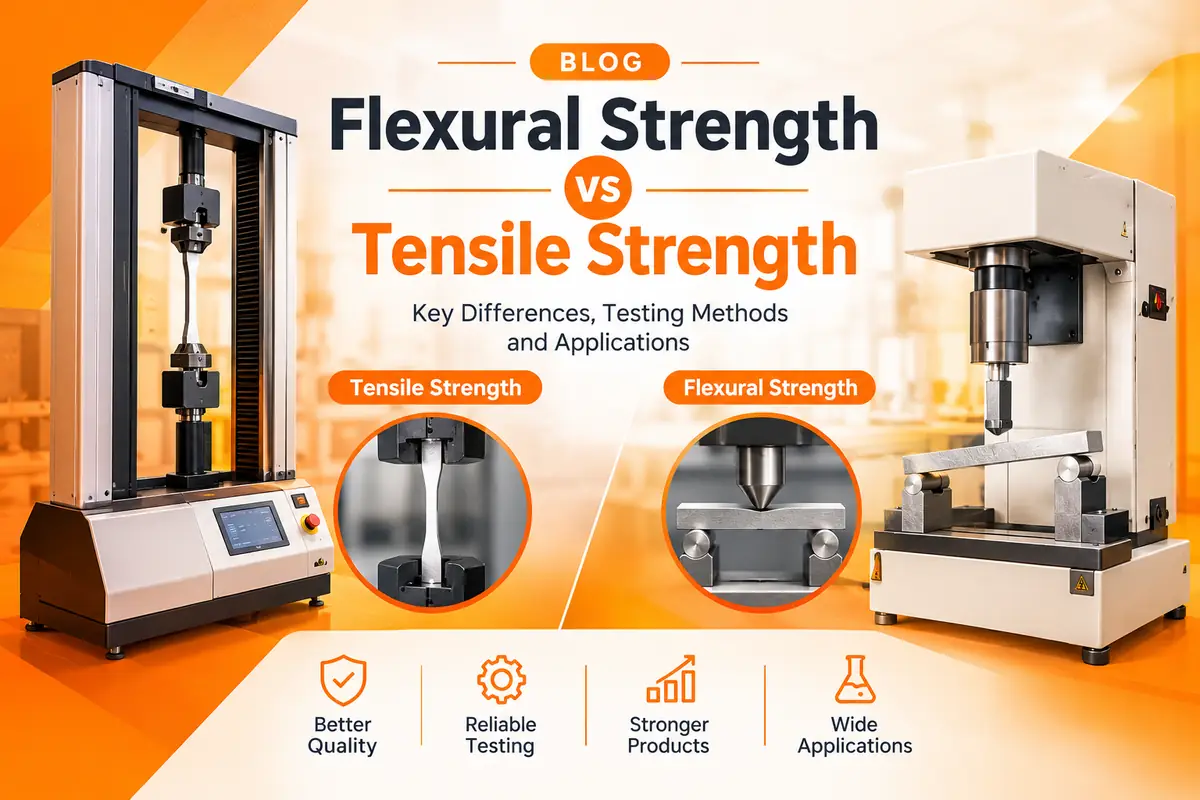
Flexural strength tester category
Flexural Strength vs Tensile Strength: Key Differences, Testing Methods and Applications
When selecting materials for manufacturing, construction or engineering applications, understanding their mechanical properties is essential. Two important properties used to evaluate material performance are flexural strength and tensile strength.
Although both properties help assess a material's strength, they describe different responses to applied forces. Tensile strength indicates how a material behaves when pulled, while flexural strength describes its resistance to bending under specified test conditions.
For manufacturers and material testing laboratories, understanding the difference between flexural strength vs tensile strength helps in selecting the appropriate testing method, interpreting results and evaluating whether a material meets its intended requirements.
In this guide, we explain how both properties are measured, how their testing methods differ, where they are used and how to select suitable testing equipment.
What Is Tensile Strength?
Tensile strength is a material's resistance to being pulled apart under an applied tensile force. It is commonly reported as the maximum tensile stress reached during a test, known as ultimate tensile strength (UTS).
During a tensile test, a prepared specimen is secured between grips. The testing machine gradually applies a pulling force while measuring the load and, where configured, the specimen's extension or strain.
The resulting measurements can help determine tensile strength, breaking load, elongation and other mechanical properties, depending on the test method and instrumentation.
Tensile strength formula
Ultimate tensile strength is generally calculated as:
Tensile Strength = Maximum Tensile Load ÷ Original Cross-Sectional Area
For example, if a specimen reaches a maximum tensile load of 20,000 N and its original cross-sectional area is 100 mm²:
Tensile strength = 20,000 ÷ 100 = 200 N/mm² (200 MPa).
This is an illustrative calculation, not a machine test result. The correct specimen dimensions, test procedure and reporting method must be followed.
Why is tensile strength important?
Tensile strength testing can help manufacturers and laboratories:
- Evaluate a material's resistance to pulling forces.
- Compare material grades and production batches.
- Check whether materials meet specified tensile requirements.
- Investigate variations in raw materials or manufacturing processes.
- Assess elongation and deformation behaviour when he appropriate measurement system is used.
- Support product development and quality assurance.
Tensile testing is used for suitable metals, plastics, rubber, wires, cables, textiles, films and other materials, depending on the machine configuration and test accessories.
What Is Flexural Strength?
Flexural strength describes a material's resistance to bending under a specified loading arrangement. It is often reported as the maximum flexural stress calculated during a bending test.
In a flexural test, a specimen is supported at defined points and loaded so that it bends. The test produces a combination of tensile and compressive stresses across the specimen: one side is generally in tension while the opposite side is in compression.
The result depends on the specimen geometry, support arrangement, loading configuration, material behaviour and applicable test method.
Flexural strength formula
The calculation depends on the test arrangement and specimen geometry. For a rectangular specimen tested using a common three-point bending arrangement, the nominal flexural stress at the centre is often calculated using:
[
\sigma_f=\frac{3FL}{2bd^2}
]
Where:
- (\sigma_f) = flexural stress
- (F) = applied force at the specified point in the test
- (L) = distance between supports
- (b) = specimen width
- (d) = specimen thickness
This equation applies to the relevant rectangular-beam, three-point bending configuration and its assumptions. Other specimen shapes and loading arrangements may require different calculations.
Why is flexural strength important?
Flexural strength testing can help manufacturers and laboratories:
- Evaluate how materials respond to bending loads.
- Compare the bending performance of different mateials.
- Assess suitable plastics, composites and constructin materials.
- Support quality control for products subjected to bending.
- Investigate material behaviour during product development.
- Verify specified flexural properties using the relevant test method.
Flexural testing is particularly useful where a component or material experiences bending rather than a purely axial pulling force.
Flexural Strength vs Tensile Strength: Comparison Table
| Comparison Point |
Tensile Strength |
Flexural strength |
| Meanding | Resistance to tensile loading | Resistance to bending under specified test conditions |
| Applied force | Pulling force | Transverse force that bends the specimen |
| Main stress conditions | Tensile stress across the specimen section | Combined tensile and compressive stress during bending |
| Testing method | Tensile test | Flexural or bending test |
| Specimen arrangement | Held between grips or fixtures | Supported and loaded according to the test configurations |
| Common result | Ultimate tensile strength, in applicable tests | Flexural strength or maximum flexural stress |
| Typical units | MPa or N/mm² |
MPa or N/mm² |
| Important parameters | Tensile load, original area, specimen geometry and strain measurements where required | Load, support, specimen width, thickness and loading arrangement |
| Common applications | Metals, wires, cables, plastics, rubber and films | Plastics, composites, concrete and other materials suitable for bending tests |
| Relevant equipement | Tensile strength machine or appropriately configured UTM | Flexural testing machine or appropriately configured UTM |
Important: Although both properties may be expressed in MPa or N/mm², they are not interchangeable. The results come from different loading conditions and test methods.
What Is the Main Difference Between Flexural and Tensile Strength?
The main difference is the way the material is loaded.
In tensile testing, the specimen is pulled along its length. The test evaluates its response to tensile stress and can establish properties such as ultimate tensile strength and elongation.
In flexural testing, the specimen is bent by applying a force across its span. This creates tensile and compressive stresses in different regions of the specimen. The test evaluates its bending response and may determine flexural strength or other specified properties.
For example, a plastic material used in a tensile-loaded strap may require tensile strength testing. A plastic panel or beam expected to bend during service may require flexural testing.
The correct method depends on the component's function and the property specified by the relevant product standard or design requirement.
Tensile Testing vs Flexural Testing: How the Tests Work
Tensile testing procedure
1. Prepare the specimen according to the applicable test method.
2. Measure and record the required initial dimensions.
3. Secure the specimen using compatible grips.
4. Apply the specified tensile loading at the required test rate.
5. Record load and extension or strain, where required.
6. Determine tensile properties according to the applicable procedure.
7. Document the test conditions and results.
Flexural testing procedure
1. Prepare the specimen to the dimensions specified by the test method.
2. Measure its width, thickness and other required dimensions.
3. Position the specimen on the appropriate supports.
4. Apply the load at the prescribed location and rate.
5. Record the applied force and relevant displacement.
6. Calculate flexural strength or other specified properties.
7. Record the test setup, conditions and result.
The exact procedure differs by material and standard. Specimen preparation, loading rate, support span, grips and fixtures must be appropriate for the intended test.
Which Materials Require Tensile Strength Testing?
Tensile testing is commonly used for materials and products that experience pulling forces or need to meet defined tensile-property requirements.
Examples include:
- Steel, aluminium and other suitable metals,
- Wires, cables and fasteners
- Plastics and engineering polymers
- Rubber and elastomers
- Textile fabrics and technical textiles
- Plastic films and packaging materials
- Composite materials
- Suitable industrial components and assemblies
The correct grips, fixtures, load capacity and measurement system depend on the material and test requirements.
Which Materials Require Flexural Strength Testing?
Flexural testing is relevant when the material's response to bending needs to be evaluated.
Typical examples include:
- Plastics and polymer specimens
- Fibre-reinforced composite materials
- Concrete and other suitable construction materials
- Selected ceramic and brittle materials, using and appropriate method
- Panels, beams and other components designed to withstand bending
- Materials used in product development and comparative testing.
Not every material is suitable for the same flexural test method. Confirm the required specimen dimensions, support arrangement and applicable standard before testing.
Can One Universal Testing Machine Perform Both Tests?
Yes, a Universal Testing Machine (UTM) can often perform tensile and flexural tests when it has the appropriate configuration, capacity, grips, supports and fixtures.
For tensile testing, the machine requires suitable grips or fixtures to hold the specimen securely. For flexural testing, it needs the appropriate bending fixture, supports and loading arrangement.
The machine must also meet the required measurement and control needs for each test. A UTM should not be assumed to perform every test automatically or without changing accessories.
Explore these Innotech products:
- Digital Tensile Strength Testing Machine — for tensile strength and breaking-load testing of compatible specimens, depending on configuration.
- 200 kN Servo Control Electro-Mechanical Universal Testing Machine — supports tensile, compression, flexural and other compatible mechanical tests using the appropriate fixtures and test setup.
For dedicated bending applications, you can also explore Innotech's Flexural Testing Machines category
How to Choose the Right Testing Machine
Before purchasing a tensile or flexural testing machine, consider these factors:
1. Identify the required property
Determine whether you need tensile strength, breaking load, elongation, flexural strength or another mechanical property.
2. Check the material and specimen dimensions
The material type, specimen shape and dimensions affect the appropriate test arrangement and accessories.
3. Determine the required load capacity
Select a suitable load range based on the expected test force and required measurement performance.
4. Confirm the fixtures and accessories
Tensile grips and flexural supports perform different functions. Check that the proposed machine includes or supports the required accessories.
5. Review the applicable test standard
Provide the relevant IS, ISO, ASTM or customer-specific test procedure so that the equipment configuration can be evaluated.
6. Consider software and reporting
Decide whether digital readings, test curves, data storage, automated calculations or computer-generated reports are required.
7. Confirm calibration and technical support
Ask about calibration requirements, documentation, installation, operator training and after-sales service.
Frequently Asked Questions
1. Is flexural strength the same as tensile strength?
No. Tensile strength measures a material's response to pulling forces, while flexural strength measures its response to bending under specified test conditions.
2. Can flexural strength be greater than tensile strength?
It can be, depending on the material, specimen geometry, test method and material behaviour. The two values should not be treated as directly interchangeable.
3. Are tensile strength and flexural strength measured in the same units?
Both are commonly reported in MPa or N/mm². However, the test methods and stress conditions differ, so the values represent different material properties.
4. Which machine is used to measure tensile strength?
A tensile testing machine or a suitably configured universal testing machine is used, with the appropriate grips, load capacity and measurement system.
5. Which machine is used to measure flexural strength?
A flexural testing machine or a suitably configured universal testing machine can be used with the correct bending supports and loading fixture.
6. Can a UTM perform tensile and flexural tests?
Yes, provided the machine's capacity and control system are suitable and the required grips, supports, fixtures and test procedures are available.
7. Which test is better for plastic materials?
Neither test is universally better. Tensile testing is used to evaluate tensile properties, while flexural testing assesses bending behaviour. The correct test depends on the application and the relevant material specification.
8. How do I select a testing machine for my laboratory?
Start with the material type, required property, specimen dimensions, maximum expected load, applicable test standard and reporting requirements. These details help determine the appropriate machine and accessories.
Conclusion
Understanding flexural strength vs tensile strength helps manufacturers and laboratories choose the right testing method for their materials and products.
Tensile strength evaluates a material's resistance to pulling forces, while flexural strength describes its resistance to bending under specified conditions. Both tests provide valuable information, but they measure different aspects of mechanical performance.
For reliable results, select a suitable testing machine, use the correct fixtures, follow the applicable test procedure and interpret the measurements according to the material specification.
If you are looking for a tensile testing machine, flexural testing machine or a universal testing machine in India, contact Innotech Engineering Devices to discuss your material, load capacity and testing requirements.
Email: info@innotechgroup.net
Phone: +91 9810431604
Address: H-307 (Corner), RIICO Industrial Area, Karoli, Tapukara, Bhiwadi, Rajasthan – 301707, India
Contact us to discuss suitable testing equipment and request a quotation.
Category: Material Testing Laboratory
Tags: Flexural Strength vs Tensile Strength, flexural strength testing machine, tensile strength testing machine, flexural testing, tensile testing, bending strength test, material testing equipment, universal testing machine price in India
Last Updated: 29 October 2026