
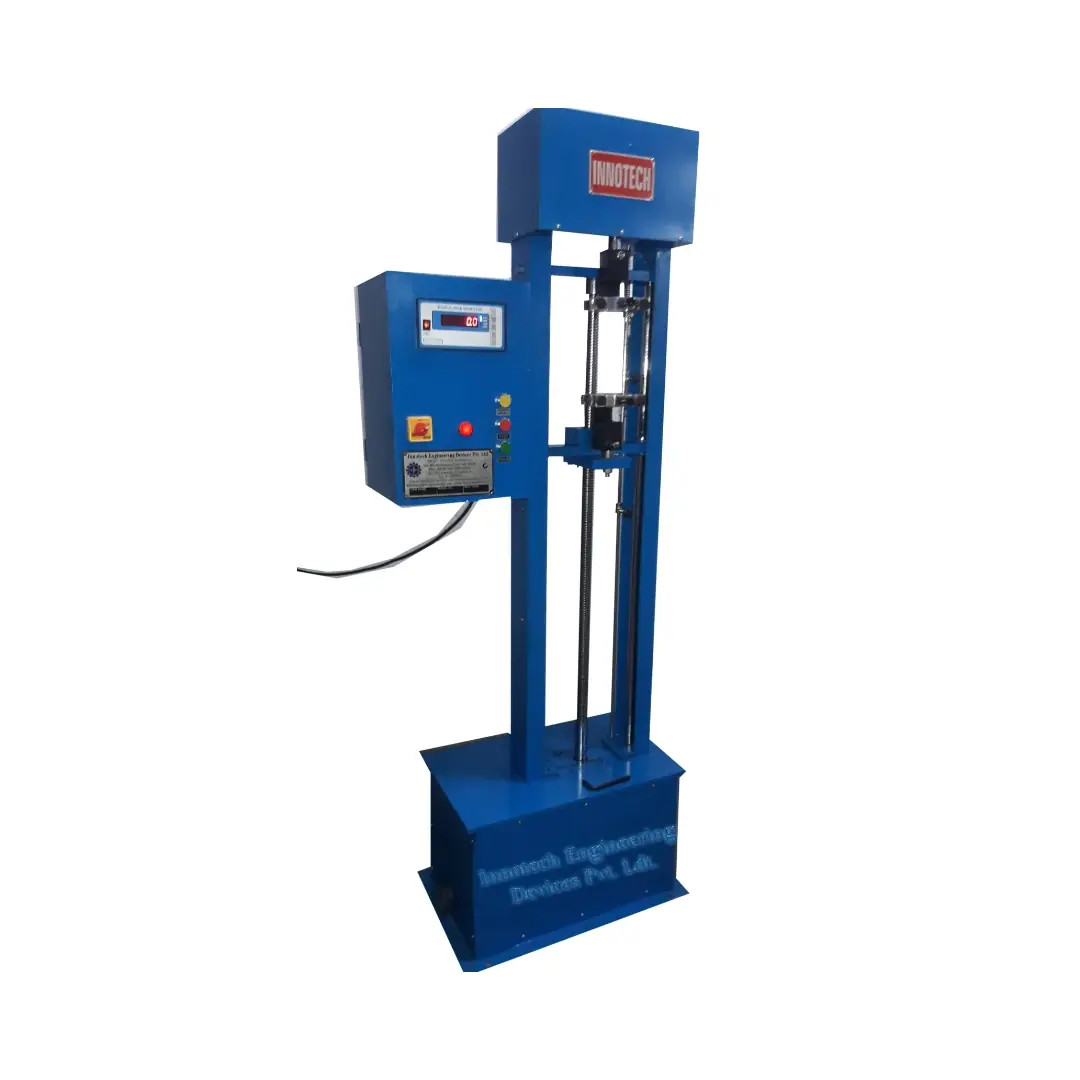
Digital Tensile Strength Testing Machine
Digital Tensile Strength Testing Machine
The Digital Tensile Strength Testing Machine is a precision material testing instrument designed to determine the tensile strength, breaking load, elongation, and other mechanical properties of suitable materials and components. With digital measurement and controlled testing operation, the machine is suitable for quality control, production inspection, research and development, and laboratory testing applications across manufacturing and engineering industries.
OVERVIEW
Description
Digital Tensile Testing Machine | Digital Tensile Strength Testing Machine
The Digital Tensile Strength Testing Machine from Innotech Engineering Devices Private Limited is a precision mechanical testing instrument designed for evaluating the tensile strength and mechanical behavior of materials under controlled tensile loading conditions.
Tensile testing is one of the most widely used mechanical testing methods for determining how a material behaves when subjected to a gradually increasing pulling force. The test can provide important parameters such as maximum tensile force, breaking load, tensile strength, elongation, and displacement, depending on the machine configuration, specimen geometry, and applicable testing standard.
The Digital Tensile Strength Testing Machine is designed to provide controlled application of tensile load while digitally monitoring the test parameters. It can be used for quality control, incoming material inspection, production testing, finished-product evaluation, research and development, and laboratory material characterization.
Depending on its configuration, the machine can be supplied with appropriate grips, fixtures, load capacities, and measurement systems for testing different materials and specimen types.
Working Principle
During a tensile test, a prepared specimen is securely held between two grips or fixtures. The machine applies a controlled tensile force by moving one grip relative to the other while the corresponding load and displacement are measured.
As the tensile force increases, the specimen may undergo elastic deformation followed by plastic deformation and ultimately fracture, depending on the material.
The machine records the applied force and displacement during the test. These measurements can be used to determine relevant tensile properties such as maximum load, breaking load, tensile strength, elongation, and other specified parameters.
The exact test procedure depends on the material, specimen dimensions, machine configuration, and applicable testing standard.
Key Features
- Digital display for convenient monitoring of test parameters
- Controlled tensile load application
- Accurate measurement of tensile force
- Measurement of displacement or elongation, depending on configuration
- Suitable for destructive tensile testing
- Different load capacities available according to application
- Interchangeable grips and fixtures available for different specimens
- Suitable for laboratory and industrial quality control
- Supports repeatable testing conditions
- Useful for raw material and finished-product inspection
- Suitable for research and development
- Data recording and computer connectivity available on selected configurations
- Robust construction for regular industrial use
Applications
The Digital Tensile Strength Testing Machine can be used for:
- Tensile strength testing
- Breaking load testing
- Elongation testing
- Maximum load measurement
- Load versus displacement evaluation
- Material quality control
- Raw material inspection
- Finished-product inspection
- Production batch comparison
- Product development
- Research and development
- Supplier material evaluation
- Mechanical property testing
- Quality assurance laboratory testing
Depending on the machine configuration and suitable grips, it can be adapted for testing different materials and products.
Materials and Products
Depending on the selected model, load capacity, grips, and fixtures, tensile testing machines can be configured for applications involving:
- Metals
- Wires
- Cables
- Plastics
- Polymers
- Rubber
- Textiles
- Fabrics
- Films
- Paper and paperboard
- Packaging materials
- Straps and belts
- Composite materials
- Engineering components
The appropriate machine configuration should be selected according to the material type, specimen dimensions, expected test load, elongation range, and applicable test standard.
Industries Served
The Digital Tensile Strength Testing Machine can be used across various manufacturing and testing sectors, including:
- General Manufacturing
- Engineering Industry
- Metal Manufacturing
- Automotive Components
- Wire and Cable Industry
- Plastic and Polymer Industry
- Rubber Industry
- Textile Industry
- Packaging Industry
- Paper Industry
- Research and Development
- Quality Control Laboratories
- Material Testing Laboratories
- Educational and Institutional Laboratories
Importance of Tensile Strength Testing
Tensile testing provides important information about the mechanical performance and strength of materials. It helps manufacturers determine whether a material or component can withstand the tensile forces expected during production, handling, assembly, and service.
Regular tensile testing can help identify variations in material quality, manufacturing processes, raw materials, and production batches.
Tensile testing can help manufacturers:
- Verify material strength
- Determine breaking load
- Evaluate elongation
- Compare different materials
- Monitor production consistency
- Inspect incoming raw materials
- Verify finished products
- Support product development
- Identify material defects or variations
- Improve quality-control processes
Quality Control Applications
The Digital Tensile Strength Testing Machine can be incorporated into incoming material inspection, in-process quality control, finished-product testing, and production batch comparison.
Manufacturers can establish testing procedures according to their product specifications and use the machine to verify that materials and components meet required tensile performance criteria.
Research and Development Applications
The machine is also suitable for research and development activities involving new materials, product designs, formulations, and manufacturing processes.
Researchers can compare materials and evaluate how factors such as composition, processing, thickness, heat treatment, reinforcement, and manufacturing conditions influence tensile performance.
Testing Standards
Tensile testing can be performed according to applicable national and international standards depending on the material and application. Standards may include ASTM, ISO, BIS/IS, and other applicable testing procedures.
The appropriate testing standard should be selected according to the material specification, specimen geometry, testing requirements, customer requirements, and intended application.
Note: Specific standards compliance should be confirmed according to the actual machine configuration, load cell, grips, software, calibration, validation, and applicable testing procedure before making a formal compliance claim.
Product Benefits
- Accurate tensile force measurement
- Digital display of test parameters
- Controlled and repeatable tensile testing
- Suitable for breaking load and elongation evaluation
- Flexible testing configurations
- Interchangeable grips available for different materials
- Supports quality control and production inspection
- Useful for material comparison
- Suitable for research and development
- Helps evaluate mechanical material performance
- Suitable for laboratory and industrial environments
- Robust construction for regular testing applications
Why Choose Innotech Engineering Devices Private Limited?
Innotech Engineering Devices Private Limited provides testing and measuring equipment for industrial quality control, material characterization, research and development, and laboratory applications.
Our Digital Tensile Strength Testing Machine can be configured according to the material being tested, required test load, specimen dimensions, elongation range, grips, fixtures, measurement requirements, and applicable testing standards.