
Dial Gauge Extensometer: Uses, Accuracy and Price in India
Jay Pal Singh
23 October 2026
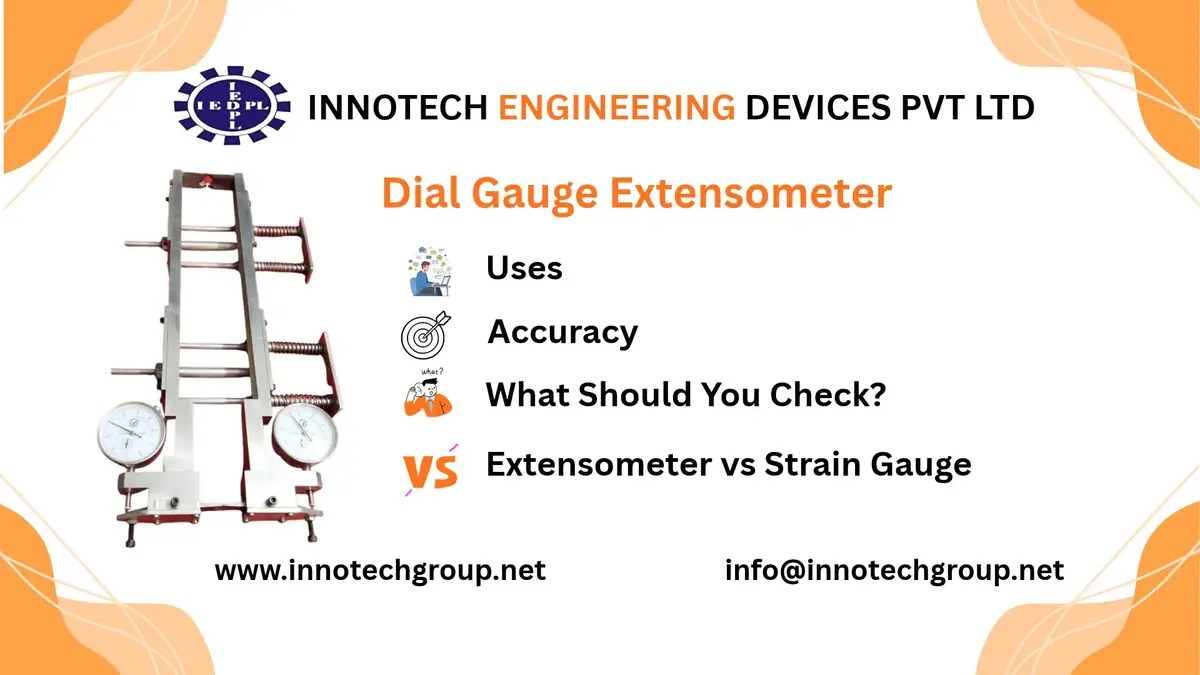
Dual Dial Mechanical Extensometer
Dial Gauge Extensometer: Uses, Accuracy and Price in India
A dial gauge extensometer is a measuring instrument used to measure the small change in length of a specimen during a tensile test. It helps laboratories and manufacturers evaluate strain, elongation and material deformation more accurately than relying only on the crosshead movement of a testing machine. If you are planning to buy an extensometer for a Universal Testing Machine (UTM), understanding its uses, accuracy, compatibility and price factors will help you select the right model.
What Is a Dial Gauge Extensometer?
A dial gauge extensometer measures the change in distance between two contact points attached to a specimen. During testing, the specimen stretches or deforms, and the instrument indicates the change in length.
It is commonly used in material testing laboratories to measure specimen extension during tensile testing. The appropriate gauge length, measuring range and accuracy depend on the specimen, test method and applicable standard.
Uses of an Extensometer in UTM
An extensometer can be used with a compatible Universal Testing Machine to measure specimen elongation and calculate strain during testing. Typical applications include:
- Tensile Testing: Measure extension as a specimen is pulled under load.
- Strain measurement: Helps determine strain over a defined gauge length.
- Elastic behaviour evaluation: Supports the measurement of deformation within the material's elastic range.
- Material comparison: Helps compare the deformation behaviour of different specimens under specified conditions.
- Quality control and research: Supports materials evaluation in manufacturing plants, testing laboratories and R&D facilities.
For a suitable setup, explore Innotech's Universal Testing Machine (UTM) (https://innotechgroup.net/products/servo-control-electro-mechanical-universal-testing-machine-200kn) and Digital Tensile Strength Testing Machine (https://innotechgroup.net/products/digital-tensile-strength-testing-machine). Confirm extensometer compatibility and the required accessories before ordering.
Dial Gauge Extensometer Accuracy: What Should You Check?
Extensometer accuracy is not the same for every model. It depends on the instrument's specification, measuring range, resolution, gauge length, calibration and the applicable test standard.
Before purchasing, check:
- Specified accuracy class or measurement error
- Resolution and measuring range
- Available gauge lengths
- Specimen thickness and attachment method
- Calibration and verification requirements
- Compatibility with your UTM and testing software
Important: Resolution is the smallest displayed increment; it does not automatically represent measurement accuracy. Always compare the manufacturer's stated performance with the requirements of your test method.
Extensometer vs Strain Gauge: What Is the Difference?
An extensometer measures extension over a defined gauge length. A strain gauge is a sensor that measures strain through changes in electrical resistance when bonded to a specimen or incorporated into a suitable sensor arrangement.
| Comparison |
Extensometer |
Strain gauge |
| Main purpose | Measures extension or strain over a gauge length | Measures local strain at the sensor location |
| Measurement method | May use mechanical, electronic, optical or other sensing methods | Commonly uses electrical resistance changes |
| Typical application | Tensile testing with a UTM | Structural monitoring, component testing and experimental strain measurements |
| Setup | Attached or aligned with the specimen according to the instrument design | Usually bonded to the specimen, with suitable wiring and instrumentation |
| Selection factors | Gauge length, travel range, accuracy and specimen attachment | Gauge factor, sensor type installation, wiring and data azquisition |
The two terms are not always mutually exclusive: some extensometers use strain-gauge sensing technology. Select the measurement system according to the test method and required results, not just its name.
How to Use an Extensometer During a Tensile Test
1. Check compatibility: Confirm that the extensometer suits the UTM, specimen dimensions and test method.
2. Prepare the specimen: Measure and mark the required gauge length according to the applicable procedure.
3. Attach the instrument: Fit the extensometer carefully at the specified gauge points, following the manufacturer's instructions.
4. Configure the test: Set the appropriate test parameters and confirm that extension readings are being recorded correctly.
5. Start the tensile test: Apply the load using the approved test procedure and monitor the measurement.
6. Remove it safely: Remove the extensometer when required by the test procedure and instrument limits. Some instruments must be removed before specimen fracture to avoid damage.
7. Review the results: Check the recorded extension and strain data against the relevant test requirements.
Always follow the instrument manual and the applicable testing standard. Incorrect attachment, alignment or gauge-length selection can affect results.
Extensometer Price in India
The extensometer price in India varies with the instrument type, accuracy class, resolution, gauge length, measuring range, compatibility, calibration requirements and data-logging features.
A mechanical dial gauge extensometer may have a different cost from an electronic contact extensometer or a non-contact video extensometer. The total cost may also depend on adapters, fixtures, software integration and calibration documentation.
For an accurate quotation, share your UTM model, specimen material, required gauge length, expected extension range, applicable test standard and accuracy requirement. These details help determine a suitable configuration without paying for unnecessary features.
Extensometer Manufacturer and Supplier in India
Innotech Engineering Devices Private Limited, based in Bhiwadi, Rajasthan, supplies material testing equipment, including Universal Testing Machines and tensile testing solutions. Customers looking for an extensometer manufacturer or supplier in India should confirm the required instrument type, compatibility and availability with the technical team.
For enquiries from Bhiwadi, Delhi NCR, Mumbai, Gujarat, Bengaluru, Chennai, Kolkata and other parts of India, contact Innotech to discuss your testing application and suitable UTM accessories.
Contact Innotech Engineering Devices Private Limited
- Phone: +91 9810431604
- Email: info@innotechgroup.net
- Address: H-307 (Corner), RIICO Industrial Area, Karoli, Tapukara, Bhiwadi, Rajasthan – 301707
- Website: innotechgroup.net
Frequently Asked Questions
Is an extensometer necessary for a tensile test?
It depends on the test objective and standard. An extensometer is useful when extension or strain must be measured over a defined gauge length with specified accuracy.
Can an extensometer be used with any UTM?
Not automatically. Check the instrument's mounting arrangement, measuring range, gauge length, interface and software compatibility.
What is the difference between extensometer resolution and accuracy?
Resolution is the smallest displayed measurement increment. Accuracy describes how closely the measured value agrees with the true or reference value within the specified conditions.
Is an extensometer more expensive than a strain gauge?
There is no universal price comparison. Cost depends on the sensing technology, instrumentation, accessories, calibration and application. A strain gauge system may also require a data-acquisition unit and installation.
How do I choose the right extensometer for my UTM?
Start with the specimen material and dimensions, required gauge length, expected extension, test standard, accuracy class and UTM compatibility.
Conclusion
A suitable dial gauge extensometer helps measure specimen extension during tensile testing and supports reliable strain evaluation. Before purchasing, compare the measuring range, gauge length, resolution, accuracy, calibration requirements and compatibility with your UTM.
Need help selecting an extensometer for your tensile testing application? Contact Innotech Engineering Devices with your test requirements to discuss a suitable configuration.
Category: Universal Testing Machine
Tags: Dial Gauge Extensometer, Tensile Testing, Universal Testing Machine, Strain Measurement, Material Testing, Extensometer Price India.
Last Updated: 23 October 2026