
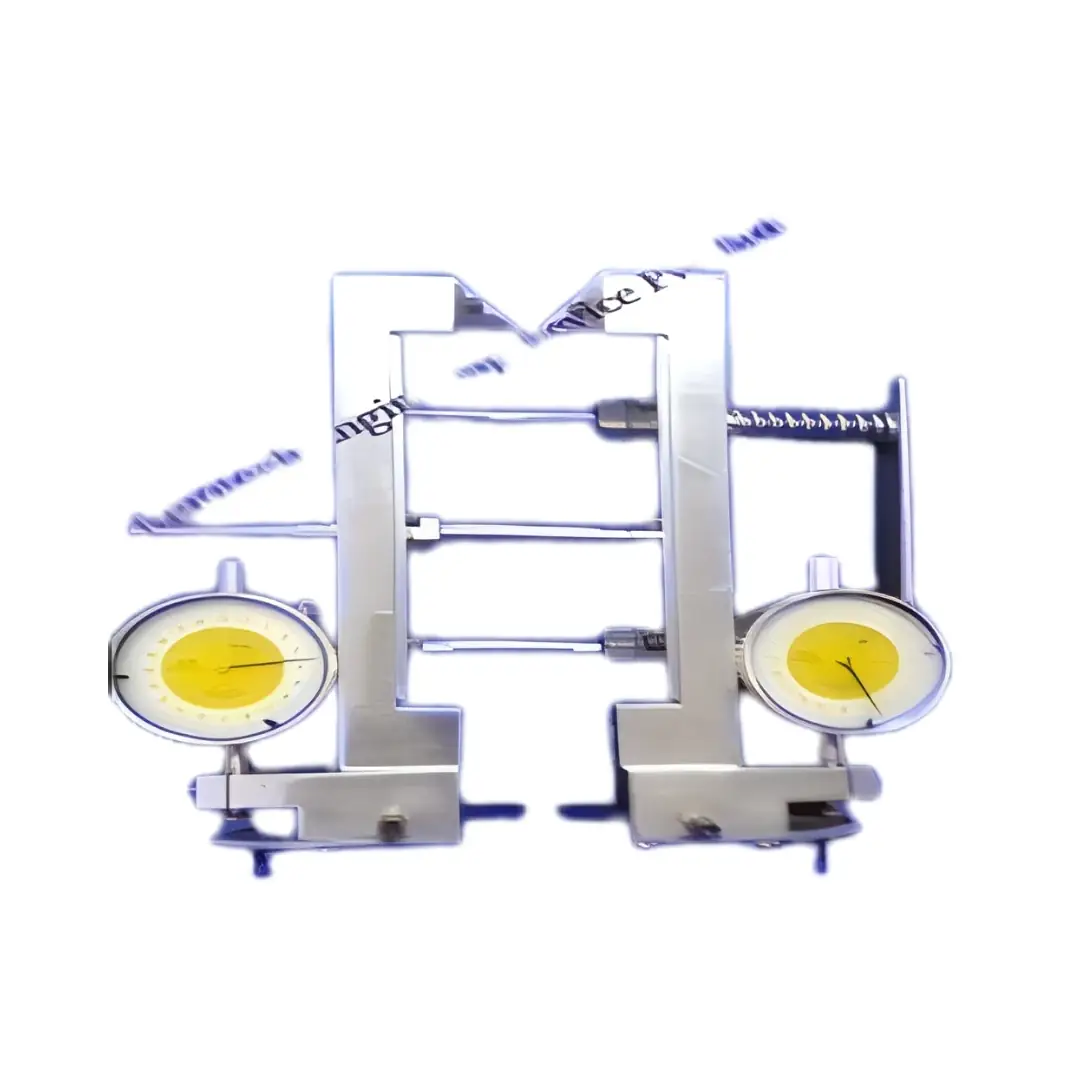
Dual-Dial Mechanical Extensometer
Dual-Dial Mechanical Extensometer
The Dual-Dial Mechanical Extensometer is designed to measure specimen elongation and deformation during tensile testing. It helps laboratories and manufacturers monitor changes in the gauge length of materials tested using compatible Universal Testing Machines (UTMs) and tensile testing machines. Innotech Engineering Devices Private Limited offers mechanical extensometer configurations according to customer requirements, including the required gauge length, measurement range, dial resolution, specimen dimensions, and testing application. We supply testing equipment across India, with our factory and office located in Bhiwadi, Rajasthan.
OVERVIEW
Description
Dual-Dial Mechanical Extensometer
The Dual-Dial Mechanical Extensometer is a material testing instrument used to measure the elongation of a specimen during tensile testing. It helps determine how a material deforms when a tensile force is applied, providing useful measurement data for material evaluation, quality control, and laboratory testing.
When a specimen is tested using a Universal Testing Machine (UTM) or tensile testing machine, the extensometer measures the change in length over a defined gauge section. This provides a more direct measurement of specimen deformation than relying only on the movement of the testing machine crosshead.
Innotech Engineering Devices Private Limited manufactures and supplies testing equipment for industrial and laboratory applications. We offer mechanical extensometer configurations based on customer requirements, including the material being tested, specimen dimensions, gauge length, measurement range, and required testing procedure.
Our equipment is available to customers across India. Our factory and office are located in Bhiwadi, Rajasthan, where customers can arrange a meeting with our team by confirming an appointment in advance.
What Is a Dual-Dial Mechanical Extensometer?
A dual-dial mechanical extensometer is an instrument designed to measure changes in the gauge length of a specimen during a mechanical test. It uses a mechanical measuring arrangement and two dial indicators to display the measured movement.
The extensometer is attached to the specimen at defined gauge points. As the specimen stretches under tensile load, the mechanical movement is transferred to the dial indicators. The readings help the operator observe specimen elongation and determine strain when the original gauge length is known.
The instrument can be used with compatible Universal Testing Machines and tensile testing machines, provided that the specimen, attachment method, gauge length, and measurement range are suitable for the selected configuration.
Technical Specifications
Important: The configurable specification guide, not a statement that every option is included in the standard instrument. The final gauge length, range, resolution, accuracy, and compatibility must be confirmed for the supplied model.
Key Features
- Dual-dial display: Provides visual readings of mechanical movement during testing.
- Direct specimen measurement: Measures extension over the selected gauge length rather than relying only on crosshead displacement.
- Mechanical operations: Does not require an electrical supply for basic mechanical measurement.
- Configurable measurement arrangement: Can be specified according to the specimen, gauge length, and intended application.
- UTM compatibility: Can be used with suitable Universal Testing Machines and tensile testing systems after compatibility is confirmed.
- Laboratory use: Suitable for material testing, research, and quality-control environments.
- Practical operation: Supports routine elongation measurements when correctly fitted and aligned.
- Application-based selection: Helps customers choose an appropriate configuration for their material testing requirements.
Working Principle
The Dual-Dial Mechanical Extensometer works by detecting the change in distance between two defined points on a test specimen.
First, the instrument is fitted to the specimen at the selected gauge points. When the tensile testing machine applies a load, the specimen begins to elongate. The extensometer senses this movement and transfers it mechanically to the dial indicators.
The dial readings represent the extension measured over the selected gauge length. These readings can be used to calculate strain when the original gauge length is known.
Strain = Change in Gauge Length ÷ Original Gauge Length
The result helps the operator evaluate the deformation behaviour of the material. Correct mounting, alignment, specimen preparation, and selection of the measurement range are important for obtaining meaningful results.
Why Is an Extensometer Used in Tensile Testing?
During tensile testing, a material may undergo elastic deformation followed by plastic deformation before failure. Measuring its extension helps laboratories understand its behaviour under applied load.
An extensometer is useful when the test requires direct measurement of deformation over a defined gauge length.
It can support the evaluation of:
- Specimen elongation
- Strain during tensile loading
- Elastic deformation
- Plastic deformation
- Material ductility
- Yield related deformatin, where the selected instrument and test porcedure are suitable
- Mechanical properties requiring gauge-length extension measurement.
The required measurement range and resolution should be selected according to the test method and expected deformation.
Applications
Metal and Alloy Testing
Mechanical extensometers can be used in suitable tensile tests involving steel, stainless steel, aluminium alloys, copper alloys, brass, metal sheets, strips, wires, and rods. The configuration must match the specimen geometry and test requirements.
Universal Testing Machines
A compatible extensometer can be used as an accessory to a UTM when direct measurement of specimen extension is required. Compatibility should be checked before ordering.
Material Testing Laboratories
Testing laboratories can use extensometers when measuring strain and elongation as part of material characterisation and mechanical-property evaluation.
Manufacturing Quality Control
Manufacturers can use extensometer measurements to compare material samples, monitor production consistency, and support their internal quality-control procedures.
Research and Development
Research teams can use extension measurements to investigate material behaviour, compare samples, and support product-development activities.
Industries That Use Mechanical Extensometers
Applications may include:
- Steel and metal manufacturing
- Automotive component manufacturing
- Engineering and fabricatin industries
- Aluminium and alloy processing
- Material testing laboratories
- Research and development facilities
- Educational and technical institutions
- Industrial quality control departments
The appropriate instrument depends on the materials, specimens, test procedure, and required measurement performance.
How to Select the Right Mechanical Extensometer
Before purchasing a mechanical extensometer, consider the following factors.
Gauge Length
Gauge length is the defined distance over which specimen extension is measured. It should match the specimen dimensions and the applicable testing procedure.
Measurement Range
Consider the expected elongation of the specimen. The selected range should be appropriate for the anticipated extension during the test.
Dial Resolution and Accuracy
Resolution describes the smallest change that can be indicated by the instrument, while accuracy concerns the closeness of the measurement to the true value. Both should be specified according to the intended application.
Specimen Geometry
The specimen's shape, dimensions, and attachment points affect the choice of mounting arrangement. Confirm that the extensometer can be fitted correctly to the sample.
Testing Machine Compatibility
Check the UTM or tensile testing machine model, available space, specimen grips, and the intended test procedure before selecting the instrument.
Applicable Testing Standard
If testing must follow a particular IS, ASTM, ISO, or other standard, confirm the required gauge length, measurement performance, and extensometer suitability against that standard.
Typical Testing Procedure
A general workflow for using a mechanical extensometer is as follows:
1. Prepare the specimen according to the selected testing procedure.
2. Identify and measure the original gauge length.
3. Secure the specimen in the compatible tensile testing machine.
4. Fit the extensometer at the specified gauge points.
5. Check the mounting and alignment.
6. Set the dial indicators to the required initial position.
7. Apply tensile load according to the test procedure.
8. Observe and record the extension readings at the required stages.
9. Remove the extensometer at the appropriate stage if the test procedure requires it.
10. Calculate strain or evaluate the recorded measurements as required.
Follow the applicable standard and instrument instructions throughout the test. The removal point, permitted strain range, and measurement procedure depend on the specimen and the specific test.
Why Choose Innotech Engineering Devices Private Limited?
Innotech Engineering Devices Private Limited provides testing equipment and configurable solutions for industrial and laboratory applications.
We understand that different customers may require different gauge lengths, measurement ranges, dial resolutions, mounting arrangements, and testing-machine compatibility. Our team can discuss these requirements before recommending a suitable mechanical extensometer configuration.
What customers can discuss with us:
- Selection according to specimen dimensions and material
- Gauge length and expected elongation
- Measurement range, resolution, and accuracy requirements
- Compatibility with an existing UTM or tensile testing machine
- Special fixtures or application-specific requirements.
- Product enquires and technical clarification.
We supply equipment to customers across India. Our factory and office are located in Bhiwadi, Rajasthan.
Frequently Asked Questions
What is a Dual-Dial Mechanical Extensometer used for?
It is used to measure the change in gauge length of a specimen during tensile testing and other suitable mechanical tests.
Can the extensometer be used with a Universal Testing Machine?
Yes, it can be used with a compatible UTM, provided that the specimen, gauge length, mounting arrangement, and measurement range are suitable.
Can I request a specific gauge length?
Yes. Share your specimen dimensions, required gauge length, and applicable test standard so that the appropriate configuration can be discussed.
Are the technical specifications fixed?
Not necessarily. Gauge length, measurement range, dial resolution, accuracy, mounting arrangement, and other parameters should be confirmed according to customer requirements and the selected configuration.
Does the mechanical extensometer require electricity?
A conventional mechanical extensometer does not require electrical power for basic mechanical measurement.
Can I purchase this extensometer from outside Rajasthan?
Yes. Innotech supplies testing equipment across India. Contact our team to discuss your location, product requirements, delivery arrangements, and any applicable service needs.
Where is Innotech's factory located?
Innotech Engineering Devices Private Limited has its factory and office in Bhiwadi, Rajasthan, India.
Can I visit the factory to discuss my requirement?
Yes. Customers who wish to meet the team at our Bhiwadi facility should contact us in advance and confirm a mutually suitable appointment date and time before visiting.
Consult to Expert – Mechanical Extensometer
Looking for a Dual-Dial Mechanical Extensometer for your UTM, tensile testing machine, or material testing laboratory?
Contact Innotech Engineering Devices Private Limited to discuss your specimen dimensions, gauge length, measurement range, and testing requirements. Our team can help you identify a suitable configuration for your application.
Company: Innotech Engineering Devices Private Limited
Factory and office: Bhiwadi, Rajasthan, India
Service and supply: Across India
Website: https://www.innotechgroup.net
Email: info@innotechgroup.net
Phone: +91 9810431604
Planning to visit our Bhiwadi facility? Please contact us first and confirm your appointment date and time before travelling.
Consult to Expert for a mechanical extensometer configuration suited to your testing requirements.
SPEC
Specifications
Equipment type
Dual-Dial Mechanical Extensometer
Measurement purpose
Specimen elongation and gauge-length extension
Application
Tensile testing and material deformation measurement
Gauge length
Selected according to specimen dimensions and testing standard
Measurement range
Configurable according to the expected specimen extension
Dial gauge resolution
Selected according to required measurement resolution
Measurement accuracy
To be specified according to the required test method
Dial arrangement
Dual-dial mechanical display
Specimen material
Metals, alloys, and other suitable materials, depending on configuration
Specimen dimensions
According to the customer's sample geometry
Testing machine compatibility
Compatible UTM or tensile testing machine, subject to verification
Mechanical operation
No electrical power required for basic mechanical measurement
Applicable testing standard
To be confirmed according to the intended test
Special requirements
Gauge length, fixtures, measurement range, and other options as agreed