
Spring Testing Machine: Working Principle, Types, Applications, Standards and Buying Guide
Jay Pal Singh
13 November 2026
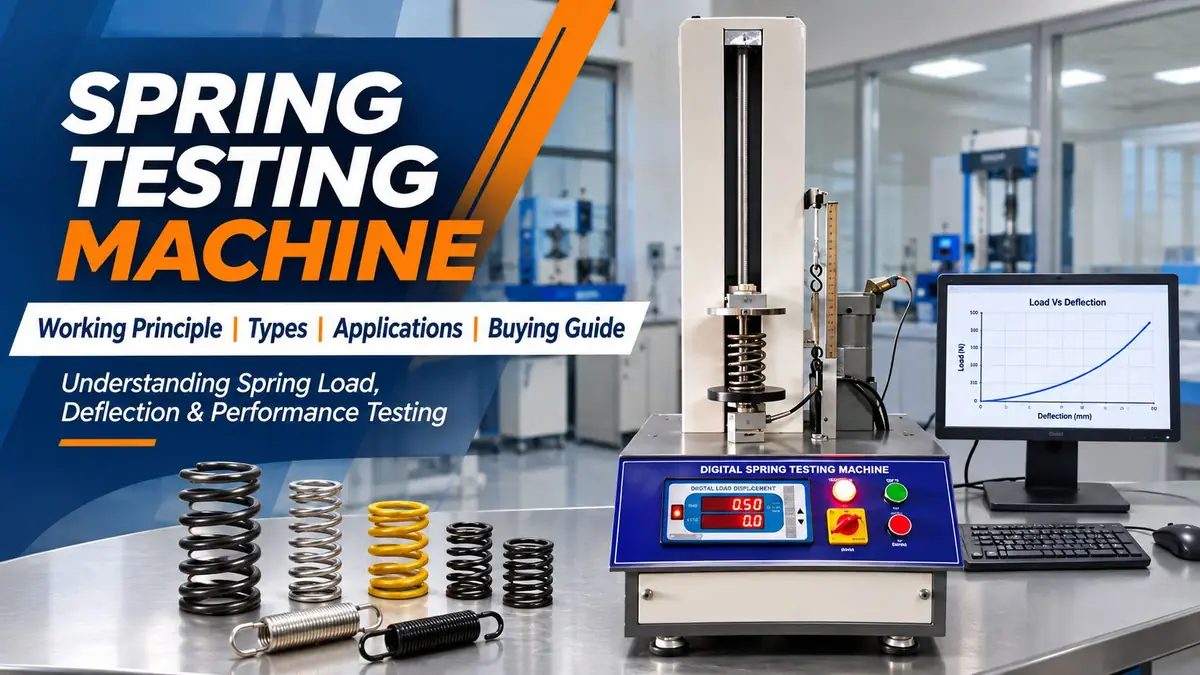
Spring Testing Machine: Working Principle, Types, Applications, Standards and Buying Guide
A spring may look like a simple mechanical component, but its performance directly affects the safety, movement and reliability of many industrial products. From automobile suspension systems and railway components to electrical switches, industrial machinery and precision instruments, springs are expected to deliver a specific force at a particular compression or extension.
But how can a manufacturer confirm that a spring is producing the correct force? How can its stiffness, load capacity and deflection be checked before it is used in a finished product?
This is where a Spring Testing Machine becomes important. It helps manufacturers and testing laboratories measure the relationship between applied force and spring displacement under controlled conditions.
Whether you are searching for a spring testing machine manufacturer in India, comparing digital spring testers, understanding the working principle or planning to purchase equipment for your factory, this guide explains the important points to consider.
What Is a Spring Testing Machine?
A Spring Testing Machine is a mechanical or electromechanical testing system used to measure the load, deflection and stiffness characteristics of springs.
During testing, a controlled force is applied to a spring, and the corresponding change in its length or position is measured. The results help determine whether the spring meets the required specifications.
For example, an automotive spring may be designed to produce a particular force when compressed to a specified length. If the actual force is too high or too low, it can affect the performance of the suspension system.
A spring tester helps identify such variations during manufacturing and quality inspection.
Depending on its configuration, the machine can evaluate:
- Compression load and deflection
- Tension or extension force
- Spring rate or stiffness
- Load at specified spring heights
- Free length and loaded length, where suitable measuring arrangements are provided
- Load variation at different displacement points
The machine may use a manual, digital or computerized operating system depending on the testing requirement.
Working Principle of a Spring Testing Machine
The working principle is based on measuring the force required to compress or extend a spring by a specified distance.
A typical machine consists of a load frame, force measurement system, displacement measuring arrangement and suitable fixtures for holding the spring.
When a spring is positioned between the testing fixtures, the loading mechanism applies force gradually. A load cell measures the applied force, while a displacement sensor or measuring scale records the movement of the loading arrangement.
The machine displays the force and corresponding displacement values. These readings can be compared with the spring's specified load-deflection requirements.
Example of a Spring Load Test
Suppose a compression spring is required to produce 100 N of force at a specified deflection. The operator places the spring in the machine and applies the load gradually.
The machine records the force and displacement. The result can then be compared with the required value mentioned in the product drawing or inspection specification.
The same procedure can be repeated at multiple loading points to understand how the spring behaves across its working range.
What Is Spring Rate?
Spring rate, also called spring stiffness, describes how much force is required to produce a unit of displacement.
It is calculated using:
Spring Rate (k) = Change in Force / Change in Deflection
[
k = \frac{F_2-F_1}{\delta_2-\delta_1}
]
Where:
- (k) = Spring rate
- (F_1) = Initial force
- (F_2) = Final force
- (\delta_1) = Initial deflection
- (\delta_2) = Final deflection
The commonly used unit is N/mm.
For example, if the force increases by 50 N over a displacement of 10 mm, the calculated spring rate is 5 N/mm over that measurement interval.
This value helps engineers understand how stiff or flexible a spring is under the tested conditions.
Different Types of Spring Testing Machines
The correct equipment depends on the spring design, testing direction, required load and level of automation.
1. Digital Spring Testing Machine
A Digital Spring Testing Machine displays force and displacement readings electronically. It is useful for routine inspection, production quality control and laboratory testing.
Depending on its configuration, it may include a digital load indicator, displacement display, peak value function and multiple measurement units.
2. Computerized Spring Testing Machine
A Computerized Spring Testing Machine connects the measurement system to a computer for test operation, data recording and result analysis.
Depending on the software, it may provide load-deflection graphs, stored test results and test reports. Buyers should confirm which software functions are included before purchasing.
3. Compression Spring Testing Machine
This type is designed to measure the force required to compress a spring. The specimen is generally positioned between suitable compression plates.
It is commonly used for checking coil springs, automotive springs, industrial compression springs and other components that operate under compressive loading.
4. Tension Spring Testing Machine
A tension spring tester applies a pulling force to measure the response of extension springs.
Suitable hooks, pins or fixtures hold the specimen during testing. The arrangement must match the spring geometry to avoid unwanted bending or misalignment.
5. Coil Spring Load Deflection Testing Machine
This machine evaluates the relationship between the load applied to a coil spring and the corresponding change in its length.
It is useful when a manufacturer needs to check force at specified spring heights or compare load values at different displacement points.
6. Special-Purpose Spring Testing Machine
Some springs have unusual dimensions, loading directions or operating arrangements. In such cases, a special-purpose machine or customized fixture may be required.
The machine should be designed around the actual spring drawing and test procedure rather than assuming that one standard fixture can accommodate every spring.
Important: A static spring tester and a spring fatigue testing machine are different. Fatigue testing involves repeated loading and unloading over a specified number of cycles. If the requirement is endurance or fatigue evaluation, confirm that the machine is specifically designed for dynamic cyclic testing.
Which Spring Parameters Can Be Tested?
Before choosing a machine, it is useful to understand the parameters that may be required during spring inspection.
| Parameter |
What it tells you |
| Load | Force produced or resisted by the spring |
| Deflection | Change in spring length under applied force |
| Free Length | Length of an unloaded spring |
| Loaded Length | Spring length under a specified load |
| Load at Specified Height | Force measured at a defined spring length |
| Compression Behaviour | Response under compressive loading |
| Extension Behaviour | Response under tensile loading |
Not every machine measures all these parameters automatically. The measuring arrangement, fixtures and software should be selected according to the actual inspection requirement.
Industrial Applications of Spring Testing Machines
Springs are used in many industries, and their performance requirements vary according to the application.
Automotive Industry
Automotive manufacturers use springs in suspension systems, engine assemblies, braking systems, seats and other mechanical components. Testing helps verify the required load and deflection characteristics.
Railway Industry
Springs used in railway suspension and other mechanical assemblies must meet specified performance requirements. Suitable testing arrangements help manufacturers inspect their load characteristics.
Electrical and Electronics Industry
Small springs are used in switches, connectors, relays and electrical assemblies. Their force characteristics can affect contact pressure and product operation.
Industrial Machinery
Springs in mechanical equipment, actuators, safety mechanisms and machine assemblies require inspection to ensure that they perform as intended.
Furniture and Seating Industry
Springs used in mattresses, seating systems and furniture mechanisms may require load and deflection evaluation for product quality.
Aerospace and Defence
Selected spring components used in specialized equipment may require controlled inspection according to engineering drawings and applicable qualification procedures.
Spring Manufacturing Units
Spring manufacturers use testing equipment during production inspection, sample approval, process control and final quality checks.
Important Standards Related to Spring Testing
Standards should be selected according to the spring type and the characteristic being measured. A spring design standard, a measurement procedure and a testing-machine calibration standard do not serve exactly the same purpose.
Some useful references include:
1. ISO 22705-1:2021 – Helical Compression Springs
This standard covers measurement and test parameters for cold-formed cylindrical helical compression springs made from round wire. It addresses characteristics such as spring geometry and mechanical measurement.
2. ISO 22705-2:2023 – Helical Extension Springs
This standard covers measurement and test methods for cold-formed cylindrical helical extension springs made from round wire.
3. IS 17458 (Part 1):2024
This Indian Standard relates to measurement and test parameters for cold-formed cylindrical helical compression springs and is based on ISO 22705-1:2021.
4. IS 18622 (Part 2):2024
This is an Indian Standard reference for measurement and test parameters for cold-formed cylindrical helical extension springs. Confirm the current published edition and scope in the BIS catalogue before specifying it in a purchase requirement.
5. EN 13906 Series
These standards provide design and calculation references for cylindrical compression, extension and torsion springs. They are useful for spring engineering, but should not be treated as automatic machine calibration certificates.
6. JIS B 7738:2020
This Japanese Industrial Standard covers calibration and verification of force-measuring and length-measuring systems used for helical compression and extension spring testing machines.
Does a Spring Testing Machine Need Calibration?
Yes, the force and displacement measuring systems should be checked and calibrated at appropriate intervals according to the laboratory's quality system, applicable requirements and intended use.
Ask the supplier for details of the calibration procedure, traceability, measurement range and available calibration documentation. If a customer or accreditation requirement specifies a particular calibration route, confirm it before ordering.
Also remember that following a spring measurement standard does not automatically mean that the machine is certified to every spring testing standard.
How to Choose the Right Spring Testing Machine
Selecting equipment only by its maximum load capacity is not enough. A machine may have a suitable force range but still be unsuitable for the spring dimensions or test method.
Consider these points before requesting a quotation.
1. Identify the Spring Type
Decide whether you need to test compression, tension, extension, torsion or another spring design. This determines the loading direction and fixture arrangement.
2. Check the Maximum Load Requirement
Estimate the highest force required during testing. Choose a suitable capacity with the help of the manufacturer and avoid selecting an unnecessarily large capacity if it reduces useful measurement resolution.
3. Confirm Spring Dimensions
Share the free length, outer diameter, wire diameter and maximum working length of the spring. These details help determine the required testing space and fixture design.
4. Define the Measurement Requirements
Decide whether you need only force readings or both force and displacement measurements. If spring rate is important, confirm that the machine can record the required values at specified positions.
5. Select Digital or Computerized Operation
A digital system may be sufficient for routine inspection. A computerized model is more appropriate when test data storage, graphs, analysis or report generation are required.
6. Check Accuracy and Resolution
Ask for the stated measurement accuracy and resolution of both the force and displacement systems. Understand the range over which the accuracy specification applies.
7. Review the Fixtures
Compression plates, tension hooks, mandrels and guiding arrangements should match the spring design. Incorrect alignment can affect readings and damage the specimen.
8. Ask About Calibration and Service
Check calibration support, installation, operator guidance, spare parts and after-sales service before finalizing the purchase.
What Should You Check Before Buying?
Use this checklist when comparing different suppliers:
- Spring type and required testing directin
- Maximum and minimum test force
- Spring dimensions and working length
- Force measurement range
- Displacement measurement range
- Required accuracy and resolution
- Digital or computerized control
- Data storage and report requirements
- Fixture and accessory availability
- Calibraiton documentation
- Installation and service support
- Compliance with the customer's test procedure
A good supplier should be able to discuss these points before recommending a model.
Spring Testing Machine Price in India: What Affects the Cost?
The price of a spring testing machine depends on its construction, measurement system and testing capabilities. There is no single price that applies to every spring tester.
Important cost factors include:
- Maximum load capacity
- Digital or computerized operating system
- Force and displacement measurement arrangements
- Requred accuracy and resolution
- Manual or motorized loading mechanism
- Specialized fixtures and accessories
- Software and data reporting features
- Customization and chamber or frame dimensions, where relevant
- Calibration, installation and service requirements
For an accurate quotation, share the spring drawing, maximum load, required deflection, testing method and expected production or inspection volume.
Spring Testing Machine Manufacturers in India: How to Select the Right Supplier
When buyers search for a spring testing machine manufacturer, they may find several suppliers offering digital, computerized and universal models. However, the best choice should not be based only on the lowest quoted price or a manufacturer's ranking claim.
Compare suppliers using practical factors:
- Manufacturing capability: Can the supplier manufacture the required machine and fixtures?
- Application understanding: Can its technical team understand your spring dimensions and test procedure?
- Measurement details: Are load range, displacement range and accuracy clearly specified?
- Demonstration: Can the supplier demonstrate testing with a sample similar to yours?
- Documentation: Are specifications, operating instructions and calibration details available?
- After-sales support: Can the company assist with installation, troubleshooting and service?
There is no universally accepted independent ranking that establishes one company as India's leading spring testing machine manufacturer. Buyers should compare actual machine capabilities, technical support and suitability for their application.
Spring Testing Machine Manufacturer in Bhiwadi, Rajasthan
Bhiwadi is an important manufacturing location in Rajasthan, making it a practical sourcing point for industrial testing equipment. Buyers searching for a spring testing machine manufacturer in Bhiwadi can evaluate local manufacturing capability, customization support and access to service.
Innotech Engineering Devices Private Limited supplies testing machines and laboratory equipment for industrial applications. Customers can discuss their spring testing requirements, including load capacity, fixture arrangement and digital or computerized measurement options.
Spring Testing Machine Supplier in Delhi and Delhi NCR
Manufacturers and laboratories in Delhi, Gurugram, Faridabad, Noida and other NCR industrial areas can compare suppliers based on technical suitability, delivery arrangements and service support.
When requesting a quotation, share the spring drawing and required load-deflection points to help the manufacturer recommend the correct configuration.
Spring Testing Machine in Mumbai and Pune
Automotive component manufacturers, engineering units and spring producers in Mumbai, Thane, Navi Mumbai and Pune may require testing systems for production inspection and quality control.
For buyers in Maharashtra, the important considerations are machine capacity, fixture compatibility, measurement requirements and installation support.
Spring Testing Machine in Chennai and Bengaluru
Automotive, electrical and engineering manufacturers in Chennai and Bengaluru may use spring testing systems to inspect components supplied to OEMs and industrial customers.
The machine should be selected according to the customer's component specification and quality inspection procedure.
Spring Testing Machine in Kolkata and Indore
Engineering, manufacturing and component production units in Kolkata and Indore can also evaluate digital and computerized spring testing equipment for routine inspection and product development.
For buyers across these cities, the selection process remains the same: confirm the spring type, force range, dimensions, required measurements and calibration needs before purchasing.
Why Choose Innotech for Spring Testing Equipment?
Innotech Engineering Devices Private Limited works in the manufacturing of testing machines and laboratory equipment for industrial and quality-control applications.
The company can discuss spring testing requirements according to the intended application, spring dimensions, force range and measurement needs. Buyers can share their drawings or sample details to help the engineering team understand the testing arrangement required.
For a suitable configuration, discuss:
- Required spring type and test method
- Maximum force and displacement
- Digital or computerized measurement
- Fixtures and accessories
- Data recording and reporting requirements
- Applicable standards and calibration expectations
The objective should be to select equipment that matches the actual inspection requirement rather than purchasing a machine based only on its product name.
Frequently Asked Questions About Spring Testing Machines
1. What is the main purpose of a spring testing machine?
It measures the force and displacement characteristics of springs. The results help manufacturers inspect spring load, deflection and stiffness against specified requirements.
2. Can one machine test both compression and tension springs?
Yes, some universal spring testing machines can test both types when suitable compression plates, tension hooks and fixtures are provided. Confirm the supported configuration before purchasing.
3. What is the difference between a digital and computerized spring tester?
A digital tester generally displays force and displacement electronically. A computerized system may additionally provide data recording, graphical analysis and report generation, depending on its software.
4. How is spring rate calculated?
Spring rate is calculated by dividing the change in force by the corresponding change in deflection. It is commonly expressed in N/mm.
5. Which industries use this equipment?
Automotive, railway, electrical, electronics, industrial machinery, furniture, aerospace-related manufacturing and spring production units use suitable spring testing equipment.
6. Can a spring testing machine measure spring fatigue life?
A conventional static spring tester does not automatically measure fatigue life. Repeated loading and unloading requires a machine designed for cyclic or fatigue testing.
7. What information is required to purchase a spring tester?
Share the spring type, maximum load, dimensions, required displacement, testing direction, accuracy requirement and whether you need digital or computerized operation.
8. What is the price of a spring testing machine in India?
The price varies with capacity, control system, measurement range, fixtures, software and customization. Request a quotation based on your actual test requirements.
9. Which standard should be followed for spring testing?
The appropriate reference depends on the spring type and measurement method. ISO 22705-1 covers relevant measurement parameters for helical compression springs, while ISO 22705-2 covers helical extension springs. Always confirm the customer's applicable standard and test procedure.
10. Where can I buy a spring testing machine in India?
You can approach an industrial testing machine manufacturer that can review your spring specifications, explain the machine configuration and provide suitable technical documentation and service support.
Get a Quote for a Spring Testing Machine
Looking for a digital spring tester, computerized spring testing machine or coil spring load-deflection testing system?
Contact Innotech Engineering Devices Private Limited to discuss your application and testing requirements. Share your spring drawing, required load, dimensions and test procedure to receive guidance on a suitable machine configuration.
Innotech Engineering Devices Private Limited
OEM Manufacturer of Testing Machines & Laboratory Equipment
Email: info@innotechgroup.net
Phone: +91 9810431604
Location: Bhiwadi, Rajasthan, India
Category: Spring Testing Machine
Tags: Spring Testing Machine, Spring Tester, Spring Testing Machine Manufacturer, Spring Testing Machine India, Digital Spring Testing Machine, Computerized Spring Testing Machine, Spring Load Testing Machine, Spring Deflection Testing Machine, Coil Spring Test
Last Updated: 13 November 2026