
Humidity Chamber Specifications: How to Prepare a Technical RFQ for Industrial Testing
Jay Pal Singh
18 November 2026
Temperature and Humidity Chamber Temperature and Humidity Chamber Humidity Chamber
Humidity Chamber Specifications: How to Prepare a Technical RFQ for Industrial Testing
Buying a humidity chamber is not simply a matter of choosing a temperature range and cabinet size. The chamber must reproduce the environmental conditions required by your product, testing standard and quality-control process.
For industrial buyers, the most important specifications include temperature and relative humidity (RH) range, stability, uniformity, usable test volume, control system, specimen loading and verification requirements.
This guide explains how to prepare a humidity chamber technical specification so manufacturers can offer equipment suited to your application.
Identify the Purpose of the Humidity Chamber
Start by identifying the product and test objective.
A temperature humidity chamber may be used for:
- Electronics and electrical component reliability testing
- Automotive parts and assemblies
- Plastic, rubber and polymer evaluation
- Packaging-material conditioning
- Cable and insulation testing
- Industrial research and development
- Material storage or conditioning under controlled conditions
A chamber used for constant-humidity conditioning may need a different configuration from one intended for programmed temperature and humidity cycles.
Before selecting a machine, confirm whether the test requires steady-state exposure, cyclic humidity, controlled conditioning or a combination.
Define the Temperature and Humidity Range
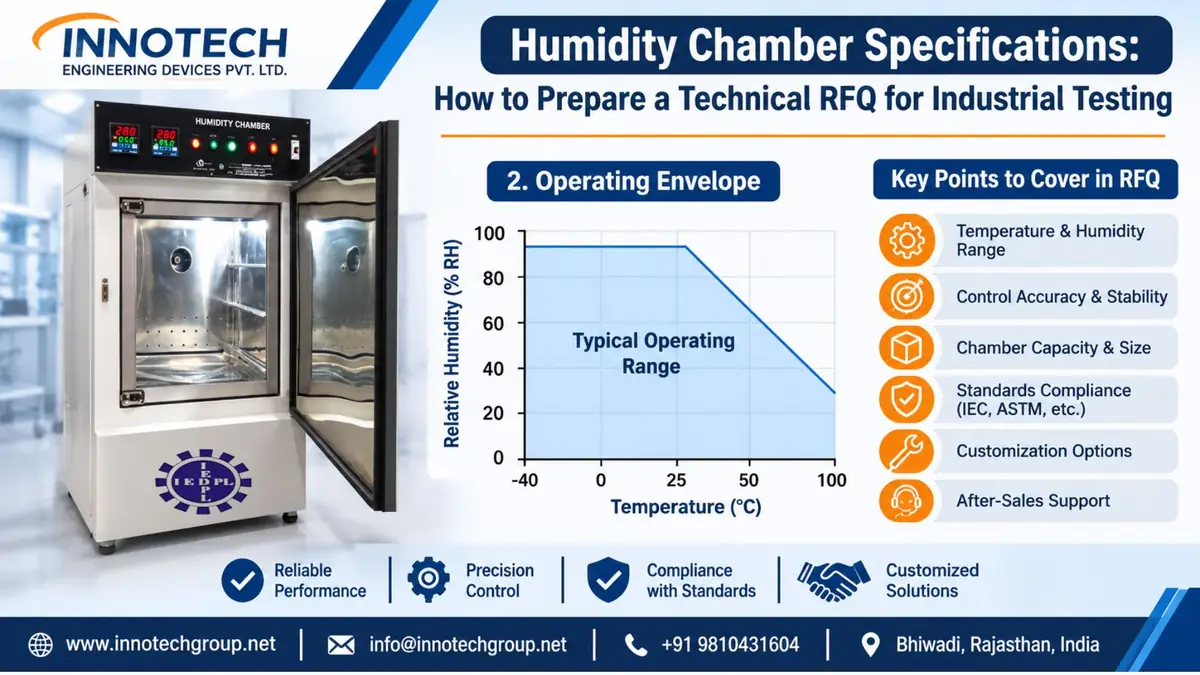
Temperature and humidity are related, but their operating ranges should not be considered independently.
For example, a chamber may be advertised with a temperature range of −40°C to +150°C and a humidity range of 20–95% RH. This does not mean it can maintain every humidity setting at every temperature.
Ask the manufacturer for the temperature-humidity operating envelope.
This identifies the combinations of temperature and relative humidity that the chamber can actually maintain.
Example RFQ Requirements
| Parameter |
Example buyer requirement |
| Temperature range | −40°C to +150°C |
| Humidity range | 20–95% RH within the specified operating envelope |
| Temperature stability | ±0.5°C at defined conditions |
| Temperature uniformity | ±2°C at defined conditions |
| RH control accuracy | ±3% RH at defined conditions |
| Test volume | 1,000 litres |
| Controller | Programmable digital controller |
| Data recording | Required |
| Test duration | Continuous opreation as specified |
These values are illustrative buyer requirements, not guaranteed Innotech specifications. Actual performance must be confirmed for the proposed model and operating conditions.
Select the Correct Chamber Capacity
Humidity chambers are available in compact laboratory, industrial cabinet and walk-in configurations.
Capacity is normally expressed in litres or cubic metres.
For example, a chamber with internal dimensions of 1,000 × 1,000 × 1,000 mm has a geometric internal volume of 1,000 litres.
However, the entire internal volume may not be usable for testing.
Allow space for:
- Air circulation
- Test specimens and fixtures
- Sensor locations
- Clearance from chamber walls
- Specimen loading and unloading
Buying tip: Provide the dimensions and total mass of your largest test specimen rather than specifying chamber volume alone.
Understand Temperature Stability, Uniformity and Accuracy
These terms describe different performance characteristics.
Temperature Stability
Stability describes how much the temperature varies with time at a specified measuring location under defined conditions.
Temperature Uniformity
Uniformity describes temperature differences across defined positions within the working space.
Temperature Measurement Accuracy
Accuracy concerns how closely the indicated or measured temperature agrees with the reference value.
A chamber can have stable control at one sensor while still exhibiting temperature differences elsewhere in the working space.
For humidity testing, ask how RH is measured and verified, including the applicable temperature conditions.
Choose the Right Control System
The controller determines how the chamber operates.
A basic controller may be suitable for constant-temperature and constant-humidity conditioning.
A programmable controller is more appropriate when the test requires multiple stages, timed exposure or automatic transitions.
Useful options to discuss include:
- Temperature and RH setpoints
- Programmable test profiles
- Digital display
- Alarm indication
- Data logging
- USB or computer connectivity
- Sensor fault indication
- Over-temperature protection
Do not assume that a touchscreen or programmable controller automatically includes remote monitoring or report-generation software.
Confirm these functions in the quotation.
Check Construction and Maintenance Requirements
Chamber construction affects durability, maintenance and suitability for the testing environment.
Important items include:
Inner chamber: Stainless steel may be specified for suitable industrial applications.
Outer body: Powder-coated steel or another suitable construction.
Insulation: Selected according to operating temperature and thermal performance.
Door sealing: Designed to reduce leakage during operation.
Air circulation: Arranged to maintain the specified working-space conditions.
Humidity system: Includes the appropriate water supply, humidification and dehumidification arrangement.
Refrigeration system: Selected according to the required temperature range and load.
Ask about water quality, drainage, cleaning access and maintenance intervals.
Identify Applicable Humidity Testing Standards
The chamber must be selected according to the required test method.
| Standard |
General relevance |
| IEC 60068-2-78 | Damp heat, steady-state testing |
| IEC 60068-2-30 | Damp heat, cyclic testing |
| IEC 60068-3-6 | Confirmation of temperature and humidity chamber performance |
| ASTM D2247 | Water resistance of coatings in 100% RH environements |
Not every humidity chamber can perform every listed test.
For example, a test involving condensation or near-saturated humidity may require a different configuration from an ordinary controlled-RH conditioning chamber.
State the exact standard and edition in your RFQ.
Ask About Loaded-Chamber Performance
A chamber's performance may change when specimens are placed inside.
Large or heat-generating products can affect temperature recovery, airflow and humidity distribution.
If the test specimen generates heat, the manufacturer should know its approximate heat dissipation.
Also confirm:
- Specimen weight
- Fixture arrangement
- Electrical feedthrough requirements
- Cable entry ports
- Whether the specimen operates during testing
- Required recovery time after door opening
These details are particularly important for electronics and automotive testing.
Humidity Chamber RFQ Checklist
Before requesting a quotation, prepare the following information.
| RFQ field |
Information to provide |
| Application | Product and industry |
| Test standard | Standard number and edition |
| Temperature | Minimum and maximum |
| Relative humidity | Required RH values at specified temperatures |
| Internal dimensions | Required working space |
| Specimen details | Size, weight and heat dissipation |
| Test duration | Hours, days or cycles |
| Controller | Constant or programmable |
| Data recording | Yes/No and required format |
| Utilities | Electrical supply, water and drainage |
| Documentation | Calibration, manuals and reports |
| Delivery | Installlation location and timeline |
A complete RFQ helps manufacturers avoid unnecessary assumptions and prepare comparable technical offers.
Customized Humidity Chamber Manufacturer in India
Innotech Engineering Devices Private Limited, based in Bhiwadi, Rajasthan, manufactures industrial testing machines and laboratory equipment.
Customers looking for a Humidity Chamber Manufacturer in India can discuss application-specific temperature, humidity, chamber dimensions, control and documentation requirements with Innotech.
Customized configurations can be evaluated against the intended testing procedure and available engineering options.
Explore:
- Temperature and Humidity Chamber https://innotechgroup.net/products/temperature-and-humidity-chamber
- Humidity Chamber https://innotechgroup.net/products/humidity-chamber
- Humidity and Temperature Conditioning Chamber https://innotechgroup.net/products/humidity-and-temperature-conditioning-chamber
Frequently Asked Questions
What specifications are important when buying a humidity chamber?
Temperature range, RH operating envelope, stability, uniformity, working volume, control system, specimen loading and test-standard requirements.
Can a humidity chamber operate at 95% RH?
Some chambers can, but the achievable RH depends on temperature and the chamber's operating envelope.
What is the difference between stability and uniformity?
Stability describes variation over time, while uniformity describes differences across the working space.
Can humidity chambers be customized?
Yes. Depending on engineering feasibility, manufacturers may offer different chamber sizes, controllers, ports and operating ranges.
What should I send to obtain an accurate quotation?
Send the required test standard, specimen details, temperature and humidity conditions, chamber size, test duration and documentation requirements.
Request a Humidity Chamber Quotation
Innotech Engineering Devices Private Limited
Manufacturer of Industrial Testing Machines & Laboratory Equipment
Bhiwadi, Rajasthan, India
Email: info@innotechgroup.net
Phone: 9810431604
Request a Technical Quotation
https://innotechgroup.net/contact
Category: Laboratory Equipment & Furnaces
Tags: humidity chamber specifications, temperature humidity chamber specifications, humidity chamber manufacturer in India, humidity control chamber, customized humidity chamber, industrial humidity chamber, temperature humidity testing specifications
Last Updated: 18 November 2026