
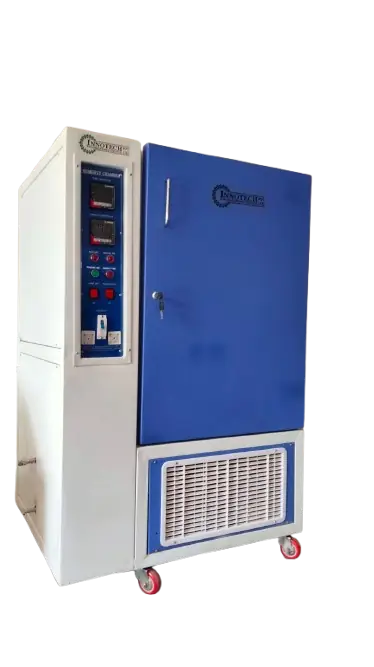
Temperature and Humidity Chamber – 8000 L Walk-In Climatic Chamber
Temperature and Humidity Chamber – 8000 L Walk-In Climatic Chamber
Looking for a temperature and humidity chamber in India to test how products, components and materials perform under controlled climatic conditions? Innotech Engineering Devices Private Limited manufactures environmental testing equipment and offers an 8000-litre (8 m³) walk-in temperature and humidity chamber designed for programmable temperature cycling and humidity exposure. With a proposed temperature range of −40°C to +150°C, humidity control of 20–95% RH within an agreed operating temperature band, and PLC/PID touchscreen control, this chamber can be configured for industrial product validation and quality assurance. Contact Innotech in Bhiwadi, Rajasthan, for technical specifications, configuration and a project-specific price quotation.
MODEL
I-THC
OVERVIEW
Description
Temperature and Humidity Chamber Manufacturer in India
What Is a Temperature and Humidity Chamber?
A Temperature and Humidity Chamber is an environmental testing machine used to expose products, components and materials to controlled temperature and relative humidity conditions. It helps manufacturers and quality-control laboratories evaluate how their products behave when exposed to hot, cold, humid and changing climatic conditions.
The Innotech Temperature and Humidity Chamber is an 8000-litre, 8 m³ walk-in-class environmental testing system designed for large components, assemblies and materials that require controlled climatic exposure. Its proposed configuration combines electrical heating, cascade refrigeration, humidification, dehumidification and programmable PLC/PID touchscreen control.
Businesses searching for a temperature and humidity chamber, humidity chamber machine, climatic chamber or temperature humidity testing equipment can discuss a configuration suited to their test requirements with Innotech Engineering Devices Private Limited, based in Bhiwadi, Rajasthan, India.
Temperature and Humidity Chamber Specifications
Important operating note: The −40°C to +150°C range refers to the proposed temperature capability, subject to final engineering design. The proposed 20–95% RH range is limited to an agreed operating envelope, nominally +20°C to +85°C. Humidity is not guaranteed throughout the full temperature range. Stability, uniformity, humidity accuracy and other performance targets must be verified under mutually agreed factory acceptance test (FAT) conditions.
Temperature and Humidity Chamber Features
1. Large 8000-Litre Walk-In Configuration
The 8 m³ working volume and proposed internal dimensions of 2000 × 2000 × 2000 mm are intended for testing larger components, assemblies and materials. Final usable space and loading arrangements should be confirmed during engineering design.
2. Wide Temperature Operating Range
The proposed −40°C to +150°C temperature range supports the planning of low-temperature, elevated-temperature and temperature-cycling tests, subject to the approved chamber design and operating conditions.
3. Controlled Humidity Exposure
The proposed humidification and dehumidification systems are designed to provide controlled relative humidity within an agreed temperature band. This allows customers to specify climatic test conditions suited to their products.
4. PLC/PID Touchscreen Control
A programmable touchscreen controller is proposed for setting test conditions, defining profiles and monitoring chamber operation. Final programming functions and I/O configuration will be confirmed during engineering.
5. Data Logging and Export
Integrated data recording with proposed USB/Ethernet export supports test documentation and review. The final data format, communication options and logging configuration should be confirmed before ordering.
6. Insulated Chamber Construction
The insulated construction, SS304 inner liner and powder-coated steel exterior are proposed for the environmental testing application. Final material and insulation details will be established in the approved technical offer.
7. Configurable Safety Provisions
The system is planned with applicable safety provisions such as over-temperature protection, compressor overload protection, phase-failure protection, door interlock or alarm, and emergency stop, subject to the final design.
8. Application-Specific Engineering
Temperature, humidity, loading, sample dimensions, test profiles, data recording and electrical requirements can be reviewed before finalizing the equipment configuration. Customers should confirm their required test methods and acceptance criteria with Innotech.
Temperature and Humidity Chamber Uses
A temperature and humidity chamber is used to investigate how environmental conditions may affect the performance, reliability and physical properties of products. Its suitability depends on the material, test method, chamber configuration and required operating conditions.
Common applications include:
- Automotive components: Climatic exposure of selected plastic parts, electrical components, connectors, sensors and assemblies.
- Electrical and electronics products: Environmental exposure testing of enclosures, circuit assemblies and electronic components where the required conditions fall within the chamber's approved operating envelope.
- Plastic and polymer products: Assessment of selected components for dimensional changes, appearance changes or material behaviour after environmental exposure.
- Industrial components: Climatic testing of parts and assemblies used in manufacturing equipment and industrial systems.
- Research and development laboratories: Controlled environmental exposure for product development and comparative testing.
- Quality assurance laboratories: Repeatable climatic test cycles for evaluating products against defined internal or customer test procedures.
- Material testing laboratories: Environmental conditioning of suitable materials before further physical or mechanical testing.
- Product validation facilities: Testing of prototypes and production samples against approved environmental test plans.
Not every product requires the same temperature, humidity, duration or cycling sequence. The intended test method must be checked against the chamber's final approved capabilities.
Temperature and Humidity Chamber Working Principle
A temperature and humidity chamber works by controlling the internal air temperature and relative humidity according to a programmed test profile.
Step 1: Load the samples. Place the test components or materials inside the chamber according to the approved loading arrangement, ensuring that airflow is not unnecessarily obstructed.
Step 2: Set the test conditions. Enter the required temperature, relative humidity, dwell duration and profile sequence using the proposed PLC/PID touchscreen controller.
Step 3: Control the temperature. Electrical heaters raise the chamber temperature when heating is required. The engineered cascade refrigeration system provides low-temperature cooling within the final approved operating range.
Step 4: Control the humidity. The humidification system adds moisture when required, while the dehumidification system reduces moisture to achieve the requested relative humidity within the permitted operating envelope.
Step 5: Monitor and record the test. The controller manages the programmed sequence, while the proposed data-logging system records relevant operating information for subsequent review.
Step 6: Evaluate the samples. After the prescribed test cycle and safe unloading, the customer evaluates the samples against the relevant acceptance criteria.
Actual control sequence, sensor configuration, logging intervals and operating limits depend on the final engineered system.
Temperature and Humidity Chamber Uses in Laboratory Testing
In a laboratory, a temperature and humidity chamber provides a controlled environment for exposing samples to specified climatic conditions. It can be used for product development, material conditioning, reliability investigations and quality-control testing.
For example, an automotive component manufacturer may need to expose a connector assembly to a defined temperature and humidity cycle before inspecting its condition or conducting an electrical performance check. An electronics manufacturer may need to assess an enclosure after a prescribed humid-heat exposure. A research laboratory may compare samples before and after environmental conditioning.
The test procedure should specify the required temperature, relative humidity, exposure duration, ramp rates, sample loading and acceptance criteria. The laboratory must also verify that the selected chamber can achieve the required combined conditions.
Temperature and Humidity Chamber Range
The operating range describes the temperature and humidity conditions the chamber is designed to produce.
The proposed Innotech chamber has a temperature operating range of −40°C to +150°C, subject to final design. Its proposed relative humidity control range is 20–95% RH within an agreed temperature band, nominally +20°C to +85°C.
Relative humidity is temperature-dependent. Consequently, the minimum and maximum humidity limits cannot be assumed to be available at every temperature. Customers should share their required temperature-humidity combinations so that the operating envelope can be reviewed before an order is finalized.
When comparing temperature humidity chamber specifications, buyers should examine the usable temperature-humidity envelope, stability, uniformity, humidity accuracy, chamber loading, recovery time, test profiles and data-logging requirements—not just the maximum temperature or humidity percentage.
Temperature and Humidity Chamber Price in India
The temperature and humidity chamber price in India depends on chamber capacity, temperature range, humidity operating envelope, cooling capacity, refrigeration architecture, control system, data-logging features, material construction, safety provisions and customization.
An 8000-litre walk-in chamber generally requires a different engineering assessment from a compact benchtop humidity chamber. For this reason, buyers should compare quotations against the same working dimensions, operating conditions, performance tolerances, test methods and supply scope.
Innotech Engineering Devices Private Limited provides project-specific equipment quotations based on the customer's technical requirements. To request the price of an 8000-litre temperature and humidity chamber, share the required temperature-humidity profile, sample dimensions, loading, applicable test standards, electrical requirements and data-recording needs.
Request a quotation: Contact Innotech at info@innotechgroup.net or call 9810431604. The manufacturing base is in Bhiwadi, Rajasthan, and enquiries can be made from anywhere in India.
Temperature and Humidity Chamber vs. Stability Chamber
A temperature and humidity chamber and a stability chamber can have overlapping functions, but they are not automatically interchangeable.
A temperature and humidity chamber is commonly selected for environmental exposure and climatic cycling, including temperature changes and controlled relative humidity within its specified operating envelope.
A stability chamber is commonly used for controlled storage and stability studies, particularly in pharmaceutical, healthcare, cosmetic and related industries. Its required temperature-humidity conditions, monitoring, documentation and compliance requirements depend on the intended application and applicable standards.
Before selecting either machine, define the required operating conditions, chamber capacity, monitoring requirements, applicable test procedures and validation expectations. Do not assume that an environmental chamber is automatically suitable for regulated pharmaceutical stability studies without confirming its intended use and compliance requirements.
How to Choose the Best Temperature and Humidity Chamber
When selecting the best temperature and humidity chamber for your application, consider the following:
1. Test requirements: Identify the exact temperature, humidity, exposure duration and cycle sequence.
2. Working capacity: Choose internal dimensions that accommodate the samples and required spacing.
3. Combined operating range: Confirm that the chamber can achieve your required temperature and RH simultaneously.
4. Temperature performance: Review stability, uniformity, ramp rates and recovery time.
5. Humidity performance: Confirm accuracy and control limits at the required setpoints.
6. Control and data recording: Specify programming, alarms, export formats and communication interfaces.
7. Safety and electrical supply: Confirm the supply, connected load and required protective functions.
8. Acceptance testing: Agree on the test method, empty or loaded conditions, measurement locations and acceptance criteria.
9. Service and installation: Discuss site readiness, commissioning, operator training and after-sales support.
10. Quotation comparison: Compare the same scope and performance requirements across manufacturers rather than choosing on price alone.
Why Choose Innotech Engineering Devices Private Limited?
Innotech Engineering Devices Private Limited manufactures and supplies testing and laboratory equipment for industrial and quality-assurance applications.
When discussing a temperature and humidity chamber project with Innotech, customers can share their sample requirements, operating conditions, test procedures and preferred control features for a technical review. This helps establish whether the proposed chamber configuration matches the intended application before the final specification and quotation are approved.
Based in Bhiwadi, Rajasthan, Innotech serves customers across India. Buyers can enquire about the proposed 8000-litre walk-in temperature and humidity chamber, request technical clarification and discuss project-specific configuration requirements.
For a quotation, provide your required temperature range, humidity range, sample size, test profile, applicable standards, electrical supply and installation location.
Frequently Asked Questions
1. What is a temperature and humidity chamber used for?
It is used to expose components, materials and products to controlled temperature and relative humidity conditions for environmental testing, product development, quality assurance and reliability investigations.
2. What is the temperature range of the Innotech temperature and humidity chamber?
The proposed temperature range is −40°C to +150°C, subject to final engineering design and agreed performance conditions.
3. What is the humidity range of this chamber?
The proposed range is 20–95% RH within an agreed temperature band, nominally +20°C to +85°C. Humidity is not guaranteed across the full temperature range.
4. What is the capacity of this temperature and humidity chamber?
The proposed working volume is 8000 litres (8 m³), with internal dimensions of 2000 × 2000 × 2000 mm.
5. What is the price of a temperature and humidity chamber in India?
The price depends on capacity, temperature and humidity requirements, cooling system, controls, data logging, safety features and installation scope. Contact Innotech for a quotation based on your required specifications.
6. Who manufactures temperature and humidity chambers in India?
Innotech Engineering Devices Private Limited, based in Bhiwadi, Rajasthan, offers environmental testing equipment and can discuss a proposed 8000-litre walk-in temperature and humidity chamber configuration for industrial applications.
7. What is the difference between a humidity chamber and a climatic chamber?
A humidity chamber focuses on controlled moisture exposure, sometimes with temperature control. A climatic chamber generally refers to equipment that simulates specified environmental conditions, often including both temperature and humidity. The actual capabilities depend on the model.
8. What is the difference between a temperature chamber and a temperature and humidity chamber?
A temperature chamber primarily controls temperature. A temperature and humidity chamber is designed to control both temperature and relative humidity within its specified operating envelope.
9. Can a temperature and humidity chamber be used for automotive testing?
It can be suitable for selected automotive components and assemblies when the required environmental conditions, sample dimensions and test procedure are supported by the final chamber configuration.
10. Is a temperature and humidity chamber suitable for pharmaceutical stability testing?
Suitability depends on the required stability conditions, monitoring, calibration, validation, documentation and applicable regulatory requirements. Confirm the complete compliance scope before selecting a chamber for regulated pharmaceutical studies.
11. What should I provide when requesting a temperature and humidity chamber quotation?
Share the required temperature and RH setpoints, test duration, cycling profile, sample dimensions, loading, applicable standards, electrical supply, data-logging needs and delivery or installation location.
12. Does Innotech supply temperature and humidity chambers across India?
Enquiries can be submitted from anywhere in India. Contact Innotech to confirm the supply, installation, commissioning and service arrangements for your location.
Request a Temperature and Humidity Chamber Quotation
Looking for an 8000-litre temperature and humidity chamber for industrial product validation or laboratory testing?
Contact Innotech Engineering Devices Private Limited to discuss your technical requirements and request a project-specific quotation.
- Website: https://www.innotechgroup.net/
- Email: info@innotechgroup.net
- Phone: 9810431604
- Location: Bhiwadi, Rajasthan, India
Share your test profile and operating conditions to help the engineering team assess the required configuration.
WHY IT WORKS
Key benefits
Controlled environmental exposure for defined test procedures.
Large working volume for suitable components and assemblies.
Programmable test profiles for repeatable operating sequences.
Recorded test information to support quality documentation.
- Opportunity to discuss a configuration around actual customer requirements.
USE CASE
Application range
BUILT IN
Features
8000 L large-capacity walk-in design
Proposed −40°C to +150°C temperature operating range
Controlled humidity within an agreed temperature envelope
PLC/PID touchscreen and programmable profiles
Integrated data logging and proposed USB/Ethernet export
- SS304 inner liner and insulated construction
SPEC
Specifications
Equipment name
Temperature and Humidity Chamber
Chamber capacity
8000 litres (8 m³)
Configuration
Walk-in class
Internal working dimensions
2000 × 2000 × 2000 mm (L × W × H)
Temperature operating range
−40°C to +150°C; empty chamber, design-dependent
Humidity control range
Proposed 20–95% RH within an agreed temperature band
Nominal humidity operating band
+20°C to +85°C
Temperature stability
Target ±0.5°C; empty chamber, subject to FAT verification
Temperature uniformity
Target ±2°C; empty chamber, subject to FAT mapping
Humidity accuracy
Target ±3% RH at defined steady-state setpoints
Inner material
SS304 stainless steel liner
Outer material
Powder-coated steel
Insulation
Insulated chamber construction
Heating system
Electrical heating
Refrigeration system
Engineered cascade refrigeration
Humidification
Controlled humidification with condensate management
Dehumidification
Engineered dehumidification system
Controller
PLC/PID touchscreen
Programming
Programmable temperature and humidity profiles
Alarms
Configurable alarms and applicable safety interlocks
Data recording
Integrated data logging
Data export
USB/Ethernet; final I/O configuration to be confirmed
Electrical supply
415 V, 3-phase, 50 Hz
Connected electrical load
To be finalized during engineering design
Safety protection
Applicable over-temperature, compressor overload, phase failure, door interlock/alarm and emergency-stop provisions
Applicable standards
Relevant IEC 60068-2 test methods; scope to be agreed