
Drop Testing vs Impact Testing: Working Principle, Standards, Applications & Machine Price in India
Jay Pal Singh
05 November 2026
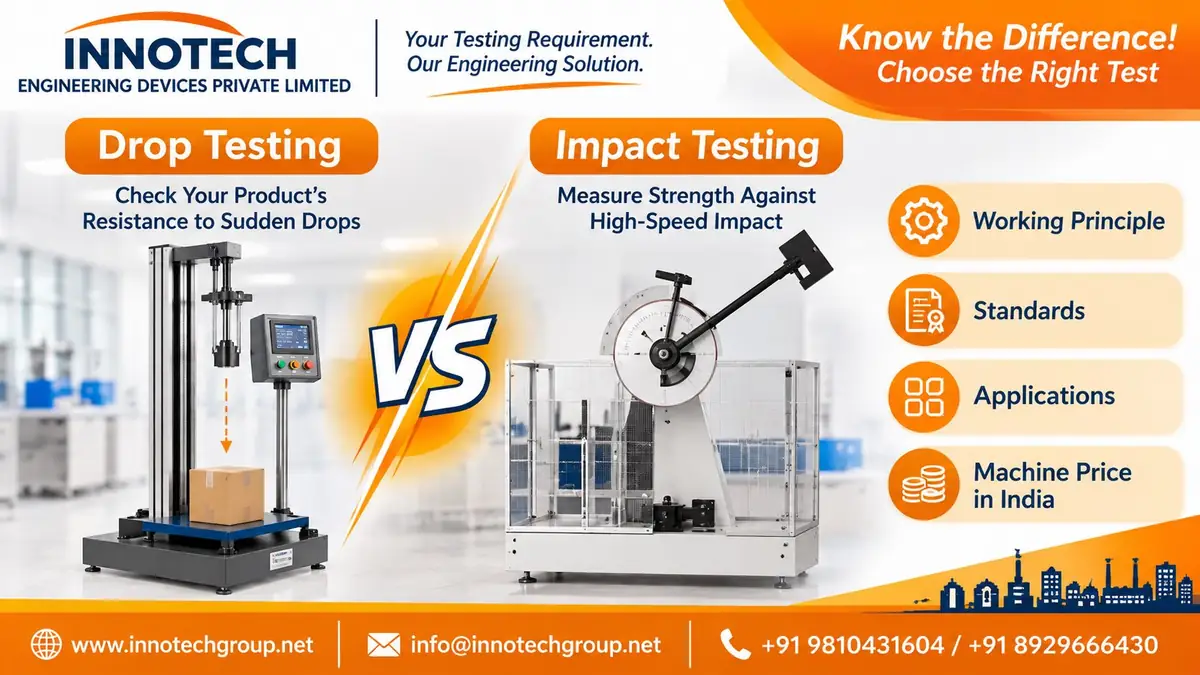
Drop Testing vs Impact Testing: Working Principle, Standards, Applications & Machine Price in India
Products and packaging can experience sudden shocks during transportation, handling, storage and actual use. A carton may fall during loading, an electronic product may experience accidental impact, or a metal component may be exposed to a sudden force during operation.
This is why manufacturers use drop testing and impact testing to evaluate product safety, material performance and quality.
Although both tests involve impact forces, their testing methods and objectives are different. A drop testing machine is commonly used to evaluate packaging and packaged products, whereas an impact testing machine can evaluate the toughness and impact resistance of materials such as metals and plastics.
In this guide, we explain their working principles, differences, industry standards, machine specifications, applications and approximate prices in India.
1. What Is Drop Testing?
Drop testing is a testing method used to evaluate how a product or package responds when it falls from a specified height onto a rigid surface.
It is particularly important for packaging manufacturers, corrugated box manufacturers, electronics companies, logistics providers and consumer product manufacturers.
The test helps identify weaknesses such as:
- Cracked or damaged packaging
- Broken corners and edges
- Deformation of cartons
- Leakage from containers
- Damage to the product inside
- Insufficient cushioning or protective packaging
A Packaging Drop Testing Machine provides a controlled arrangement for releasing a package from a selected height and observing its response after impact.
2. Working Principle of a Drop Testing Machine
The working principle of a drop tester is based on controlled free-fall impact.
The package is placed on the machine's holding or release arrangement. The required drop height is selected according to the applicable testing procedure. The package is then lifted and released, allowing it to fall freely onto the impact surface.
After the drop, the operator checks the package and its contents for visible or functional damage.
Typical drop testing procedure:
1. Prepare the package or test specimen.
2. Measure its weight and dimensions.
3. Position it correctly on the drop tester.
4. Set the required drop height.
5. Select the required face, edge or corner orientation.
6. Release the package using the machine mechanism.
7. Inspect the package and product after impact.
8. Record the observations and compare them with the acceptance criteria.
The test sequence and drop height should follow the selected standard or customer requirement.
3. What Is Impact Testing?
Impact testing evaluates the ability of a material or component to withstand a sudden force without breaking or suffering unacceptable damage.
It is widely used in metal manufacturing, automotive engineering, plastic manufacturing, construction, material research and quality-control laboratories.
Common impact testing methods include:
Charpy Impact Test: A notched specimen is supported horizontally and struck by a pendulum. The energy absorbed during fracture is measured.
Izod Impact Test: A notched specimen is held vertically as a cantilever and struck by a pendulum. The absorbed impact energy is used to assess impact resistance.
Drop-Weight Impact Test: A specified weight is released from a selected height onto a specimen to evaluate its resistance to sudden impact. The exact method depends on the material and applicable standard.
Impact testing helps manufacturers understand material toughness, fracture behaviour and suitability for demanding applications.
4. Working Principle of an Impact Testing Machine
In a conventional Charpy or Izod pendulum impact tester, a pendulum hammer is raised to a specified starting position and released.
The hammer strikes the prepared specimen and breaks or deforms it. The pendulum continues its movement after impact, and the energy absorbed by the specimen is determined from the change in the pendulum's energy.
The measured energy is generally expressed in joules (J).
The result helps evaluate the material's resistance to sudden loading under the specified test conditions.
5. Difference Between Drop Testing and Impact Testing
| Comparison |
Drop Testing |
Impact Testing |
| Main Purpose | Evaluate packaging or product performance during a fall | Evaluate material or component impact resistance |
| Testing method | Free-fall from a specified height | Pendulum strike or controlled drop-weight impact |
| Test specimen | Cartons, boxes, containers and packaged products | Metals, plastics and other specified materials |
| Main parameters | Drop height, package weight, orientation and impact surface | Impact energy, specimen dimensions, notch and test velocity |
| Result evaluation | Damage, deformation, breakage or package failure | Absorbed energy, fracture behaviour or impact resistance |
| Common equipment | Packaging Drop Tester | Charpy, Izod or Drop-Weight Impact Tester |
| Industries | Packaging, logistics, electronics and FMCG | Automotive, metal, plastic and engineering |
Which test should you choose?
Choose drop testing when you want to evaluate how packaging or a complete product performs during accidental falls and transportation.
Choose material impact testing when you need to measure the resistance of a material or component to sudden loading or fracture.
6. Important Industry Standards for Drop and Impact Testing
Selecting the correct testing standard is essential because different standards specify different specimen conditions, test arrangements and procedures.
| Standard |
Testing application |
| ASTM D5276 | Free-fail drop testing of loaded containers |
| ISO 2448 | Vertical impact testing of complete, filled transport packages by dropping |
| ISO 2206 | Identification of package parts during testing |
| ASTM D880 | Impact testing of shipping containers and systems |
| ISTA 1A | Performance testing of individual packaged products weighing 150 lb (68kg) or less |
| ISTA 3A | General simulation testing for individual packaged products shipped through parcel delivery systems |
| ASTM E23 | Notched-bar impact testing of metallic materials |
| ISO 148-1 | Vharpy pendulum impact testing of metallic materials |
| ASTM D256 | Izod pendulum impact resistance testing of plastics |
| ISO 180 | Izod impact strength testing of plastics |
The applicable standard depends on the material, package type, product weight and customer specification. ISTA procedures may also include vibration and atmospheric conditioning in addition to drop testing.
Always verify the required standard and its current edition before selecting or purchasing testing equipment.
7. Important Specifications of a Drop Testing Machine
The specifications of a packaging drop tester should be selected according to the size, weight and testing requirements of the package.
| Specification |
What to consider |
| Drop height | Required minimum and maximum testing height |
| Load capacity | Maximum weight of package |
| Platform size | Suitable dimensions for the test package |
| Drop orientation | Face, edge and corner testing requirements |
| Lifting arrangement | Manual, motorized or suitable mechanism |
| Release mechanism | Controlled and repeatable package release |
| Impact surface | Suitable rigid and level impact base |
| Safety arrangement | operator protection and safe release operation |
| Control System | Manual or motorized height setting, as required |
8. Important Specifications of an Impact Testing Machine
For Charpy and Izod impact testers, the following parameters should be checked before purchasing:
| Specification |
What to consider |
| Test method | Charpy, Izod or both |
| Impact energy | Required pendulum energy in joules |
| Pendulum hammer | Suitable hammer and striker arrangement |
| Specimen dimensions | Standard specimen size for the selected method |
| Notch arrangement | Required notch type and geometry |
| Impact velocity | As specified by the applicable standard |
| Display | Analogue or digital energy indication |
| Safety guard | Protective arrangement around the pendulum |
| Verification | Machine verification and calibration requirements |
9. Advantages of Drop and Impact Testing
Advatage of Drop Testing:
- Helps identify packaging weakness before dispatch
- Supports better carton and protective packaging design
- Helps evaluate face, edge and corner impact performance
- Supports packaging quality-control procedures
- Helps reduce product damage during handling and transporation
Advantages of impact testing:
- Helps compare the toughness of different materials
- Supports material selection and product development
- Identifies material vehaviour under sudden loading.
- Helps evaluate consistency between material batches
- Supports quality inspection in manufacturing laboratories
10. Drop Testing Machine and Impact Testing Machine Price in India
The price of a testing machine depends on its configuration, capacity, automation, accessories and required testing standards.
The following are indicative market planning ranges, not fixed quotations:
| Machine type |
Approximate price range in India |
| Basic manual packaging drop tester | Rs. 60,000 - Rs. 1,50,000 |
| Motorized or pneumatic packaging drop tester | Rs. 1,50,000 - Rs. 3,00,000 |
| Advanced or cusomized packaging drop tester | Rs. 3,00,000 - Rs. 5,00,000 |
| Basic Charpy or Izod impact tester | Rs. 80,000 - Rs. 1,50,000 |
| Digital or combined Charpy-Izod tester | Rs. 1,50,000 - Rs. 3,50,000 |
| Advanced or automated impact testing system | Project-specific quotation |
Actual prices can vary considerably between manufacturers and configurations. A quotation should be compared on the basis of test capacity, standard compliance, accessories, verification, installation and after-sales support rather than price alone.
11. Drop Testing and Impact Testing Machine Manufacturer in India
Innotech Engineering Devices Private Limited manufactures and supplies testing machines and laboratory equipment for industrial quality-control and material testing applications.
Our Single-Arm Packaging Drop Testing Machine is designed to evaluate the impact resistance and protective performance of packaged products during simulated dropping, handling and transportation conditions.
The equipment can be considered for packaging laboratories, corrugated box manufacturers, manufacturing units, logistics applications and quality-control departments.
Machine selection can be discussed according to package dimensions, sample weight, required drop height, test orientation and applicable testing procedure.
For impact testing applications, share your material type, test method, required impact energy and applicable standard so that the suitable equipment configuration can be discussed.
We serve industrial customers in Bhiwadi, Rajasthan, Delhi NCR and across India.
Contact Innotech Engineering Devices Private Limited
Email: info@innotechgroup.net
Phone: +91 9810431604
Address: H-307 RIICO Industrial Area Karoli, Tapukara, Bhiwadi, Rajasthan
Frequently Asked Questions
1. What is the difference between drop testing and impact testing?
Drop testing evaluates the performance of a package or product when dropped from a specified height. Impact testing evaluates the resistance of a material or component to sudden force or fracture.
2. Which ASTM standard is used for packaging drop testing?
ASTM D5276 covers free-fall drop testing of loaded containers.
3. What is the ISO standard for package drop testing?
ISO 2248 is associated with vertical impact testing of complete, filled transport packages by dropping.
4. What is the ASTM standard for Charpy impact testing?
ASTM E23 covers notched-bar impact testing of metallic materials.
5. What is the ASTM standard for Izod impact testing of plastics?
ASTM D256 covers Izod pendulum impact resistance testing of plastics.
6. What is the price of a drop testing machine in India?
Basic packaging drop testers may cost approximately ₹60,000 to ₹1,50,000, while motorized and advanced configurations may cost more depending on specifications.
7. What is the price of an impact testing machine in India?
Basic Charpy and Izod machines may start around ₹80,000, while digital and advanced systems can cost several lakh rupees depending on capacity and configuration.
8. Can a drop testing machine perform Charpy or Izod tests?
No. A packaging drop tester and a Charpy or Izod pendulum impact tester use different test arrangements and are designed for different applications.
9. Where can I buy a drop testing machine in Delhi NCR or India?
You can contact Innotech Engineering Devices Private Limited in Bhiwadi, Rajasthan, for packaging drop testing equipment and application-based machine selection support.
Category: Packaging Testing Equipment
Tags: Drop Testing vs Impact Testing: Working Principle, Standards, Applications & Machine Price in India Products and packaging can experience sudden shocks during transportation, handling, storage and actual use. A carton may fall during loading, an electron
Last Updated: 05 November 2026