
Digital Crock Meter: Working Principle, Testing Procedure, Manual & Price Guide
Jay Pal Singh
12 November 2026
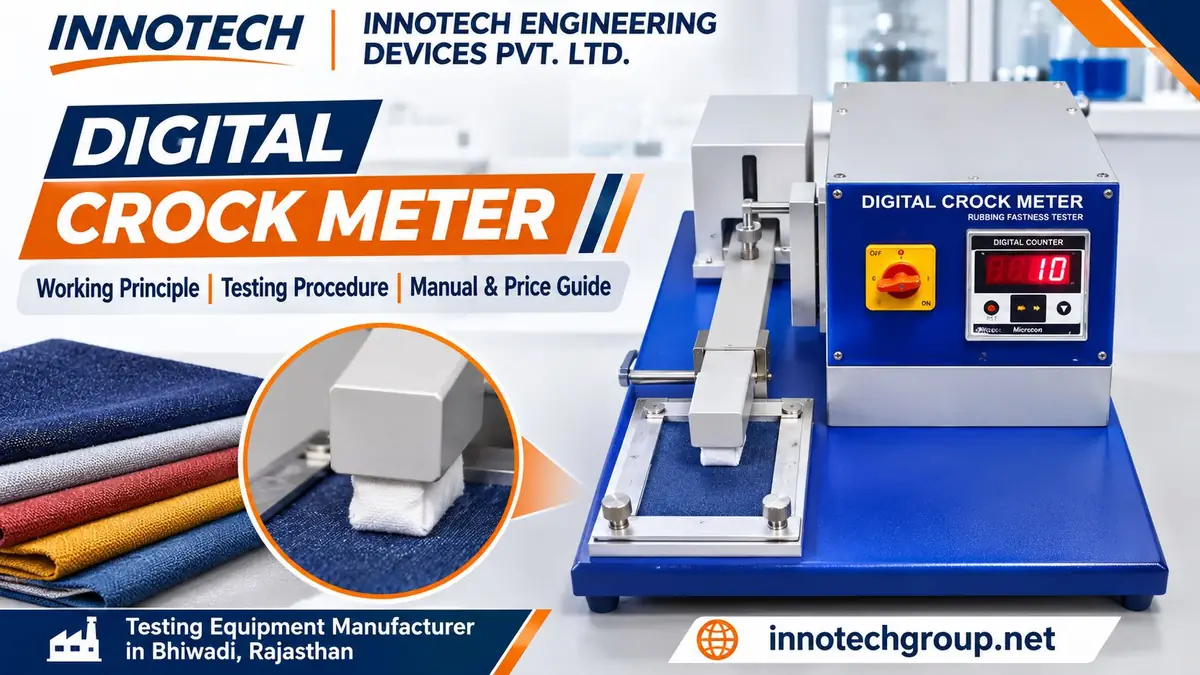
Digital Rubbing Fastness Tester
Digital Crock Meter: Working Principle, Testing Procedure, Manual & Price Guide
Colour quality is an important factor in textile, garment and footwear manufacturing. A fabric may look attractive when it is new, but if its colour transfers onto another surface during rubbing, it can affect product quality and customer satisfaction. This is why manufacturers and quality control laboratories perform colour fastness to rubbing tests using a Digital Crock Meter.
A Digital Crock Meter, also known as a Crockmeter or Rubbing Fastness Tester, is used to evaluate how much colour transfers from a textile surface onto a standard rubbing cloth under controlled conditions. It helps textile manufacturers, garment exporters and testing laboratories assess the rubbing fastness of fabrics under dry and wet conditions.
For manufacturers looking for a reliable Digital Crock Meter in India, understanding its working principle, testing procedure, applicable standards and price factors is important before purchasing the equipment.
1. What Is a Digital Crock Meter?
A Digital Crock Meter is a textile testing instrument used to determine the colour fastness of fabrics against rubbing. It works by rubbing a standard white cotton crocking cloth against a prepared fabric specimen under controlled testing conditions.
The machine produces a repeated rubbing movement over a specified distance while maintaining the required pressure on the test specimen.
After completing the test, the rubbing cloth is examined for colour staining. The staining is generally evaluated using an appropriate Grey Scale to assess the fabric's resistance to colour transfer.
A digital or motorised Crockmeter uses a controlled drive mechanism and a digital counter to manage and monitor the rubbing cycles, reducing variations associated with manual operation.
Common testing applications include:
- Dyed and printed fabrics
- Cotton and blended textiles
- Knitted and woven fabrics
- Denim and apparel materials
- pholstery and furnishing fabrics
- Garments and footwear materials
2. How Does a Digital Crock Meter Work?
The working principle of a Digital Crock Meter is based on controlled friction between a test specimen and a standard rubbing cloth.
The fabric sample is secured on the testing platform. A rubbing finger fitted with standard white crocking cloth moves repeatedly over the specimen under a specified load.
The rubbing action causes any loosely attached or transferable colour to move from the specimen onto the white cloth.
The test is performed under dry or wet conditions, depending on the testing requirement.
The basic working process involves:
1. Preparing the fabric specimen according to the applicable test method.
2. Fixing the specimen securely on the testing platform.
3. Attaching the standard crocking cloth to the rubbing finger.
4. Applying the specified testing load.
5. Setting the required number of rubbing cycles on the digital counter.
6. Operating the machine to complete the rubbing movement.
7. Removing and examining the crocking cloth.
8. Evaluating the staining using the relevant Grey Scale.
This process helps laboratories assess the resistance of textile materials to colour transfer during everyday use and handling.
3. Dry Rubbing Test vs Wet Rubbing Test
A Crockmeter is commonly used for two important types of colour fastness testing.
| Testing parameter |
Dry rubbing test |
Wet rubbing test |
| Crocking cloth | Dry standard cloth | Moistened standard cloth |
| Test condition | Dry rubbing | Wet rubbing |
| Purpose | Checks colour transfer under dry friction | Checks colour transfer under wet friction |
| Application | General fabric quality assessment | Colour stability when exposued to moisture |
| Evaluation | Grey Scale for staining | Grey Scale for staining |
Dry rubbing test: A dry crocking cloth is rubbed against the fabric to determine whether colour transfers under dry friction.
Wet rubbing test: A crocking cloth is prepared with the moisture level specified by the applicable test method. It is then rubbed against the specimen to evaluate colour transfer under wet conditions.
Both tests are important because a fabric may perform differently under dry and wet rubbing conditions.
4. Digital Crock Meter Testing Procedure
Following a consistent testing procedure is essential for obtaining repeatable results.
Step 1: Prepare the test specimen
Cut the fabric specimen to the dimensions specified in the applicable testing standard. Condition the sample where required.
Step 2: Prepare the rubbing cloth
Take the required standard white crocking cloth. For wet testing, prepare the cloth according to the moisture requirements of the selected test method.
Step 3: Mount the specimen
Place the fabric on the testing platform and secure it properly using the specimen holder.
Step 4: Attach the crocking cloth
Fix the white rubbing cloth onto the rubbing finger using the appropriate holding arrangement.
Step 5: Set the testing parameters
Set the required number of rubbing cycles using the digital counter. Confirm that the appropriate load and test configuration are selected.
Step 6: Start the test
Operate the Digital Crock Meter. The rubbing finger moves repeatedly across the fabric specimen.
Step 7: Evaluate the result
Remove the crocking cloth and compare the transferred colour with the appropriate Grey Scale for staining.
The final assessment should follow the applicable standard and laboratory procedure.
5. Digital Crock Meter Manual: How to Operate the Machine
A Digital Crock Meter manual provides operating instructions, testing precautions, machine maintenance information and guidance for obtaining consistent results.
Although the exact operating controls may differ between machine models, the following general guidelines are useful:
| Operation |
General instructions |
| Machine setup | Place the instrument on a stable, level surface |
| Sample preparation | Prepare the fabric according to the selected test method |
| Cloth mounting | Secure the crocking cloth properly |
| Load arrangement | Use the specified testing load |
| Counter setting | Enter the required rubbing cycles |
| Test operation | Start the rubbing mechanism |
| Result assessment | Evaluate staining using the appropriate Grey Scale |
| Maintenance | Clean the testing platform and inspect moving components |
Important operating precautions:
- Always use suitable standard crocking cloth.
- Avoid loose specimen mounting.
- Check the rubbing finger and sample holder before testing.
- Do not change testing loads without checking the applicable method.
- Keep the instrument clean after use.
- Follow the manufacturer's operating manual for model-specific instructions
For laboratory buyers, it is advisable to request the operating manual, recommended accessories and technical support when purchasing a new Crockmeter.
6. International Standards for Crockmeter Testing
A Digital Crock Meter is commonly used for colour fastness to rubbing tests according to recognised textile testing methods.
Some relevant standards include:
| Standard |
Testing application |
| ISO 105-X12 | Colour fastness to rubbing |
| AATC TM8 | Colour fastness to crocking |
| BS 1006 D02 | Colour fastness to rubbing |
| JIS L 0849 | Colour fastness to rubbing |
The exact test configuration, specimen preparation, rubbing conditions and evaluation procedure should be selected according to the applicable standard and its current edition.
Laboratories should verify the required standard before purchasing testing equipment.
7. Important Features to Consider When Buying a Digital Crock Meter
Selecting the right Crockmeter depends on the testing requirements of your laboratory or manufacturing facility.
Consider the following features:
- Digital counter: Helps set and monitor the required rubbing cycles.
- Controlled rubbing movements: Supports consistent testing.
- Specified rubbing load: Ensure testing is performed under the required pressure.
- Rubbing finger: Its diameterr and configuration should suit the selected test method.
- Dry and wet testing: Should suppport the required testing applications.
- Construction quality: A durable machine body supports regular laboratory use.
- Terchnical support: Availability of operating instructions, accessories and after sales assistance is important.
Before placing an order, compare the machine's specifications with your laboratory's actual testing requirements.
8. Digital Crock Meter Price in India: What Determines the Cost?
The Digital Crock Meter price in India depends on the machine's configuration, construction, automation and supplied accessories.
Online product listings show considerable price variation. For example, publicly listed products include a Digital Crock Meter around ₹32,000 from Texcare and a digital rubbing fastness tester listed around ₹64,999 by Texmart. These are individual advertised prices, not a standard market rate or directly comparable quotations.
The following factors influence the final Crockmeter price:
1. Manual or motorised operation.
2. Digital counter and control system.
3. Construction material and machine design.
4. Rubbing finger and additional testing attachments.
5. Standard accessories and crocking cloth.
6. Calibration documentation, warranty and technical support.
7. Customisation and specific laboratory requirements.
If you are searching for a Crockmeter price, it is advisable to compare the complete machine configuration rather than selecting equipment based only on the initial quoted amount.
Contact the manufacturer with your testing requirements to receive an appropriate quotation.
9. Applications of Digital Crock Meter Across Industries
Digital Crockmeters are used in different industries where colour transfer and rubbing resistance are important quality parameters.
Textile manufacturing: Testing dyed and finished fabrics for colour fastness.
Garment manufacturing: Checking colour transfer in finished apparel and clothing materials.
Dyeing and printing: Evaluating the rubbing fastness of dyed and printed materials.
Footwear industry: Assessing the colour transfer characteristics of textile and other suitable footwear materials.
Home furnishing: Testing upholstery, furnishing fabrics and related textile materials.
Quality control laboratories: Performing routine dry and wet rubbing tests for material inspection and quality evaluation.
10. Digital Crock Meter Manufacturer in Bhiwadi, Rajasthan – Innotech
Innotech Engineering Devices Private Limited is a manufacturer of industrial testing machines and laboratory equipment based in Bhiwadi, Rajasthan.
We manufacture testing equipment for different industrial applications and understand the importance of reliable testing in manufacturing and quality control environments.
Our Digital Crock Meter is intended for laboratories and manufacturers that require equipment for evaluating colour fastness to rubbing under dry and wet test conditions.
When selecting a Crockmeter, buyers should consider the required testing standard, machine configuration, accessories and operating requirements.
Manufacturers, textile laboratories, garment exporters and industrial buyers can contact our team to discuss their testing requirements and obtain product details and pricing.
Looking for a Digital Crock Meter Manufacturer in Bhiwadi or India?
Contact Innotech Engineering Devices Private Limited for product information, technical specifications and a quotation.
Email: info@innotechgroup.net
Phone: +91 9810431604
Location: H-307, RIICO Industrial Area, Karoli, Tapukara, Bhiwadi, Rajasthan.
Frequently Asked Questions About Digital Crock Meter
1. What is a Digital Crock Meter used for?
A Digital Crock Meter is used to determine the colour fastness of fabrics against dry and wet rubbing. It measures colour transfer from a fabric specimen onto a standard white crocking cloth.
2. What is the difference between a Crockmeter and a Digital Crock Meter?
A Crockmeter is the general name for a rubbing fastness testing instrument. A Digital Crock Meter generally includes a digital counter and may use motorised operation to control rubbing cycles.
3. What is the Digital Crock Meter price in India?
The price depends on the machine configuration, motorised operation, digital controls, accessories and calibration requirements. Request a manufacturer quotation for the exact model and configuration.
4. What is a Digital Crock Meter manual?
A Digital Crock Meter manual is an operating guide that explains machine setup, sample preparation, testing procedures, counter operation, maintenance and safety precautions.
5. Which standards are used for Crockmeter testing?
ISO 105-X12 and AATCC TM8 are commonly used methods for evaluating colour fastness to rubbing.
6. Why are dry and wet rubbing tests important?
Dry and wet rubbing tests help manufacturers understand how much colour transfers from a fabric under different friction conditions. Both tests are useful for textile quality control.
7. Where can I buy a Digital Crock Meter in India?
You can contact Innotech Engineering Devices Private Limited, a testing equipment manufacturer in Bhiwadi, Rajasthan, to discuss your Digital Crock Meter requirements, specifications and pricing.
Conclusion
A Digital Crock Meter is an important instrument for textile colour fastness testing. It helps manufacturers and quality control laboratories evaluate colour transfer under dry and wet rubbing conditions.
Understanding its working principle, testing procedure, relevant standards and price factors makes it easier to select the right Crockmeter for laboratory requirements.
If you are looking for a Digital Crock Meter manufacturer in Bhiwadi, Rajasthan, contact Innotech Engineering Devices Private Limited for product information and a quotation.
Category: Textile Testing Equipment
Tags: Digital Crock Meter, Crockmeter, Crock Meter, Crockmeter Price, Digital Crock Meter Price, Digital Crock Meter Manual, Rubbing Fastness Tester, Colour Fastness Testing, Textile Testing Equipment, Wet Rubbing Test, Dry Rubbing Test, Textile Testing Machine
Last Updated: 12 November 2026