Digital Crock Meter – Digital Rubbing Fastness Tester
Digital Crock Meter – Digital Rubbing Fastness Tester
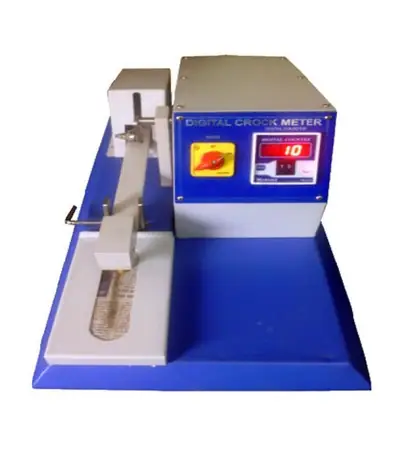
Digital Crock Meter is a textile testing instrument designed to evaluate the colour fastness of fabrics, garments and other textile materials against rubbing under dry and wet conditions. Also known as a Digital Crockmeter or Rubbing Fastness Tester, it helps determine colour transfer from a test specimen to a standard rubbing cloth under controlled testing conditions. The machine is suitable for textile manufacturers, garment exporters, dyeing units, fabric processing industries and quality control laboratories. Innotech Engineering Devices Private Limited manufactures Digital Crock Meters in Bhiwadi, Rajasthan, with customised machine configurations, testing arrangements and technical specifications according to customer requirements. We supply textile testing equipment across India.
MODEL
IDCM
OVERVIEW
Description
Digital Crock Meter Manufacturer in Bhiwadi, Rajasthan, India
The Digital Crock Meter is a specialised textile testing instrument used to determine the colour fastness of fabrics, garments and textile materials against rubbing. It evaluates whether colour or dye transfers from the surface of a textile specimen onto a standard rubbing cloth when subjected to controlled friction. The test can be performed under dry and wet conditions to understand how textile materials behave during different rubbing conditions.
Also known as a Digital Crockmeter, Crock Meter Testing Machine or Digital Rubbing Fastness Tester, this equipment is widely used by textile manufacturers, garment exporters, fabric processing units, dyeing industries and quality control laboratories. It helps assess fabric colour performance and supports quality inspection before textile products are supplied to customers.
Innotech Engineering Devices Private Limited manufactures Digital Crock Meter machines in Bhiwadi, Rajasthan, India. We provide customised testing equipment based on customer applications, laboratory requirements and selected technical specifications, with supply available across India.
What Is a Digital Crock Meter?
A Digital Crock Meter is a textile laboratory testing machine used to evaluate colour fastness to rubbing, commonly known as rubbing fastness or crocking resistance.
During the test, a textile specimen is placed and secured on the machine's testing platform. A standard white cotton rubbing cloth is attached to the rubbing finger. The rubbing finger moves repeatedly over the specimen under a specified load and movement conditions.
After completing the selected number of rubbing cycles, the rubbing cloth is removed and examined for colour staining. The degree of colour transfer can be assessed using an appropriate grey scale for staining according to the selected testing method.
The test helps determine whether dyes, pigments or surface colours are likely to transfer from textile materials during handling, wearing, contact or other rubbing activities.
Working Principle of Digital Crock Meter
The Digital Crock Meter works on the principle of controlled reciprocating rubbing movement. A specimen is mounted on the testing platform, while a standard rubbing cloth is fixed to the rubbing finger.
In a motorised digital configuration, an electric drive mechanism moves the rubbing finger repeatedly along a defined track. The digital counter allows the operator to set or monitor the required number of rubbing cycles, depending on the machine configuration.
The rubbing action creates friction between the textile specimen and the standard rubbing cloth. After the specified test cycles are completed, the cloth is inspected for colour transfer.
The test is generally carried out separately under dry and wet conditions. Comparing both results helps manufacturers understand how moisture affects colour transfer from the fabric.
Dry and Wet Rubbing Fastness Testing
Dry Rubbing Test
In dry rubbing fastness testing, a clean, dry standard rubbing cloth is attached to the rubbing finger. The cloth is moved over the textile specimen under the prescribed test conditions.
After the test, the rubbing cloth is examined for staining. This assessment helps determine how much colour transfers when the textile surface comes into contact with another dry material.
Dry rubbing testing is particularly useful for evaluating apparel fabrics, denim, upholstery, uniforms and other dyed textile products.
Wet Rubbing Test
In wet rubbing fastness testing, the standard rubbing cloth is moistened according to the selected test procedure before being placed against the specimen.
The rubbing process is then performed under the specified testing conditions. The resulting colour staining is evaluated after the test.
Wet rubbing assessment is important because moisture can influence dye transfer. It helps textile manufacturers understand how materials may perform when exposed to perspiration, moisture or damp contact.
Applications of Digital Crock Meter in Textile Industries
The Digital Crock Meter is used in different textile manufacturing and quality inspection environments.
Fabric Manufacturing Units
Fabric manufacturers use rubbing fastness testing to assess the colour performance of woven and knitted fabrics during production and final quality inspection.
Garment Manufacturing Industries
Garment manufacturers use the test to evaluate colour transfer from finished clothing materials. It helps support quality checks for shirts, trousers, jackets, uniforms and other garments.
Denim and Jeans Manufacturing
Denim manufacturers can use crocking tests to evaluate surface colour transfer from dyed denim fabrics. Dry and wet results are useful for checking colour performance during garment development and quality control.
Textile Dyeing and Processing Units
Dyeing and finishing units use rubbing fastness assessment to compare dyeing processes, evaluate finishing treatments and investigate colour transfer concerns.
Textile Export Houses
Export-oriented manufacturers use colour fastness testing to support buyer specifications, internal inspection procedures and product quality documentation.
Home Furnishing and Upholstery Industries
The instrument can support rubbing fastness assessment of upholstery fabrics, curtains, furnishing textiles and other suitable materials.
Textile Testing Laboratories
Independent and in-house testing laboratories use Crock Meter equipment to conduct controlled rubbing tests and assess staining results for customer samples.
Materials That Can Be Tested
Depending on specimen preparation, fixture arrangement and the selected test method, a Digital Crock Meter can be used for:
- Woven fabrics
- Knitted fabrics
- Dyed cotton fabrics
- Polyester and blended fabrics
- Denim and dyed garments
- Upholstery and furnishing textiles
- Printed textile materials
- Suitable non-woven textile materials
- Yarn specimens with an apropriate additional fixture, where supported
Important Factors Affecting Crocking Test Results
Consistent testing conditions are important when comparing the rubbing fastness of textile materials.
Specimen preparation: The textile sample should be prepared according to the relevant test procedure, with suitable dimensions and conditioning.
Rubbing cloth: The prescribed standard rubbing cloth should be used for the selected test method.
Applied force: The rubbing finger must apply the required load to maintain the intended test conditions.
Rubbing movement: The rubbing track and movement must follow the applicable testing procedure.
Wet cloth preparation: For wet rubbing tests, the rubbing cloth should be prepared using the specified moisture requirements.
Number of cycles: The test should be completed for the required number of rubbing cycles.
Result assessment: Colour staining should be evaluated using the appropriate grey scale for staining.
Following the selected method consistently helps laboratories improve test repeatability and comparison between samples.
Relevant Testing Standards for Digital Crock Meter
The following standards and test methods are relevant to textile colour fastness to rubbing:
- ISO 105-X12 - Textiles: Tests for colour fastness, colour fastness to rubbing.
- AATCC TM8 - Colourfastness to Crocking: Crockmeter Method.
- AATCC TM165 - Colourfastness to Crocking: Textile Floor Coverings.
- BS 1006 D02 - Colour fastness to rubbing test method.
- JIS L 0849 - Test methods for colour fastness to rubbing.
The applicable method depends on the textile material, testing requirements and laboratory procedure. The actual machine configuration must be checked against the chosen method before making a compliance claim.
Why Choose a Digital Crock Meter?
A digital motorised Crock Meter offers several practical advantages for textile quality testing.
- Controlled rubbing movement helps maintain consitent testing conditions.
- Digital cycle monitoring supports accurate test-cycle tracking.
- Dry and wet rubbing assessment helps evaluate different colour transfer conditions.
- Standard rubbing accessories suppport prescribed test arrangements.
- Repeatable testing procedures assist quality control departments
- Suitable configurations can support differetn textile testing applications.
How to Select the Best Digital Crock Meter
Before purchasing a Digital Crock Meter, textile manufacturers and laboratories should evaluate their intended testing applications.
Consider the following points:
- Test method: Confirm whether the laboratory requires ISO, AATC or another specific test procedure.
- Rubbing finger: check the required finger diameter and fixture arrangement.
- Applied load: Verify that the machine supports the force required by the selected method.
- Rubbing track: Confirm the required reciprocating movement and stroke length.
- Digital counter: Consider the cycle setting and counting requirements.
- Accessories: Check the availabillity of rubbing cloth holders, specimen clamps and additional fixtures.
- Machine configuration: Select a suitable arrangement for your laboratory's workload and material types.
Selecting the correct configuration helps ensure that the equipment supports the intended testing procedure.
Digital Crock Meter Price in India
The Digital Crock Meter price depends on the machine configuration, control system, testing accessories, selected standards and additional customer requirements.
A standard digital configuration and a customised laboratory testing arrangement may have different prices. Buyers should compare technical specifications, supplied accessories, test method compatibility and after-sales support rather than selecting equipment based only on the initial purchase price.
If you are searching for a Digital Crock Meter price, Crock Meter cost or a customised rubbing fastness tester in India, contact Innotech Engineering Devices Private Limited for a quotation based on your application.
Digital Crock Meter Manufacturer in India – Innotech Engineering Devices Private Limited
Innotech Engineering Devices Private Limited is an OEM manufacturer of testing machines and laboratory equipment based in Bhiwadi, Rajasthan, India.
We manufacture testing equipment for different industrial sectors and provide customised solutions according to customer requirements. Our focus is on practical machine configurations, application-specific testing arrangements and technical solutions for industrial quality control.
We welcome enquiries from textile manufacturers, garment factories, dyeing units, textile exporters, fabric processing companies and testing laboratories across India.
Request a Quote for Digital Crock Meter
Looking for a Digital Crock Meter manufacturer in India? Contact Innotech Engineering Devices Private Limited for machine details, technical consultation and customised pricing.
Share your textile testing application, required testing standards and laboratory requirements with our team. We will discuss a suitable machine configuration according to your needs.
Manufacturer: Innotech Engineering Devices Private Limited
Location: Bhiwadi, Rajasthan, India
Email: info@innotechgroup.net
Phone: +91 9810431604
Q1. What is a Digital Crock Meter used for?
A Digital Crock Meter is used to evaluate the colour fastness of fabrics and textile materials against rubbing. It determines whether dye or colour transfers from a textile specimen to a standard rubbing cloth.
Q2. What is the difference between dry and wet rubbing tests?
In dry rubbing tests, a dry standard rubbing cloth is used. In wet rubbing tests, the rubbing cloth is moistened according to the selected test procedure. Both tests help assess colour transfer under different conditions.
Q3. Which industries use Digital Crock Meters?
Textile mills, garment manufacturers, denim manufacturers, dyeing units, fabric processing industries, textile exporters and quality control laboratories use Crock Meter testing equipment.
Q4. Which standards are used for Crock Meter testing?
ISO 105-X12 and AATCC TM8 are commonly referenced methods for colour fastness to rubbing. Other methods may apply to specific textile products and applications.
Q5. What is the difference between a manual and a digital Crock Meter?
A manual Crock Meter generally uses hand-operated rubbing movement, whereas a digital motorised Crock Meter uses a powered mechanism and digital cycle monitoring. The motorised arrangement reduces variation associated with manual operation.
Q6. How is a Crock Meter test result evaluated?
After the rubbing test, the standard rubbing cloth is examined for colour staining. An appropriate grey scale for staining is used to assess the degree of colour transfer.
Q7. What factors affect Digital Crock Meter pricing?
The price depends on the machine configuration, digital control arrangement, accessories, testing requirements and selected technical specifications.
Q8. Can I get a Digital Crock Meter with customised specifications?
Yes. Innotech Engineering Devices Private Limited offers customised testing machine configurations according to customer applications and laboratory requirements.
Q9. Where can I buy a Digital Crock Meter in India?
You can contact Innotech Engineering Devices Private Limited, Bhiwadi, Rajasthan, for Digital Crock Meter enquiries, customised configurations and supply across India.
Q10. Is a Digital Crock Meter suitable for textile testing laboratories?
Yes. It is suitable for laboratories conducting dry and wet rubbing fastness tests on compatible fabrics, garments and textile materials.
WHY IT WORKS
Key benefits
Digital counter for test-cycle monitoring.
Motorised reciprocating rubbing mechanism.
Standard rubbing finger arrangement.
Controlled specimen holding arrangement.
Suitable for dry and wet rubbing tests.
Standard rubbing cloth mounting arrangement.
Easy specimen mounting and removal.
Customisable machine configuration and testing accessories.
Designed for textile laboratories and industrial quality control applications.
USE CASE
Application range
SPEC
Specifications
Product name
Digital Crock Meter
Machine type
Digital / Motorised
Testing application
Colour fastness to rubbing
Testing conditions
Dry and wet
Rubbing finger diameter
16 ± 0.1 mm (ISO 105-X12 reference)
Rubbing finger force
9 ± 0.2 N (ISO 105-X12 reference)
Rubbing track
104 ± 3 mm (ISO 105-X12 reference)
Counter
Digital cycle counter
Rubbing movement
Reciprocating
Drive arrangement
Motorised, subject to configuration
Rubbing cloth
Standard cotton rubbing cloth
Result assessment
Grey scale for staining
Specimen arrangement
As per selected test method
Power supply
As per machine configuration
Machine material
As per machine configuration
Dimensions
As per machine configuration
Weight
As per machine configuration
Customisation
Available
DIM
Dimensions
Overall machine dimensions
To be confirmed
Machine weight
To be confirmed
Rubbing finger assembly
As per selected method
Specimen holder
As per configuration
Rubbing cloth holder
Standard cloth mounting arrangement
Digital counter
Included as per selected configuration
Standard rubbing cloth
Available as accessory
Additional testing fixtures
Customisable