
Which Universal Testing Machine Should You Buy? Types, Capacity, Applications and Selection Guide
Jay Pal Singh
17 October 2026
Introduction: Which Universal Testing Machine Is Right for Your Requirements?
Are you looking for a Universal Testing Machine (UTM) for tensile testing, compression testing, steel testing, plastic testing or industrial quality control? Choosing the correct machine can be challenging because different materials, specimen sizes and testing standards require different capacities and configurations. A small component may need a low-force testing system, while reinforcement steel, metal products and other high-strength materials may require a high-capacity hydraulic UTM. Innotech Engineering Devices Private Limited manufactures and supplies Universal Testing Machines in a wide range of capacities, from 1 N and other low-force requirements to 1000 kN and higher capacities, subject to application requirements and engineering feasibility. Our range includes servo-controlled electro-mechanical UTMs, such as the 200 kN model, and computerised hydraulic UTMs, such as the 1000 kN model. This guide explains the main types of UTM machines, where they are used, how to select the right capacity and what information to share when requesting a quotation.
What Is a Universal Testing Machine?
A Universal Testing Machine is a material testing system that applies a controlled force to a specimen and measures its response. Depending on the machine configuration and selected accessories, it can perform tensile, compression, bending, flexural, shear and other mechanical tests.
Manufacturers use a UTM to evaluate material strength, deformation and performance against specified requirements. Testing results can support quality control, product development, material selection and research.
The machine must be selected according to the material, specimen dimensions, maximum expected force, measurement accuracy, applicable testing standard and type of test required.
Classification of Universal Testing Machines
Universal Testing Machines can be classified in several ways.
1. Classification by Testing Capacity
The following ranges are a practical starting point for discussing your requirements, not universal capacity limits for particular industries.
| Indicative Capacity Range |
Typical Applications to Investigate |
Potential Users |
| Low-Force systems, starting around 1 N | Small specimens, films, fibres and delicate components, depending on the instrument | Research labs, plastics labs and specialist testing facilities |
| Up to approximately 10 kN | Small components, polymers, wires and lower-force material testing | Product manufacturers, educational and laboratory facilities |
| Approximately 10-50 kN | Suitable plastics, rubber, wires, fasteners and general material testing | Manufacturing and quality-control laboratories |
| Approximately 50-200 kN | Suitable metal specimens, engineering components and higher-force tensile test | Engineering companies, metal processors and material testing laboratories |
| Approximately 200-600 kN | Higher-force test on suitable metals, structural materials and components | Heavy engineering and industrial testing facilities |
| Approximately 600-1000kN and above | High-force testing of suitable reinforcement steel and other materials requiring substantial loads | Construction-related laboratories, steel manufacturers and specialised testing facilities |
Important: These are broad indicative ranges. They do not establish which capacity is suitable for a specific material or standard. For example, two steel specimens may require different testing capacities because their dimensions, grades and expected breaking loads differ.
2. Classification by Loading System
Electro-Mechanical Universal Testing Machine
An electro-mechanical UTM uses an electric motor and a mechanical drive, such as a ball screw, to move the crosshead. Servo-controlled versions regulate movement according to the selected test parameters and feedback from the control system.
Potential advantages include controlled crosshead movement, computerised operation and the absence of a hydraulic loading circuit.
Suitable applications may include tensile testing, compression testing and other mechanical tests for which the machine capacity and available fixtures are appropriate.
Explore Innotech's 200 kN Servo Control Electro-Mechanical Universal Testing Machine
https://innotechgroup.net/products/servo-control-electro-mechanical-universal-testing-machine-200kn.
Hydraulic Universal Testing Machine
A hydraulic UTM uses hydraulic pressure to generate the testing force. Hydraulic systems are commonly used for high-force material testing applications.
Depending on the configuration, these machines can support tensile, compression, bend, re-bend and other tests using suitable grips, platens and fixtures.
Potential buyers include steel manufacturers, construction material testing facilities, industrial laboratories and other users whose specimens require a high testing force.
Explore Innotech's Computerised Universal Testing Machine – 1000 kN
(https://innotechgroup.net/products/computerised-universal-testing-machine).
Computerised Universal Testing Machine
A computerised UTM uses a control and data acquisition system to monitor the test and record measurements. Depending on the supplied software, it may display graphs, calculate test parameters and generate reports.
Computerisation is a feature of the control and measurement system rather than a separate loading principle. Both electro-mechanical and hydraulic UTMs can have computerised control, depending on their configuration.
Which UTM Should You Buy for Your Industry?
The correct choice depends on your test requirements, not simply your industry name.
Steel and Metal Manufacturing
If you manufacture steel products, metal components, rods, wires or reinforcement bars, you may need a UTM for tensile testing or other mechanical tests.
Before selecting the capacity, identify the specimen dimensions, material grade, expected maximum force and applicable test standard. Some applications may require a high-capacity hydraulic machine, while others can use a lower-capacity electro-mechanical machine.
Construction and Infrastructure
Construction-related testing laboratories may need to test reinforcement steel, metal products and other construction materials.
A hydraulic UTM may be suitable when the required test force is high. For reinforcement steel bend and re-bend testing, check the applicable standard and confirm that the required mandrels, fixtures and machine arrangement are available.
Plastics and Polymer Manufacturing
Plastic manufacturers may need to measure tensile strength, elongation and other mechanical properties.
The suitable UTM depends on the type of plastic, specimen dimensions and force expected during the test. A lower-capacity electro-mechanical UTM may be appropriate for some specimens, but the required measurement range must be checked.
Rubber and Elastomer Manufacturing
Rubber products, seals, hoses and elastomer specimens may require tensile, elongation or other tests. The machine should be selected according to the force range, specimen shape and grip requirements.
Wire, Cable and Fastener Manufacturing
Wire, cable and fastener testing may involve tensile or proof-load testing. Selecting the correct machine requires consideration of the product's expected load and the gripping arrangement needed to prevent slipping or specimen damage.
Research, Educational and Testing Laboratories
Laboratories may require flexibility for different materials, specimen sizes and testing methods. A computerised UTM can help with data recording and analysis, provided the software and measurement system support the required test.
For laboratories handling a wide variety of specimens, consider whether one machine with suitable accessories will meet the requirements or whether separate machines are needed for different force ranges.
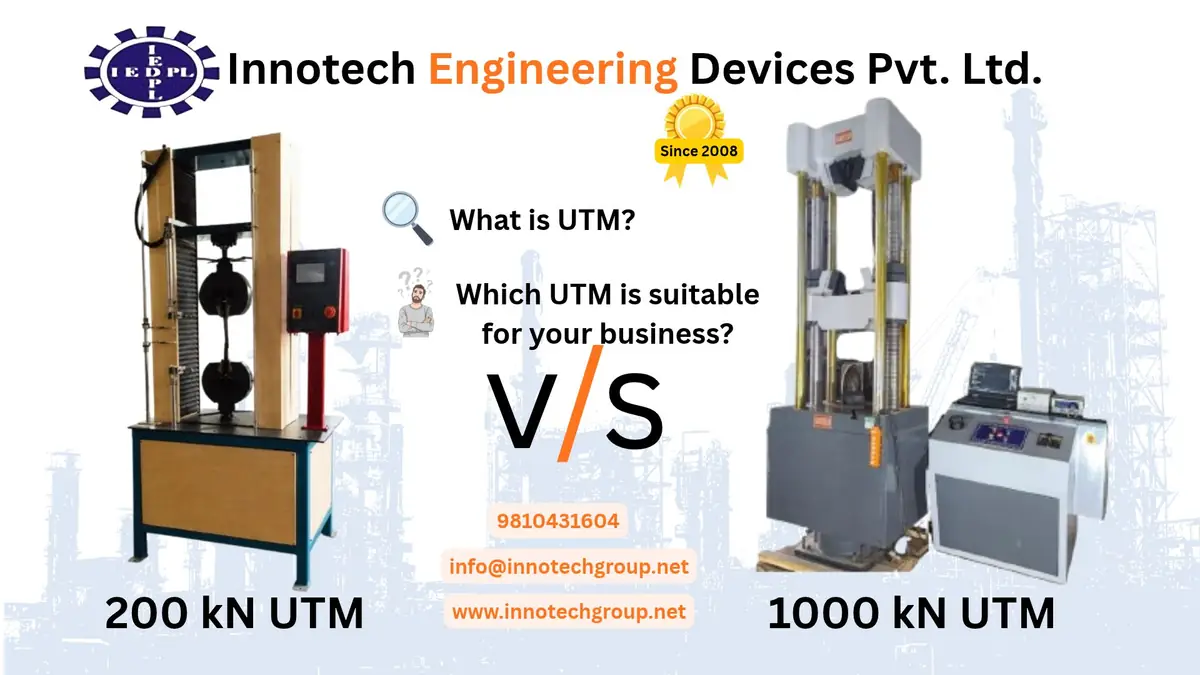
Innotech's 200 kN and 1000 kN Universal Testing Machines
Innotech manufactures different UTM configurations. The following comparison explains the two models for which product information is available.
| Feature |
200 kN UTM |
1000 kN UTM |
| Loading system | Servo-controlled electro-mechanical | Hydraulic |
| Nominal capacity | 200 kN | 1000 kN |
| Equivalent force in tonnes-force | Approximately 20 | Approximately 102 |
| Typical selection consideration | Suitable when required testing force falls within the machine's verified operating and measurement range | Suitable when the required testing force is substantially higher and within the machine's verified range |
| Control and data | Computerised control and data analysis, as configured | Computerised control and data acquisition, as configured |
| Possible test types | Tensile, compression, flexural and other test with appropriate fixtures | Tensile, compression, bend, re-bend and other tests with appropriate fixtures |
| Accessories | Grips, fixtures and extensometer options according to requirements | Grips, platens, madrels and extensometer options according to requirements |
The 1000 kN machine has a nominal capacity five times that of the 200 kN machine. However, this does not mean the 1000 kN model is automatically the better purchase. If your specimens need a much lower force, a smaller capacity with a suitable measurement range may be more appropriate.
Review the actual machine specifications, measurement accuracy, usable load range, accessories and applicable test standard before making a final decision.
How to Calculate the Capacity You Need
A common mistake is to choose a UTM based only on the name of the material. The required force also depends on the specimen's dimensions and mechanical properties.
For a tensile test, the approximate relationship is:
Required force = Expected tensile stress × Original cross-sectional area
For example, when stress is expressed in N/mm² and cross-sectional area in mm², the result is in newtons. Divide the result by 1000 to convert newtons to kilonewtons.
This calculation is a preliminary selection aid, not a substitute for the test standard or engineering assessment. The expected breaking load, specimen variation, required measurement accuracy, safety margins and applicable testing procedure should also be considered.
Ask your engineering team or equipment manufacturer to confirm the appropriate capacity and usable measurement range before ordering.
What Should You Check Before Buying a UTM?
Use this checklist when comparing Universal Testing Machines.
1. Material: What are you testing—steel, plastic, rubber, wire, composite or another material?
2. Specimen dimensions: What are the length, width, thickness or diameter?
3. Required force: What is the estimated maximum load or breaking force?
4. Test type: Do you need tensile, compression, flexural, bending, shear or another test?
5. Testing standard: Does the test need to follow a particular IS, ASTM, ISO or other standard?
6. Accuracy and resolution: What measurement performance is required by your test procedure?
7. Test space: What tensile clearance, compression space and column clearance are needed?
8. Accessories: Are special grips, compression platens, mandrels or an extensometer required?
9. Software: Do you need graphs, automatic calculations, report generation or specific data exports?
10. Installation: Is the available floor space, foundation and electrical supply suitable?
Providing these details helps the manufacturer recommend a suitable configuration instead of simply offering the highest-capacity machine.
What Determines the Price of a Universal Testing Machine?
There is no single price that applies to every UTM. The cost depends on several factors:
- Maximum testing capacity
- Electro-mechanical or hydraulic loading system
- Load measurement system and accuracy requirements
- Test space and machine frame design
- Computerised control and software functionality
- Grips, fixtures, compression platens and mandrels
- Extensometers and other measurement accessories
- Required testing standards and documentation
- Installation, training and service requirements
For a useful quotation, share the intended material, specimen dimensions, required testing force, test types and accessories. This allows the machine configuration to be assessed before the price is finalised.
Why Choose Innotech Engineering Devices?
Innotech Engineering Devices Private Limited manufactures and supplies testing equipment for industrial, laboratory and research applications.
A range of capacities: We offer UTM solutions from low-force requirements to 1000 kN and higher capacities, subject to application requirements and engineering feasibility.
Different loading systems: Our range includes servo-controlled electro-mechanical and hydraulic UTM configurations.
Application-based selection: We can discuss your material, test procedure, specimen dimensions and required measurement range to help identify a suitable machine configuration.
Supply across India: Innotech has supplied testing machines to customers at multiple locations across India.
Configurable accessories: Grips, fixtures, platens, mandrels and measurement accessories can be discussed according to the selected model and intended application.
Our aim is to help customers identify equipment that meets their actual testing requirements rather than choosing a machine based on capacity alone.
Frequently Asked Questions
Which Universal Testing Machine is suitable for my company?
The appropriate machine depends on your material, specimen dimensions, expected maximum force, test method, applicable standard and required measurement performance. Share these details with the manufacturer to determine a suitable configuration.
Is a 200 kN UTM enough for steel testing?
It may be suitable for some steel specimens, but not every steel test. Calculate or establish the expected test force and confirm the machine's usable load range, gripping arrangement and compliance with the required test method.
When should I choose a 1000 kN hydraulic UTM?
Consider a 1000 kN hydraulic UTM when the required test force and application fall within its specified operating range. The final selection should also account for measurement accuracy, test space, fixtures and applicable standards.
What is the difference between hydraulic and electro-mechanical UTM machines?
An electro-mechanical UTM uses an electric motor and mechanical drive to move the crosshead. A hydraulic UTM uses hydraulic pressure to generate testing force. The suitable option depends on the required capacity, test procedure, control requirements and operating preferences.
Can one UTM perform multiple tests?
Yes, where the machine's capacity, control system, software and compatible fixtures support those tests. Different grips, platens and accessories may be necessary for tensile, compression, bending and other test methods.
Does Innotech supply customised UTM capacities?
Innotech offers UTM solutions across a wide capacity range, including low-force systems and machines of 1000 kN and higher where feasible. The required capacity, machine design and accessories should be confirmed for each application.
How can I request a quotation?
Share your material type, specimen dimensions, expected maximum load, test methods, applicable standards and accessory requirements with Innotech. This information helps our team discuss the appropriate machine configuration and quotation.
Find the Right Universal Testing Machine for Your Application
Choosing the right Universal Testing Machine begins with understanding what you need to test and the force required. A low-force material testing system, a 200 kN servo-controlled electro-mechanical UTM and a 1000 kN hydraulic UTM serve different requirements. The best choice is the one that matches your material, specimen, testing method, measurement requirements and budget.
Innotech Engineering Devices Private Limited manufactures and supplies Universal Testing Machines in a range of capacities and configurations for customers across India.
Contact Innotech for technical guidance and a quotation.
Website: www.innotechgroup.net
Email: info@innotechgroup.net
Phone: +91 9810431604
Location: Bhiwadi Rajasthan India
Share your testing requirements to discuss a suitable UTM capacity, loading system, software and accessories for your application.
Category: Universal Testing Machine
Tags: Univeral Testing Machine, UTM Machine In Bhiwadi Rajasthan, UTM for Tensile Testing,
Last Updated: 17 October 2026