
Types of Rockwell Hardness Testers: Analog, Digital, Automatic and Bench Models
Jay Pal Singh
28 October 2026
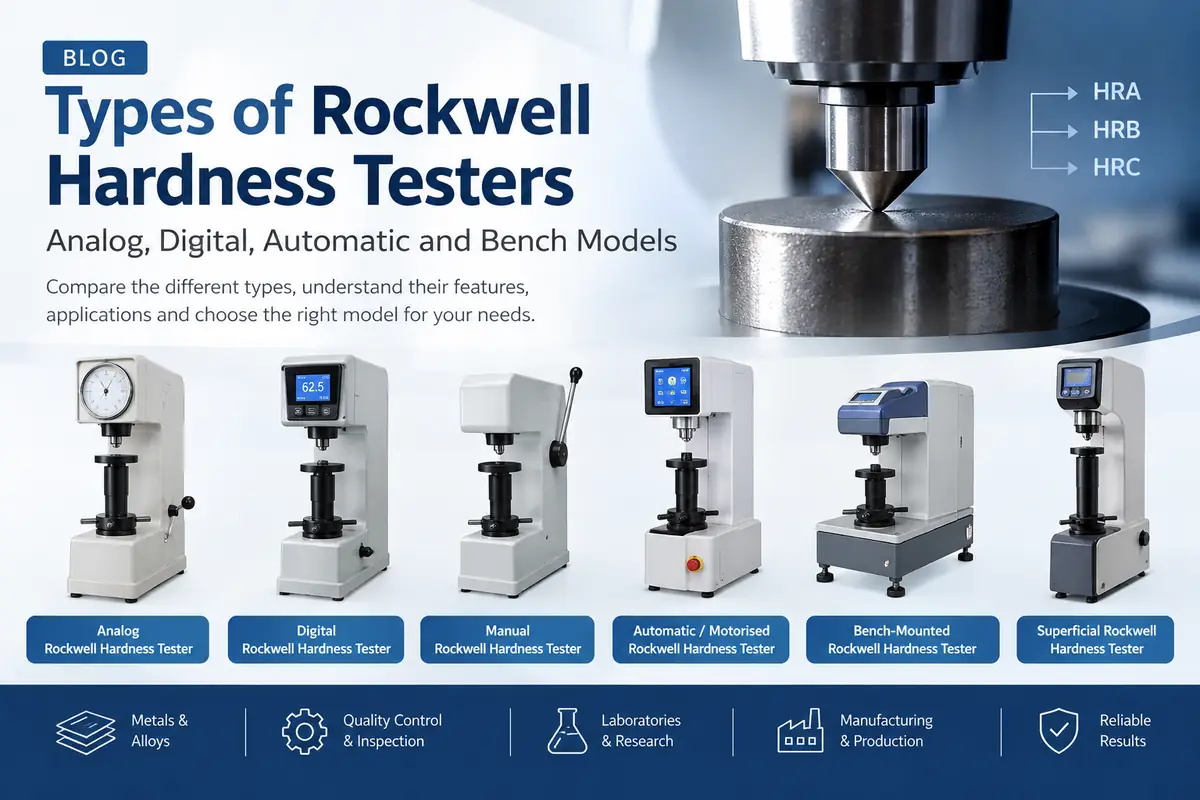
Types of Rockwell Hardness Testers: Analog, Digital, Automatic and Bench Models
Choosing the right Rockwell hardness tester is important for manufacturers, quality-control laboratories and engineering companies that need to evaluate the hardness of metallic materials. Different hardness testing machines offer different operating methods, display systems and levels of automation. Selecting a suitable model depends on the material, component dimensions, required Rockwell scale, testing frequency and laboratory requirements.
If you are comparing a digital Rockwell hardness tester with an analog model, or deciding between manual and automatic equipment, understanding the differences can help you make a more informed purchase.
Innotech Engineering Devices Private Limited supplies industrial testing machines and laboratory equipment from Bhiwadi, Rajasthan, India. Contact our team to discuss your hardness testing application and the configuration required for your work.
What Is a Rockwell Hardness Tester?
A Rockwell hardness tester measures the resistance of a material to indentation. The test uses a specified indenter and a sequence of preliminary and additional forces. The machine measures the resulting change in indentation depth and converts it into a Rockwell hardness value.
Depending on the material and test method, different indenters and Rockwell scales may be used. Common examples include the regular Rockwell B and C scales, which are often used for different categories of metals.
The appropriate scale depends on the material's expected hardness, thickness and other test requirements. The tester must also be suitable for the specimen geometry and applicable test method.
1. Analog Rockwell Hardness Tester
An analog Rockwell hardness tester displays the test result using a mechanical dial or pointer-based indicator. The operator performs the test according to the instrument's procedure and reads the indicated hardness value.
Key characteristics
- Dial-based hardness reading.
- Mechanical operating arrangement, depending on the model.
- Direct visual interpretation of the displayed value.
- Suitable for routine testing when the required scales and accessories are supported.
Applications
nalog Rockwell testers may be used in metalworking workshops, production inspection, engineering laboratories and manufacturing quality-control departments.
Advantages and limitations
Analog models can be straightforward to operate and may suit workplaces that prefer a conventional measurement interface. However, reading the dial requires care, and result recording may involve manual documentation.
The actual accuracy, supported scales and operating method depend on the machine model and its condition.
2. Digital Rockwell Hardness Tester
A digital Rockwell hardness tester displays the test result electronically. Depending on its configuration, it may include a digital interface for displaying hardness values and selecting test settings.
Key characteristics
- Electronic display of test readings.
- Potentially easier result reading compared with a pointer-based dial
- Digital presentation of the selected test scale and available settings
- Additional data functions on models equipped with suitable electronics and software.
Applications
Digital Rockwell hardness testers may be useful in production facilities, inspection departments, testing laboratories and research environments where operators regularly measure and record hardness values.
Advantages and limitations
A digital display can reduce the difficulty of interpreting a dial and may simplify documentation. However, a digital display does not automatically guarantee higher accuracy than an analog machine. Accuracy depends on the instrument design, calibration, verification, test procedure and condition of the equipment.
Before purchasing, confirm whether the model supports data storage, statistical analysis, computer connectivity or report generation. These functions should not be assumed unless they are included in the specifications.
3. Manual Rockwell Hardness Tester
A manual Rockwell hardness tester requires the operator to perform specified operating steps, such as positioning the specimen and applying the test force through the machine's operating mechanism.
The term manual describes the operating method rather than the display type. A manual machine may have an analog or digital readout, depending on its design.
Applications
Manual testers may suit smaller production facilities, workshops and laboratories that perform routine hardness checks without requiring a highly automated workflow.
What to consider
Operators must follow the specified procedure consistently, position the specimen correctly and allow the measurement sequence to complete as required. The machine should be selected according to the intended test scale, specimen dimensions and testing frequency.
4. Automatic or Motorised Rockwell Hardness Tester
An automatic or motorised Rockwell hardness tester automates some of the force application or test sequence. The level of automation varies between models.
Some machines may automate the application and removal of test forces, while others may provide additional electronic controls. Automatic operation should not be confused with a fully automated production-line testing system.
Applications
Automatic or motorised models may be considered for laboratories and manufacturing operations that carry out repeated hardness measurements and want to reduce operator intervention during the test cycle.
Advantages and limitations
Automation can help standardise certain operating steps and support testing efficiency. However, the operator must still prepare the specimen correctly, select the appropriate test method, verify the machine and interpret the results in context.
Before selecting an automatic model, ask the supplier to clarify which steps are automated, what controls are provided and whether the machine supports the required testing scales.
5. Bench-Mounted Rockwell Hardness Tester
A bench-mounted Rockwell hardness tester is designed for installation on a suitable workbench or dedicated support. The term bench-mounted describes the installation arrangement rather than the test technology.
Bench-mounted machines may be manual, digital, motorised or configured with other operating features. Their suitability depends on the machine's design, testing capacity and intended use.
Applications
These machines may be used in:
- Manufacturing quality-control departments
- Engineering and metalworking workshops
- Material testing laboratories
- Component inspection facilities
- Educational and technical laboratories
The supporting surface must be stable and suitable for the instrument. Specimen size, access around the testing area and operator requirements should be considered during installation planning.
6. Regular and Superficial Rockwell Hardness Testers
Rockwell hardness testers can also be classified according to the test method and force range they support.
Regular Rockwell testing
Regular Rockwell testing uses the forces and procedures specified for the selected regular Rockwell scale. Scales such as HRA, HRB and HRC are used for suitable materials and hardness ranges.
For example, HRC is commonly used for harder steels, while HRB is often used for softer metals and certain non-ferrous materials. The correct scale must be selected according to the material and applicable test method rather than by convenience alone.
Superficial Rockwell testing
Superficial Rockwell testing uses lower test forces and is intended for suitable applications where a shallower indentation is needed, such as certain thin materials or smaller components.
Not every standard Rockwell tester supports superficial Rockwell testing. Confirm the supported test method, forces, scales, indenters and accessories before buying a machine for thin specimens.
Comparison of Rockwell Hardness Tester Types
| Tester type |
Main characteristic |
Potentially suitable for |
Important consideration |
| Analog | Dial-based display | Routine hardness checks | Requires careful dial reading |
| Digital | Electric display | Regular testing and result reading | Data functions depends on model |
| Manual | Operator-controlled steps | Workshops and laboratories | Consistent operating procedure is essential |
| Automatic or motorised | Automated selected test steps | Repetitive testing workflows | Confirm the actual automation level |
| Bench-mounted | Designed for bench installation | Fixed laboratory or inspection stations | Required a suitable stable support |
| Superficial Rockwell | Supports lower-force test methods | Suitable thin or smaller specimens | Must support the required superficial scales |
These categories can overlap. For example, a tester may be digital, motorised and bench-mounted at the same time.
How to Choose the Right Rockwell Hardness Tester
Before purchasing a Rockwell hardness testing machine, review the following factors.
1. Material being tested
Identify whether you will test carbon steel, alloy steel, stainless steel, aluminium, brass or another metallic material. The material and expected hardness range help determine the appropriate scale.
2. Required Rockwell scale
Confirm whether you need HRA, HRB, HRC, a superficial Rockwell scale or another supported method. Do not assume that every machine supports all scales.
3. Component size and shape
Check the specimen thickness, dimensions, geometry and available access for positioning. Cylindrical, irregular or small components may require suitable fixtures or an alternative testing arrangement.
4. Testing frequency
A workshop that performs occasional checks may have different requirements from a production line or laboratory conducting large numbers of measurements each day.
5. Display and data requirements
Decide whether an analog dial is sufficient or whether you need a digital display, data recording, computer connectivity or report generation.
6. Calibration and verification
Ask about calibration documentation, verification procedures and maintenance requirements. Measurement reliability depends on more than the display type alone.
7. Standards and documentation
Confirm the applicable test method, such as the relevant edition of ASTM E18 or ISO 6508, where required by your application or customer specification. Verify the current standard and the machine's stated compatibility before ordering.
Rockwell Hardness Tester Price in India
The price of a Rockwell hardness tester in India depends on its operating method, display system, supported scales, automation, accessories, measurement capabilities and overall configuration.
An analog model may differ in price from a digital or motorised tester, while machines supporting specialised testing requirements may need additional accessories or features. Prices should therefore be compared using the actual specifications rather than the product name alone.
For a suitable quotation, share your material type, required Rockwell scale, specimen dimensions, expected testing volume and preferred display or automation features with the supplier.
Why Contact Innotech Engineering Devices?
Innotech Engineering Devices Private Limited supplies industrial testing machines and laboratory equipment for manufacturing, material evaluation and quality-control applications.
If you are selecting a Rockwell hardness tester, our team can discuss your application requirements and help clarify the machine specifications to review. Confirm the supported scales, indenter type, test-force sequence, accuracy, calibration status, accessories and applicable standards in the final technical quotation.
Contact Innotech Engineering Devices Private Limited
Website: https://innotechgroup.net
Email: info@innotechgroup.net
Phone: +91 9810431604
Address: H-307, RIICO Industrial Area, Karoli, Tapukara, Bhiwadi, Rajasthan, India
Contact our team to discuss your hardness testing requirements and request a quotation for a suitable machine configuration.
Frequently Asked Questions
What are the main types of Rockwell hardness testers?
Common categories include analog, digital, manual, automatic or motorised, bench-mounted and superficial Rockwell testers. These categories describe different aspects of the machine and can overlap.
Is a digital Rockwell hardness tester more accurate than an analog model?
Not necessarily. Accuracy depends on the machine design, calibration, verification, condition and test procedure. A digital display may make readings easier to interpret, but it does not automatically guarantee better measurement performance.
What is the difference between regular and superficial Rockwell testing?
Regular Rockwell testing uses the forces specified for regular Rockwell scales. Superficial Rockwell testing uses lower forces for suitable applications, including certain thin materials and smaller components.
Which Rockwell scale is used for steel?
The appropriate scale depends on the steel grade, hardness range, specimen thickness and test requirements. HRC is commonly used for harder steels, but the correct scale should be selected according to the applicable method.
What should I check before buying a Rockwell hardness tester?
Confirm the required scales, test forces, indenters, specimen dimensions, display and data features, calibration requirements, accessories and applicable standards.
Conclusion
Rockwell hardness testers are available in different configurations to suit a range of laboratory and industrial requirements. Analog and digital models differ mainly in how readings are displayed, while manual and automatic models differ in their operating methods. Bench-mounted describes the installation arrangement, and superficial Rockwell testing refers to a different test-force range and method.
The right choice depends on the material, required Rockwell scale, component geometry, testing frequency and documentation needs. Compare the confirmed technical specifications and calibration requirements before selecting a machine for your laboratory or production facility.
Category: Hardness Testing Equipments
Tags: rockwell hardness tester, types of rockwell hardness testers, rockwell hardness testing machine, analog rockwell hardness tester, analogue rockwell hardness tester, digital rockwell hardness tester, automatic rockwell hardness tester, manual rockwell hard
Last Updated: 28 October 2026