
Tensile Testing Machine Buying Guide: Specifications, Capacity, Standards, Software & Price in India
Jay Pal Singh
17 November 2026
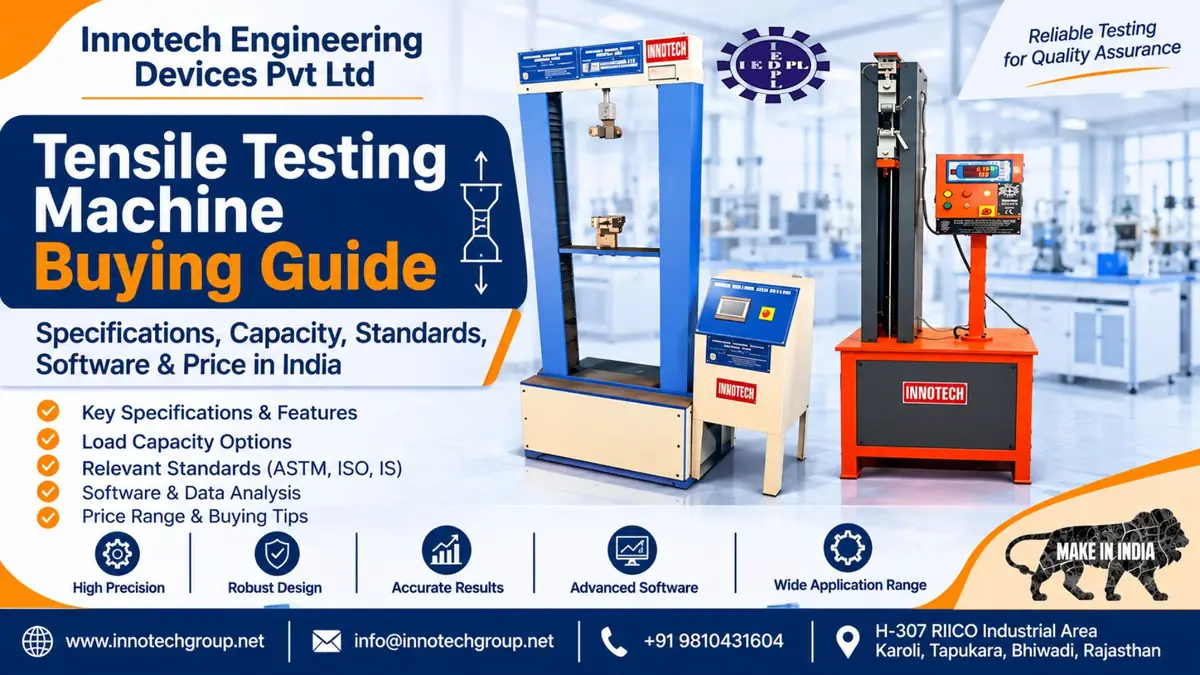
Digital Tensile Testing Machine
Hydraulic Tensile Testing Machine
Tensile Testing Machine Buying Guide: Specifications, Capacity, Standards, Software & Price in India
Buying a Tensile Testing Machine for an industrial laboratory or manufacturing plant requires careful technical evaluation.
Two machines with the same 10 kN or 100 kN capacity may differ significantly in accuracy, test speed, grips, software and measurement capabilities.
Choosing the wrong machine can result in unsuitable testing ranges, specimen slippage, unreliable strain measurements or unnecessary additional costs.
This guide explains how industrial buyers can select a Digital Tensile Testing Machine, Computerized Tensile Tester, Servo-Controlled UTM or Hydraulic Tensile Testing Machine based on actual testing requirements.
It is prepared by Innotech Engineering Devices Private Limited, an OEM testing machine manufacturer in Bhiwadi, Rajasthan, India.
What Specifications Matter When Buying a Tensile Testing Machine?
Before comparing suppliers, prepare a technical requirement sheet.
| Specification |
Why it matters |
| Maximum capacity | Must exceed the expected test force with suitable margin |
| Verified force range | Determines where forvce accuracy is established |
| Load cell accuracy | Affects force measurement reliability |
| Crosshead speed | Must suppport the reuired test method |
| Speed control | Important for repeatable loading conditions |
| Crosshead travel | Must accommodate specimen extension |
| Grip seperation | Determines available specimen geometry |
| Extensometer | Required for certain strain measurements |
| Software | Determines available calculations and reports |
| Calibration | Provides measurements verifications |
| Safety provisions | Protect operators and equipments |
Buyer tip: Do not compare machine capacity alone. Ask for the complete specification sheet and a list of included accessories.
How to Select Tensile Testing Machine Capacity
Capacity is the maximum force a testing machine is designed to apply.
Common machine ratings include 1 kN, 5 kN, 10 kN, 20 kN, 50 kN, 100 kN, 200 kN, 300 kN, 600 kN and 1000 kN.
The correct rating depends on specimen cross-sectional area and expected material strength.
ensile Force Calculation
For an engineering estimate:
Expected force (N) = Expected tensile stress (MPa) × Original cross-sectional area (mm²)
Example:
A metal specimen has:
- Original cross-sectional area: 100 mm²
- Expected ultimate tensile strength: 500 MPa
Estimated maximum force:
500 × 100 = 50,000 N = 50 kN
A machine rated at exactly 50 kN would offer no additional capacity margin for this estimated maximum. A higher suitable rating may be considered, while ensuring that the test forces remain within its verified measurement range.
Tensile Testing Machine Capacity Comparison
| Capacity |
Potential application |
| 1-5 kN | Films, textiles, elastomers and compatible small specimens |
| 10 kN | Plastics, polymers and suitable engineering components |
| 20-50 kN | Engineering polymers, composites and some metals |
| 100-200 kN | Higher-force metals and industrial components |
| 300-600 kN | Reinforcement bars, rods adn heavier metallic specimens |
| 1000 kN+ | Heavy duty industrial testing |
These are examples, not material-specific capacity guarantees.
Explore the 10 kN Tensile Testing Machine https://innotechgroup.net/products/10-kn-tensile-testing-machine and 200 kN Servo-Controlled Universal Testing Machine https://innotechgroup.net/products/servo-control-electro-mechanical-universal-testing-machine-200kn
Digital vs Computerized vs Servo-Controlled vs Hydraulic Tensile Testing Machine
| Machine type |
Main characterics |
Buyer consideration |
| Digital tensile tester | Electronic measurement and display | Suitable for defined routine tests |
| Computerized tensile tester | Computer-based measurements and reporting | Useful for detailed test records |
| Servo controlled electromechanical | Controlled motor-driven loading | Suitable for programmable test movement |
| Hydraulic tensile tester | Hydraulic force generation | Useful for higher-force testing |
| Servo hydraulic UTM | controlled hydraulci actuation | Consider for demanding force-control applications |
A computerized machine is not necessarily servo-controlled. Likewise, a servo-controlled system does not automatically include every software calculation or test mode.
Select the actual configuration, not simply the product label.
Tensile Testing Machine Load Cell: Accuracy and Resolution
The load cell converts applied force into an electrical measurement.
Buyers should verify:
- Maximum load-cell capacity
- Minimum verified force
- Accuracy class
- Percentage-of-reading or percentage-of-full-scale
- specification
- Measurement resolution
- Calibration method
- Compatibility with the controller
A machine with a high maximum capacity is not automatically ideal for very low-force specimens.
For example, testing a thin plastic film on a large-capacity machine may require an additional lower-capacity load cell.
Important: A display showing many decimal places does not prove high measurement accuracy.
Tensile Test Extensometer: Why It Matters
An extensometer measures specimen deformation over a defined gauge length.
It is particularly useful when testing standards require accurate strain measurement.
Types of Extensometers
| Type |
Typical consideration |
| Mechanical extensometer | Compatible extension measurement |
| Clip-on electronic extensometer | Direct specimen strain measurement |
| Long-travel extensometer | High-elongation materials |
| Video extensometer | Non-contact optical measurement |
| High-temperature extensometer | Elevated-temperature testing |
| Low-temperature-compatible extensometer | Cold-environment testing |
Calculating Strain from Extension
Engineering strain is:
Strain = Change in gauge length / Original gauge length
For example:
- Original gauge length = 50 mm
- Measured specimen extension = 2 mm
Engineering strain = 2 / 50 = 0.04, or 4%.
Crosshead movement should not automatically be substituted for actual specimen extension because machine and grip compliance can affect the reading.
Read our Mechanical Extensometer Guide https://innotechgroup.net/blog/mechanical-extensometer-tensile-testing-guide
Tensile Testing Machine Software: What Should Buyers Demand?
Computerized tensile testing machine software should support the actual required testing methods.
Ask whether the supplied software includes:
- Specimen dimensions and identification
- Test speed configuration
- Live force and displacement monitoring
- Load-extension graphs
- Stress-strain graphs
- Maximum force and breaking-load results
- Tensile strength calculations
- Yield strength and proof stress calculations
- Percentage elongation
- Young's modulus
- Test report generation
- Data export and storage
- User permissions and report customization
Not all features are standard. Verify each one in the quotation.
For audit-sensitive laboratories, also discuss calibration records, software version control, data backup and test traceability.
Tensile Test Results: What Does the Machine Measure?
A tensile test can produce different mechanical properties depending on the specimen and instrumentation.
| Test result |
Meaning |
| Maximum load | Highest recorded tensile force |
| Breaking load | Force recorded at fracture |
| Tensile strength | Tensile stress calculated from force and area |
| Yield strength | Stress associated with the defined onset of yielding |
| Elongation | Increase in specimen length |
| Percentage elongation | Extension relative to original gauge length |
| Young's modulus | Slop of the elastic stress-strain relationship |
| Load-extension curve | Relationship between force and extension |
| Stress-strain curve | Relationship between stress and strain |
Tensile Strength Calculation
Tensile strength (MPa) = Force (N) / Original cross-sectional area (mm²)
Example:
Maximum force = 12,000 N
Original area = 40 mm²
Tensile strength = 300 MPa
This is a simplified engineering-stress example. Actual results must follow the specified test method.
For more detailed explanations, read How to Read Tensile Test Results https://innotechgroup.net/blog/how-to-read-tensile-test-results
Tensile and Flexural Testing: Can One UTM Perform Both?
A suitable Universal Testing Machine can perform different mechanical tests when equipped with the required fixtures and control functions.
| Test |
Main purpose |
Typical fixture |
| Tensile | Resistance to pulling | Tensile grips |
| compression | Resistance to compressive loading | Compression platens |
| Flexural | Resistance to bending | Three-point or four-point bending fixture |
| Peel | Seperation force of bonded materials | Peel fixture |
| Shear | Resistance to shearing | Dedicated shear fixture |
| Tear | Resistance to tear propagation | Suitable tear grips |
The machine must have sufficient capacity, test space, measurement accuracy and compatible software.
Read Flexural Strength vs Tensile Strength https://innotechgroup.net/blog/flexural-strength-vs-tensile-strength and One Machine, Many Tests https://innotechgroup.net/blog/one-machine-many-tests-universal-testing-machine
ASTM, ISO and IS Standards for Tensile Testing Machines
The applicable testing standard depends on the material and test objective.
| Material or requirement |
Relevant standards |
| Metallic materials | ASTM E8/E8M, ISO 689201, IS 1608 (Part 1) |
| Steel products | ASTM A370 |
| Reinforcement steel | IS 1786, ISO 115630-1 |
| Plastics | ASTM D638, ISO 527 |
| Rubbber | ASTM D412, ISO 37 |
| Thin plastic films | ASTM D882 |
| Polymer composites | ASTM D3039/D3039M |
| Textile fabrics | ASTM D5034, ASTM D5035, ISO 13934-1 |
| Plastic flexural testing | ASTM D790, ISO 178 |
| Force verification | ASTM E4, ISO 7500-1 |
| Extensometer calibration | ISO 9513 |
What Does Standards Compliance Mean?
A machine should not be considered compliant merely because a standard is mentioned in its catalogue.
The supplier must confirm that the supplied configuration supports the required:
- Test speed and control method
- Force accuracy and verified range
- Specimen geometry
- Gripping arrangement
- Strain measurement
- Test procedure
- Calibration and reporting requirements
For tenders, request a point-by-point technical compliance statement.
Tensile Testing Machine HSN Code in India
Tensile testing equipment generally falls under HSN heading 9024, covering machines for testing mechanical properties of materials.
| HSN Code |
General classification |
| 9024 10 00 | Machines for testing metals |
| 9024 80 00 | Machines for testing textiles, paper and paperboard |
| 9024 80 99 | Other machines |
| 9024 90 00 | Parts and accessories |
The correct classification depends on the supplied product and should be verified before invoicing. HSN classification and GST rate determination are related but separate checks.
Tensile Testing Machine Price in India: What Affects Cost?
A machine's price depends on its complete technical scope.
Major cost factors include:
1. Force capacity and load frame
2. Digital or computerized control
3. Servo motor, ball screw or hydraulic system
4. Load-cell capacity and accuracy
5. Crosshead travel and testing speed
6. Grips and special fixtures
7. Extensometer
8. Software functions
9. Calibration and documentation
10. Freight, installation, training and warranty
A lower initial quotation may exclude grips, calibration, software or installation.
Compare the total supplied testing solution, not only the base machine price.
Questions to Ask a Tensile Testing Machine Manufacturer
Before issuing a purchase order, ask:
- Is the quoted machine suitable for our specimen and standard?
- What is the verified force measurement range?
- What accuracy class is supplied?
- Which grips are included?
- What is the maximum crosshead travel?
- Does the software calculate all required results?
- Is an extensometer included?
- What calibration certificate is supplied?
- Is installation and training included?
- What is the warranty and service response arrangement?
- Are spare parts and future software support available?
A complete technical offer should answer these questions clearly.
How to Prepare a Tensile Testing Machine RFQ
Provide the manufacturer with the following information.
| RFQ Requirements |
Example information |
| Material | Steel, plastic, rubbber, film, wire |
| Specimen | Diameter, width, thickness, length |
| Expected load | Maximum expected breaking force |
| Standard | ASTM, ISO, IS or customeer method |
| Required results | UTS, yield, elongation, modulus |
| Speed | Required test speed or test method |
| Grips | Round, flat, film, rubber or custom |
| Software | Graphs, calculations, report format |
| Calibration | Required accuracy and documentation |
| Location | Installation city and state |
Providing these details helps avoid unnecessary quotation revisions and unsuitable machine selection.
Tensile Testing Machine Manufacturer in Bhiwadi and India
Innotech Engineering Devices Pvt. Ltd. manufactures industrial testing machines and laboratory equipment in Bhiwadi, Rajasthan, India.
We offer digital tensile testers, computerized testing systems, servo-controlled machines, hydraulic tensile testers and customized testing solutions.
Customers searching for a Tensile Testing Machine Manufacturer in India, Digital Tensile Testing Machine Manufacturer in India, Tensile Testing Machine in Bhiwadi or Servo UTM Supplier in Delhi NCR can contact our OEM team.
Explore our products:
- Digital Tensile Strength Testing Machine https://innotechgroup.net/products/digital-tensile-strength-testing-machine
- Single Column Computerized Tensile Testing Machine https://innotechgroup.net/products/single-column-computerized-tensile-testing-machine
- 10 kN Tensile Testing Machine https://innotechgroup.net/products/10-kn-tensile-testing-machine
- Computerized Servo-Controlled Tensile Testing Machine https://innotechgroup.net/products/computerized-servo-controlled-tensile-strength-testing-machine
- Hydraulic Tensile Testing Machine https://innotechgroup.net/products/hydraulic-tensile-testing-machine
- 200 kN Servo-Controlled Universal Testing Machine https://innotechgroup.net/products/servo-control-electro-mechanical-universal-testing-machine-200kn
Frequently Asked Questions
Which tensile testing machine is best for an industrial laboratory?
The best machine depends on the materials, expected force, required standards, accuracy, test space and software requirements.
What is the difference between tensile strength and breaking load?
Breaking load is a force measurement. Tensile strength is a stress value calculated using force and specimen cross-sectional area.
Is an extensometer necessary for tensile testing?
An extensometer may be required when the test method demands accurate specimen strain, modulus, yield or elongation measurement.
Can a computerized tensile testing machine generate test reports?
Yes, when the supplied software includes the required data acquisition, calculations and reporting functions.
What should I check before buying a UTM in India?
Check capacity, verified force range, accuracy, speed, grips, extensometer, software, standards, calibration and service support.
Request a Tensile Testing Machine Quotation
Innotech Engineering Devices Private Limited
OEM Manufacturer of Testing Machines & Laboratory Equipment
Factory: H-307, RIICO Industrial Area, Karoli, Tapukara, Bhiwadi – 301707, Rajasthan, India
Phone: +91 9810431604
Email: info@innotechgroup.net
Request a Technical and Commercial Quotation
https://innotechgroup.net/contact
Share your specimen details and testing requirements. Our team can discuss a suitable machine configuration for your application.
Category: Tensile Testing Machine
Tags: tensile testing machine buying guide,tensile testing machine specifications, tensile testing machine software, tensile test extensometer, tensile and elongation test, tensile strength test, tensile testing machine price in India
Last Updated: 18 November 2026