
Static Load Testing of Sanitaryware: Test Procedure, Purpose and Quality Control
Jay Pal Singh
02 October 2026
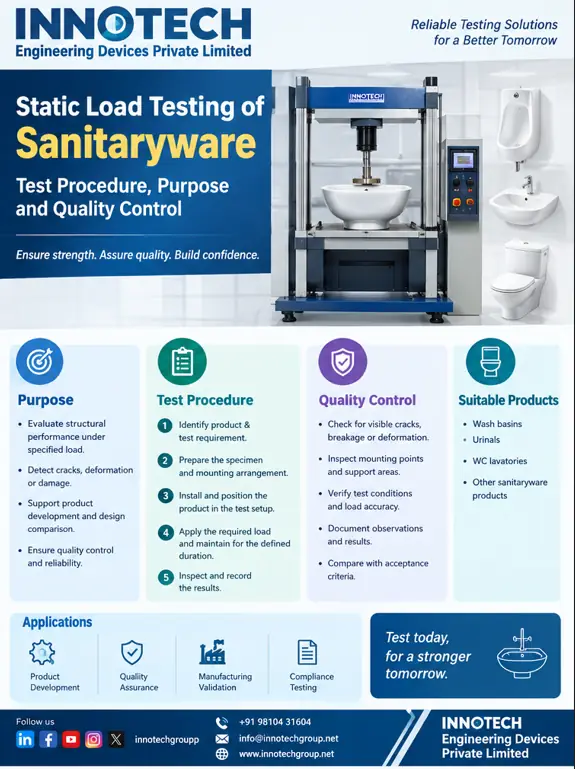
Static Load Testing of Sanitaryware: Test Procedure, Purpose and Quality Control
A wash basin or wall-mounted urinal may look strong after manufacturing, but how can a manufacturer evaluate whether it can withstand a specified load during use? Visual inspection alone cannot answer every question about structural performance. This is where static load testing of sanitaryware becomes useful.
Sanitaryware products such as wash basins, urinals and WC lavatories must be evaluated according to their intended application, design and relevant product requirements. A static load test applies a specified mechanical load to a product and maintains it for a defined period so that its response can be observed.
For manufacturers and quality-control laboratories, this testing can support product development, design comparison, quality assurance and investigation of potential weaknesses.
What Is Static Load Testing of Sanitaryware?
Static load testing is a method of evaluating how a product responds to a sustained mechanical load. Instead of applying a sudden impact, the testing system applies a controlled load and maintains it for a specified duration.
In sanitaryware testing, the arrangement may be designed for products such as:
- Wall-mounted urinals
- Wash basins
- WC labatories
- Suitable bathroom fixtures
- Other sanitarywave products reqiring a defined load test
The load, holding duration, support arrangement and acceptance criteria depend on the product and applicable testing requirements. A test should follow the relevant product specification or approved procedure rather than an arbitrary load value.
Why Is Static Load Testing Important?
Sanitaryware products can experience mechanical forces through their mounting arrangements, support points and intended use. Their performance depends on several factors, including product geometry, material properties, mounting design and manufacturing consistency.
Static load testing can help manufacturers investigate:
Structural performance: How the product responds to a specified load.
Potential damage: Whether visible cracking, deformation or other damage occurs during the test.
Mounting and support arrangements: Whether the test setup represents the required loading condition.
Product development: How changes in product design or construction affect test performance.
Quality control: Whether tested samples meet the relevant acceptance requirements.
Testing provides evidence under defined conditions, but it does not automatically guarantee performance under every real-world condition.
How Does a Static Load Test Work?
The exact procedure depends on the sanitaryware product and the applicable test method. A typical testing process includes the following stages.
1. Identify the Product and Test requirement
Confirm the product type, dimensions, installation arrangement, required test load, holding duration and acceptance criteria.
2. Prepare the Specimen
Inspect the product before testing and prepare it according to the selected procedure. Any mounting components or supports should match the required test arrangement.
3. Install and Position the Product
Secure the product using the appropriate fixtures and supports. Correct positioning is important because an unsuitable setup may change how the load is transferred through the specimen.
4. Apply the Required Load
The testing system applies the specified load to the designated area or loading point. The load should be applied according to the intended test procedure.
5. Maintain the Load
The required load is held for the specified period. During this stage, the operator follows the inspection and monitoring requirements of the test method.
6. Inspect and Record the Results
After the test, examine the specimen for relevant signs of damage or deformation. Record the test conditions, observations and result against the required acceptance criteria.
What Should Be Checked During Testing?
The observations required during a sanitaryware load test depend on the product specification and testing method.
Common areas of interest may include:
- Visible cracks or breakage
- Permanent deformation, where relevant
- Damage near mounting points
- Movement or instability in the tes fixture
- Changes observed during the load-holding period
- Whether the specimen meets the defined acceptance critria
The laboratory should document the test conditions as well as the outcome. Recording only whether a specimen passed or failed may not provide enough information for a useful failure investigation.
Applications
Wash Basin Testing
Testing can help evaluate the response of suitable wash basins under the specified loading arrangement.
Urinal Testing
A suitable fixture and loading setup can be used to assess urinals according to their relevant product requirements.
WC Lavatory Testing
Testing may support evaluation of suitable WC lavatories where a static load test is required by the applicable procedure.
Product Development
Manufacturers can compare prototypes or product designs to investigate how construction and support arrangements affect performance.
Quality Control
Testing can form part of an inspection programme when used with documented procedures and suitable acceptance criteria.
Static Load Testing Machine vs Impact Testing Machine
These machines serve different testing purposes.
A static load testing system applies and maintains a specified load for a defined period. An impact testing machine evaluates a specimen's response to a sudden impact or rapidly applied force.
The correct equipment depends on the property being evaluated. A static load test should not be substituted for an impact test when the relevant requirement specifically calls for impact performance.
How to Choose a Static Load Testing System
Before selecting a machine, manufacturers and laboratories should consider:
- Type and dimensions of the sanitaryware product
- Rquired maximum test load
- Load measurement and contrl requirements
- Required load-holding duration
- Product support and fixture arrangements
- Loading point and direction
- Test procedure and acceptance criteria
- Result recoding requirements
- Expected testing frequency
- Future product configurations
A configurable machine may be useful when the laboratory needs to test different product sizes or shapes. However, the fixture and loading arrangement must still be appropriate for each application.
Static Load Testing System for Sanitaryware Quality Control
A dedicated testing system can help standardise how products are positioned, loaded and inspected. Consistent test procedures make it easier to compare samples and maintain useful testing records.
Innotech Engineering Devices Private Limited offers a Static Load Testing System intended for suitable sanitaryware applications, including urinals, wash basins and WC lavatories. The published system configuration includes a maximum testing capacity of 500 kgf / 5 kN, with adjustable supports and product-specific attachments. Confirm the required technical configuration and test suitability with the manufacturer before ordering.
Explore the Static Load Testing System product page(https://innotechgroup.net/products/static-load-testing-system) for further information.
Frequently Asked Questions
What is static load testing used for?
It evaluates how a product responds when a specified mechanical load is applied and maintained for a defined period.
Why is static load testing used for sanitaryware?
It can help manufacturers evaluate the response of suitable sanitaryware products under defined loading conditions and support quality-control activities.
Which products can be tested?
Depending on the testing system and procedure, applications may include urinals, wash basins, WC lavatories and other suitable sanitaryware products.
How is the required test load decided?
The load and holding duration should be taken from the relevant product specification, applicable test method or approved testing requirement.
Does passing a static load test guarantee product safety?
No single test can establish performance under every possible condition. Results should be interpreted according to the scope of the test and combined with other required evaluations.
How do I select a sanitaryware testing machine?
Consider the product dimensions, required load, fixture arrangement, holding duration, measurement needs and applicable test procedure.
Consult Our Expert for a Static Load Testing System
Looking for a Static Load Testing System for sanitaryware testing and quality control? Contact Innotech Engineering Devices Private Limited to discuss your product dimensions, loading requirements, fixtures and intended test procedure.
Call: 9810431604
Email: info@innotechgroup.net
Website: www.innotechgroup.net
Share your product details and testing requirements to discuss a suitable machine configuration and request a quotation.
Category: Material Testing and Quality Control
Tags: Static Load Testing, Sanitaryware Testing, Wash Basin Testing, Urinal Testing, WC Lavatory Testing, Quality Control, Testing Equipment, Static Load Testing of Sanitaryware, Static Load Testing System, Sanitaryware Testing Machine, Wash Basin Load Testing,
Last Updated: 02 October 2026