
Pin on Disc Test Parameters, Specimen Preparation & Tribometer Buying Guide
Jay Pal Singh
19 November 2026
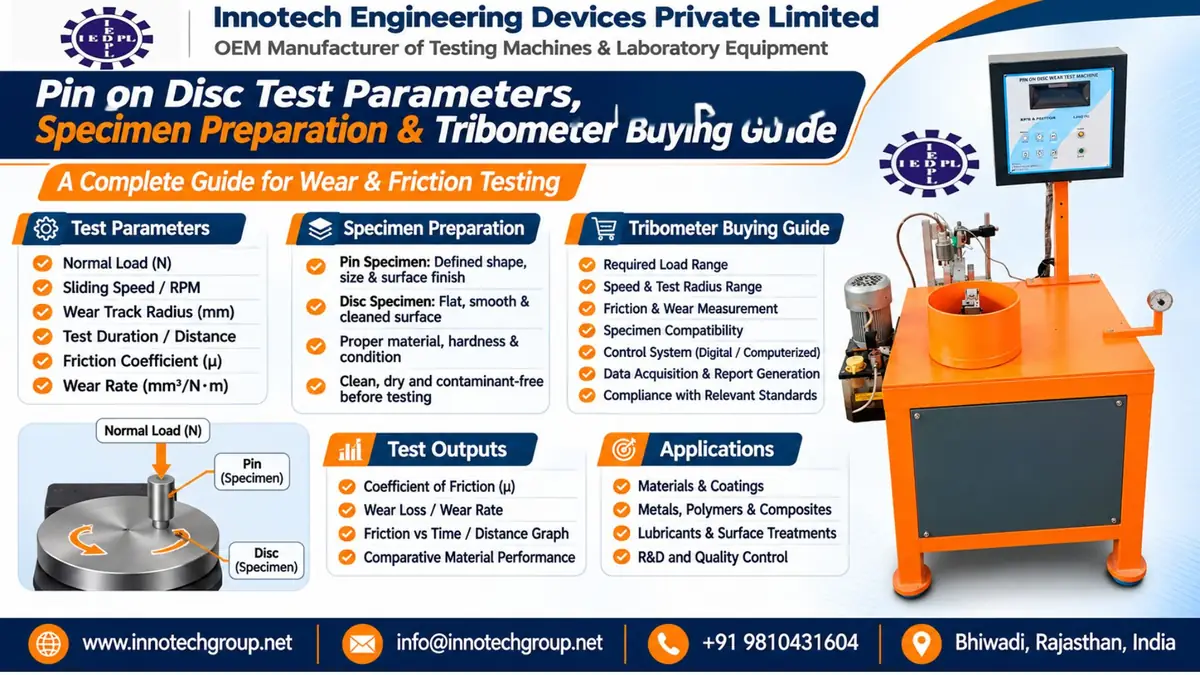
Pin on Disc Test Parameters, Specimen Preparation & Tribometer Buying Guide
Selecting a Pin on Disc Wear Testing Machine requires careful consideration of specimen geometry, normal load, sliding speed, wear-track radius, test duration and measurement requirements.
Two machines may look similar but offer very different testing capabilities.
This guide helps materials engineers, research laboratories, universities and industrial purchase departments define their testing requirements before buying a Pin on Disc Tribometer in India.
What Parameters Matter in Pin on Disc Testing?
| Test parameter |
Why it matters |
| Normal load | Determines the applied contact force |
| Disc RPM | Controls rotational speed |
| Wear-track radius | Determines sliding velocity at a given RPM |
| Sliding distance | Defines accumulated sliding exposure |
| Test duration | Controls total testing time |
| Pin geometry | Influences contact conditions |
| Disc material | Determines counter face characteristics |
| Surface roughness | Influences initial contact and wear behaviour |
| Friction force | Used to evaluate friction coefficient |
| Wear measurement | Used to quantify material loss |
| Lubrication | Changes the contact environment |
| Temperature | Can affect material and lubricant behaviour |
These parameters must be selected together.
How to Select the Normal Load
The normal load is the force pressing the pin specimen against the rotating disc.
A higher load can change contact stress, deformation, temperature and wear mechanisms.
However, increasing load does not necessarily produce a simple proportional increase in wear.
Choose the load based on the material, specimen geometry, test objective and applicable standard.
A machine with a high maximum load is not necessarily suitable for accurate low-load testing.
RPM, Sliding Speed and Wear-Track Radius
Rotational speed is measured in revolutions per minute.
Sliding velocity depends on both RPM and the radial position of the pin.
Sliding velocity (m/s) = 2π × Radius (m) × RPM / 60
For example, at 600 rpm:
- At 20 mm radius, sliding velocity is approximately 1.257 m/s.
- At 40 mm radius, sliding velocity is approximately 2.513 m/s.
The same RPM therefore produces different contact speeds.
A technical quotation should identify both the disc speed range and the available wear-track radius or diameter.
Pin Specimen Preparation
Before testing, confirm:
- Pin material and grade
- Diameter and length
- Contact-end geometry
- Surface finish
- Cleaning procedure
- Initial mass, where required
- Hardness and material condition
- Specimen identification
The contact end may be flat, rounded or another defined geometry, depending on the test method.
Specimen preparation should follow the applicable standard or approved laboratory procedure.
Disc Specimen Preparation
The rotating disc acts as the counterface.
Important characteristics include:
- Disc material
- Diameter and thickness
- Hardness
- Surface finish
- Flatness and runout
- Wear-track location
- Cleaning and replacement procedure
A hardened steel disc may be suitable for some tests, but it is not the correct counterface for every material investigation.
The counterface must be selected according to the research objective.
Dry vs Lubricated Pin on Disc Testing
Dry Sliding Wear Testing
Dry testing evaluates sliding contact without intentionally supplied lubricant.
It is used in suitable material comparison, coating, polymer and wear studies.
Lubricated Sliding Wear Testing
Lubricated testing introduces an oil or other specified lubricant into the contact.
The result can depend on lubricant type, viscosity, temperature, supply rate and test geometry.
If lubricated testing is required, confirm that the proposed tribometer includes the necessary lubricant handling and containment arrangement.
Friction Measurement Requirements
A tribometer may use a force sensor to measure tangential friction force.
The coefficient of friction can then be calculated from friction force and normal load.
Before purchasing, ask the manufacturer to confirm:
- Friction force range
- Measurement resolution
- Calibration method
- Sampling and recording capability
- Software calculation functions
- Graph and export formats
Do not assume that every digital tribometer has identical measurement accuracy or data-acquisition capability.
Wear Measurement Requirements
Wear may be evaluated using mass loss, displacement, profilometry or another suitable method.
These methods do not measure exactly the same quantity.
For example, online displacement sensing may help track changes during testing, while gravimetric analysis determines specimen mass loss.
The buyer should specify whether online wear monitoring, post-test wear measurement or both are required.
ASTM G99: What Should Buyers Check?
ASTM G99 is relevant to wear testing using a pin-on-disk apparatus.
Before selecting a machine for ASTM G99 work, confirm that the intended specimen configuration, loading, speed, measurement procedure and reporting requirements can be supported.
The applicable standard edition should be reviewed during technical evaluation.
Equipment conformity should be supported by the approved specification and appropriate verification, rather than assumed from a marketing description.
Pin on Disc Tribometer Specifications to Include in an RFQ
| Parameter |
Buyer should specify |
| Normal load | Minimum and maximum required |
| Speed | Required RPM and sliding velocity |
| Track radius | Minimum and maximum |
| Pin dimensions | Diameter, length and contact geometry |
| Disc dimensions | Diameter, thickness and materials |
| Friction measurement | Required range and resoultio |
| Wear measurement | Online sensor, mass loss or profilometry |
| Test duration | Maximum continuous run |
| Lubrication | Dr, lubricated or both |
| Temperature | Ambient or controlled |
| Controller | Manual, digital or computerised |
| Software | Graphs, data export and reports |
| Calibration | Required measurement verification |
| Accessories | Fixtures, discs, pin and safety enclosure |
| Installation | Electrical and laboratory requirements |
Common Mistakes When Buying a Tribometer
- Choosing only by price: Compare actual measurement capability and scope of supply.
- Ignoring track radius: RPM alone does not establish sliding velocity.
- Assuming all wear sensors measure wear volume: Measurement methods differ.
- Ignoring specimen preparation: Poor specimen consistency can compromise comparisons.
- Assuming all ASTM G99 requirements are covered: Check the specific procedure.
- Overlooking software: Confirm the required graphs, data export and reports.
- Not specifying dry or lubricated testing: The hardware configuration may differ.
Pin on Disc Wear Testing Machine Price in India
The machine price depends on its load range, speed control, friction measurement, wear instrumentation, controller, software and optional accessories.
Computerised data acquisition, environmental control and specialized fixtures may affect cost.
A reliable quotation should clearly identify standard features, optional accessories, delivery scope and applicable documentation.
Why Choose an OEM Manufacturer?
An OEM can discuss the intended test procedure before finalizing the machine configuration.
This is useful when laboratories need application-specific specimen fixtures, instrumentation, operating conditions or reporting functions.
Innotech Engineering Devices Private Limited, based in Bhiwadi, Rajasthan, manufactures industrial testing machines and offers customized configurations according to technical feasibility and customer requirements.
Frequently Asked Questions
What load range should I choose?
Choose a range that covers the required test forces with suitable measurement capability.
What is the difference between RPM and sliding speed?
RPM describes disc rotation. Sliding speed also depends on the contact radius.
Can one machine test different materials?
Yes, provided the selected configuration supports the required specimens, loads and test conditions.
Is software necessary?
It depends on whether the laboratory requires real-time graphs, data recording or automated calculations.
Can a pin on disc machine perform lubricated tests?
A suitable machine can, when equipped with the required lubrication arrangement.
What should I send to a manufacturer for a quotation?
Share the applicable standard, material details, load, speed, track radius, specimen dimensions, measurement needs and required accessories.
Conclusion
The correct pin on disc tribometer is the one that supports the intended test method, specimen geometry, measurement requirements and laboratory workflow.
A detailed RFQ helps manufacturers recommend a technically suitable configuration and prepare a comparable quotation.
Request a Pin on Disc Tribometer Quotation
Innotech Engineering Devices Private Limited
Bhiwadi, Rajasthan, India
Email: info@innotechgroup.net
Phone: +91 9810431604
Category: Pin On Disc
Tags: pin on disc test parameters, pin on disc specimen preparation, pin on disc tribometer specifications, pin on disc machine buying guide, pin on disc normal load, pin on disc sliding speed, pin on disc wear track radius, dry sliding wear testing, lubricated
Last Updated: 19 November 2026