
Melt Flow Index vs Melt Volume Flow Rate: Difference, Test Method and Applications
Jay Pal Singh
22 October 2026
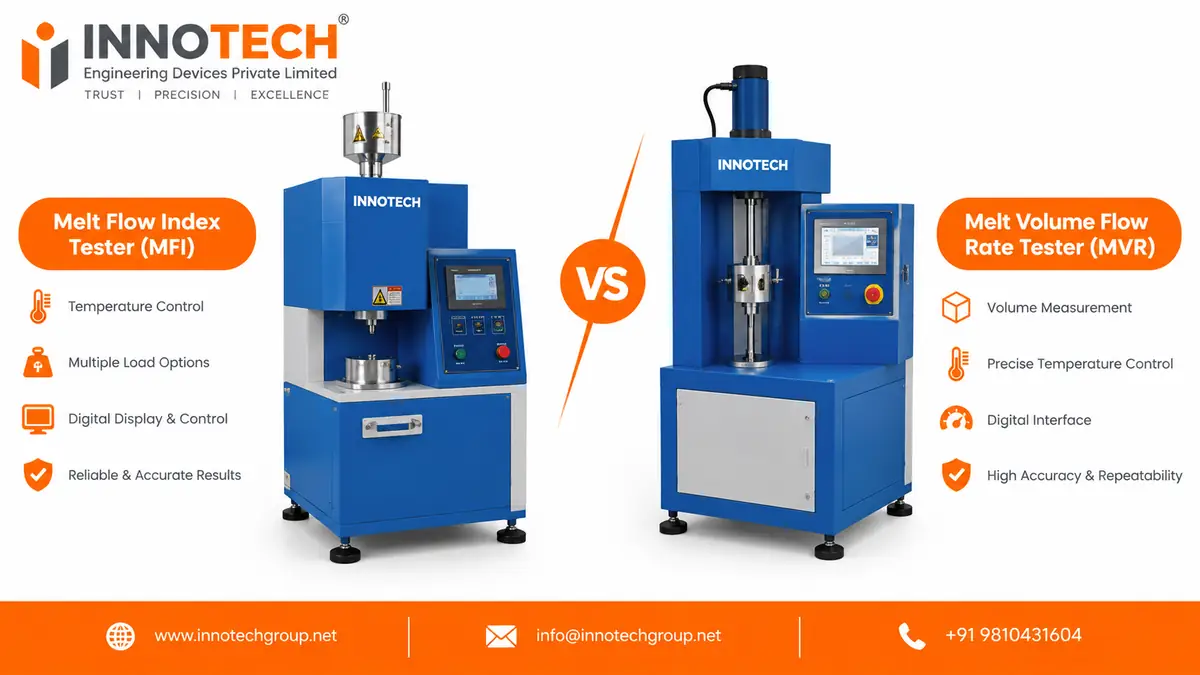
Melt Flow Index vs Melt Volume Flow Rate: Difference, Test Method and Applications
Choosing the right plastic testing method is important for manufacturers who want consistent raw material quality, smooth production and reliable finished products. Two commonly used measurements in thermoplastic testing are Melt Flow Rate (MFR) and Melt Volume Flow Rate (MVR). Both help evaluate how molten plastic flows under specified test conditions, but they measure different properties.
If you are searching for a Melt Flow Index Tester in India, understanding the difference between MFR and MVR can help you select the right testing method for your laboratory or production facility.
In this guide, we explain the difference between Melt Flow Index and Melt Volume Flow Rate, how each test works, where the results are used, and what to consider when selecting a Melt Flow Index Testing Machine from Innotech Engineering Devices
https://innotechgroup.net/products/digital-melt-flow-index-mfi-tester
Note: The link above points to Innotech's website homepage. Replace it with your exact Melt Flow Index machine product-page URL before publishing so readers land directly on the relevant product.
What Is Melt Flow Index (MFI)?
Melt Flow Index (MFI) is a commonly used term for evaluating the flow behaviour of a thermoplastic material when it is heated and pushed through a standard die under a specified load.
In technical reporting, the measurement is generally expressed as Melt Mass-Flow Rate (MFR). It indicates the mass of molten polymer that passes through the die in a specified time.
MFR is commonly expressed in grams per 10 minutes (g/10 min).
For example, if two samples of the same polymer are tested using the same temperature, load and procedure, the sample with the higher MFR generally flows more easily under those test conditions.
However, a higher MFR does not automatically mean that a plastic material is better. The appropriate value depends on the polymer grade, manufacturing process and final application.
Why is the Melt Flow Index test important?
The test helps manufacturers and quality-control laboratories to:
- Compare the fglow behaviour of incoming plastic raw materials.
- Check consistency between batches of the same material grade.
- Support incoming material inspection and quality control.
- Evaluate whether a material is suitable for a particular processing application.
- Identify changes in material behaviour that may require further investigation.
MFR should be interpreted alongside other material properties and the requirements of the relevant product or application.
What Is Melt Volume Flow Rate (MVR)?
Melt Volume Flow Rate (MVR) measures the volume of molten polymer passing through a standard die over a specified period under defined test conditions.
It is generally expressed in cubic centimetres per 10 minutes (cm³/10 min).
Like MFR, MVR is measured at a specified temperature and load. The key difference is that MVR reports the volume of material flowing through the die rather than its mass.
MVR can be useful when comparing thermoplastic materials and examining flow behaviour without expressing the result directly as mass per unit time. It is also relevant when calculating MFR from MVR using the appropriate melt density.
Melt Flow Index vs Melt Volume Flow Rate: Comparison Table
The following table explains the key differences in simple language.
| Comparison Point |
Melt Flow Index / MFR |
Melt Volume Flow Rate / MVR |
| Full Form | Melt Flow index is the common industry term, MFR means MELT Mass-Flow Rate | Melt Volume Flow Rate |
| What is measures | Mass of molten polymer passing through the die | Volume of molten polymer passing through the die |
| Typical unit | g/10 min | cm3/10 min |
| Measurement basis | Mass | Volume |
| Test Conditions | Specified temperature, load, die, and procedure | Specified temperature, load, die, and procedure |
| Reporting | Result is expressed as mass per 10 minutes | Result is expressed as volume per 10 minutes |
| Main use | Routine quality control and matrial-grade comparison | Flow evaluation and volume-based material comparison |
| Relationship | Cane be calculated from MVR when the appropriate melt density is known | Can be converted to MFR using the appropriate melt density |
| Important consideration | Results are meaningful when test conditions are comparable | Results are meaningful when test conditions are comparable |
Important: MFR and MVR values should not be compared directly as if they were the same unit or measurement. Always check the polymer grade, test temperature, applied load, test method and reporting units.
What Is the Difference Between MFR and MVR in Practical Terms?
Imagine a laboratory testing molten plastic using a standard die.
- With MFR, the laboratory determines how many grams of polymer pass through the die in a specified time.
- With MVR, the laboratory determines how many cubic centimetres of polymer pass through the die in that time.
Both measurements describe flow under defined conditions, but one reports mass and the other reports volume.
For the same test conditions, MFR and MVR can be related through the melt density:
MFR = MVR × melt density
When the units are g/10 min for MFR, cm³/10 min for MVR, and g/cm³ for density, the units are consistent.
The density used must be appropriate for the material and measurement conditions. Do not automatically use room-temperature solid density as a substitute for melt density.
Melt Flow Index Test Method: Step-by-Step
A Melt Flow Index Tester is used to measure the flow of thermoplastic material under defined temperature and load conditions. The exact procedure depends on the applicable standard, material and instrument configuration.
Step 1: Prepare the sample
Take a representative sample of the thermoplastic material. Follow the material-specific procedure for sample conditioning, drying and preparation wherever required.
Step 2: Set the test temperature
Set the instrument to the temperature specified for the material and test method. Allow the equipment to reach the required temperature and stabilise before testing.
Step 3: Load the material
Place the prepared polymer sample into the heated barrel according to the instrument's operating procedure. Insert the specified piston and apply the prescribed load.
Step 4: Allow the material to melt
Allow the sample to heat for the specified time. Proper temperature control and consistent preparation are important for repeatable results.
Step 5: Measure the flow
Depending on the instrument and method, the material flowing through the die can be evaluated by collecting and weighing extrudate over a specified time or by measuring the piston displacement over time.
- A mass-based result is reported as MFR.
- A volume-based result is reported as MVR.
The selected method and reporting basis should match the laboratory's requirements.
Step 6: Calculate and record the result
Record the test temperature, applied load, test method, units and measured result. If comparing batches, use consistent test conditions and follow the relevant standard.
Which Standards Are Commonly Used?
Two widely recognised standards for melt flow testing of thermoplastics are:
- ASTM D1238 — Standard test method for melt flow rates of thermoplastics by extrusion plastometer.
- ISO 1133 series — Methods for determining the melt mass-flow rate (MFR) and melt volume-flow rate (MVR) of thermoplastics.
The appropriate standard, procedure, temperature, load and reporting requirements depend on the material and application. Check the latest applicable edition and your customer's specifications before testing.
Applications of MFR and MVR Testing
MFR and MVR testing is useful in several industries that process thermoplastic materials.
1. Plastic raw material manufacturing
Producers can use melt flow measurements to monitor consistency between material batches and support quality-control procedures.
2. Injection moulding
The test can help evaluate whether a material's flow behaviour is appropriate for the intended moulding process. Actual processing suitability also depends on part geometry, mould design, machine settings and other polymer properties.
3. Extrusion
Plastic pipe, sheet, film and profile manufacturers may use flow measurements as part of raw material inspection and process-quality checks.
4. Packaging industry
Plastic film, container, cap and packaging component manufacturers can use melt flow testing to help check the consistency of selected thermoplastic grades.
5. Research and development laboratories
Testing laboratories can use MFR and MVR results when comparing material grades, investigating batch variation and supporting polymer development.
6. Recycling and reprocessing
Melt flow measurements may help identify changes in the flow behaviour of recycled or reprocessed thermoplastics. The result alone does not establish the complete quality or suitability of recycled material.
How to Choose a Melt Flow Index Testing Machine
If you are planning to buy a Melt Flow Index Tester in India, consider the following points before selecting a machine.
| Selection Factor |
What to Check |
| Test method | Whether your laboratory needs mass0based MFR, volume-based MVR or both |
| Temperature range | Suitability for the polymers and test conditions you use |
| Applied loads | Availability of the loads required by your test method |
| Mesaurement method | How the instrument measuresor calculates MFR and MVR |
| Control and display | Temperature control, display and test-setting requirements |
| Data recording | Whether you need manual records, digital results or data export |
| Applicable standards | Compatibility with the test procedures specified by your laboratory or customers |
| Calibration and support | Availability of suitable calibration, maintenance and technical support |
| Budget | Price based on the required configuration, fetures and accessories |
Before placing an order, share your polymer type, required test standard, temperature and load combinations, reporting units, and any data-recording requirements with the supplier.
Why Use a Melt Flow Index Tester?
A suitable Melt Flow Index Testing Machine can support routine testing and comparison of thermoplastic materials when used with a consistent, appropriate test procedure.
Potential benefits include:
- More consistent raw material inspection.
- Easier comparison of material batches under the same test conditions.
- Support for incoming quality control and laboratory documentation.
- Better understanding of polymer flow behaviour.
- A repeatable method for checking specified material properties.
The reliability of results depends on the instrument's suitability, calibration, sample preparation, test conditions and operator procedure.
Frequently Asked Questions
1. Are Melt Flow Index and Melt Flow Rate the same?
Melt Flow Index (MFI) is a widely used industry term. Technically, the mass-based result is generally reported as Melt Mass-Flow Rate (MFR), usually in g/10 min.
2. What is the main difference between MFR and MVR?
MFR measures the mass of molten polymer flowing through a die per specified time. MVR measures its volume over the same type of specified time period. Their typical units are g/10 min and cm³/10 min, respectively.
3. Can MFR be calculated from MVR?
Yes. MFR can be calculated from MVR when the appropriate melt density is available and the units are consistent. The density and measurement conditions must be suitable for the material.
4. Does a higher MFR mean better plastic quality?
No. A higher MFR generally indicates greater flow under the specified test conditions, but it does not automatically mean better quality. The suitable value depends on the polymer grade and intended application.
5. Which industries use Melt Flow Index testing?
Common users include plastic raw material manufacturers, injection moulding companies, extrusion manufacturers, packaging producers, recycling facilities and polymer testing laboratories.
6. What affects Melt Flow Index test results?
Results can be affected by test temperature, applied load, sample preparation, material moisture or degradation, test timing, die condition and instrument performance. Consistent procedures are essential for meaningful comparisons.
7. How do I choose a Melt Flow Index Testing Machine?
Start with your material type, applicable test standard, required temperature and load combinations, desired reporting method and data-recording needs. Ask the supplier to confirm that the proposed configuration meets these requirements.
Looking for a Melt Flow Index Testing Machine in India?
Innotech Engineering Devices Private Limited provides industrial testing equipment solutions for laboratory and quality-control applications. If you are evaluating a Melt Flow Index Testing Machine for thermoplastic testing, discuss your material, required test method and reporting needs with the team before selecting a configuration.
Contact Innotech Engineering Devices Private Limited
- Email: info@innotechgroup.net
- Phone: +91 9810431604
- Address: H-307 (Corner), RIICO Industrial Area, Karoli, Tapukara, Bhiwadi, Rajasthan – 301707, India
Contact the team to discuss your requirements and request a quotation for a suitable testing solution.
Conclusion
Melt Flow Rate (MFR) and Melt Volume Flow Rate (MVR) are related but different measurements used to evaluate the flow behaviour of molten thermoplastics. MFR reports mass per unit time, while MVR reports volume per unit time. Understanding these differences helps laboratories choose the correct reporting method, follow the appropriate test standard and compare materials more reliably.
For consistent results, select a suitable testing machine, follow the specified test conditions and interpret the result in the context of the polymer grade and its intended application.
Category: Plastic Testing Equipment
Tags: Melt Flow Index, Melt Flow Rate, Melt Volume Flow Rate, MFR vs MVR, MFI Testing, Plastic Testing, Polymer Testing, Thermoplastic Testing, ASTM D1238, ISO 1133, Quality Control, Laboratory Testing Equipment, Plastic Raw Materials, Injection Moulding, Plast
Last Updated: 22 October 2026