
How to Use a Mechanical Extensometer in Tensile Testing: A Practical Guide
Jay Pal Singh
10 October 2026
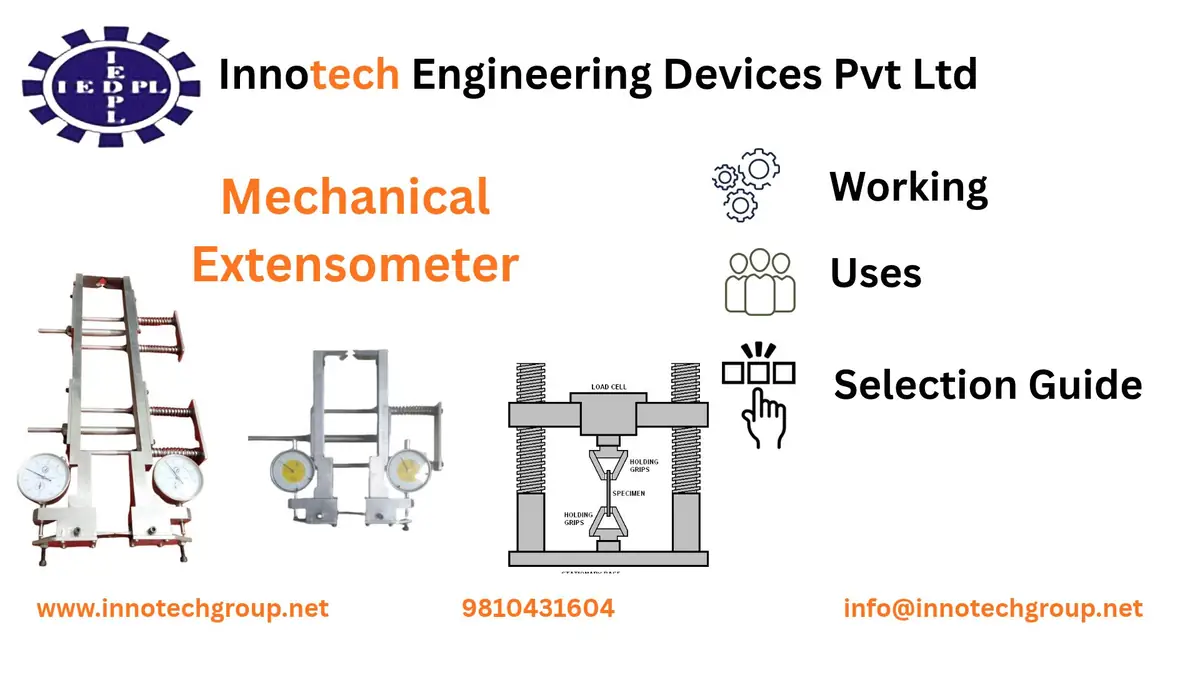
Dial Gauge Extensometer: Working Principle, Uses and Selection Guide
A dial gauge extensometer is a measuring instrument used to measure small changes in the length of a test specimen during mechanical testing. It is commonly associated with tensile testing, where engineers need to understand how a material stretches when a pulling force is applied.
During a tensile test, a material may extend gradually before reaching its yield point, maximum load or breaking point. Measuring this extension helps engineers evaluate the material's mechanical behaviour and compare its performance against specified requirements.
For laboratories, manufacturers and quality-control departments, understanding how a dial gauge extensometer works is important when selecting accessories for a Universal Testing Machine (UTM).
In this guide, we explain the working principle, applications, important selection factors and frequently asked questions about dial gauge extensometers.
What Is a Dial Gauge Extensometer?
A dial gauge extensometer is a mechanical measuring device designed to measure the extension or change in distance between two measurement points on a test specimen.
The instrument is attached to the specimen using suitable contact points or fixtures. When the specimen stretches or deforms during testing, the relative movement of these points is transmitted to a dial indicator, allowing the extension to be read from the scale.
Unlike a measurement based only on the movement of the testing machine's crosshead, an extensometer can measure deformation directly over a defined gauge length on the specimen.
The exact measurement range, resolution, accuracy and compatible specimen types depend on the instrument's design and configuration.
How Does a Dial Gauge Extensometer Work?
The working principle is based on measuring relative displacement between two points on a specimen.
Step 1: Prepare the specimen
A test specimen is prepared according to the applicable test method. Its dimensions and gauge length are established as required by the testing procedure.
Step 2: Attach the extensometer
The extensometer is positioned on the specimen so that its measuring points track the change in distance over the selected gauge length. The instrument must be fitted correctly to avoid slipping or introducing unwanted measurement errors.
Step 3: Apply the test load
The specimen is loaded using a compatible Universal Testing Machine. During tensile testing, the specimen begins to elongate as the applied force increases.
Step 4: Measure the extension
The movement of the specimen's measurement points is transferred through the extensometer's mechanism to its dial indicator. The operator observes the indicated change in length according to the instrument's scale and operating instructions.
Step 5: Record and interpret the results
The measured extension is recorded and interpreted alongside the applied load and other relevant test data. When the required initial gauge length and extension measurements are available, engineering strain can be calculated.
Engineering strain is calculated as:
Engineering strain = Change in gauge length ÷ Original gauge length
For example, if a specimen with an original gauge length of 50 mm extends by 0.25 mm, the engineering strain is 0.005, or 0.5%.
This example is illustrative only and does not represent the specification of a particular extensometer.
What Is a Dial Gauge Extensometer Used For?
Dial gauge extensometers are used where measurement of small specimen extensions is required during a suitable mechanical test.
Common applications include:
- Tensile Testing: Measuring specimen elongation under tensile loading.
- Material characterisation: Studying the deformation behaviour of selected materials.
- Metal and alloy testing: Measuring extension during suitable tensile tests.
- Quality Control: Supporting checks against defined material requirements.
- Research and Development: Collecting deformation measurements for material studies.
- Educational laboratories: Demonstrating the relationship between applied force studies.
- Manufacturing industries: Supporting material evaluation and product quality procedures.
The suitability of an instrument depends on the specimen dimensions, test method, expected deformation and measurement requirements.
Dial Gauge Extensometer and Universal Testing Machine
A Universal Testing Machine applies a controlled force to a specimen and measures the resulting load. Depending on its configuration, it may also record crosshead movement and other test parameters.
A dial gauge extensometer provides a separate measurement of specimen extension over a defined gauge length.
The two instruments can therefore serve complementary purposes during a tensile test.
| Feature |
Universal Testing Machine |
Dial Guage Extensometer |
| Main function | Applies test load and measurement force | Measures extension over a gauge length |
| Typical use | Tensile, compression and other configured tests | Extension measurement during compatible test |
| Measurement | Load and other configured parameters | Relative displacement between measurement points |
| Installation | Testing frame with suitable fixtures | Attached to the specimen using its designed mounting method |
| Results | Load and other configured test data | Extension readings for relevant calculations |
A dial gauge extensometer is not a replacement for the UTM's load measurement system. The appropriate combination depends on the test procedure and the results required.
What Is the Difference Between an Extensometer and Crosshead Displacement?
This is an important consideration when selecting testing equipment.
Crosshead displacement indicates the movement of the testing machine's crosshead. This movement may include effects from machine deformation, grip movement, specimen seating and other factors, in addition to the specimen's own elongation.
An extensometer measures the relative change in length over a defined gauge length on the specimen. It can therefore provide a more direct measurement of specimen deformation over that region.
The measurements are not automatically interchangeable. The suitable measurement method depends on the required result, material, test standard and instrument capabilities.
Important Factors to Consider When Selecting a Dial Gauge Extensometer
Before purchasing an extensometer, check the following factors.
1. Gauge length
Gauge length is the original distance between the measurement points. Select a gauge length appropriate for the specimen and the applicable test procedure.
2. Measurement range
The instrument's measurement range should cover the expected specimen extension for the intended test. An unsuitable range may prevent the required measurement from being completed.
3. Resolution and accuracy
Resolution describes the smallest change that the instrument can display or distinguish. Accuracy concerns how close the measurement is to the true or reference value. Check both requirements against the intended application and relevant test method.
4. Specimen material and dimensions
Consider the material being tested, specimen thickness, shape, dimensions and available mounting points. The contact arrangement must be suitable for the specimen.
5. Compatibility with the UTM
Check the extensometer's mounting arrangement and compatibility with the testing setup. Consider the specimen grips, available working space and the testing machine's operating procedure.
6. Test method and standards
If testing must follow a particular standard, verify the required gauge length, measurement performance, instrument class and test procedure before purchasing.
7. Calibration and maintenance
Check the instrument's calibration requirements, inspection procedure and maintenance recommendations. Appropriate calibration and handling help maintain confidence in measurement results.
Factors That Can Affect Extensometer Readings
Incorrect installation or use can affect measurement reliability. Common factors to consider include:
- Incorrect positioning on the specimen.
- Slipping or movement of the contact points.
- An unsuitable gauge length or measurement range.
- Damage, wear or mechanoical looseness.
- Incorrect zero setting or reading of the dial.
- Specimen preparation issues.
- Failure to follow the relevant test procedure.
- Calibration that is overdue or unsuitable for the required measurement.
Follow the instrument manufacturer's instructions and the applicable test method to reduce avoidable errors.
## h2: Dial Gauge Extensometer Price in India
The price of a dial gauge extensometer depends on its measurement range, gauge length, resolution, accuracy requirements, construction, compatibility and intended application.
Additional requirements, such as special mounting arrangements or compatibility with a particular testing system, may also affect the final quotation.
Before comparing prices, confirm that the instruments being compared meet the same technical requirements. A lower price alone does not establish that an instrument is suitable for a specific testing application.
For an accurate quotation, provide the intended test method, specimen details, required measurement range and any applicable standard.
How to Choose a Reliable Extensometer Supplier in India
When evaluating an extensometer supplier, consider more than price. Check whether the supplier can clarify the instrument's specifications, intended applications, compatibility and documentation.
Useful questions to ask include:
- Does the instrument meet the required gauge lenth and measurement range?
- Is the stated resoltion and accuracy suitable for the test?
- Is it compatible with the existing Universal Testing Machine?
- What calibration documentation is available?
- Are operating instructions and technical support available?
- Can the supplier confirm compliance with the required test method?
Confirm these details before placing an order, especially when a customer requires exact specification matching.
Dial Gauge Extensometer Supplier — Innotech Engineering Devices Private Limited
Innotech Engineering Devices Private Limited supplies testing equipment for industrial, laboratory and quality-control applications. Based in Bhiwadi, Rajasthan, the company works with customers to understand their material-testing requirements.
If you are looking for an extensometer for a Universal Testing Machine, share your specimen details, test method, required gauge length, measurement range and applicable standards with our team. These details help establish which instrument configuration may be suitable for your application.
Product availability, technical specifications and compatibility should be confirmed before ordering.
Contact Innotech Engineering Devices Private Limited
- Location: Bhiwadi, Rajasthan, India
- Phone: +91 9810431604
- Email: info@innotechgroup.net
- Website: https://www.innotechgroup.net
Consult to Expert for assistance with your material-testing equipment requirements.
Frequently Asked Questions About Dial Gauge Extensometers
1. What is the main purpose of a dial gauge extensometer?
Its main purpose is to measure the change in length between two points on a specimen during a suitable mechanical test, particularly tensile testing.
2. Can a dial gauge extensometer be used with a Universal Testing Machine?
Yes, if the extensometer is compatible with the specimen, test method and testing machine setup. Confirm the mounting arrangement and measurement requirements before use.
3. What is gauge length in an extensometer?
Gauge length is the original distance between the instrument's measurement points on the specimen. Extension is measured relative to this initial distance.
4. Is an extensometer the same as a dial gauge?
No. A dial gauge is a displacement indicator, while an extensometer is an instrument or assembly designed to measure specimen extension over a defined gauge length. Some mechanical extensometers use a dial indicator to display the measurement.
5. What is the difference between extensometer resolution and accuracy?
Resolution is the smallest change the instrument can display or distinguish. Accuracy indicates how close the measurement is to the correct or reference value. Both should be considered when selecting an instrument.
6. Does an extensometer measure tensile strength?
An extensometer measures extension, not tensile strength directly. Tensile strength is determined using the measured maximum force and the specimen's original cross-sectional area, according to the applicable test method.
7. How often should an extensometer be calibrated?
The calibration interval depends on the manufacturer's recommendations, usage, required measurement confidence and applicable quality procedures or standards. Follow the documented calibration requirements for your application.
8. What information is needed to purchase a dial gauge extensometer?
Useful information includes the specimen material and dimensions, required gauge length, expected extension, measurement range, accuracy requirements, test method and compatibility requirements for the existing testing machine.
9. What affects the price of a dial gauge extensometer in India?
Price depends on the instrument's design, gauge length, measurement range, resolution, accuracy, accessories and application requirements. Request a quotation based on the required specifications.
10. Where can I enquire about an extensometer in Bhiwadi, Rajasthan?
You can contact Innotech Engineering Devices Private Limited at +91 9810431604 or info@innotechgroup.net to discuss your application and technical requirements.
Conclusion
A dial gauge extensometer is a useful instrument for measuring specimen extension during suitable mechanical tests. Understanding its working principle, gauge length, measurement range, accuracy and compatibility with a Universal Testing Machine helps laboratories and manufacturers select an appropriate solution.
Before purchasing, confirm the technical requirements, applicable test method and calibration needs. For assistance with testing equipment requirements, contact Innotech Engineering Devices Private Limited in Bhiwadi, Rajasthan.
Consult to Expert to discuss your application.
Category: Universal Testing Machine
Tags: Dial Gauge Extensometer, Extensometer Working Principle, Tensile Testing, Universal Testing Machine, Material Testing Equipment, Strain Measurement, Elongation Measurement, Mechanical Testing, Laboratory Testing Equipment, UTM Accessories, Quality Control
Last Updated: 10 October 2026