
Humidity Testing: Applications, Importance & Industries
Jay Pal Singh
08 October 2026
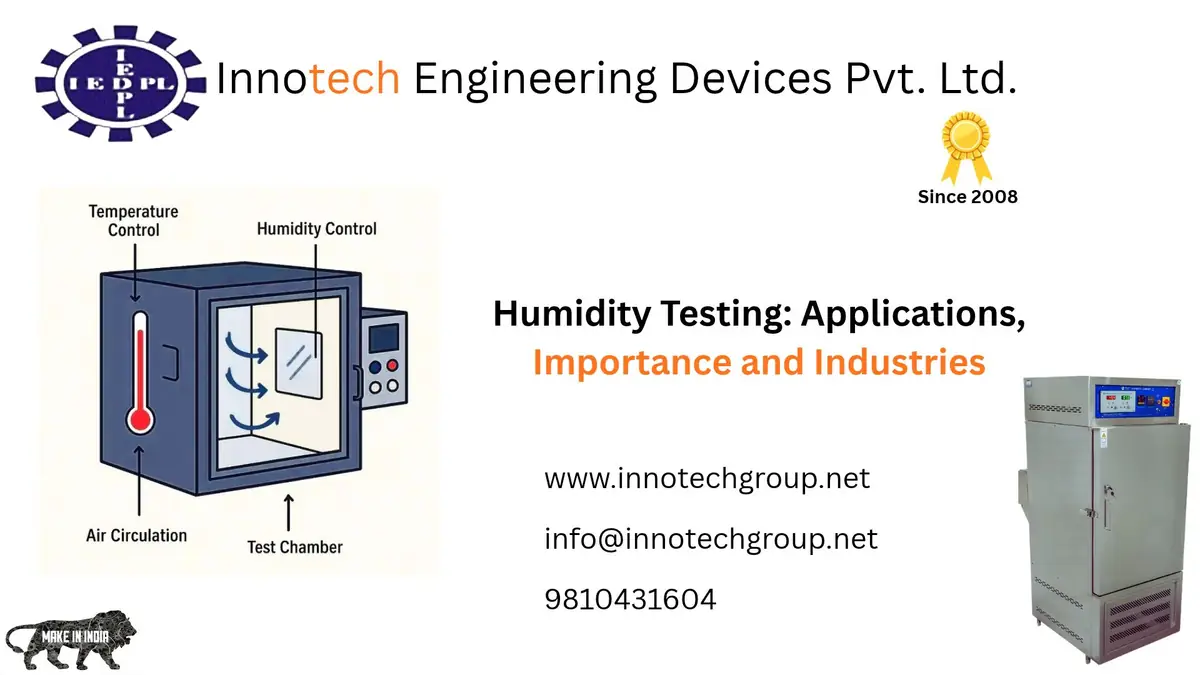
Humidity & Temperature Conditioning Chamber
Humidity Testing: Applications, Importance and Industries
Humidity is one of the environmental factors that can significantly affect the performance, durability and service life of products. Moisture in the surrounding air can cause corrosion, swelling, electrical leakage, material degradation, coating failure and changes in physical properties.
Because products may be used in different climates and storage conditions, manufacturers need to understand how their products behave when exposed to controlled humidity and temperature conditions.
Humidity testing provides a controlled way to evaluate this behavior. A Temperature and Humidity Chamber or Humidity Chamber can recreate selected environmental conditions inside a controlled test space, allowing engineers and quality teams to observe how materials, components and finished products respond.
What Is Humidity Testing?
Humidity testing is an environmental testing method used to expose a product, material or component to controlled levels of moisture and, where required, temperature.
During a test, samples are placed inside a controlled chamber. The chamber maintains the selected environmental conditions for a specified period. After exposure, the samples can be inspected and tested for changes in appearance, dimensions, electrical performance, mechanical properties or other application-specific characteristics.
The exact temperature, relative humidity, exposure time and test cycle depend on the product, material and applicable testing procedure.
Why Is Humidity Testing Important?
Moisture can affect products in several ways. Depending on the material and application, prolonged humidity exposure may result in:
- Corrosion of metallic components
- Electrical leakage aor insulation problems
- Swelling or dimensional changes
- Surface deterioration
- Coating or adhesice degration
- Changes in mechanical properties
- Packaging deterioration
- Microbial or biologivcal growth in suitable materials
- Reduced product reliability
Testing under controlled conditions helps manufacturers identify potential weaknesses before products are introduced into demanding environments.
Humidity Testing in the Electronics Industry
Electronic products often contain sensitive components that can be affected by moisture. Humidity testing helps manufacturers evaluate the environmental durability of electronic assemblies and components.
Printed Circuit Boards
Printed circuit boards contain conductive tracks, solder joints and electronic components that can be affected by prolonged moisture exposure.
Controlled humidity testing can help evaluate issues such as corrosion, insulation deterioration and changes in electrical performance. The results may support improvements in material selection, protective coatings and product design.
Electronic Components and Assemblies
Connectors, sensors, displays, switches, power electronics and other assemblies may experience different environmental conditions during transportation, storage and operation.
Humidity exposure testing can help determine whether these components maintain their required performance under specified environmental conditions.
Humidity Testing for Pharmaceutical and Healthcare Products
Environmental conditions can influence pharmaceutical products, medical devices and their packaging. Controlled humidity testing can therefore form part of stability, packaging and material evaluation programs.
Pharmaceutical Stability
Some pharmaceutical materials are sensitive to moisture. Changes in humidity may affect physical characteristics, chemical stability or packaging performance.
Controlled environmental exposure can provide useful information for stability evaluation when conducted according to the applicable pharmaceutical testing procedure.
Medical and Healthcare Packaging
Packaging plays an important role in protecting medical products from environmental exposure.
Humidity testing can be used to evaluate packaging materials, seals, barriers and other components under specified environmental conditions. This can help identify potential deterioration before products reach storage or distribution environments.
Humidity Testing in Automotive Applications
Automotive components can experience significant changes in temperature and moisture throughout their service life.
Humidity testing may be applied to components such as:
- Electronic control units
- Sensors
- Connectors
- Lighting components
- Displays
- Switches
- Coated metal components
- Interior materials
- Automative electrical assembles
Testing helps engineers evaluate environmental durability and identify possible moisture-related failure mechanisms.
Humidity Testing for Paints, Coatings and Metals
Moisture is an important factor in the degradation of metals and protective coatings.
Humidity exposure can help evaluate whether a coating maintains its protective properties when exposed to prolonged moisture. Depending on the test method, samples can be inspected for blistering, corrosion, adhesion changes, discoloration or other forms of deterioration.
Humidity testing can therefore support the development and comparison of paints, protective coatings and surface treatments.
Humidity Testing for Plastics, Rubber and Polymers
Polymer-based materials can respond differently to moisture depending on their composition and application.
Humidity exposure may cause changes in dimensions, flexibility, strength, appearance or other physical properties. Controlled testing allows manufacturers and researchers to compare material behavior under defined environmental conditions.
Applications can include:
- Plastic components
- Rubber products
- Elastomers
- Polymer films
- Composit materials
- Packaging materials
- Automotive polymer components
Humidity Testing in Aerospace Applications
Aerospace materials and components may experience demanding environmental conditions during storage, transportation and operation.
Humidity testing can contribute to the evaluation of materials, coatings, electronic systems, composite components and other parts where environmental durability is important.
For aerospace applications, the test conditions should always be selected according to the applicable specification or qualification procedure.
Humidity Testing for Packaging Materials
Packaging can be affected by moisture during storage and transportation.
Paper, cardboard, films, polymer packaging and other materials may experience changes in strength, dimensions, appearance or sealing performance when exposed to humidity.
Controlled environmental testing can help packaging manufacturers understand how their products behave under selected moisture conditions.
What Does a Humidity Chamber Test?
A humidity chamber can be configured to control environmental conditions such as:
- Temperature
- Relative humidity
- Exposure duration
- Temperature humidity cycles
- Heating and cooling conditions
- Humidification and dehumidification
- Air Circulation
The exact capabilities depend on the chamber design and the required testing application.
How Does a Temperature and Humidity Chamber Work?
The test specimen is placed inside the chamber and the required environmental conditions are selected through the control system.
The chamber uses heating, cooling, humidification and air circulation systems to establish the required conditions. Sensors continuously monitor the chamber environment, while the controller adjusts the system to maintain the selected conditions.
For programmed tests, different temperature and humidity stages can be configured according to the required test procedure.
Important Factors When Selecting a Humidity Chamber
Selecting the correct chamber requires more than simply choosing a chamber size. Important considerations include:
Chamber Size
The internal working space should be suitable for the specimens being tested while allowing appropriate air circulation.
Temperature and Humidity Range
The required operating range should be established from the intended test procedure and product application.
Control and Monitoring
A suitable digital controller, sensors and display system help monitor environmental conditions during testing.
Test Cycles
If the application requires changing environmental conditions, the chamber should support the required programmable temperature and humidity sequences.
Data Recording
For applications requiring traceability, data logging or software-based monitoring may be incorporated into the chamber configuration.
Safety
Over-temperature protection, alarms and other safety features should be selected according to the chamber design and application.
Humidity Testing and Product Reliability
Environmental testing does not simply show whether a product works under one particular condition. It can help manufacturers understand potential failure mechanisms and improve product reliability.
Testing during product development can allow engineers to identify weaknesses in materials, coatings, seals, electronic assemblies and packaging before large-scale production.
This makes controlled humidity testing useful for product development, quality control, material research and environmental qualification.
Humidity Chamber for Laboratory and Industrial Testing
Humidity and Temperature Conditioning Chambers can be configured for different laboratory and industrial requirements. Chamber capacity, temperature range, humidity range, control system, shelving, sensors, data logging and test cycles can be selected according to the intended application.
Innotech Engineering Devices Private Limited manufactures and supplies environmental testing and conditioning equipment according to customer requirements.
The appropriate chamber configuration depends on the product being tested, specimen dimensions, environmental conditions and applicable testing procedure.
Frequently Asked Questions
What is the purpose of humidity testing?
Humidity testing is used to evaluate how products, materials and components respond to controlled moisture and temperature conditions.
What is a humidity chamber used for?
A humidity chamber is used to create controlled temperature and relative humidity conditions for environmental exposure, conditioning, reliability evaluation and material testing.
Which industries use humidity testing?
Electronics, automotive, aerospace, pharmaceutical, healthcare, plastics, rubber, packaging, coatings and material-testing industries can use humidity testing depending on their product requirements.
Can humidity testing be combined with temperature testing?
Yes. Temperature and humidity can be controlled together in an environmental chamber when the test procedure requires combined environmental exposure.
Can humidity chambers be customized?
Yes. Chamber dimensions, temperature range, humidity range, controls, sensors, shelves, data logging and programmable test cycles can be configured according to the application.
Conclusion
Humidity can have a major influence on the reliability and service life of products. Controlled environmental testing gives manufacturers a practical way to evaluate this effect before products are exposed to real-world conditions.
From electronic assemblies and automotive components to coatings, polymers, packaging and pharmaceutical products, humidity testing can support better material selection, product development and quality control.
The most important consideration is to select the environmental conditions according to the product, intended application and applicable testing procedure rather than using the same test conditions for every product.
Consult an Expert
If you are planning humidity or temperature-humidity testing and need help selecting a suitable chamber configuration, contact Innotech Engineering Devices Private Limited.
Email: info@innotechgroup.net
Phone: +91 9810431604
Website: www.innotechgroup.net
Category: Environmental Testing
Tags: Humidity Testing, Humidity Chamber, Temperature Humidity Testing, Temperature Humidity Chamber, Environmental Testing, Environmental Test Chamber, Humidity Testing Applications, Humidity Test, Material Testing, Product Reliability Testing, Electronics Tes
Last Updated: 08 October 2026