
How to Read Tensile Test Results: Tensile Strength, Yield Strength and Elongation
Jay Pal Singh
28 September 2026
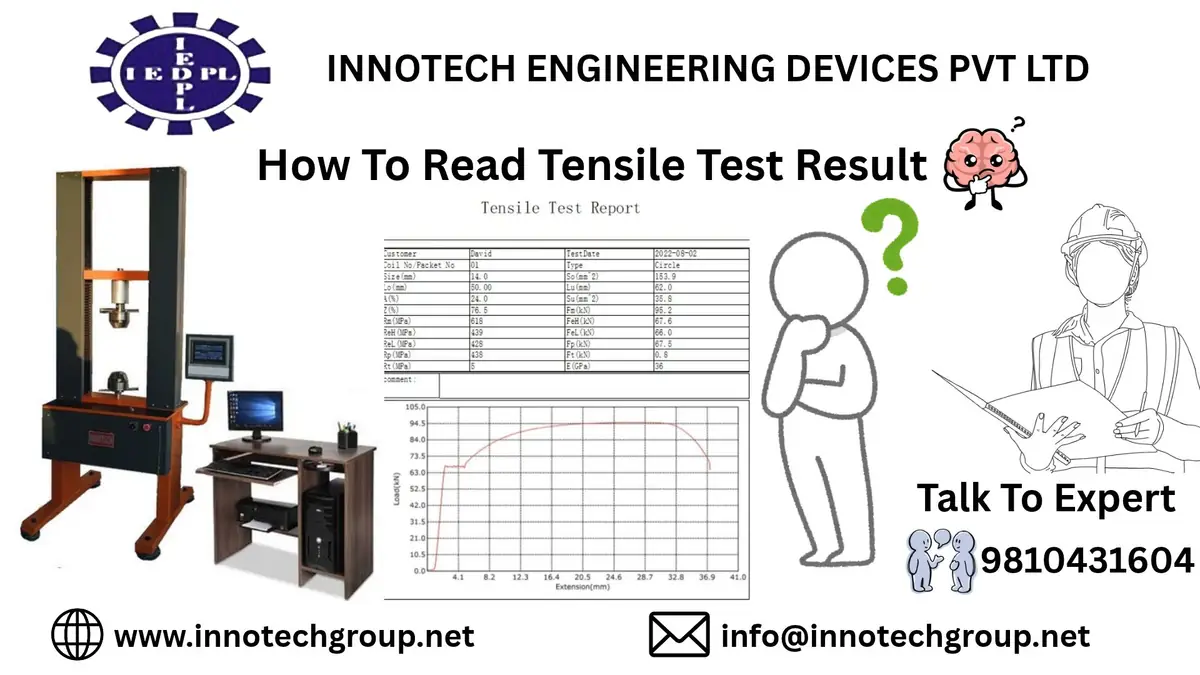
Digital Tensile Testing Machine
How to Read Tensile Test Results: Tensile Strength, Yield Strength and Elongation
A tensile testing machine does more than pull a specimen until it breaks. The test produces information about how a material responds to increasing force, when permanent deformation begins and how much it stretches before failure.
Understanding these results helps quality-control teams, engineers and material-testing laboratories compare materials and evaluate whether they meet specified requirements.
What Is a Tensile Test?
A tensile test measures how a specimen behaves when a pulling force is applied. The specimen is held between grips and stretched under controlled conditions while the testing system records force and extension.
When specimen dimensions and the required measurements are available, the results can be used to calculate properties such as tensile strength, yield strength and elongation.
Four Important Tensile Test Results
1. Tensile Strength
Tensile strength is the maximum tensile stress reached during a test. It is commonly calculated using the maximum recorded force divided by the specimen's original cross-sectional area.
It helps compare the maximum tensile stress sustained by materials tested under defined conditions.
2. Yield Strength
Yield strength indicates the stress associated with the onset of significant permanent deformation, as defined by the applicable test method. Some materials do not show a clear yield point, so an offset method may be used when specified.
This result is useful when evaluating materials that must resist permanent deformation under service loads.
3. Elongation at Break
Elongation at break describes how much a specimen extends before fracture, usually expressed as a percentage of its original gauge length when measured according to the relevant method.
It helps indicate a material's ability to deform before breaking. Elongation values should be compared using consistent specimen dimensions and test procedures.
4. Young's Modulus
Young's modulus describes a material's stiffness within the elastic region of its stress-strain response. It is determined from the slope of the relevant linear portion of the stress-strain curve when the test method and data quality support that calculation.
A higher modulus generally indicates greater stiffness under comparable conditions; it does not automatically mean that a material has greater tensile strength.
What Is a Stress-Strain Curve?
A stress-strain curve shows how stress changes as strain increases during a tensile test.
The curve can help identify the initial elastic response, yielding behaviour where present, strain hardening and the approach to fracture. Its exact shape varies with material type, specimen preparation and testing conditions.
Stress is based on force and specimen area, while strain describes deformation relative to the original gauge length. These calculated values allow material behaviour to be compared more meaningfully than force readings alone.
How Does a Digital Tensile Testing Machine Help?
A digital tensile testing machine applies a controlled tensile load and displays or records measurements supported by its configuration. Depending on the system, it may record force, extension, peak load and test data for subsequent analysis.
For reliable results, users should select appropriate grips, prepare specimens correctly, use a suitable load capacity and follow the applicable test procedure. Calibration and proper alignment also matter.
Common Applications
Tensile testing is used in material laboratories and quality-control departments working with metals, plastics, rubber, textiles, wires, packaging materials and other products, subject to suitable fixtures and test methods.
Typical objectives include incoming-material inspection, product development, batch comparison and checking whether materials meet specified mechanical-property requirements.
How to Choose a Tensile Testing Machine
Before selecting a machine, identify:
- The materials and specimen dimensions to be tested.
- The maximum expected force and required measurement accuracy.
- The required grips, fixtures and extensometer, if applicable
- The test speed and data-reporting requirements.
- The relevant test method and any applicable standards.
- Whether the application requires routine inspection or more detailed research.
The correct configuration depends on the materials and tests the laboratory intends to perform.
Frequently Asked Questions
What is the difference between tensile strength and yield strength?
Tensile strength is the maximum tensile stress reached during the test. Yield strength relates to the onset of permanent deformation under the definition used by the applicable test method.
Does higher tensile strength mean a material is more flexible?
No. Tensile strength and flexibility are different properties. Elongation and modulus provide additional information about deformation and stiffness.
Why is elongation important?
It indicates how much a specimen extends before fracture under the specified test conditions, helping users evaluate deformation behaviour.
Can one tensile testing machine test different materials?
Potentially, yes. The machine must have a suitable capacity, grips, fixtures, measurement system and test procedure for each material and specimen type.
Consult an Expert
Need help selecting a digital tensile testing machine for your laboratory? Discuss your materials, expected loads, specimen dimensions and testing requirements with Innotech Engineering Devices Private Limited.
Consult an Expert: 9810431604
Email: info@innotechgroup.net
Website: hwww.innotechgroup.net
Category: Material Testing & Universal Testing Machines
Tags: Tensile Test Results, Tensile Testing, Tensile Strength, Yield Strength, Elongation at Break, Young's Modulus, Stress-Strain Curve, Tensile Test Procedure, Digital Tensile Testing Machine, Universal Testing Machine, UTM Machine, Tensile Testing Equipment,
Last Updated: 28 September 2026