
GSM Round Cutter: Working Principle, GSM Formula, Diameter, Uses & Buying Guide in India
Jay Pal Singh
24 November 2026
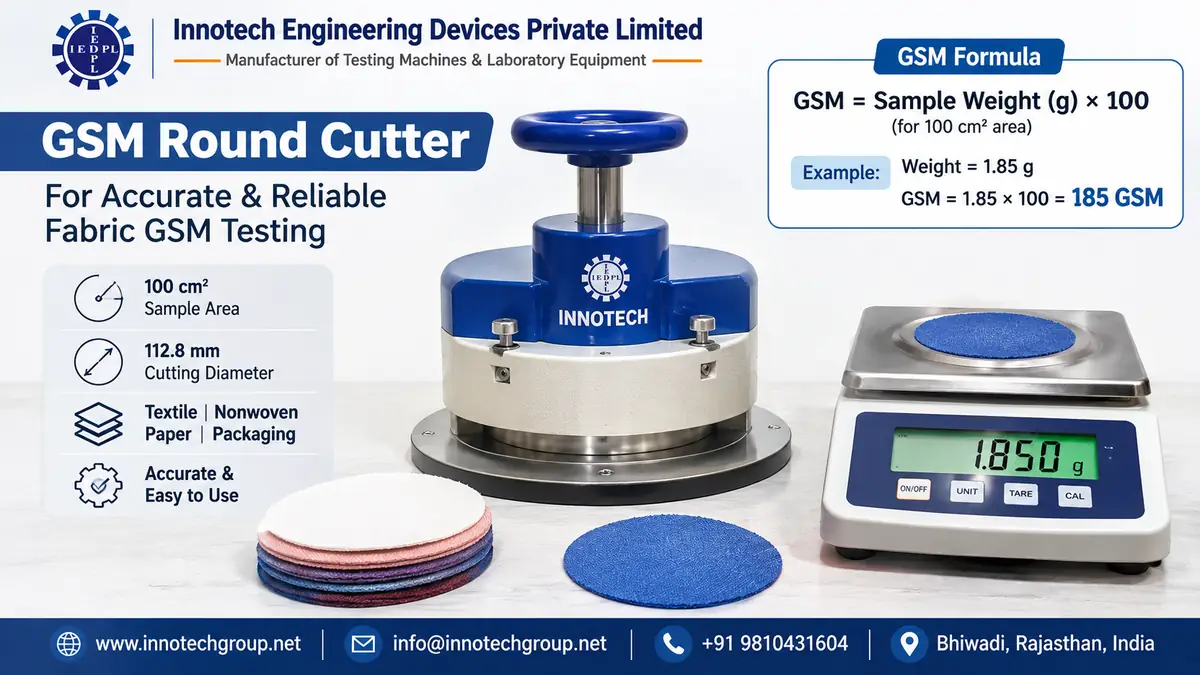
GSM Round Cutter: Working Principle, GSM Formula, Diameter, Uses & Buying Guide in India
A complete guide for textile manufacturers, paper mills, packaging companies and quality control laboratories.
When purchasing fabric, paper or packaging materials, one important question is: Does the material have the correct GSM?
A fabric may look and feel suitable, but its actual weight per square metre may differ from the approved specification. Such differences can affect material consumption, product consistency, purchasing decisions and quality control.
A GSM Round Cutter helps laboratories prepare circular specimens of known area for accurate grammage determination.
Whether you are searching for a GSM Round Cutter Machine, want to understand the GSM Round Cutter formula, or need a reliable GSM Round Cutter Manufacturer in India, this guide explains the working principle, sample diameter, testing procedure, applications, industry standards and buying considerations.
What Is a GSM Round Cutter?
A GSM Round Cutter is a laboratory sample-cutting instrument used to prepare circular specimens of known area from suitable textile, paper, nonwoven and flexible sheet materials.
GSM stands for Grams per Square Metre, which expresses the mass of material covering one square metre.
A commonly used GSM Round Cutter produces a specimen with a nominal area of 100 cm², equal to 0.01 m².
After cutting, the specimen is weighed using a suitable precision balance. Its mass is then converted into GSM.
The machine is also known as:
- Fabric GSM Cutter
- Circular GSM Sample Cutter
- Textile GSM Testing Cutter
- Paper Grammage Cutter
- GSM Round Cutter with Weighing Scale
Important: A conventional GSM cutter prepares the specimen; it does not measure its mass. A weighing balance is required to calculate GSM.
Why Is GSM Important in Textile and Paper Manufacturing?
GSM is an important quality parameter because it describes the mass per unit area of a material.
In textiles, GSM helps buyers compare fabric constructions and verify supplied material against approved specifications.
In paper manufacturing, grammage is used to characterize paper and paperboard products.
GSM measurements support:
- Fabric weight verification
- Incoming-material inspection
- Production batch comparison
- Material consumption estimation
- Paper and packaging quality control
- Supplier sample approval
- Product development
- Laboratory testing and reporting
However, GSM alone does not establish material strength, durability, thickness or overall quality. These characteristics may require additional tests.
GSM Round Cutter Working Principle
The GSM Round Cutter working principle is based on cutting a specimen of accurately known area and determining its mass.
A typical manual GSM cutter contains a rigid body, rotating cutting mechanism, sharp blades, handle and cutting support pad.
The material is positioned flat on the pad. The operator applies the required pressure and operates the cutting mechanism to produce a circular specimen.
The specimen is then weighed using a calibrated balance.
The measured mass is divided by the specimen area to calculate GSM.
For reliable testing, the specimen area, cutting quality, sample conditioning and balance performance must be controlled.
How to Use a GSM Round Cutter Machine
The following is a general laboratory procedure. Always follow the applicable material test standard and equipment operating manual.
Step 1: Select the sample
Take a representative sample from the fabric, paper or other material. Avoid damaged or unrepresentative areas.
Step 2: Condition the material
Condition the specimen where required by the relevant standard. Moisture content can affect the measured mass.
Step 3: Prepare the cutting surface
Place the material on a suitable cutting pad or approved support.
Step 4: Position the GSM cutter
Keep the cutter stable and ensure the material is flat without unwanted stretching or folds.
Step 5: Cut the specimen
Operate the cutting mechanism according to the manufacturer's instructions.
Step 6: Remove the sample
Carefully remove the circular specimen and inspect its edges for incomplete cutting or loose fibres.
Step 7: Weigh the specimen
Use a suitable calibrated weighing balance and record the mass in grams.
Step 8: Calculate GSM
Apply the formula corresponding to the actual specimen area.
Step 9: Repeat the measurement
Test the required number of specimens from appropriate locations and calculate the average where prescribed.
Step 10: Record the results
Document specimen identification, mass, area, calculated GSM and relevant testing conditions.
GSM Round Cutter Formula – How to Calculate Fabric GSM
The general GSM calculation formula is:
GSM = Sample Weight (g) ÷ Sample Area (m²)
When the specimen area is expressed in square centimetres:
GSM = Sample Weight (g) × 10,000 ÷ Sample Area (cm²)
For a standard 100 cm² GSM Round Cutter:
GSM = Sample Weight (g) × 100
GSM Calculation Example
Suppose a circular fabric specimen weighs 1.85 grams.
GSM = 1.85 × 100
Result = 185 GSM
This means the material has a measured mass per unit area of 185 grams per square metre.
GSM Calculation Table
| Specimen Weight |
Calculated GSM |
| 0.80g | 80 GSM |
| 1.20g | 120 GSM |
| 1.50g | 150 GSM |
| 1.80g | 180 GSM |
| 2.00g | 200 GSM |
| 2.50g | 250 GSM |
| 3.00g | 300 GSM |
These calculations apply to a 100 cm² specimen. Different sample areas require different conversion factors.
GSM Round Cutter Diameter and Sample Area
One of the most common technical questions is: What is the diameter of a GSM Round Cutter?
For a circular specimen:
Area = π × Diameter² ÷ 4
For a specimen area of 100 cm²:
Diameter = √(4 × 100 ÷ π)
Theoretical diameter = approximately 112.84 mm
Many standard GSM cutters therefore use a nominal cutting diameter of approximately 112.8 mm.
The exact diameter and allowable tolerance should be verified for the selected machine.
A small change in specimen area can affect the calculated GSM, particularly when using a fixed conversion factor.
Types of GSM Round Cutter Machines
Manual GSM Round Cutter
A Manual GSM Round Cutter uses operator-applied force to cut circular specimens. It is commonly selected for routine testing of suitable textile and paper materials.
Hydraulic GSM Round Cutter
A Hydraulic GSM Round Cutter uses a hydraulic mechanism to provide cutting force. It may be considered for specialized applications where greater cutting force is required.
Hydraulic operation does not automatically guarantee greater cutting accuracy. Tooling and specimen-area verification remain important.
GSM Round Cutter with GSM Scale
A GSM Round Cutter with GSM Scale combines a sample cutter with a suitable weighing balance.
Some dedicated GSM scales can display GSM directly for a selected specimen area, while conventional balances display specimen mass.
Customized GSM Round Cutter
A customized GSM Round Cutter may be required for special sample dimensions, materials, cutting mechanisms or laboratory workflows.
The correct machine depends on the material and applicable test method.
Industries Using GSM Round Cutter Machines
The GSM Round Cutter Machine is used across multiple material-testing applications.
| Industry |
Typical Application |
| Textile manufacturing | Woven and knitted fabric GSM testing |
| Garment industry | Fabric weight verification |
| Paper manufacturing | Paper grammage testing |
| Packagiing industry | Paperborad and suitable packaging materials |
| Nonwoven manufacturing | Mass per unit area testing |
| Automotive textiles | Upholstery and interior fabric testing |
| Home furnishings | Curtains, upholstery and bedding fabrics |
| Medical Textiles | Suitable nonwoven and fabric materials |
| Technical textiles | Industrial fabric GSM evaluation |
| Research laboratories | Material testing and quality-control studies |
For films, coated materials, leather and thicker sheets, the cutting mechanism must be suitable for the material.
GSM Round Cutter Testing Standards
The relevant standard depends on the material being tested.
| Standard |
Application |
| ASTM D3776/D3776M | Mass per unit area of fabric |
| ISO 3801 | Mass per unit length and area of woven fabrics |
| IS 1964 | Mass per unit length and area of textile fabrics |
| ISO 536 | Grammage determination of paper and board |
A GSM Round Cutter is a specimen preparation tool. Compliance with a testing standard depends on the complete procedure, including sampling, conditioning, weighing, calculation and reporting.
For example, ASTM D3776/D3776M includes different procedures for full pieces, full-width samples, small swatches and narrow fabrics.
Buyers should confirm the required method rather than assume that every circular sample is suitable for every standard.
Common GSM Testing Mistakes and How to Avoid Them
Even a well-designed cutter cannot compensate for incorrect testing procedures.
| Common Mistake |
Recommended Practice |
| Stretching knitted fabric during cutting | Keep the specimen flat and relaxed |
| Using worn cutting blades | Inspect and replace blades when necessary |
| Incorrect sample area | Verify the cutting dimensions |
| Using an unsuitable balance | Select suitable capacity and readability |
| Ignoring sample condtioning | Follow the applicable standard |
| Testing only one unrepresentative location | Use the required sampling plan |
| Incorrect calculation factor | Use the actual specimen area |
| Cutting thick materials with unsuitable tooling | Confirm cutting capability befire testing |
Good specimen preparation is essential for reliable GSM results.
How to Select the Best GSM Round Cutter Machine
If you are planning to purchase a GSM Round Cutter in India, consider these factors before selecting a supplier.
Material compatibility: Confirm whether the machine is intended for woven fabric, knitted fabric, paper, nonwoven or other materials.
Cutting area: A 100 cm² configuration is common, but the required test procedure should determine the specimen area.
Blade arrangement: Check blade material, replacement availability and cutting quality.
Cutting mechanism: Choose manual, hydraulic or another suitable arrangement according to material requirements.
Construction: Evaluate the machine's stability, handling and maintenance needs.
Weighing balance: Confirm whether a precision balance or GSM scale is included.
Accuracy: Request details of specimen-area tolerance and verification.
Documentation: Ask for technical specifications, operating instructions and agreed inspection records.
Service support: Consider maintenance, spare blades and cutting pads.
Customization: Confirm whether the manufacturer can accommodate special requirements.
The best GSM Round Cutter is not necessarily the most expensive model. It is the machine that reliably prepares the required specimen for the selected test procedure.
GSM Round Cutter Price in India
The GSM Round Cutter price depends on its design, cutting mechanism, body construction, blade arrangement, accessories and customization requirements.
A basic manual GSM cutter may differ considerably from a hydraulic cutting system or a complete grammage testing kit with a weighing balance.
Before requesting a quotation, provide:
- Material type and thickness
- Required specimen area
- Manual or powered cutting preference
- Balance or GSM scale requirement
- Applicable testing standard
- Quantity and delivery location
A configuration-based quotation helps buyers compare technically suitable equipment.
GSM Round Cutter Manufacturer in India – Why Consider Innotech?
When searching for a GSM Round Cutter Manufacturer in India, buyers should evaluate manufacturing capability, technical specifications, customization options and service arrangements.
Innotech Engineering Devices Private Limited manufactures industrial testing machines and laboratory equipment in Bhiwadi, Rajasthan.
We welcome enquiries for GSM Round Cutter Machines used in textile, paper, packaging and laboratory testing applications.
Customers looking for a GSM Round Cutter Manufacturer in Rajasthan, GSM Round Cutter Manufacturer in Bhiwadi, or a GSM Round Cutter Supplier in India can contact our technical team with their requirements.
Innotech serves industrial customers across India, including Delhi NCR, Haryana, Rajasthan, Gujarat, Maharashtra, Karnataka, Tamil Nadu and Telangana.
Our objective is to help buyers identify a suitable machine configuration for their material and testing application.
Frequently Asked Questions About GSM Round Cutters
What is the purpose of a GSM Round Cutter?
It prepares circular specimens of known area for calculating material mass per square metre.
What is the standard GSM Round Cutter diameter?
A nominal 100 cm² circular specimen has a theoretical diameter of approximately 112.84 mm.
What is the formula for GSM calculation?
GSM equals specimen weight in grams divided by specimen area in square metres. For a 100 cm² specimen, multiply the weight in grams by 100.
Can a GSM Round Cutter be used for paper?
Yes, provided the machine is suitable for the paper or paperboard material and the selected testing procedure.
Does a GSM Round Cutter measure GSM directly?
A conventional cutter does not. It prepares the sample, which must be weighed using a suitable balance.
What is the difference between a manual and hydraulic GSM Round Cutter?
A manual cutter uses operator-applied force, while a hydraulic cutter uses hydraulic actuation. Selection depends on material and cutting requirements.
What is the best GSM Round Cutter for textile testing?
The best choice depends on the fabric type, specimen area, cutting quality, applicable standard and laboratory workload.
Where can I buy a GSM Round Cutter in Rajasthan?
Innotech Engineering Devices Private Limited, located in Bhiwadi, Rajasthan, accepts enquiries for GSM Round Cutter Machines and customized laboratory testing equipment.
Buy GSM Round Cutter Machine from Innotech
Looking for a GSM Round Cutter Manufacturer and Supplier in India?
Whether you require a manual GSM cutter, a GSM Round Cutter with a precision weighing scale or an application-specific cutting solution, contact Innotech Engineering Devices Private Limited.
Share your material type, specimen dimensions, testing standard and preferred machine configuration to receive technical specifications and a quotation.
Company: Innotech Engineering Devices Private Limited
Manufacturing Location: Bhiwadi, Rajasthan, India
Email: info@innotechgroup.net
Phone: +91 9810431604
Contact Innotech for GSM Round Cutter technical specifications and customized equipment enquiries.
Category: Textile Testing Equipment
Tags: GSM Round Cutter, GSM Round Cutter Manufacturer in India, GSM Round Cutter Machine, GSM Round Cutter in Rajasthan, GSM Round Cutter in Bhiwadi
Last Updated: 24 November 2026