
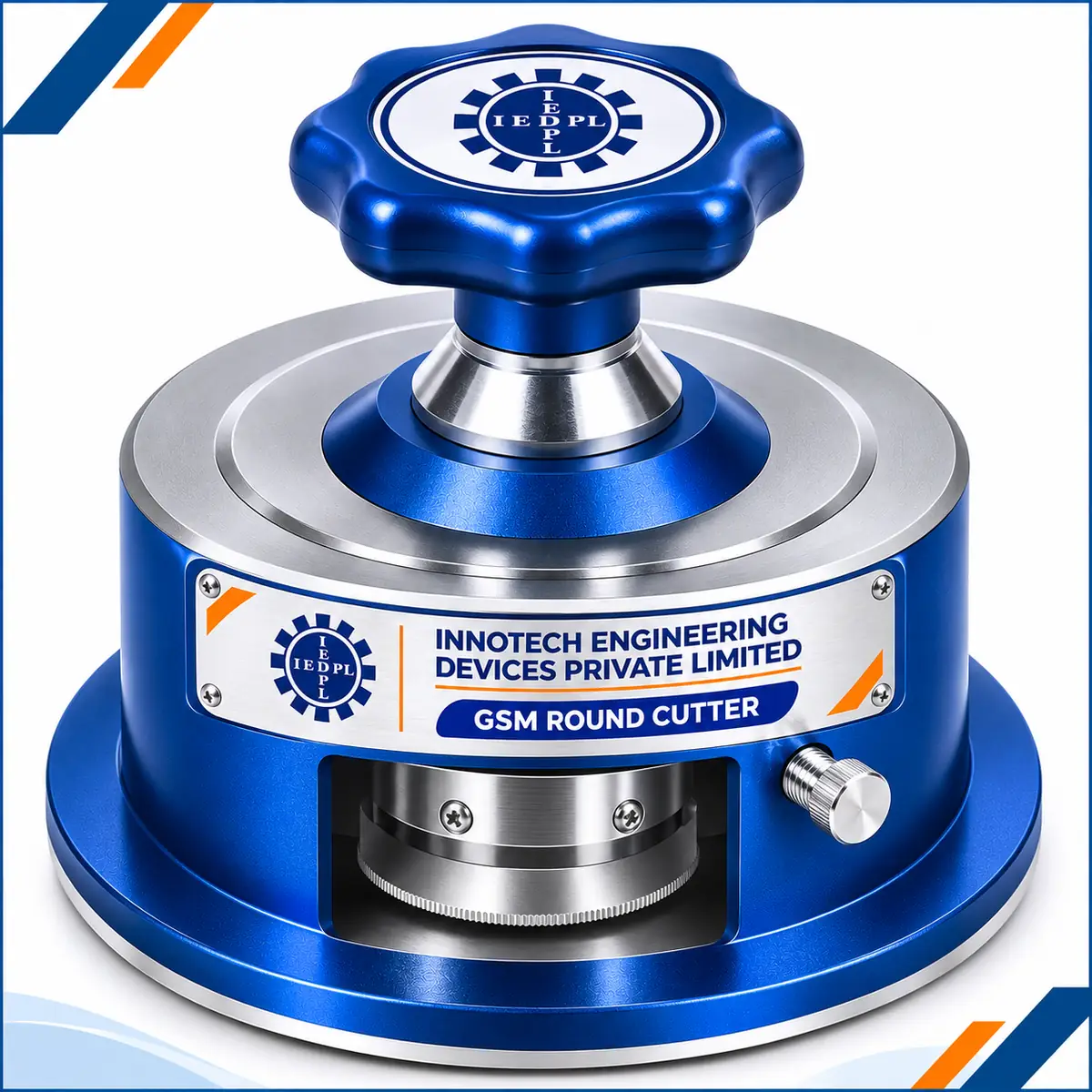
GSM Round Cutter – Fabric, Textile & Paper GSM Testing Machine
GSM Round Cutter – Fabric, Textile & Paper GSM Testing Machine
The GSM Round Cutter by Innotech Engineering Devices Private Limited is designed for preparing circular specimens for grammage (grams per square metre) testing of textiles, fabrics, paper, nonwoven materials and suitable packaging products. A standard configuration provides a nominal 100 cm² cutting area, enabling straightforward GSM calculation using a precision weighing balance. Available with application-specific blade arrangements, construction materials, cutting mechanisms and optional GSM weighing scales, the machine supports quality control and laboratory sample preparation. Manufactured in Bhiwadi, Rajasthan, India, with configurations based on customer requirements.
MODEL
IGRC
OVERVIEW
Description
GSM Round Cutter Machine – Manufacturer in Bhiwadi India
The GSM Round Cutter is a precision sample-cutting instrument used to prepare circular specimens for determining the mass per unit area of fabrics, textiles, paper, nonwoven materials and suitable packaging products. GSM stands for grams per square metre, a measurement widely used in textile manufacturing, paper production and industrial quality control.
Innotech Engineering Devices Private Limited manufactures testing machines and laboratory equipment in Bhiwadi, Rajasthan, India. Our GSM Round Cutter Machine can be configured according to customer requirements, including cutting mechanism, sample area, blade arrangement, construction and optional weighing accessories.
What Is a GSM Round Cutter?
A GSM Round Cutter, also called a Fabric GSM Cutter, Circular Sample Cutter or Paper Grammage Cutter, prepares a specimen of known area for weighing.
A common laboratory configuration cuts a circular specimen of 100 cm², equivalent to 0.01 m². The specimen is weighed on a suitable precision balance, and its mass is converted into grams per square metre.
The cutter prepares the sample; the weighing balance measures its mass. A manual GSM Round Cutter does not independently measure GSM.
GSM Round Cutter Working Principle
The GSM Round Cutter works through a mechanical cutting action. The sample is positioned on a suitable cutting surface, and the cutting mechanism produces a circular specimen of predetermined area.
Depending on the model, cutting may be performed through rotary blades, a press-type mechanism or another application-specific arrangement.
How to Use a GSM Round Cutter Machine
1. Select a representative sample according to the applicable test procedure.
2. Condition the material where required by the testing standard.
3. Place the sample flat on the cutting pad or approved cutting surface.
4. Operate the cutter according to its mechanism.
5. Remove the circular specimen without stretching or damaging it.
6. Weigh the specimen using a suitable calibrated balance.
7. Calculate GSM using the known specimen area.
8. Repeat the test at the required sampling locations and calculate the average.
For accurate results, the specimen must have clean edges and a known area. Damaged blades, uneven cutting or incorrect weighing can affect the result.
GSM Round Cutter Diameter and Sample Area
A standard 100 cm² circular specimen has a theoretical diameter of approximately 112.84 mm.
The relationship between area and diameter is:
Area = π × Diameter² ÷ 4
For a circular specimen of 100 cm²:
Diameter = √(4 × 100 ÷ π) = 11.284 cm = 112.84 mm
Other sample areas can be considered for specialized applications, provided the calculation factor and test procedure are adjusted accordingly.
GSM Round Cutter Formula – How to Calculate GSM
The general formula is:
GSM = Sample Weight (g) ÷ Sample Area (m²)
For a 100 cm² specimen:
GSM = Sample Weight (g) × 100
GSM Calculation Example
Suppose a circular fabric specimen weighs 1.85 g.
GSM = 1.85 × 100 = 185 g/m²
The fabric has a measured mass per unit area of 185 GSM.
| Sample Weight |
GSM for 100 cm² |
| 0.80g | 80 GSM |
| 1.20g | 120 GSM |
| 1.50g | 150 GSM |
| 2.00g | 200 GSM |
| 2.50g | 250 GSM |
| 3.00g | 300 GSM |
For another cutting area, use the general formula rather than multiplying by 100.
GSM Round Cutter Applications
GSM Round Cutter for Textile and Fabric Testing
Textile manufacturers use GSM measurements to evaluate fabric mass per unit area. The results support material specifications, product development, batch inspection and production quality control.
Applications include woven fabrics, knitted fabrics, garments, upholstery, technical textiles and selected nonwoven materials.
GSM Round Cutter Machine for Paper and Packaging
A GSM Round Cutter for Paper can prepare samples for grammage determination of suitable paper, paperboard and packaging materials.
Paper grammage helps manufacturers assess material consistency and compliance with purchasing specifications.
GSM Round Cutter for Nonwoven Materials
Nonwoven manufacturers may use circular specimen preparation to determine mass per unit area for suitable materials used in hygiene products, filtration, automotive applications and industrial textiles.
GSM Round Cutter for Films and Flexible Sheets
Selected film, foil and laminated sheet materials can be evaluated using an appropriate cutting mechanism. Cutting suitability depends on material thickness, flexibility and blade design.
GSM Round Cutter with GSM Scale
A GSM Round Cutter with GSM Scale combines specimen preparation with a weighing arrangement.
For a standard 100 cm² specimen, the mass in grams is multiplied by 100 to calculate GSM.
Some dedicated GSM balances provide direct GSM display for a selected sample area. This function must be confirmed for the particular balance.
For accurate measurement, buyers should consider balance readability, capacity, calibration and the expected specimen mass.
Manual vs Hydraulic GSM Round Cutter
Manual GSM Round Cutters are commonly used for routine laboratory sampling of suitable thin and flexible materials.
A Hydraulic GSM Round Cutter is a specialized powered cutting concept that may be considered for applications requiring greater cutting force. Its suitability depends on the material, tooling and required sample geometry.
Hydraulic operation is not automatically more accurate than a properly designed manual cutter. Cutting-area accuracy, blade condition and specimen quality remain essential.
GSM Round Cutter Testing Standards
Relevant standards depend on the material and test method.
| Standard |
Application |
| ASTM D3776/D3776M-20(2025) | Mass per unit area of fabric |
| ISO 3801:1977 | Mass per unit length and area of woven fabrics |
| IS 1964:2001 | Mass per unit length and area of textile fabrics |
| ISO 536:2019 | Grammage of paper and board |
A GSM Round Cutter is a specimen preparation tool. Compliance with a testing standard depends on the complete test procedure, specimen preparation, conditioning, weighing and calculation requirements.
GSM Round Cutter Manufacturer in Bhiwadi, Rajasthan, India
Innotech Engineering Devices Private Limited is a manufacturer of testing machines and laboratory equipment located in Bhiwadi, Rajasthan.
Customers searching for a GSM Round Cutter Manufacturer in India, GSM Round Cutter Manufacturer in Rajasthan, or GSM Round Cutter Manufacturer in Bhiwadi can contact Innotech for technical specifications and application-based equipment requirements.
We welcome enquiries from textile manufacturers, paper mills, packaging industries, testing laboratories, educational institutions, industrial buyers and distributors across India.
How to Select the Right GSM Round Cutter
Before purchasing, consider:
- Material type and thickness
- Required sample area and diameter
- Manual or powered cutting arrangement
- Blade type and replacement requirements
- Cutting pad or support arrangement
- Expected testing frequency
- Specimen-area tolerance
- Weighing balance requirements
- Applicable test standards
- Maintenance and spare-part availability
Frequently Asked Questions
What is a GSM Round Cutter used for?
It prepares circular samples of known area for determining the mass per square metre of textiles, paper and suitable sheet materials.
What is the diameter of a GSM Round Cutter?
For a nominal 100 cm² specimen, the theoretical diameter is approximately 112.84 mm.
What is the GSM Round Cutter formula?
GSM equals specimen mass in grams divided by specimen area in square metres. For a 100 cm² specimen, multiply its mass in grams by 100.
Can a GSM Round Cutter be used for paper?
Yes, provided the cutter is suitable for the paper or board material and the selected test procedure.
Does a GSM Round Cutter measure GSM directly?
No. A conventional manual cutter prepares the specimen. A balance is required to measure its mass.
Can I purchase a GSM Round Cutter with a weighing scale?
A suitable precision balance or direct-reading GSM scale can be included as an optional accessory, subject to configuration.
What is the difference between a manual and hydraulic GSM Round Cutter?
A manual cutter uses operator-applied force, while a hydraulic design uses hydraulic actuation. The appropriate mechanism depends on the material and cutting requirements.
Can a GSM Round Cutter be customized?
Yes. Cutting area, tooling, construction and accessories may be customized according to technical feasibility.
Request GSM Round Cutter Technical Specifications
Looking for a GSM Round Cutter Manufacturer in India for textile, fabric, paper or packaging testing?
Contact Innotech Engineering Devices Private Limited for technical specifications, customized requirements and quotations.
Email: info@innotechgroup.net
Phone: +91 9810431604
Location: Bhiwadi, Rajasthan, India
WHY IT WORKS
Key benefits
Simplifies specimen preparation for GSM testing
Helps maintain a consistent specimen area
Supports repeatable grammage measurements
Reduces manual cutting and measurement effort
Suitable for routine laboratory quality control
Helps monitor material consistency between batches
Supports supplier and incoming-material inspection
Can be integrated into textile and packaging QC procedures
Allows straightforward GSM calculation with a suitable balance
Offers configuration flexibility for different materials
USE CASE
Application range
BUILT IN
Features
Precision circular specimen preparation
Nominal 100 cm² cutting-area configuration
Mechanical cutting arrangement
Options for replaceable cutting blades
Compact laboratory-friendly design
Durable body construction
Suitable sample support arrangements
Straightforward operation and maintenance
Optional cutting pads and spare blades
Optional GSM weighing balance
Application-specific design customization
Suitable for textile and paper testing workflows
SPEC
Specifications
Equipment
GSM Round Cutter Machine
Primary Function
Circular specimen preparation
Standard Sample Area
Nominal 100 cm²
Theoretical Cutting Diameter
Approximately 112.84 mm
Alternative Cutting Areas
Application-specific, subject to design
Cutting Mechanism
Manual rotary, press-type or other suitable design
Blade Arrangement
Multiple precision blades or application-specific cutting tool
Blade Material
Hardened tool steel or suitable wear-resistant material
Body Construction
Aluminium alloy, steel or suitable engineered construction
Cutting Pad
Replaceable pad or alternative approved cutting support
Sample Thickness
According to material and selected cutting mechanism
Sample Material
Fabric, paper, nonwoven, film and suitable sheet materials
Operating Mode
Manual; powered configurations subject to feasibility
Weighing Scale
Optional precision balance / GSM scale
Safety
Suitable guards, blade protection or locking provisions
Accessories
Cutting pad, replacement blades, sample tools
Customization
Cutting area, construction, mechanism and accessories