
Extensometer: Types, Least Count, Working Principle & Uses
Jay Pal Singh
06 November 2026
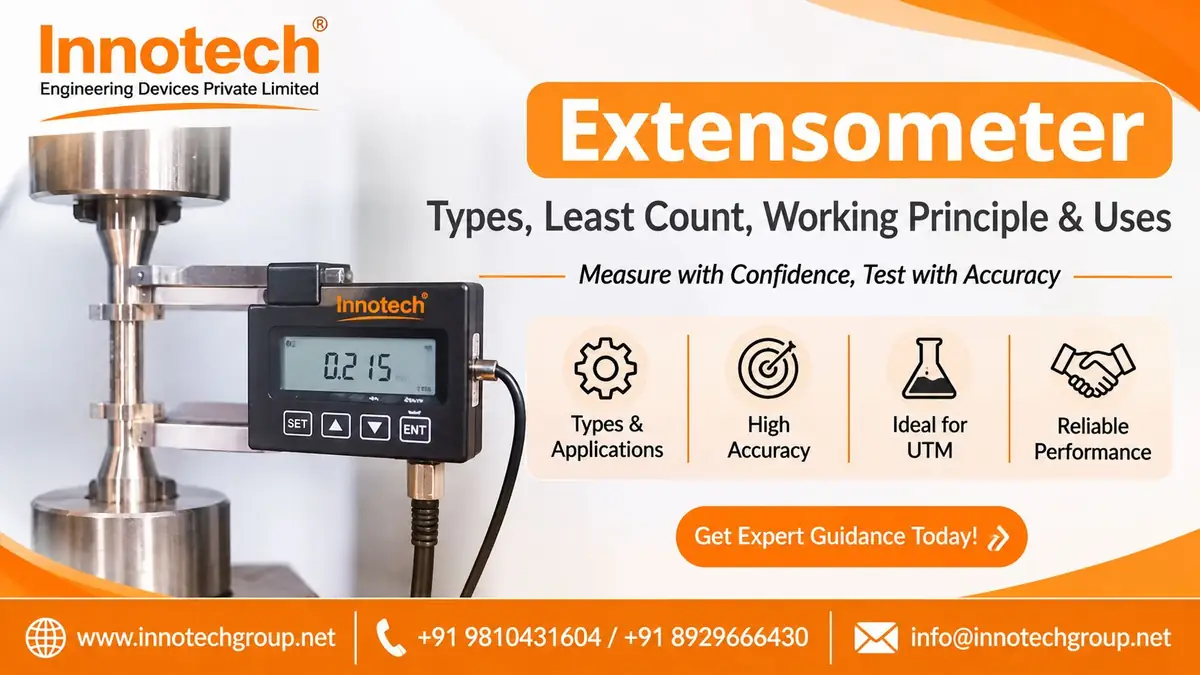
Dual Dial Mechanical Extensometer
Extensometer: Types, Least Count, Working Principle, Uses & Price in India
When a material is stretched or compressed during testing, its length changes. Measuring this small dimensional change accurately is important for understanding the strength and deformation behaviour of materials.
An extensometer is a measuring instrument used to determine the change in length of a specimen under an applied force. It is commonly used with Universal Testing Machines (UTM) for tensile testing, strain measurement and determining the elastic properties of materials.
Different types of extensometers are available, including mechanical, dial gauge, digital, electronic and non-contact models. Each has different measurement capabilities and applications.
In this guide, we explain how an extensometer works, its types, least count, applications, differences between extensometers and strain gauges, and how to select the right instrument for your laboratory.
1. What Is an Extensometer?
An extensometer is an instrument used to measure the change in distance between two reference points on a material specimen.
The distance between these points is called the gauge length.
When a specimen is subjected to tensile or compressive force, its dimensions change. The extensometer measures this change and helps calculate strain.
For example, if a metal specimen has an original gauge length of 50 mm and increases to 50.20 mm during testing, its extension is 0.20 mm.
Why is an extensometer used?
- To measure specimen elongation during tensile testing.
- To calculate material strain.
- To determine Young's modulus of elasticity.
- To study elastic and plastic deformation.
- To measure small dimensional changes.
- To analyse material behaviour under applied loads.
2. How Does an Extensometer Work? (Working Principle)
The working principle of an extensometer is based on measuring the relative movement between two points on a specimen.
During testing, the instrument detects the change in distance between its measuring points and converts it into a readable displacement value.
Working process
- Prepare the test specimen according to the applicable test method.
- Set the required gauge length on the extensometer.
- Attach the instrument to the specimen or align the optical measuring system.
- Record the initial measurement.
- Apply tensile or compressive force using the testing machine.
- The specimen changes length as the load increases.
- The extensometer measures the displacement between the reference points.
- Use the measured extension to calculate strain.
Extensometer measurement formula
Engineering strain is calculated using:
[
\varepsilon=\frac{\Delta L}{L_0}
]
Where:
- ε = Engineering strain
- ΔL = Change in length
- L₀ = Original gauge length
Example:
| Parameter |
Measurement |
| Original gauge length | 50 mm |
| Final gauge length | 50.20 mm |
| Extension | 0.20 mm |
| Engineering strain | 0.004 |
| Percentage strain | 0.4% |
This measurement helps engineers understand how a material responds to an applied force.
3. Different Types of Extensometers and Their Applications
Extensometers are available in different designs depending on the required measurement accuracy, application and testing environment.
| Type |
Working principle |
Main application |
| Mechanical extensometer | Mechanical displacement measurement | Routine tensile testing |
| Dial gauge extensometer | Pointer-based displacement reading | Material testing laboratories |
| Digital extensometer | Electronic sensing and digital display | Digital measurement |
| Clip-on extensometer | Attached directly to specimen | UTM tensile tesing |
| Optical extensometer | Camera or optical measurement | Non-contact testing |
| Geotechnical extensometer | Measures relative ground movement | Tunnels, soil and rock monitoring |
Mechanical and dial gauge extensometer
A mechanical extensometer uses measuring arms, contact points and a mechanical indication arrangement to measure specimen extension.
A dual-dial mechanical extensometer uses two dial indicators to observe displacement. It is suitable for laboratories requiring a straightforward mechanical measurement arrangement.
Digital and electronic extensometer
Digital extensometers display measurements electronically. Electronic clip-on extensometers are attached to the specimen and measure changes in gauge length through a sensing mechanism.
They are useful for laboratories requiring digital readings, electronic data acquisition and strain analysis.
Non-contact extensometer
An optical extensometer uses cameras, laser-based systems or image-processing technology to measure specimen deformation without physical contact.
It is useful for delicate specimens and applications where contact measurement is unsuitable.
Geotechnical extensometer
A geotechnical extensometer measures movement in soil, rock and underground structures.
Common types include rod, wire, borehole and in-place extensometers. They are used for tunnel monitoring, mining, foundation settlement and structural deformation studies.
4. Extensometer Least Count: How Small Can It Measure?
The least count refers to the smallest measurement increment indicated by an instrument.
The least count depends on the dial indicator, sensor and mechanical arrangement.
Examples of extensometer least count
| Instrument |
Illustrative least count or resolution |
| Mechanical dial extensometer | 0.01 mm |
| Fine-graduation dial extensometer | 0.001 mm |
| Digital extensometer | Model-dependent |
| Electronic extensometer | Sensor-dependent |
| Optical extensometer | System-dependent |
These are examples, not universal specifications.
How to calculate least count?
For a dial indicator:
[
LC=\frac{\text{Value of one revolution}}{\text{Number of divisions}}
]
For example:
- One revolution = 1 mm
- Total divisions = 100
[
LC=\frac{1}{100}=0.01\text{ mm}
]
Therefore, the dial indicator has a least count of 0.01 mm.
Important: Least count and accuracy are different. A measuring instrument may display very small increments without necessarily having the same level of measurement accuracy.
5. What Is an Extensometer for UTM?
A UTM extensometer is used with a Universal Testing Machine to measure the actual extension of a specimen during tensile testing.
A UTM measures the applied load and may also record crosshead displacement. However, crosshead movement can include deformation or movement of the machine frame, grips and fixtures.
An extensometer measures displacement directly over a defined specimen gauge length.
Why is it important?
- Measures specimen elongation.
- Helps determine Young's modulus.
- Supports stress-strain curve generation.
- Measures small elastic deformation.
- Improves strain measurement during tensile testing.
Extensometer vs UTM crosshead displacement
| Parameter |
Extensometer |
UTM crosshead |
| Measurement | Specimen extension | Machine crosshead movement |
| Reference | Specimen gauge length | Machine movement |
| Main purpose | Strain measurement | Overall displacement |
| Machine compliance effect | Reduced when properly mounted | Can influence readings |
For laboratories performing elastic modulus testing, an appropriate extensometer is particularly important.
6. How to Pick the Right Extensometer?
Selecting the right extensometer depends on the specimen, testing method and required measurement range.
Consider these seven factors before purchasing:
1. Application: Identify whether you need the instrument for tensile testing, compression testing, geotechnical monitoring or another application.
2. Gauge length: Select a gauge length suitable for the specimen and applicable test standard.
3. Measuring range: Ensure that the instrument can measure the expected extension without exceeding its operating range.
4. Least count: Select an appropriate measurement resolution for the required testing accuracy.
5. Specimen dimensions: Check specimen thickness, width, shape and mounting compatibility.
6. UTM compatibility: For electronic models, verify the signal interface and compatibility with the testing machine controller.
7. Calibration: Check accuracy specifications, calibration requirements and applicable standards.
Quick selection guide
| Requirement |
Extensometer to consider |
| Routine laboratory testing | Mechanical extensometer |
| Pointer-based readings | Dial gauge extensometer |
| Digital display | Digital measurement |
| Electronic strain measurement | Clip-on extensometer |
| Delicate specimens | Optical extensometer |
| Ground movement monitoring | Geotechnical extensometer |
7. Extensometer vs Strain Gauge: What Is the Difference?
Both instruments are used for measuring deformation, but their working principles differ.
An extensometer measures the change in distance between two reference points, whereas a strain gauge measures local strain through a sensing element.
| Parameter |
Extensometer |
Strain gauge |
| Measurement | Extension or displacement | Local strain |
| Installation | Contact or non-contact | Usually bonded for resistance types |
| Output | Mechanical or electronic | Electrical signal |
| Application | Tensile testing | Structural and component testing |
| Measuring area | Defined gauge length | Small local sensing area |
What are the two main types of strain gauges?
Two broad categories are:
1. Bonded strain gauges: Attached directly to a specimen using a suitable adhesive. Foil resistance strain gauges are widely used.
2. Unbonded strain gauges: Resistance elements are arranged between supports and respond to deformation of the supporting structure.
What are strain gauges used for?
- Load cells.
- Pressure transducers.
- Bridge monitoring.
- Structural deformation analysis.
- Automotive component testing.
- Aircraft component testing.
- Experimental stress analysis.
What are the four types of strain?
The four commonly discussed deformation modes are:
1. Tensile strain – material elongation.
2. Compressive strain – material shortening.
3. Shear strain – angular deformation.
4. Bending strain – deformation caused by bending.
These are types of mechanical deformation, not four official types of extensometers.
8. What Is a Dial Gauge Extensometer?
A dial gauge extensometer is a mechanical measuring system that uses dial indicators to measure small changes in specimen length.
It generally consists of:
- Dial indicator.
- Measuring arms.
- Contact points.
- Mechanical linkage.
- Gauge-length arrangement.
- Zero-setting mechanism.
A dual-dial mechanical extensometer uses two indicators to observe movement through its measuring arrangement.
For more details about its construction, operation and applications, see our Dual Dial Mechanical Extensometer (https://innotechgroup.net/products/dual-dial-mechanical-extensometer).
What is a dial gauge used for?
A dial gauge, also called a dial indicator, measures small linear displacement or deviations from a reference position.
Common uses include:
- Checking machine alignment.
- Measuring shaft runout.
- Checking flatness.
- Measuring dimensional variation.
- Measuring specimen extension when integrated into an extensometer.
9. How to Calculate Dial Gauge Reading?
The basic formula is:
Displacement = Number of Divisions × Least Count
Example:
- Least count = 0.01 mm.
- Pointer movement = 25 divisions.
[
25\times0.01=0.25\text{ mm}
]
The measured displacement is 0.25 mm.
If the initial reading is 0.10 mm and the final reading is 0.35 mm:
[
\text{Extension}=0.35-0.10=0.25\text{ mm}
]
For a lever-based or dual-dial extensometer, follow the manufacturer's prescribed calculation, including any applicable mechanical ratio.
What is the least count of a dial gauge?
Common examples include 0.01 mm and 0.001 mm, depending on the dial graduation and model.
What are the two types of dial gauges?
The two common display arrangements are:
- Analog dial gauge – pointer and graduated scale.
- Digital dial gauge – electronic numerical display.
10. Extensometer Standards and Calibration
For material testing laboratories, extensometer calibration is important for obtaining reliable measurements.
Some relevant standards include:
| Standard |
Application |
| ASTM E83-25 | Extensometer calibration and classification |
| ISO9513:2012 | Calibration of extensometer used in uniaxial testing |
| ASTM E8/E8M | Tensile testing of metallic materials |
| ISO 6892-1 | Tensile testing of metallic materials |
| ISO 18674-2 | Gretechnical monitpring using extensometers |
The appropriate standard depends on the application. For example, ASTM E83 and ISO 9513 relate to laboratory extensometer calibration, whereas ISO 18674-2 concerns geotechnical monitoring.
Always verify the required standard and calibration classification before purchasing.
11. Extensometer Price in India: What Affects the Cost?
The price of an extensometer depends on its construction, measurement capabilities and intended application.
Important price factors include:
1. Mechanical, digital or electronic design.
2. Gauge length.
3. Measuring range.
4. Least count and resolution.
5. Accuracy requirements.
6. Calibration requirements.
7. Data acquisition and software integration.
8. Special mounting arrangements or customisation.
A mechanical dial gauge extensometer and an advanced optical extensometer have different cost structures.
Instead of selecting an instrument only by price, compare its measurement range, gauge length, accuracy and compatibility with your testing machine.
Looking for an extensometer price in India? Contact Innotech Engineering Devices Private Limited with your application and technical requirements for a suitable quotation.
Frequently Asked Questions
1. How does an extensometer work?
It measures the change in distance between two reference points on a specimen and converts the displacement into a measurable reading.
2. What are the different types of extensometers?
Mechanical, dial gauge, digital, electronic clip-on, optical and geotechnical extensometers are commonly used types.
3. What is the least count of an extensometer?
It depends on the instrument design. Mechanical dial-based models may have 0.01 mm or 0.001 mm graduations.
4. How do I select an extensometer for UTM?
Check gauge length, measuring range, specimen dimensions, least count, accuracy and compatibility with your UTM.
5. What is the difference between an extensometer and a strain gauge?
An extensometer measures extension between two reference points, while a strain gauge measures local deformation.
6. What is a dial gauge extensometer?
It is a mechanical extensometer that uses dial indicators to measure specimen extension.
7. How do you calculate dial gauge readings?
Multiply pointer divisions by the least count. Subtract the initial reading from the final reading to calculate the displacement.
8. What is a geotechnical extensometer?
It monitors movement and deformation in soil, rock, tunnels and underground structures.
9. What are the four types of strain?
Tensile, compressive, shear and bending strain are four commonly discussed deformation modes.
10. How do you pronounce extensometer?
It is commonly pronounced as ik-STEN-so-MEE-ter.
11. What is the price of a dial gauge extensometer?
It depends on its gauge length, measuring range, dial configuration, least count and construction.
13. Contact Innotech for Extensometer Requirements
Innotech Engineering Devices Private Limited is an OEM manufacturer of testing machines and laboratory equipment based in Bhiwadi, Rajasthan, India.
We manufacture and supply testing equipment for material testing laboratories, industrial quality control departments and research facilities.
If you are looking for a mechanical extensometer, dual-dial extensometer or a suitable measurement solution for your UTM, our team can help you understand the available configurations.
Request a quotation:
Company: Innotech Engineering Devices Private Limited
Address: H-307, RIICO Industrial Area, Karoli, Tapukara, Bhiwadi, Rajasthan, India
Email: info@innotechgroup.net
Phone: +91 9810431604 / +91 8929666430
For a quick quotation, share your UTM capacity, specimen dimensions, required gauge length, measuring range and preferred extensometer type.
Category: Testing & Measuring Instruments
Tags: Extensometer, Mechanical Extensometer, Dial Gauge Extensometer, UTM Accessories, Strain Measurement, Extensometer Least Count, Tensile Testing, Strain Gauge, Geotechnical Extensometer, Material Testing Equipment
Last Updated: 06 November 2026