
Different Types of Torsion Testing Machines: Working Principle, Applications, Standards & Buying Guide
Jay Pal Singh
10 November 2026
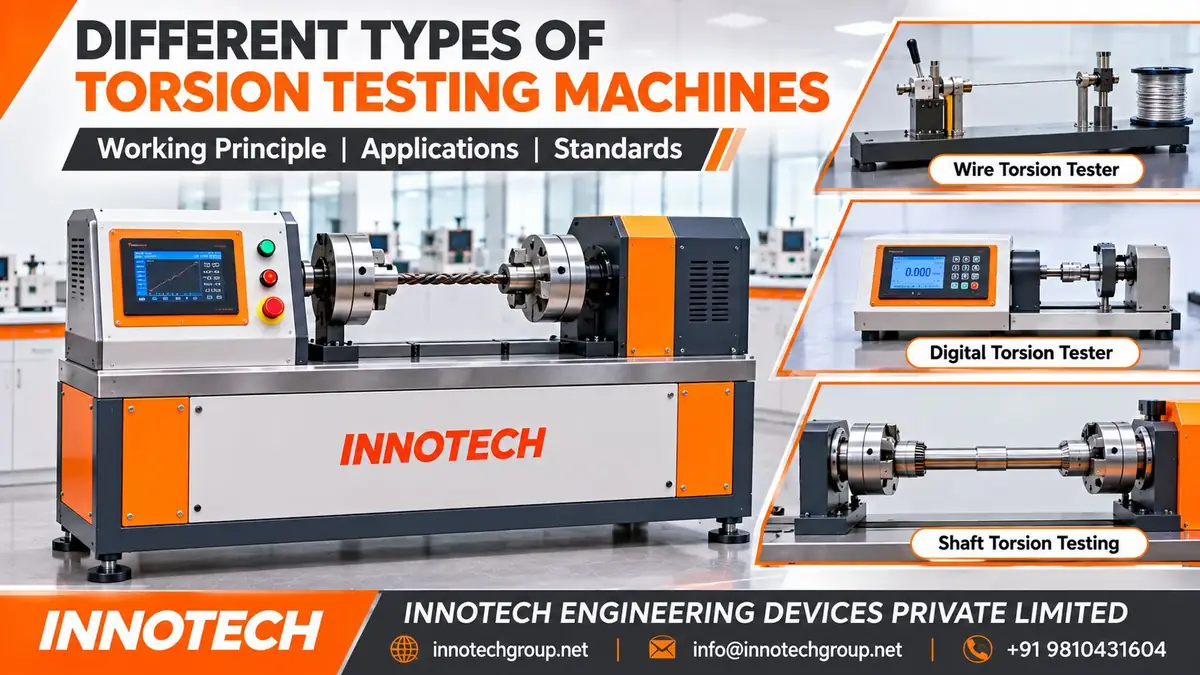
Different Types of Torsion Testing Machines: Working Principle, Applications, Standards & Buying Guide
A torsion testing machine is an important material testing instrument used to determine how materials and engineering components behave when subjected to twisting forces. From metal wires and steel shafts to springs, fasteners and industrial components, torsion testing helps manufacturers evaluate strength, deformation, ductility and resistance to rotational forces.
Different industries require different types of torsion testing equipment depending on the material, specimen dimensions, torque capacity and testing method. Selecting the correct torsion test machine is important for obtaining reliable results and maintaining product quality.
In this guide, we will explain the different types of torsion testing machines, their working principles, applications, industry standards and important factors to consider before purchasing torsion test equipment.
1. What Is a Torsion Testing Machine?
A torsion testing machine is a mechanical testing instrument designed to apply a controlled twisting force, known as torque, to a test specimen. During testing, one end of the specimen is held stationary while the other end rotates to produce torsional deformation.
The machine measures the applied torque and corresponding angle of twist to evaluate the material's resistance to rotational loading.
A torsion test is commonly performed on:
- Steel and metal rods
- Metallic wires
- Shafts and drive components
- Springs
- Fasteners and bolts
- Automotive components
- Plastic and polymer components
- Engineering materials
The test helps determine torsional strength, shear modulus, maximum torque, angle of twist and failure behaviour, depending on the test method and machine configuration.
2. Different Types of Torsion Testing Machines
Torsion testing machines are available in different configurations. Their selection depends on the application, material type, torque requirement and level of automation.
A. Digital Torsion Testing Machine
A digital torsion testing machine uses electronic measurement systems to record torque, angular displacement and the number of rotations during testing.
Main features:
- Digital torque measurement
- Electronic display
- Adjustable rotational speed
- Angle of twist measurement
- Test data monitoring
- Digital result display
Applications: Metal testing laboratories, wire manufacturing industries, engineering colleges and quality control departments.
B. Computerised Torsion Testing Machine
A computerised torsion testing machine combines a controlled drive system, torque measurement sensors and computer-based testing software.
It allows operators to monitor test parameters, generate torque versus angle-of-rotation graphs and record test results.
Main features:
- Computerised test monitoring
- Torque and angular displacement recording
- Graphical analysis
- Test data storage
- Automatic report generation, depending on software configuration
Applications: Research laboratories, automotive industries, material testing laboratories and industrial quality control facilities.
C. Wire Torsion Testing Machine
A wire torsion testing machine is specially designed to evaluate the torsional ductility and twisting behaviour of metallic wires.
The specimen is held between two gripping arrangements, and one grip rotates around the wire's longitudinal axis. The machine records the number of turns until fracture or the specified test endpoint.
Applications:
- Steel wire manufacturing
- Electrical conductor manufacturing
- Spring wire production
- Metal wire quality inspection
- High tensile wire testing
Common testing references include ASTM A938 and ISO 7800.
D. Spring Torsion Testing Machine
A spring torsion testing machine evaluates the rotational resistance and torque characteristics of torsion springs.
The spring is mounted in a suitable fixture, and controlled angular movement is applied to measure the corresponding torque.
Applications:
- Automotive spring manufacturing
- Door and hinge mechanisms
- Industrial machinery
- Electrical switches
- Mechanical assemblies
This testing helps manufacturers evaluate spring torque, rotational stiffness and performance consistency.
E. Shaft and Component Torsion Testing Machine
This type of torsion testing system is designed for testing shafts, rods, fasteners and other mechanical components subjected to rotational forces.
Depending on the machine configuration, it can evaluate the maximum torque, torsional strength, angle of twist and failure behaviour.
Applications:
- Automotive drive shafts
- Transmission components
- Steel rods
- Mechanical fasteners
- industrial couplings
- Engineering components
F. Torsional Fatigue Testing Machine
A torsional fatigue testing machine applies repeated twisting or reversing torque cycles to evaluate how a material or component behaves under repeated rotational loading.
Unlike a simple torsion test, which may involve a single loading sequence, torsional fatigue testing examines performance over multiple cycles.
Applications:
- Automotive transmission components
- Rotating shafts
- Mechanical couplings
- Industrial drive systems
- Aerospace engineering components
G. Axial-Torsion Testing Machine
An axial-torsion testing machine applies both axial force and rotational torque to a specimen. Depending on its configuration, tensile or compressive loading can be combined with torsional loading.
Applications:
- Advanced material research
- Medical device testing
- Automotive components
- Special engineering materials
- Complex mechanical assemblies
These machines are generally used when a component experiences combined loading conditions during actual operation.
Important: These categories describe different machine designs and application configurations. A single testing system may support more than one testing mode if it is equipped with suitable fixtures and control systems.
3. Working Principle of a Torsion Testing Machine
The working principle of a torsion testing machine is based on applying controlled torque to a specimen and measuring its response to twisting.
The testing process generally involves the following steps:
Step 1: Specimen Preparation
A test specimen is prepared according to the relevant testing standard. Its diameter, length, cross-sectional shape and surface condition are recorded.
Step 2: Specimen Mounting
The specimen is fixed between two grips or holding fixtures. One side remains stationary while the other side is connected to the rotating drive mechanism.
Step 3: Application of Torque
The motor-driven or manually operated mechanism applies rotational movement to the specimen at a controlled speed.
Step 4: Measurement of Torque
A torque measurement system records the twisting force applied to the specimen.
Step 5: Measurement of Angular Displacement
The machine measures the angle of rotation or number of turns during the test.
Step 6: Result Analysis
The collected measurements are analysed to determine torsional properties, deformation characteristics and failure behaviour.
The final test report may include maximum torque, angle of twist, torque versus rotation graph and other calculated material properties, depending on the machine and test method.
4. Types of Torsion Tests
Different torsion test methods are used according to material properties and product requirements.
| Test Type |
Purpose |
| Simple Torsion test | Measures twisting behaviour in one direction |
| Reverse torsion test | Evaluates resistance to alternating twisting |
| Torsional strength test | Determines maximum torque before failure |
| Torsional ductility test | Evaluates deformation capacity under twisting |
| Torsional fatigue test | Studies resistance to repeated torque cycles |
| Proof torque test | Checks whether a components withstands a specified torque |
| Functional torque test | Evaluates torque requirements of finished products |
For example, metallic wire manufacturers may use simple or reverse torsion testing to evaluate wire quality, while automotive manufacturers may require shaft torsion or torsional fatigue testing.
5. Applications of Torsion Testing Equipment Across Industries
Torsion testing equipment is used in several manufacturing and research sectors.
Metal and Steel Industry: Testing metal rods, steel bars, wires and other components for torsional strength and ductility.
Automotive Industry: Evaluating drive shafts, transmission parts, fasteners and rotational components.
Wire and Cable Industry: Checking the twisting resistance and ductility of metallic conductors and wires.
Spring Manufacturing: Measuring torque characteristics and rotational performance of torsion springs.
Fastener Industry: Evaluating the torque resistance and failure behaviour of bolts, screws and other fastening components.
Plastic and Polymer Industry: Studying torsional deformation and mechanical behaviour of suitable polymer specimens.
Research and Testing Laboratories: Conducting material characterisation, product development and mechanical testing.
6. Important Industry Standards for Torsion Testing
Testing standards help laboratories maintain consistent specimen preparation, testing procedures and measurement methods.
Some relevant international and Indian standards include:
| Standard |
Applications |
| ASTM A938 | Torsion testing of metallic wire |
| ISO 7800 | Simple torsion testing of metallic wire |
| ISO 18338 | Torsion testing of metallic materials at ambient temperature |
| IS 1717:2018 | Simple torsion testing of metallic wire |
| IS 17415:2023 | Torsion testing of metallic materials at room temperature |
| ASTM E143 | Determination of shear modulus by torsion testing |
| ASTM E2624 | Torque calibration of testing machines and devices |
The correct standard depends on the specimen material, dimensions and required test method. ASTM E2624, for example, concerns torque calibration rather than a general specimen testing procedure.
Manufacturers and laboratories should verify the applicable edition and testing requirements before selecting a torsion testing machine.
7. How to Choose the Right Torsion Testing Machine?
Selecting suitable torsion test equipment requires understanding the testing application and specimen requirements.
Consider these important factors:
1. Torque Capacity: Select a machine with sufficient torque capacity for the maximum expected testing load.
2. Specimen Dimensions: Check the specimen diameter, length and gripping requirements.
3. Testing Speed: Different materials and standards may require different rotational speeds.
4. Measurement Accuracy: Check torque measurement accuracy, angular displacement resolution and calibration requirements.
5. Control System: Choose between manual, digital and computerised configurations according to your testing needs.
6. Grips and Fixtures: Ensure that the machine supports suitable grips for wires, rods, shafts, springs or other specimens.
7. Testing Standards: Confirm that the machine configuration supports the required ASTM, ISO or IS test method.
8. Data Recording: Computerised software can be useful for graphical analysis, data storage and report generation.
8. Torsion Testing Machine Price in India
The price of a torsion testing machine in India depends on its torque capacity, machine design, automation level, measurement accuracy and accessories.
A basic manual torsion tester generally has a different cost structure from a computerised torsion testing machine with advanced measurement and reporting features.
Factors affecting the price include:
- Maximum torque capacity
- Digital or computerised control system
- Torque sensor accuracy
- Rotational speed range
- Specimen gripping arrangements
- Testing software
- Calibration requirements
- Special purpose fixtures
For an accurate quotation, buyers should share their specimen details, required testing method, applicable standards and expected torque capacity with the manufacturer.
9. Torsion Testing Machine Manufacturer in India, Bhiwadi and Delhi
Innotech Engineering Devices Private Limited is an Indian manufacturer of material testing machines and laboratory equipment, serving industrial customers, manufacturing units and testing laboratories.
Based in Bhiwadi, Rajasthan, with manufacturing operations serving Delhi and other regions, the company provides testing machine solutions for different industrial applications.
Buyers looking for a torsion testing machine manufacturer in India, torsion tester manufacturer in Bhiwadi, torsion test equipment supplier in Delhi or customised torsion testing solutions can discuss their application requirements with our technical team.
Machine configurations can be selected according to torque capacity, specimen dimensions, testing standards, control requirements and application-specific accessories.
Why consider Innotech for torsion testing equipment?
- Industrial material testing equipment manufacturing
- Application-specific machine configurations
- Customised testing solutions
- Technical assistance for machine selection
- Domestic and international customer enquiries
Contact our team to discuss your torsion testing requirements and request product details or a quotation.
Frequently Asked Questions (FAQs)
Q1. What is the main purpose of a torsion testing machine?
A torsion testing machine measures how materials and components behave under twisting forces. It helps determine torque resistance, torsional strength, angle of twist and deformation characteristics.
Q2. What are the different types of torsion testing machines?
Common configurations include digital torsion testing machines, computerised torsion testers, wire torsion testing machines, spring torsion testers, shaft torsion testing machines, torsional fatigue systems and axial-torsion testing machines.
Q3. Which materials can be tested using a torsion tester?
Depending on machine configuration and fixtures, suitable specimens include steel, metallic wires, metal rods, springs, fasteners, plastics, polymers and engineering components.
Q4. What is the difference between a torsion test and a tensile test?
A tensile test applies pulling force along the specimen's axis, whereas a torsion test applies rotational force around its longitudinal axis. Tensile testing evaluates tensile properties, while torsion testing evaluates resistance to twisting.
Q5. Which standards are used for torsion testing of wire?
ASTM A938 and ISO 7800 are commonly referenced standards for torsion testing of metallic wire. IS 1717:2018 is another relevant Indian standard for simple torsion testing of metallic wire.
Q6. What information is required before purchasing torsion test equipment?
Buyers should provide the specimen material, dimensions, required torque capacity, testing standard, rotational speed and preferred control system.
Q7. Can a torsion testing machine be customised?
Yes. Depending on the machine design, torque range, gripping arrangements, specimen dimensions, drive system and software configuration can be customised for specific testing applications.
Conclusion
Selecting the right torsion testing machine is important for evaluating the twisting behaviour and mechanical performance of materials and engineering components. From wire torsion testing machines to computerised torsion testers and torsional fatigue systems, each configuration serves different testing requirements.
Understanding the working principle, machine types, applications and relevant standards helps manufacturers and laboratories select suitable torsion test equipment.
If you are looking for a torsion testing machine manufacturer in India, contact Innotech Engineering Devices Private Limited for technical information and application-based testing solutions.
Company: Innotech Engineering Devices Private Limited
Email: info@innotechgroup.net
Phone: +91 9810431604
Location: Bhiwadi, Rajasthan, India.
Category: Torsion Testing Equipment
Tags: torsion testing machine, torsion test, torsion test equipment, torsion testing, torsion tester, torsion test apparatus, torsion test machine, torsion test rig, torsion twist testing, digital torsion testing machine, wire torsion testing machine, computeri
Last Updated: 10 November 2026