
Compression Testing Machine vs Universal Testing Machine (UTM): Key Differences, Uses and Which One to Choose
Jay Pal Singh
21 October 2026
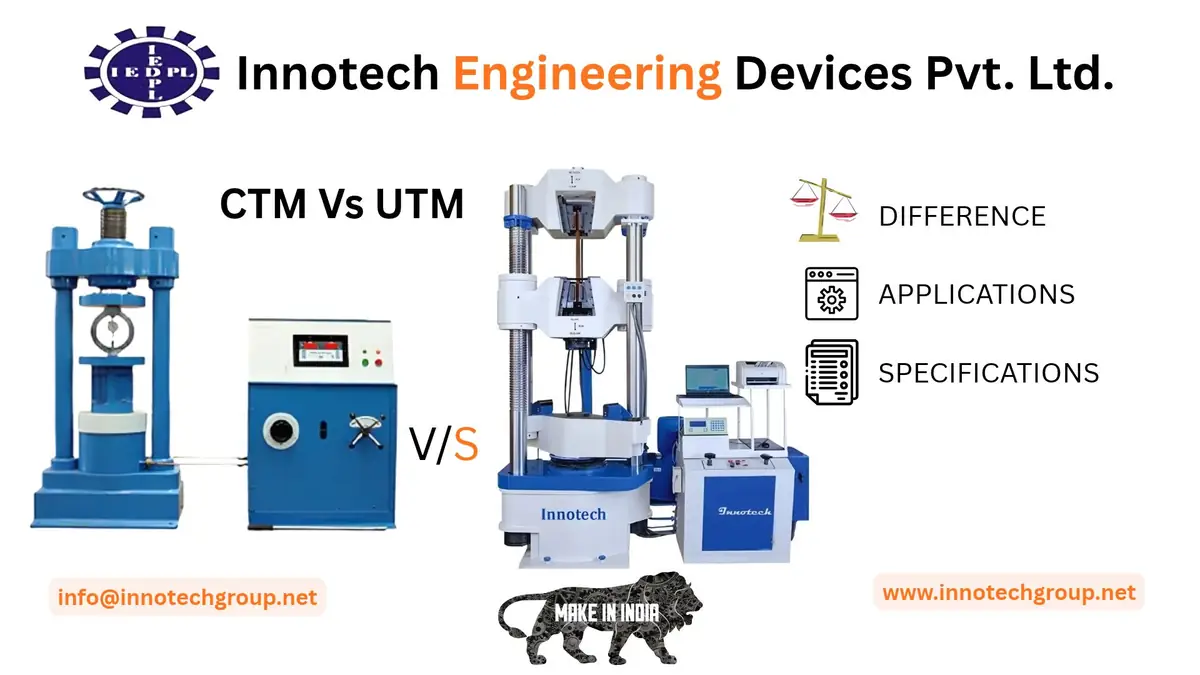
Compression Testing Machine vs Universal Testing Machine (UTM): Key Differences, Uses and Which One to Choose
If you are planning to purchase a Compression Testing Machine or Universal Testing Machine (UTM) for your laboratory, manufacturing plant or quality-control department, the right choice depends on the materials you test and the mechanical properties you need to measure. A Compression Testing Machine is primarily designed to evaluate how a specimen behaves under compressive force, while a Universal Testing Machine can perform compression testing as well as other mechanical tests, such as tensile and flexural testing, when equipped with the appropriate fixtures and accessories.
Innotech Engineering Devices Private Limited manufactures and supplies industrial testing machines and laboratory equipment from Bhiwadi, Rajasthan, India. If you need a dedicated compression testing solution or a versatile UTM for multiple testing applications, your choice should be based on test requirements, maximum force, specimen dimensions, applicable standards and budget.
Explore our Compression Testing Machines and related equipment(https://innotechgroup.net/categories) or view the
Servo Control Electro Mechanical Universal Testing Machine – 200 kN (https://innotechgroup.net/products/servo-control-electro-mechanical-universal-testing-machine-200kn) to understand one available UTM configuration.
What Is a Compression Testing Machine?
A Compression Testing Machine is used to determine how a material or component responds when a compressive force is applied. During a compression test, the specimen is positioned between suitable compression platens or fixtures, and the machine applies a controlled load according to the required test procedure.
The test can help determine properties such as compressive strength, deformation under load, load-bearing capacity and failure behaviour, depending on the specimen, test method and measurement system.
Compression testing is used for suitable materials and products such as concrete specimens, building materials, plastics, foam, packaging materials, rubber components and other products that experience compressive loading. The correct machine type and capacity depend on the intended application.
For example, testing concrete cubes may require a dedicated compression testing machine designed for the relevant concrete testing procedure. Testing a plastic specimen under compression may instead require a suitable materials testing system configured with appropriate compression fixtures.
What Is a Universal Testing Machine (UTM)?
A Universal Testing Machine (UTM) is a materials testing system designed to perform different types of mechanical tests using suitable grips, fixtures, platens and accessories.
Depending on its design and configuration, a UTM can perform:
- Tensile Testing: Evaluates how a material behaves when pulled.
- Compression testing: Evaluates how a specimen responds to compressive force.
- Flexural or bending testing: Measures behaviour under bending loads.
- Shear testing: Evaluates resistance to force acting paralllel to a material's surface or section.
- Peel or adhesion testing: Evaluates seperation force for suitable bonded or layered materials.
Not every UTM performs every test automatically. The machine must have the appropriate load capacity, operating mode, fixtures, measurement system and software for the required test.
A UTM can be particularly useful for laboratories that test different materials or need to perform more than one type of mechanical test using a shared machine platform.
Difference Between Compression Testing Machine and Universal Testing Machine
The main difference is the range of testing applications. A Compression Testing Machine is focused on compressive loading, whereas a UTM is designed to support multiple types of mechanical testing, depending on its configuration.
Compression Testing Machine vs UTM: Comparison Table
| Comparison parameter |
Compression Testing Machine |
Universal Testing Machine (UTM) |
| Main Purpose | Evaluates material or component behaviour under compression | Performs different mechanical tests, depending on configuration |
| Primary loading | Compressive force | Tensile, compressive and other supported loading models |
| Types of tests | Mainly compression testing | May include tensile, compression, flexural, shear, peel and other tests |
| Specimen arrangement | Commonly uses compression platens or application-specific supports | Uses suitable grips, compression platens and test fixtures |
| Material applications | Depends on machine type, may include concrete, plastics, packaging and other materials | May include metals, plastics, rubber, composites, wires and engineering components |
| Testing flexibility | Focused on compression applications | Broader testing flexibility |
| Accessories | Compression platens and applicaion-specific fixtures | Different grips, compression platens, bending fixtures and other compatible accessories |
| Test data | Depends on the model and measurement system | May include load, displacement, stress, strain and test curves, depending on configuration |
| Laboratory requirements | Suitable when compression testing is the primary requirements | Suitable when multiple mechanical test types are needed |
| Selection priority | compression load, specimen size, platen arrangement and test standard | Load capacity, test types, fixtures, measurement accuracy and software |
| Cost considerations | Depends on machine type, capacity controls and accessories | Depends on capacity, drive system, controls, software and included fixtures |
| Best suited for | Dedicated compression testing tasks | Laboratories requirring multiple supported mechanical tests |
Important: These are general differences. Actual capabilities depend on the machine design. Some specialised compression testing machines have advanced controls, while some UTMs require additional fixtures or software before they can perform a particular test.
Working Principle: Compression Testing Machine vs UTM
Working Principle of a Compression Testing Machine
The specimen is placed between compression platens or suitable supports. The machine applies a controlled compressive force, and the measurement system records the load and, where available, displacement or deformation.
The test continues according to the specified procedure. The operator or software evaluates the resulting measurements to determine the required compressive properties or whether the specimen meets the defined acceptance criteria.
The test speed, maximum load, specimen dimensions and result calculations depend on the applicable material test method.
Working Principle of a Universal Testing Machine
A UTM applies a controlled force to a specimen using a suitable test arrangement. For tensile testing, the specimen is held between grips and pulled. For compression testing, the specimen is placed between compression platens. For flexural testing, the appropriate bending fixture is installed.
A load cell measures force, while additional sensors or an extensometer may measure displacement or strain, depending on the test requirements. The control system records the measurements and can generate test curves or calculate selected properties when the required software and measurement accessories are available.
The operating procedure must match the material, test type and applicable standard.
Applications of a Compression Testing Machine
Compression testing equipment is used in industries where materials or products must withstand compressive forces.
1. Construction and Building Materials
Suitable compression testing machines are used to evaluate the compressive strength of concrete specimens and other construction materials under the relevant test procedures.
2. Plastics and Polymers
Compression tests can help assess the deformation and compressive behaviour of suitable rigid plastics and polymer specimens.
3. Packaging Materials
Appropriate equipment can be used to evaluate the compression resistance of packaging products, containers and other suitable specimens.
4. Rubber, Foam and Elastomers
Compression testing can help assess deformation and load response in suitable rubber, foam and elastomeric materials.
5. Quality Control Laboratories
Manufacturers can compare test results against internal specifications, product requirements and applicable standards.
The required load capacity and test configuration differ across these applications. A concrete compression testing machine, for example, should not be assumed to be interchangeable with a machine designed for small polymer specimens.
Applications of a Universal Testing Machine
A Universal Testing Machine can support several mechanical testing applications when the required accessories and configuration are available.
1. Metal and Steel Testing
A suitable UTM can be used for tensile testing and other supported mechanical tests on metal specimens to evaluate strength and deformation behaviour.
2. Plastic and Polymer Testing
With suitable fixtures, a UTM can support tensile, compression and flexural tests on compatible plastic specimens.
3. Rubber and Elastomer Testing
Appropriate grips and fixtures can be used to assess tensile or compression behaviour and other supported properties of rubber materials.
4. Composite Material Testing
A suitably configured machine can be used for selected mechanical tests on compatible composite specimens.
5. Wire, Cable and Fastener Testing
Suitable grips and fixtures allow certain UTMs to test tensile strength or other specified mechanical properties of wires, cables, fasteners and related products.
6. Research and Development
A UTM can support product development, material comparison and design validation when the required test methods and measurement accessories are available.
7. Industrial Quality Assurance
Manufacturers can use a properly configured UTM for routine inspection and material testing across different production requirements.
Which Machine Is Better for Compression Testing?
Neither machine is automatically better in every situation. The best choice depends on the specific compression test you need to perform.
Choose a dedicated Compression Testing Machine when compression testing is your main requirement and the machine is designed for your specimen type, test load and applicable standard.
Consider a Universal Testing Machine when you need compression testing along with tensile, flexural or other supported mechanical tests. A UTM may reduce the need to purchase separate machines for different test types, provided the required fixtures and configuration are available.
Before making a decision, confirm:
- The material and specimen dimensions
- The maximum force required during testing
- The type of test and required result
- The applicable testing standard
- The required platen, grips or other fixtures
- The measurement accuracy and calibration requirements
- Whether computerized controls, data recording or test reports are needed.
- the total cost, including necessary accessories and installation
Compression Testing Machine vs UTM: Which Is More Cost-Effective?
The price of a Compression Testing Machine or UTM depends on its intended application, capacity, drive system, controls, measurement arrangement and accessories.
A dedicated compression machine may be a practical investment when your laboratory performs a specific compression test repeatedly. A UTM may offer greater value when you need multiple types of mechanical testing and can use one machine with interchangeable fixtures.
However, a UTM is not necessarily cheaper than a dedicated compression machine. The initial price and operating cost depend on the actual configuration. Consider the complete system cost, including accessories, software, calibration, installation, maintenance and any future testing requirements.
For an accurate quotation, share your test requirements with the supplier instead of comparing machines by price alone.
How to Choose the Right Testing Machine
Use the following checklist before requesting a quotation.
Step 1: Identify the test. Decide whether you need compression testing only or a combination of tensile, compression and flexural tests.
Step 2: Confirm the material. Specify whether you will test concrete, metal, plastic, rubber, composites, packaging or another material.
Step 3: Determine the required load capacity. Select the capacity based on the expected test force and applicable test procedure. Avoid choosing a machine solely because it has a higher capacity.
Step 4: Check specimen dimensions. Confirm the available test space, platen size, grip arrangement and specimen mounting requirements.
Step 5: Confirm the testing standard. Identify the required ASTM, ISO, BIS or other applicable standard. Confirm that the proposed configuration can perform the required method.
Step 6: Review measurement and reporting. Ask whether load, displacement, strain, test curves and reports are required, and confirm which are supported by the proposed model.
Step 7: Compare the full quotation. Check the machine, included accessories, software, installation, calibration requirements, warranty and after-sales support.
Compression Testing Machine and UTM Solutions from Innotech
Innotech Engineering Devices Private Limited manufactures and supplies industrial testing machines and laboratory equipment from Bhiwadi, Rajasthan, India.
If your requirement is primarily compression testing, explore our [Compression Testing Machines and related equipment](https://innotechgroup.net/categories) to review the available product range and identify a suitable solution.
If you need a machine for multiple mechanical tests, view our [Servo Control Electro Mechanical Universal Testing Machine – 200 kN](https://innotechgroup.net/products/servo-control-electro-mechanical-universal-testing-machine-200kn). This model is described for tensile, compression, bending, shear, peel and other supported tests, depending on the selected fixtures and configuration.
For the right recommendation, share your material type, specimen dimensions, required load capacity, testing standard and the tests you need to perform. Our team can discuss the appropriate machine configuration and quotation.
Frequently Asked Questions
1. What is the main difference between a Compression Testing Machine and a UTM?
A Compression Testing Machine is primarily designed for compression tests. A Universal Testing Machine can perform compression testing and other mechanical tests, such as tensile or flexural testing, when equipped with suitable fixtures and controls.
2. Can a Universal Testing Machine perform compression testing?
Yes. A UTM can perform compression tests when it has the appropriate compression platens, load capacity, control settings and measurement system for the required test procedure.
3. Is a Compression Testing Machine used only for concrete?
No. Different types of compression testing machines are used for different materials, including concrete, plastics, packaging, foam and other suitable specimens. The machine must match the application and test standard.
4. Which machine is suitable for tensile and compression testing?
A suitably configured Universal Testing Machine is often a good choice when both tensile and compression testing are required. Confirm that the machine includes the required grips, compression platens, load capacity and software.
5. Is a UTM suitable for a quality-control laboratory?
Yes. A UTM can be suitable for quality-control laboratories that need to test different materials or perform multiple mechanical tests. The configuration should match the laboratory's actual testing requirements.
6. What affects the price of a Compression Testing Machine?
Price depends on the machine type, load capacity, frame design, control system, measurement accuracy, test fixtures, applicable standards and other included features.
7. What affects the price of a Universal Testing Machine?
UTM pricing depends on capacity, drive system, control and measurement system, software, grips, fixtures, extensometers and other accessories. Installation and service requirements may also affect the total cost.
8. How do I choose the right machine capacity?
Start with the maximum expected test force, specimen dimensions and relevant test standard. Ask the manufacturer to recommend a suitable capacity and measurement range for your specific application.
9. Can a UTM perform bending or flexural testing?
Many UTMs can perform bending or flexural tests when supplied with the appropriate fixture and compatible control and measurement arrangements. Confirm the required test method before purchasing.
10. Where can I buy a Compression Testing Machine or UTM in India?
Innotech Engineering Devices Private Limited supplies industrial testing machines and laboratory equipment from Bhiwadi, Rajasthan, India. Contact the team with your application details to discuss suitable configurations and pricing.
Request a Quotation from Innotech
Need help selecting a Compression Testing Machine or Universal Testing Machine in India? Innotech Engineering Devices Private Limited can discuss your material testing requirements and help you identify a suitable configuration.
Phone: +91 9810431604
Email: info@innotechgroup.net
Website: www.innotechgroup.net
Address: H-307 (Corner), RIICO Industrial Area, Karoli, Tapukara, Bhiwadi, Rajasthan – 301707, India.
Share your test type, material, specimen dimensions, required load capacity and applicable standard to request a quotation.
Category: Industrial Testing Machines / Material Testing
Tags: Compare a Compression Testing Machine vs UTM, including uses, working principles, differences, applications and buying tips. Explore Innotech solutions.
Last Updated: 21 October 2026