
Colour Matching Cabinet: Working Principle, Uses, Light Sources, Standards & Buying Guide
Jay Pal Singh
24 November 2026
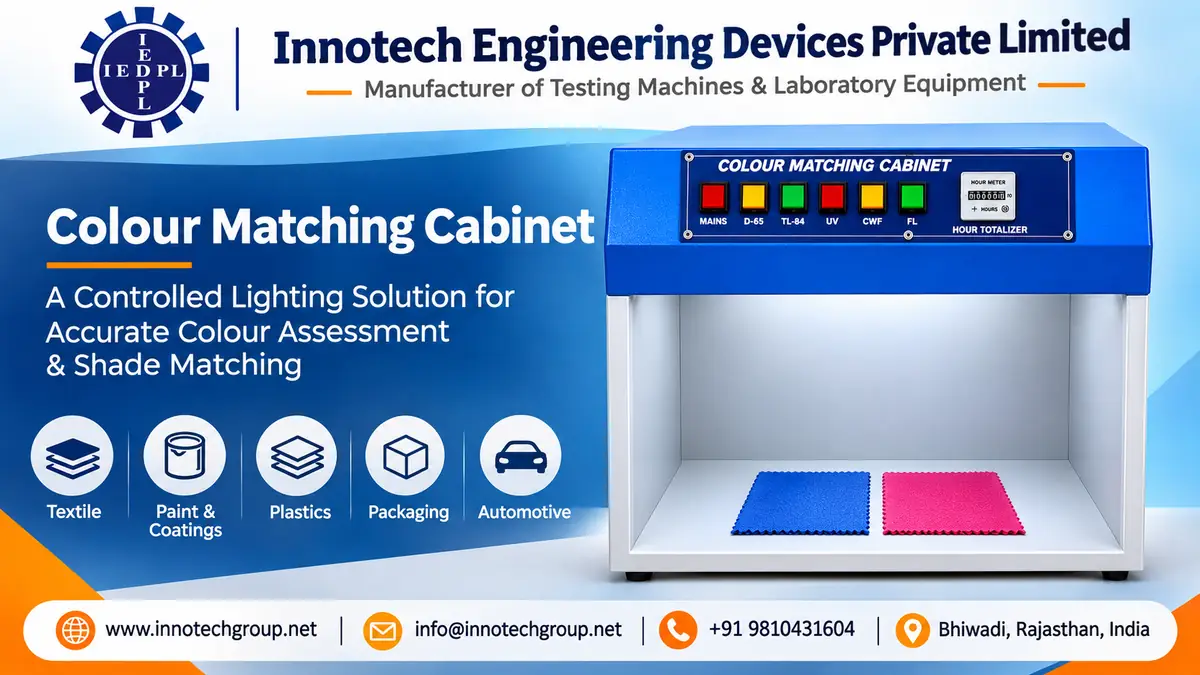
Colour Matching Cabinet: Working Principle, Uses, Light Sources, Standards & Buying Guide
Have you ever noticed that two fabric samples look identical in daylight but appear different under shop lighting? Or that a plastic component matches its approved colour sample in the factory but looks noticeably different after installation?
This happens because the appearance of colour depends on the light source, material and viewing conditions.
For textile manufacturers, garment exporters, paint producers, plastic moulders and packaging companies, even a small shade difference can lead to rejected batches, rework and customer complaints.
A Colour Matching Cabinet helps address this problem by providing controlled lighting conditions for visual colour comparison.
In this guide, we explain the Colour Matching Cabinet working principle, uses, light sources, industry standards, applications, specifications and important factors to consider before buying a machine in India.
What Is a Colour Matching Cabinet?
A Colour Matching Cabinet, also called a Color Matching Cabinet Machine, Colour Assessment Cabinet, Shade Matching Cabinet or Colour Matching Light Box, is a laboratory instrument used to compare the colour appearance of materials under selected lighting conditions.
It provides a controlled viewing environment where an approved reference sample and a production sample can be examined side by side.
Unlike ordinary room lighting, the cabinet uses selected illuminants to help operators evaluate shade consistency under repeatable conditions.
It is commonly used for:
- Visual shade matching
- Colour consistency inspection
- Metamerism assessment
- Production batch approval
- Supplier sample evaluation
- Product development and quality control
A colour matching cabinet supports human visual assessment. It does not automatically measure numerical colour difference (ΔE) like a spectrophotometer.
Why Is a Colour Matching Cabinet Important?
Colour is an important product-quality characteristic in industries where customers expect a consistent appearance.
Consider a garment manufacturer producing 5,000 shirts. If the sleeves and body panels come from different fabric lots, they may appear identical under factory lighting but noticeably different in a retail showroom.
A similar issue occurs when painted metal and plastic automotive components must match.
Using a colour matching cabinet helps manufacturers:
- identify shade differences before dispatch
- compare production samples against approved references
- Evaluate colour appearance under different illuminants
- Detect potential metamerism
- Impove communication between suppliers and buyeres
- Reduce avoidable shade-related rejections
- Establish more consitent visual inspection procedures
The cabinet does not guarantee that all colour differences will be eliminated. Reliable results also depend on trained observers, appropriate standards and correct sample preparation.
Colour Matching Cabinet Working Principle
The working principle of a Colour Matching Cabinet is based on visual comparison under controlled illumination.
When light strikes a material, certain wavelengths are absorbed and others are reflected. The reflected light reaches the observer's eyes and contributes to the perceived colour.
Changing the spectral composition of the light can change how the same material appears.
A colour matching cabinet contains selected light sources within a controlled viewing enclosure. The operator compares a test sample against a reference under one illuminant and then repeats the comparison under other illuminants.
Main Components
| Component |
Function |
| Viewing chamber | Provides a controlled environment for sample comparison |
| D65 light source | Supports a daylight colour assessment |
| TL84 / F11 source | Represents a type of retail fluorescent illumination |
| CWF source | Provides cool white fluorescent illumination |
| Illuminant A | Supports warm incandescent-light assessment |
| UV source | Helps evaluate fluorescence and optical brighteners |
| Neutral grey interior | Reduces unwanted backgroud colour influence |
| Control switches | Allow selection of the required light source |
| Lamp-hour meter | Helps monitor lamp usage where fitted |
The actual number of light sources and cabinet features depends on the selected model.
How to Use a Colour Matching Cabinet – Step-by-Step
Correct operation is essential for meaningful visual colour comparison.
Step 1: Prepare the samples
Select an approved reference and a representative production sample. Ensure they are clean, dry and appropriately conditioned.
Step 2: Check the viewing chamber
Remove unrelated objects and ensure the neutral background and light sources are in suitable condition.
Step 3: Position the specimens
Place both samples close together in the prescribed viewing arrangement. Maintain consistent orientation, particularly for textured or directional materials.
Step 4: Select the primary illuminant
Switch on the required light source, commonly D65 for daylight assessment, and allow any necessary stabilization.
Step 5: Compare the colour appearance
Observe differences in hue, lightness, saturation, shade uniformity and overall appearance.
Step 6: Change the light source
Repeat the comparison under TL84, CWF, Illuminant A or other required illuminants.
Step 7: Check for metamerism
Identify whether samples that match under one light source appear different under another.
Step 8: Record the results
Document the illuminant, specimen identification, observer, viewing conditions and assessment outcome.
Step 9: Make the quality decision
Accept, reject or investigate the sample according to the agreed customer specification.
For reliable comparisons, use the viewing geometry and assessment procedure required by the applicable standard.
5. Colour Matching Cabinet Light Sources Explained
One of the most important purchasing decisions is selecting the correct Colour Matching Cabinet light sources.
Different industries and customers may specify different illuminants.
| Light Source |
Typical Characteristic |
Common Use |
| D65 | Daylight reference, approximately 6500 K | General daylight colour assessment |
| D50 | Daylight reference, approximately 5000 K | Printing and graphic arts |
| TL84 / F11 | Fluorescent illuminant, approximately 4500 K | Retail and textile comparisons |
| CWF | Cool white fluorescent, approximately 4150 K | Commercial and office lighting comparisons |
| Illuminant A | Incandescent reference, approximately 2856 K | Warm indoor-light assessment |
| U30 / TL 83 | Warm fluorescent, approximately 3000 K | Retail and commercial lighting |
| UV | Ultraviolet radiation | Flurescence and optical-brightener assessment |
Important: Colour temperature alone does not establish that a lamp correctly reproduces a standard illuminant. Its spectral characteristics and the cabinet's viewing conditions also matter.
For example, two lamps described as 6500 K may not produce identical colour appearance.
Which Light Sources Should You Choose?
For textile shade matching, D65 and specified retail illuminants are commonly requested.
For printing and graphic arts, D50 may be particularly relevant.
For materials containing fluorescent whitening agents, a suitable UV assessment arrangement can be important.
Before ordering, confirm the illuminants required by your customer's inspection procedure.
6. What Is Metamerism in Colour Matching?
Metamerism occurs when two materials appear to match under one light source but differ under another.
For example, a blue fabric and a blue plastic accessory may look identical under daylight but show different shades under fluorescent lighting.
This can happen because their spectral reflectance characteristics differ.
How Does a Colour Matching Cabinet Help Detect Metamerism?
The operator compares the same specimens under multiple specified illuminants.
If the samples match under D65 but show a noticeable difference under TL84, the observation indicates a possible metameric mismatch.
This is particularly important when products contain components made from different materials, dyes or pigments.
A cabinet helps detect visual metamerism; it does not necessarily calculate a numerical metamerism index.
Industries Where Colour Matching Cabinets Are Used
A Colour Matching Cabinet for textile and industrial testing is relevant to many manufacturing sectors.
| Industry |
Typical Application |
| Textile manufacturing | Fabric shade matching and dye-lot comparison |
| Garment industry | Colour matching of garment panels and accessories |
| Dyeing and finishing | Assessment of dyed samples and production batches |
| Paint and coatings | Comparison of coated panels and colours standards |
| Plastic manufacturing | Matching moulded components against approved samples |
| Automotive industry | Interior trim, upholstery and component colour comparison |
| Printing industry | Visual assessment of printed colours |
| Paper and packaging | Colour consitency of paperboard and printed packaging |
| Leather and footwear | Shade matching of leather, synthetic leather and accessories |
| Furniture and laminates | Matching decorative surfaces and finishing materials |
The required cabinet configuration may differ between industries.
Colour Matching Cabinet Industry Standards
Industry standards help define appropriate viewing conditions and assessment procedures.
| Standard |
Relevance |
| ASTM D1729 | Visual appraisal of colours and colour differences of diffusely illuminated opaque materials |
| ISO 3664 | Viewing conditions for graphic technology and photography |
| ISO 105-A02 | Grey scale for assessing colour change in textiles |
| ISO 3668 | Visual comparison of the colour of paints |
| ISO 105-A03 | Grey scale for assessing staining in textiles |
These standards do not all describe the same equipment or application.
For example, ISO 3664 is particularly relevant to graphic technology, while ISO 105-A02 and ISO 105-A03 address textile assessment scales rather than cabinet construction.
Buyers should confirm the applicable edition, required illuminant, viewing geometry and other conditions before claiming compliance.
Colour Matching Cabinet vs Spectrophotometer
A common buyer question is whether a colour matching cabinet can replace a spectrophotometer.
| Colour Matching Cabinet |
Spectrophotometer |
| Suppports visual colour comparison | Measures spectral reflectance of transmittance |
| Uses human observers | Produces numerical measurement data |
| Helps identify visual metamerism | Can support quantitative colour and metamerism calculations |
| Suitable for appearance approval | Suitable for measurement-based colour control |
| Depends on viewing conditions and observer | Depends on instrument geometry, calibration and measurement settings |
For demanding colour-control applications, both instruments may be used together.
What Should You Know Before Buying a Colour Matching Cabinet?
If you are planning to purchase a Colour Matching Cabinet Machine in India, evaluate more than the number of lamps or cabinet dimensions.
Essential Buying Checklist
- Application: Is the cabinet for textiles, plastics, paint, printing or another mateials?
- Light sources: Which illuminants does your customer require?
- Viewing area: Can the cabinet accommodate the largest sample?
- Viewing geometry: Does it support the required assessment method?
- Neutral background: Is the interior suitable for controlled visual comparison?
- Lamp performance: Are the illuminates apprpriate for the specific procedure?
- Lamp monitoring: Are hour meters switching or programmable sequencing?
- Controls: Do you need manual switching or programmable sequencing?
- Documentation: Are operating instructions and inspection records supplied?
- Maintenance: Can lamps and other components be replaced conveniently?
- Customization: Can the maniufacturer accommodate special samples or fixtures?
- Technical support: Are installation guidance and service arrangements available?
Common Buying Mistakes
- Choosing a cabinet only because it has more light sources
- Assuming all D65-labelled lamps have identical spectral performance
- Confusing lamp-hour display resolution with colour measurement accuracy
- Ignoring viewing geometry and sample size
- Assuming UV lamps are interchangeable
- Purchasing without confirming the customer's required standard
- Expecting the cabinet to measure ΔE automatically
Colour Matching Cabinet Price in India
The Colour Matching Cabinet price depends on the required configuration rather than one universal specification.
Major factors include:
- Number and type of light sources
- Cabinet dimensions and construction
- Lamp quality and spectral requirements
- Manual or automatic switching
- Lamp-hour monitoring
- Sample positioning accessories
- Standards-related performance requirements
- Documentation and customization
A compact cabinet for routine fabric comparison may have different requirements from a large assessment booth used for automotive components.
For an accurate quotation, share the material type, required illuminants, specimen dimensions, standards and expected testing frequency.
Colour Matching Cabinet Manufacturer in India – Why Choose Innotech?
When searching for a Color Matching Cabinet Manufacturer in India, buyers should evaluate technical understanding, equipment configuration, manufacturing capability and service arrangements.
Innotech Engineering Devices Private Limited is a manufacturer of industrial testing machines and laboratory equipment based in Bhiwadi, Rajasthan.
We welcome enquiries for application-specific colour matching cabinets with customer-selected light sources, viewing areas, controls and accessories, subject to technical feasibility.
For buyers searching for a Colour Matching Cabinet Manufacturer in Rajasthan, Color Matching Cabinet Manufacturer in Bhiwadi, or Colour Matching Cabinet Supplier in India our team can review the required application and provide a suitable technical proposal.
We serve industrial customers across India, including Delhi NCR, Haryana, Rajasthan, Gujarat, Maharashtra, Karnataka, Tamil Nadu and Telangana.
Our approach is to help buyers identify a suitable equipment configuration rather than recommend one fixed cabinet for every application.
Frequently Asked Questions About Colour Matching Cabinets
What is the main purpose of a Colour Matching Cabinet?
It provides controlled lighting for comparing the colour appearance of reference and production samples.
What is the difference between D65 and TL84?
D65 is a daylight reference illuminant, while TL84 represents a fluorescent lighting condition commonly associated with retail environments.
Can a Colour Matching Cabinet detect metamerism?
Yes. Comparing samples under different illuminants can reveal visual metameric differences.
Is a Colour Matching Cabinet suitable for textile testing?
Yes. It is commonly used for fabric shade comparison, dyed yarn inspection and garment colour approval.
Does a Colour Matching Cabinet measure colour accuracy?
A conventional cabinet supports visual assessment. Numerical colour measurements require suitable measurement instruments.
What is the best Colour Matching Cabinet in India?
The best choice depends on the required illuminants, sample dimensions, viewing conditions, relevant standards and service requirements.
Can a Colour Matching Cabinet be customized?
Yes. Cabinet size, lighting arrangements, controls and sample fixtures can be specified according to technical feasibility.
Where can I find a Colour Matching Cabinet supplier near me?
Buyers can search for manufacturers by location and confirm their ability to supply the required configuration. Innotech accepts enquiries from customers throughout India.
Request a Colour Matching Cabinet Quotation
Looking for a reliable Colour Matching Cabinet Manufacturer and Supplier in India?
Whether you require a textile shade matching cabinet, multi-light-source colour assessment booth or customized visual inspection arrangement, contact Innotech Engineering Devices Private Limited with your application and technical requirements.
Company: Innotech Engineering Devices Private Limited
Manufacturing Location: Bhiwadi, Rajasthan, India
Email: info@innotechgroup.net
Phone: +91 9810431604
Request technical specifications or a customized quotation for your colour matching application.
Category: Textile Testing Equipment
Tags: Colour Matching Cabinet Machine, Color Matching Cabinet Manufacturer in India, Colour Matching Cabinet Light Sources, Colour Matching Cabinet for Textile, Colour Matching Cabinet Price, Metamerism Testing
Last Updated: 24 November 2026