
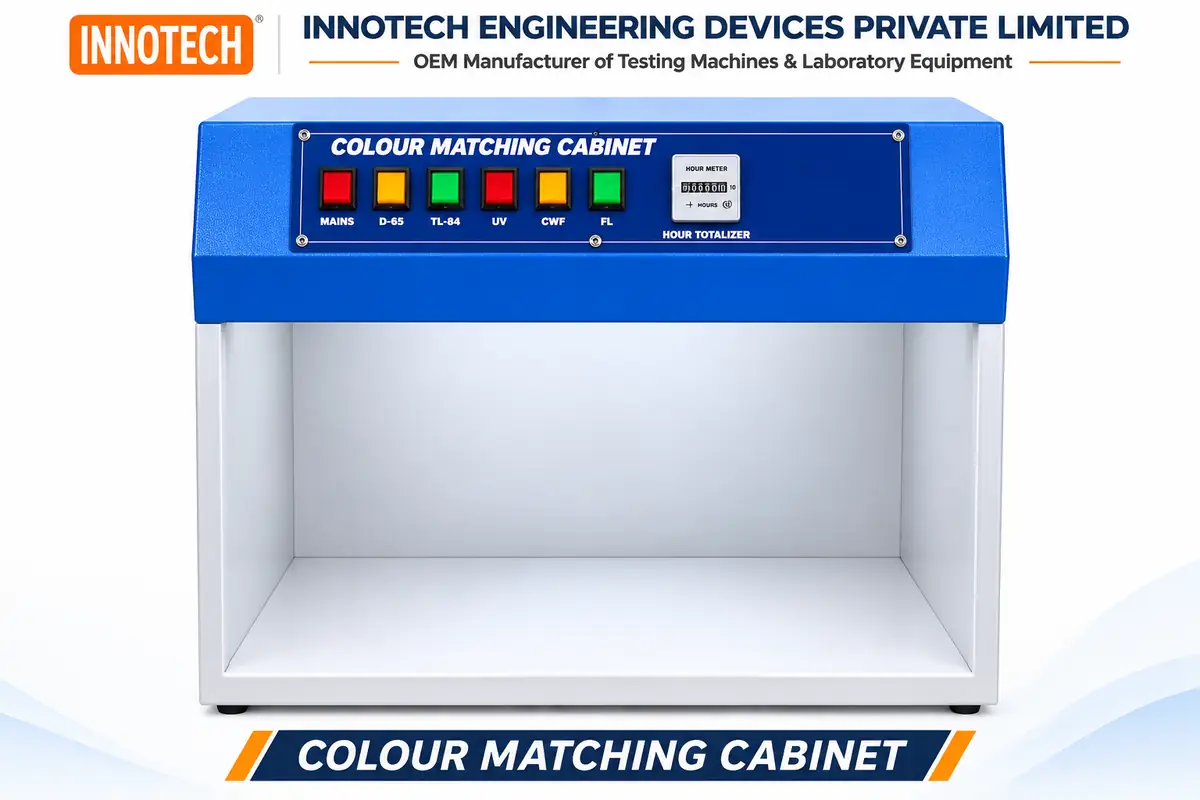
Colour Matching Cabinet – Multi-Light Source Color Assessment Machine
Colour Matching Cabinet – Multi-Light Source Color Assessment Machine
The Colour Matching Cabinet by Innotech Engineering Devices Private Limited is designed for visual colour assessment, shade matching and metamerism evaluation under controlled lighting conditions. Suitable for textiles, garments, plastics, paints, printing, packaging and quality control laboratories, this colour matching cabinet machine can be configured with D65, TL84, CWF, UV, incandescent and other application-specific light sources. Available with customizable viewing areas, lighting arrangements and control options, it helps manufacturers compare samples with approved colour standards. Manufactured in Bhiwadi, Rajasthan, India, for industrial and laboratory requirements.
MODEL
ICMC
OVERVIEW
Description
Colour Matching Cabinet – Manufacturer in Bhiwadi India
The Colour Matching Cabinet is a laboratory and industrial quality control instrument used to visually compare colours under controlled lighting conditions. Also known as a Color Matching Cabinet Machine, Colour Matching Light Box, Shade Matching Cabinet or Color Assessment Booth, it helps manufacturers evaluate shade consistency, colour differences and metamerism before product approval.
Innotech Engineering Devices Private Limited is a manufacturer of industrial testing machines and laboratory equipment based in Bhiwadi, Rajasthan, India. Our Colour Matching Cabinet solutions are offered according to customer requirements, including viewing area, light-source combinations, controls and sample-handling needs.
What Is a Colour Matching Cabinet Machine?
A Colour Matching Cabinet provides a controlled viewing environment for comparing a production sample with an approved colour standard.
Colours may appear different under daylight, retail lighting, office lighting or incandescent illumination. A sample that matches a reference under one light source may show a visible difference under another.
The cabinet allows operators to examine samples under selected illuminants, helping identify potential colour inconsistencies before production approval, dispatch or customer inspection.
It is widely used in textile laboratories, garment manufacturing, printing, paint production, plastics, packaging, automotive components and other industries where visual appearance is important.
Colour Matching Cabinet Working Principle
The working principle of a Color Matching Cabinet is based on controlled illumination and visual comparison.
A reference sample and production sample are placed side by side inside the viewing booth. The operator selects a suitable light source and compares the colour appearance under standardized viewing conditions.
The process generally involves:
1. Placing the approved reference and test sample in the viewing area.
2. Selecting the required light source, such as D65 daylight.
3. Allowing appropriate lamp stabilization where required.
4. Comparing shade, tone, brightness and visible colour differences.
5. Switching to additional light sources, such as TL84 or CWF.
6. Checking whether the samples continue to match under different lighting conditions.
7. Recording the observations and deciding whether the sample meets the approved visual acceptance criteria.
For repeatable results, the observer, viewing geometry, background, sample condition and light-source performance must be controlled.
Colour Matching Cabinet Light Sources – D65, TL84, CWF, UV and Incandescent
Different light sources are used to evaluate colour appearance under different illumination conditions.
| Light Source |
Typical Description |
Application |
| D65 | Standard daylight illuminant, approximately 6500 K | General daylight colour assessment |
| TL84 / F11 | Retail-type fluorescent illuminati, approximately 4000 K | Garments, textiles and retail product assessment |
| CWF | Cool White fluorescent lighting, approximately 4150 K | Office and commercial lighting comparisons |
| Illuminant A | Tungsten/incandescent reference approximately 2856 K | Warm indoor lighting evaluation |
| U30 / TL83 | Warm fluorescent lighting, approximately 3000 K | Retail and indoor lighting comparisons |
| UV | Ultraviolet illumination | Assessment fo fluorescence and optical brightener response |
These are typical illuminant descriptions. Actual spectral performance, lamp type, quantity and suitability depend on the selected cabinet configuration.
Why Are Multiple Light Sources Important?
A product may appear acceptable in daylight but show a shade difference under store lighting.
Using multiple illuminants helps manufacturers identify metamerism, where samples with different spectral reflectance characteristics appear to match under one illumination condition but differ under another.
This is particularly important for dyed fabrics, printed packaging, plastic components, coatings and products assembled from materials supplied by different vendors.
Colour Matching Cabinet for Textile and Garment Industries
A Colour Matching Cabinet for textile applications supports visual inspection of dyed fabrics, yarns, garments, accessories and finished textile products.
Textile manufacturers can use the cabinet for:
- Fabric shade matching against approved standards
- Dye-lot and batch colour consistency checks
- Yarn and thread shade evaluation
- Garment panel colour comparison
- Textile accessory matching
- Metamerism assessment
- Pre-dispatch visual quality inspection
- Customer sample approval
A controlled viewing environment helps reduce disagreements caused by differences in ambient lighting.
Colour Matching Cabinet Manufacturer in Bhiwadi, Rajasthan, India
Innotech Engineering Devices Private Limited manufactures testing machines and laboratory equipment in Bhiwadi, Rajasthan.
As a Color Matching Cabinet Manufacturer in India, Innotech can discuss customer-specific requirements for viewing dimensions, lighting arrangements, operating controls and inspection applications.
Industrial buyers looking for a Colour Matching Cabinet Supplier in Rajasthan, a Color Matching Cabinet Manufacturer in Bhiwadi, or laboratory equipment suppliers serving Delhi NCR and other Indian industrial regions can contact our technical team.
International buyers and distributors may also submit their requirements for technical evaluation and quotation.
How to Select the Right Colour Matching Cabinet
Before purchasing, consider the following:
1. Industry and material: Identify whether the cabinet will be used for textiles, paints, plastics, packaging or other products.
2. Light-source requirements: Confirm which illuminants are required by your customer or internal inspection procedure.
3. Sample dimensions: Select a viewing chamber large enough to accommodate the reference and test samples.
4. Viewing conditions: Check the viewing geometry, neutral background and lighting requirements.
5. Controls: Decide whether individual switches, lamp-hour meters or automatic light sequencing are necessary.
6. Standards: Identify any applicable customer, ASTM, ISO or other visual colour assessment requirements.
7. Maintenance: Confirm lamp availability, replacement procedures and performance verification arrangements.
8. Documentation: Request a technical data sheet, operating instructions and agreed inspection documentation.
Colour Matching Cabinet Standards and Visual Assessment
The following standards may be relevant, depending on the application:
| Standard |
Application |
| ASTM D1729 | Visual appraisal of colours differences under specified viewing conditions |
| ISO 3664 | Viewing conditins for graphic technolofy and photography |
| ISO 105-A02 | Grey scale for assessing change in textile colour |
| ISO 105-A03 | Grey scale for assessig staining in textile testing |
ISO 105-A02 and ISO 105-A03 concern textile assessment scales; they are not general cabinet certification standards.
The applicable standard must be selected according to the material, customer requirements and inspection method. Compliance should be claimed only when the particular cabinet configuration has been verified against the relevant requirements.
Frequently Asked Questions
What is a Colour Matching Cabinet used for?
It is used for visual shade matching, colour consistency inspection and metamerism evaluation under controlled lighting conditions.
What is the difference between a Colour Matching Cabinet and a spectrophotometer?
A colour matching cabinet supports human visual comparison. A spectrophotometer measures spectral characteristics and can support numerical colour calculations. They are complementary instruments, not interchangeable devices.
Which light sources are used in a Color Matching Cabinet?
Common options include D65, TL84, CWF, Illuminant A, U30 and UV, depending on the required application.
Can a Colour Matching Cabinet be customized?
Yes. Chamber dimensions, light-source combinations, controls and sample fixtures can be specified according to customer requirements, subject to design feasibility.
Is a Colour Matching Cabinet suitable for textiles?
Yes. It is commonly used to compare fabric shades, dyed yarns, garments and textile accessories under selected lighting conditions.
What affects Colour Matching Cabinet price?
The light-source combination, chamber dimensions, construction, controls, lamp-hour monitoring, accessories and technical requirements influence the quotation.
Where can I buy a Colour Matching Cabinet in India?
Buyers can contact Innotech Engineering Devices Private Limited, Bhiwadi, Rajasthan, for application discussions, technical specifications and customized equipment enquiries.
Request Technical Specifications and a Quotation
Looking for a Colour Matching Cabinet Manufacturer in India for textile, plastics, paint, printing or industrial quality control applications?
Contact Innotech Engineering Devices Private Limited with your required light sources, sample dimensions, inspection procedure and preferred controls.
Email: info@innotechgroup.net
Phone: +91 9810431604
Manufacturing Location: Bhiwadi, Rajasthan, India
WHY IT WORKS
Key benefits
Consistent visual colour assessment
Early detection of shade variation and metamerism
Improved batch-to-batch colour inspection
Reduced influence of ambient lighting
Support for customer shade approvals
Configurable lighting and viewing arrangements
Better supplier-to-customer colour communication
USE CASE
Application range
BUILT IN
Features
Multiple illuminant configurations
Neutral grey viewing chamber
Manual or optional programmable lamp selection
Optional lamp-hour monitoring
Customizable sample viewing area
Suitable sample holders and viewing fixtures
Powder-coated industrial construction options
Accessible electrical and lamp components
SPEC
Specifications
Product
Colour Matching Cabinet / Color Assessment Booth
Application
Visual colour comparison and shade assessment
Light Sources
D65, TL84, CWF, Illuminant A, U30, UV or selected combinations
Number of Illuminants
Typically 3–6 types or as required
Viewing Area
Compact, standard or enlarged chamber; dimensions as required
Viewing Geometry
45°/0° or other method-appropriate arrangement
Interior Finish
Neutral, low-reflectance grey surface
Cabinet Construction
Powder-coated metal or suitable engineered construction
Control System
Individual lamp switching or optional programmable sequencing
Lamp Hour Monitoring
Optional individual or total operating-hour indication
Temperature Management
Ventilation or thermal management according to lamp design
Electrical Supply
Commonly 220–240 V AC, 50 Hz; alternatives subject to design
Accessories
Viewing stand, sample holders, magnets or fixtures
Safety
Electrical protection and suitable enclosure construction
Documentation
Operating instructions and agreed inspection records
Customization
Light sources, chamber size, controls and accessories