
Ball-on-Disc Tribometer: Working Principle, Test Procedure and Comparison with Pin-on-Disc Testing
Jay Pal Singh
28 September 2026
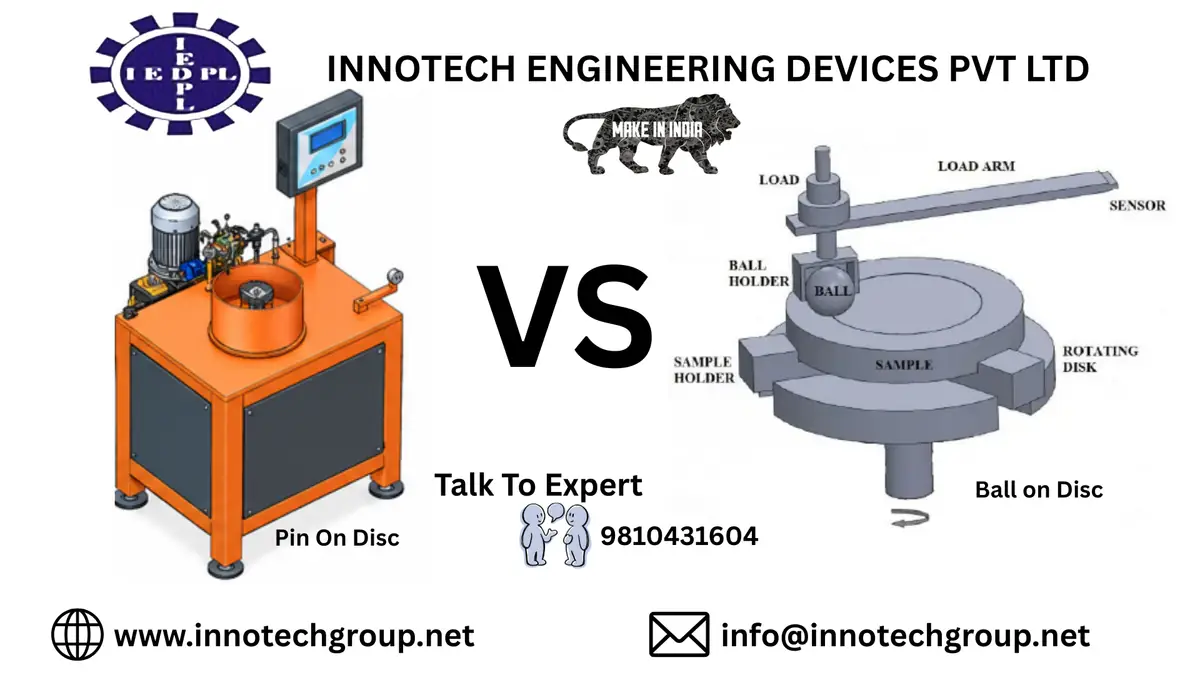
Ball-on-Disc Tribometer: Working Principle, Test Procedure and Comparison with Pin-on-Disc Testing
A material may appear smooth and durable but still experience friction, surface damage and wear when it moves against another surface. A ball-on-disc tribometer helps researchers study this behaviour under controlled testing conditions.
For laboratories evaluating coatings, metals, polymers and other engineering materials, understanding the test setup is important for selecting the right tribometer and interpreting the results.
What Is a Ball-on-Disc Tribometer?
A ball-on-disc tribometer is a testing instrument used to investigate friction and wear between two contacting surfaces. A ball is pressed against a rotating disc under a specified load. The relative movement creates sliding contact, allowing frictional behaviour and surface wear to be evaluated.
The results depend on factors such as the applied load, sliding speed, test duration, material combination, surface finish and environmental conditions.
Working Principle
The test generally follows these steps:
Prepare the specimens: Clean and position the ball and disc according to the test procedure.
Apply the load: Bring the ball into contact with the disc using the specified normal force.
Start rotation: Rotate the disc at the selected speed to create sliding contact.
Monitor friction: Measure frictional force or calculate the coefficient of friction when the instrument supports the required measurements.
Evaluate wear: Examine the resulting wear marks and assess material loss using a suitable measurement method.
Keeping test conditions consistent helps when comparing different materials or surface treatments.
Ball-on-Disc vs Pin-on-Disc Testing
Both methods are used to study friction and wear, but their contact arrangements differ.
| Parameter | Ball-on-disc | Pin-on-disc |
| Contact arrangement |
A ball contacts a rotating disc | A pin contacts a rotating disc |
| Contact geometry | Initially concentrated contact around the ball | Depends on pin-end shape and contact condition |
| Common investigation | Friction and wear involving spherical contact | Friction and wear involving pin-shaped specimens |
| Important considerations | Ball materials, diameter and contact conditions | Pin geometry, dimensions and contact conditions |
The appropiate setup depends on the materials, contact geometry and test objective. Results from the two configurations should not automatically be treated as directly equivalent.
Applications of Ball-on-Disc Testing
Ball-on-disc testing may be used for:
- Evaluting friction and wear of coatings and surface treatments.
- Comparing the tribological behaviour of metals and alloys.
- Investigating polymer and composite material combinations.
- Studing lubricant effects under defined test conditions.
- Supporting research and product development in automotive and mechanical engineering.
- Evaulating surface performance in laboratory research.
The suitability of a particular instrument depends on its configuration and the test requirements.
What Should You Consider When Selecting a Tribometer?
Before choosing a ball-on-disc tribometer, consider the required load range, rotational speed, ball and disc dimensions, friction measurement capability, test duration, data recording and wear-measurement method. Also check whether the equipment can reproduce the contact conditions required by your application.
A clearly defined test procedure is essential because load, speed, surface condition and environmental factors can affect the results.
Frequently Asked Questions
What does a ball-on-disc tribometer measure?
Depending on its instrumentation, it can measure frictional force, support calculation of the coefficient of friction and help evaluate wear through appropriate specimen examination and measurement.
Is ball-on-disc testing the same as pin-on-disc testing?
No. Both investigate friction and wear, but they use different contacting specimen geometries. The choice depends on the application and test method.
Which materials can be evaluated?
Metals, coatings, polymers and composites may be evaluated when the instrument, specimen configuration and test procedure are suitable.
Why are test conditions important?
Load, speed, test duration, surface finish and lubrication can influence friction and wear. Consistent conditions are important for meaningful comparisons.
Consult an Expert
Need help identifying a suitable tribometer for your laboratory or application? Contact Innotech Engineering Devices Private Limited to discuss your testing requirements.
Consult an Expert: +91 98104 31604
Email: info@innotechgroup.net
Website: https://innotechgroup.net/products/pin-on-disc-wearing-tribometer-machine
Category: Tribology & Material Testing
Tags: Ball-on-Disc Tribometer, Ball-on-Disc Testing, Ball-on-Disc Wear Testing, Tribometer Testing Machine, Tribology Testing, Friction Testing, Wear Testing, Friction and Wear Testing, Pin-on-Disc Testing, Pin-on-Disc Tribometer, Coefficient of Friction, Slidi
Last Updated: 28 September 2026