
85°C/85% RH Humidity Testing for Electronics: Procedure, Standards and Chamber Selection
Jay Pal Singh
18 November 2026
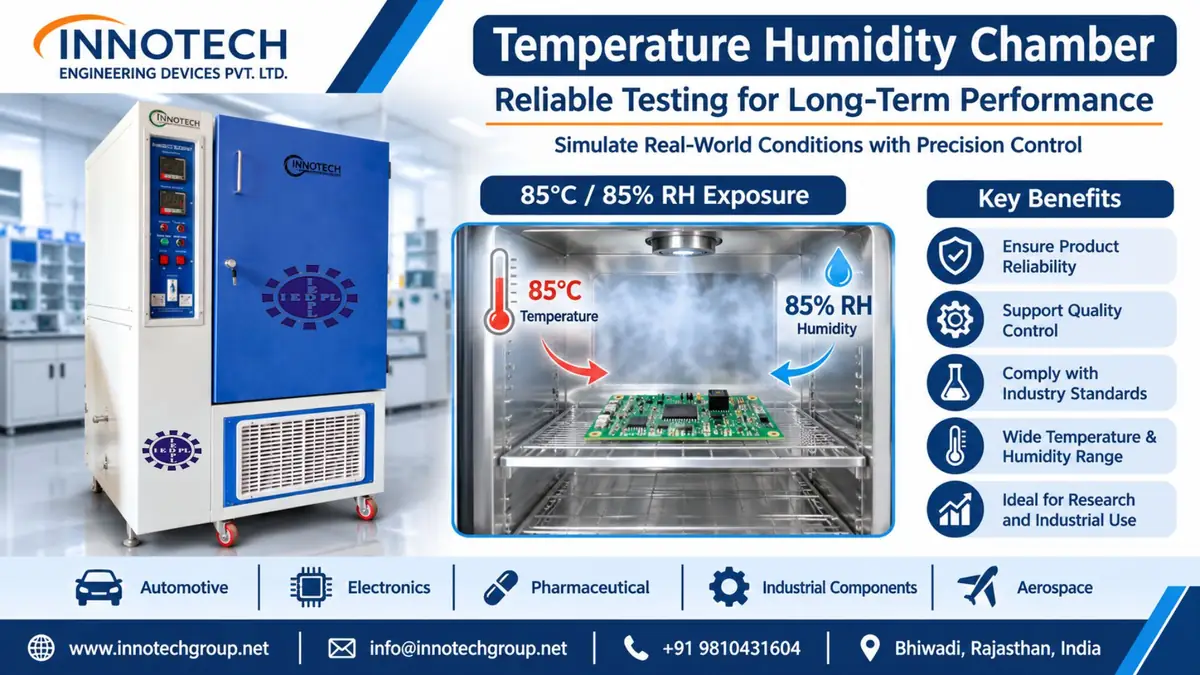
Environmental Chamber Humidity Chamber Temperature and Humidity Conditioning Chamber
85°C/85% RH Humidity Testing for Electronics: Procedure, Standards and Chamber Selection
Electronic components are often exposed to humidity during manufacturing, storage, transportation and everyday operation.
Moisture can contribute to corrosion, insulation problems, electrical leakage and deterioration of materials. These effects become particularly important when electronic products operate in hot and humid environments.
85°C/85% RH humidity testing, commonly called the 85/85 test, is one environmental stress condition used to evaluate the moisture resistance and reliability of suitable electronic components and assemblies.
This guide explains the purpose of 85/85 testing, the basic procedure, relevant standards and how to select a temperature humidity chamber for electronics testing.
What Is an 85/85 Humidity Test?
An 85/85 humidity test exposes a specimen to:
- Temperature: 85°C
- Relative humidity: 85% RH
- Duration: Defined by the applicable product specification or qualification plan
The test is intended to evaluate how the specimen responds to prolonged high-temperature and high-humidity exposure.
Depending on the component and test method, engineers may examine electrical characteristics, physical deterioration, corrosion, insulation performance or other defined acceptance criteria.
An 85/85 test is not a universal qualification procedure. The test duration, electrical bias, measurements and pass/fail limits depend on the applicable standard.
Why Is Humidity Testing Important for Electronics?
Humidity can affect electronic products in several ways.
Corrosion of Conductive Materials
Moisture, together with contaminants and suitable electrical conditions, may contribute to corrosion of metallic contacts, conductors and other components.
Electrical Leakage
Moisture absorbed by insulating materials or deposited on surfaces may reduce insulation resistance.
Material Degradation
Certain polymers, adhesives, coatings and encapsulating materials can absorb moisture or experience property changes during environmental exposure.
Reliability of Electronic Assemblies
Repeated or prolonged environmental exposure can reveal weaknesses that are not apparent during routine room-temperature inspection.
Humidity testing helps manufacturers investigate these risks before products are released or after design changes.
Which Electronic Products Require Humidity Testing?
Temperature humidity testing is relevant to many electronics applications.
| Product Category |
Typical evaluation objective |
| Printed circuit boards | Moisture-related electrical and material behavior |
| Electronic components | Reliability under high humidity |
| Automotive electronic modules | Environmental durability |
| Connectors and terminals | Contact and corrosion behaviour |
| Sensors | Measurement stability after exposure |
| Control panels | Performance in humid conditions |
| Encapsulated components | Moisture resistance of protective materials |
| Electrical insulation | Resistance and dielectric-property changes |
The test method should be selected according to the product's operating environment and qualification requirements.
How Is an 85/85 Humidity Test Performed?
The following is a general overview, not a substitute for a specific standard.
Step 1 — Identify the Test Requirement
Confirm the applicable standard, temperature, RH, duration, specimen condition and acceptance criteria.
Step 2 — Inspect the Specimen
Record the initial condition of the component.
Where required, measure electrical or mechanical properties before exposure.
Step 3 — Prepare the Humidity Chamber
Set the specified temperature and RH conditions.
Confirm that the chamber can maintain the required setpoints simultaneously and that its measurement system is suitable for the test.
Step 4 — Position the Specimen
Place the specimen so that airflow and environmental exposure are not unnecessarily obstructed.
If the component must be electrically powered or biased, use a suitable and safe feedthrough arrangement.
Step 5 — Begin Environmental Exposure
Expose the specimen for the specified duration.
The chamber should record temperature and humidity as required by the test procedure.
Step 6 — Complete Recovery and Measurements
After exposure, follow the prescribed recovery conditions before performing final inspections or measurements.
Some test methods require measurements during exposure or immediately afterward.
Step 7 — Evaluate Results
Compare the results with the specified acceptance criteria.
The chamber provides the environmental conditions; the product specification determines whether the specimen passes.
85/85 Test Duration: How Many Hours Are Required?
There is no single test duration applicable to every electronic product.
Some qualification procedures specify hundreds or thousands of hours, while others use different exposure conditions or durations.
The correct duration depends on:
- Component type
- Test objective
- Applicable standard
- Whether electrical bias is applied
- Customer qualification requirements
- Required inspection intervals
Do not assume that a test performed at 85°C and 85% RH for an arbitrary duration establishes product compliance.
Steady-State vs Cyclic Humidity Testing
Electronics laboratories commonly need to distinguish between constant exposure and environmental cycling.
| Parameter |
Steady-state damp heat |
Cyclic damp heat |
| Temperature | Held at specified conditions | Changes according to a cycle |
| Humdity | Controlled at specified conditions | Changes during the cycle |
| Condensation | May be intentionally avoided | May occur under specified conditions |
| Main purpose | Resistance to sustained humid exposure | Resistance to cyclic temeperature/humidity effects |
| Example standard | IEC 60068-2-78 | IEC 60068-2-30 |
A chamber capable of holding a constant humidity setpoint is not necessarily suitable for every cyclic humidity test.
The control system, refrigeration, humidification and dehumidification arrangements must support the required profile.
Humidity Testing Standards for Electronics
Relevant standards and qualification procedures may include:
IEC 60068-2-78 — Damp Heat, Steady State
This standard addresses exposure to high humidity at constant temperature without condensation.
It is useful when a specified product test requires steady-state damp heat exposure.
IEC 60068-2-30 — Damp Heat, Cyclic
This standard addresses cyclic damp heat testing, where temperature changes and moisture effects are important.
IEC 60068-3-6 — Chamber Performance Confirmation
This standard provides guidance for confirming the performance of temperature and humidity chambers.
JESD22-A101 — Steady-State Temperature Humidity Bias Life Test
This JEDEC method is relevant to certain semiconductor reliability evaluations involving temperature, humidity and electrical bias.
The applicable standard, revision, conditions and acceptance requirements should be confirmed from the component qualification specification.
Important: A chamber's ability to achieve a temperature and RH setpoint does not by itself establish compliance with any of these standards.
What About PCB Conformal Coating Humidity Tests?
Printed circuit boards may use conformal coatings to help protect electrical assemblies from environmental exposure.
Humidity testing can help evaluate the performance of coated assemblies under specified conditions.
However, the correct procedure depends on the coating material, assembly construction and intended application.
A test involving condensation is not equivalent to an ordinary non-condensing 85/85 exposure.
When requesting equipment for PCB coating tests, specify whether the procedure requires:
- Constant high humidity
- Temperature/humidity cycling
- Condensation
- Electrical bias
- Insulation resistance measurements
- Controlled recovery conditions
This information helps the manufacturer determine whether a standard humidity chamber is appropriate.
How to Select a Humidity Testing Chamber for Electronics
For an electronics laboratory, the following specifications are especially important.
| Requirement |
Why it matters |
| Temperature/RH operating envelope | Confirms simultaneous 85°C and 85% RH operation |
| Temperature stability | Helps maintain controlled exposure |
| Humidity control performance | Supports repeatable test conditions |
| Chamber uniformity | Helps minimize differences across specimen locations |
| Data logging | Provides environmental test records |
| Programmable profiles | Needed for applicable cyclic tests |
| Cable access ports | Useful for powered or biased specimens |
| Specimens capacity | Accommodates test samples and fixtures |
| Safety protection | Protects equipment and support safe operation |
| Performance verification | Documents chamber performance |
For electrically powered specimens, also communicate the heat generated during testing.
The chamber's ability to maintain conditions with a heat-generating load should be evaluated.
Common Mistakes in Electronics Humidity Testing
Incorrect Temperature and RH Combination
A chamber may support the desired temperature and humidity separately but not simultaneously.
Insufficient Specimen Clearance
Crowded loading can obstruct airflow and affect test conditions.
Inadequate Data Recording
Without reliable environmental records, it may be difficult to demonstrate that the exposure conditions were maintained.
Wrong Test Method
Using a steady-state test in place of a required cyclic test can produce results that do not meet the intended qualification procedure.
Missing Acceptance Criteria
A humidity test is incomplete without defined measurements and pass/fail criteria.
Temperature Humidity Chamber Manufacturer in India
Innotech Engineering Devices Private Limited manufactures industrial testing machines and laboratory equipment in Bhiwadi, Rajasthan.
For electronics manufacturers, R&D laboratories and quality-control departments, Innotech can discuss customized temperature and humidity chamber configurations according to the required test conditions.
Before requesting a quotation, provide the test standard, specimen dimensions, electrical loading requirements, temperature/RH conditions and test duration.
Explore Innotech's:
- Temperature and Humidity Chamber https://innotechgroup.net/products/temperature-and-humidity-chamber
- Humidity Chamber https://innotechgroup.net/products/humidity-chamber
- Humidity Testing Applications and Industries https://innotechgroup.net/blog/humidity-testing-applications-industries
Frequently Asked Questions
What does 85/85 mean in humidity testing?
It refers to an environmental exposure condition of 85°C temperature and 85% relative humidity.
Is 85/85 testing suitable for every electronic component?
No. The test must be selected according to the component type, qualification standard and intended application.
Can a standard humidity chamber perform an 85/85 test?
Only if its verified operating envelope and performance meet the required temperature, RH, specimen-loading and test conditions.
Does 85/85 testing require electrical bias?
Not always. Some procedures require electrical bias, while others specify different specimen conditions.
Is humidity testing the same as thermal shock testing?
No. Humidity testing evaluates moisture-related environmental effects. Thermal shock testing evaluates response to rapid temperature transitions.
Can a humidity chamber test PCB conformal coatings?
A suitably configured chamber may support specified humidity exposure tests, but condensation and electrical measurement requirements must be checked separately.
Conclusion
85°C/85% RH humidity testing is an important environmental evaluation method for suitable electronic components and assemblies.
Reliable testing requires the correct standard, exposure duration, chamber operating range, specimen arrangement and acceptance criteria.
Selecting the appropriate equipment helps electronics manufacturers generate meaningful test results and maintain consistent quality-control records.
Request a Temperature Humidity Chamber Quotation
Innotech Engineering Devices Private Limited
OEM Manufacturer of Testing Machines & Laboratory Equipment
Factory: H-307, RIICO Industrial Area, Karoli, Tapukara, Bhiwadi – 301707, Rajasthan, India
Email: info@innotechgroup.net
Contact Innotech for a Technical Quotation
https://innotechgroup.net/contact
Category: Laboratory Equipment & Furnaces
Tags: 85/85 humidity testing, humidity test for electronics, 85/85 test, temperature humidity testing, PCB humidity testing, high temperature high humidity test, humidity testing chamber, electronics reliability testing
Last Updated: 18 November 2026