



PLASTIC IMPACT TESTER
Types of Plastic Impact Testers
-
Izod Impact Tester
-
Charpy Impact Tester
-
Combined Izod & Charpy Impact Tester
-
Pendulum Type Impact Tester
-
Digital / Computerized Impact Tester
Applications
-
Thermoplastics and thermosetting plastics
-
PVC, PE, PP, ABS, Nylon, Polycarbonate
-
Plastic sheets, molded components
-
Automotive plastic parts
-
Electrical & electronic plastic components
Technical Specifications (Typical)
-
Impact Energy Range: 1 J, 2.75 J, 5.5 J, 11 J, 22 J
-
Pendulum Capacity: Up to 25 Joules
-
Display Type: Analog / Digital / Computerized
-
Test Method: Izod / Charpy
-
Resolution: 0.01 J
-
Specimen Size: As per ASTM / ISO standards
-
Clamp Type: Vice-type specimen clamp
-
Machine Body: Heavy-duty cast iron / steel frame
-
Safety Guard: Full protective enclosure
Standards Supported
-
ASTM D256
-
ISO 180
-
ISO 179
-
BS EN standards
Salient Features
-
High accuracy pendulum mechanism
-
Easy pendulum change for multiple energy ranges
-
Digital energy loss calculation
-
User-friendly operation
-
Robust and vibration-free construction
-
Calibration certificate traceable to national standards
Accessories (Optional)
-
Notching machine for plastic specimens
-
Extra pendulums (different energy ranges)
-
Computerized data acquisition software
-
Safety enclosure
A Plastic Impact Tester is a laboratory testing instrument used to determine the impact strength, toughness, and energy absorption capacity of plastic materials under sudden load conditions. It is widely used in plastic manufacturing, polymer testing labs, R&D centers, and quality control departments.
Related products

FLEXURAL STRENGTH TESTING MACHINE
Technical Specifications
Load Capacity
-
Range: 10 kN to 300 kN
-
Suitable for concrete beams, tiles, blocks, polymers, composites
Loading Type
-
Three-point bending
-
Four-point bending
Control System
-
Manual / Motorized / Servo-controlled
-
Pace rate control available
-
Closed-loop feedback system (in advanced models)
Display
-
Digital load indicator
-
Touchscreen controller (computerized models)
-
Real-time load vs deflection graph
Accuracy
-
±1% or better of indicated load
-
Calibrated load cell system
Loading Rate
-
Adjustable loading rate
-
Standard compliant loading speed control
Test Span Adjustment
-
Adjustable support span
-
Roller support fixtures
Drive Mechanism
-
Hydraulic power pack or electromechanical screw drive
-
Servo motor (in advanced systems)
Data Output
-
Software-based data acquisition
-
Test reports generation
-
USB / PC connectivity
-
Automatic peak load capture
Safety Features
-
Overload protection
-
Emergency stop
-
Limit switches
-
Guard enclosure
Standards Compliance
-
ASTM C78 / ASTM D790
-
IS 516
-
ISO standards for flexural testing
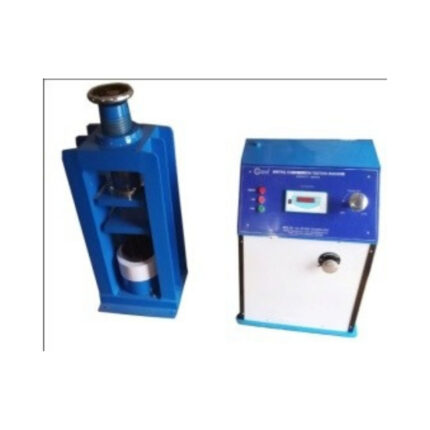
COMPRESSION TESTING MACHINE
Technical Specifications
-
Capacity Range:
50 Ton / 100 Ton / 200 Ton / 300 Ton / 500 Ton / 2000 kN -
Load Measurement:
Digital load indicator / Computerized data acquisition system -
Load Accuracy:
±1% of indicated load (Class 1) -
Loading Method:
Hydraulic compression with controlled pace rate -
Pace Rate Control:
Manual / Semi-automatic / Fully automatic -
Platen Size:
200 × 200 mm / 300 × 300 mm / Customizable -
Maximum Piston Stroke:
50 – 100 mm -
Frame Construction:
Heavy-duty welded steel frame with high rigidity -
Power Supply:
230V AC, Single Phase / 415V AC, Three Phase -
Hydraulic Pressure:
High-pressure axial piston pump -
Standards Compliance:
IS:14858, IS:516, ASTM C39, ASTM C109, BS EN standards -
Safety Features:
Overload protection, pressure relief valve, emergency stop

SAMPLE CUTTING PRESS
Technical Specifications
(Specifications may vary by model and capacity)
-
Type: Hydraulic / Pneumatic / Manual Sample Cutting Press
-
Capacity: 5 Ton / 10 Ton / 20 Ton / 25 Ton / 30 Ton (or as required)
-
Pressing Area: 300 × 300 mm to 500 × 500 mm
-
Daylight Gap: 100 – 250 mm
-
Ram Stroke: Adjustable
-
Pressure Control: Manual / Digital Pressure Gauge
-
Operation Mode: Push Button / Foot Switch / Dual Hand Safety Control
-
Cutting Accuracy: High repeatability with clean edges
-
Platen Material: Hardened Steel / EN-grade Steel
-
Frame Construction: Heavy-duty welded steel frame
-
Power Supply: 230V / 415V AC, 50 Hz
-
Safety Features: Emergency stop, overload protection, safety guard
-
Standards Compliance: ASTM, ISO, IS, DIN, BS
Applications
-
Rubber and plastic testing laboratories
-
Automotive and aerospace material testing
-
Textile and leather industries
-
Packaging and polymer testing
-
Quality control and R&D labs
Key Features
-
Uniform cutting pressure
-
Rugged and vibration-free structure
-
Easy die replacement
-
Low maintenance operation
-
High operator safety
-
Suitable for standard and custom dies

VIBRATING TABLE
Key Features
-
Heavy-duty fabricated steel construction
-
Adjustable vibration frequency and amplitude
-
Uniform vibration across table surface
-
Low noise and energy-efficient operation
-
Anti-vibration mounts for floor protection
-
Manual / digital / PLC control options
-
Maintenance-free vibrator motor
-
Custom table size and load capacity available
Applications
-
Concrete cube and block compaction
-
Precast concrete products
-
Foundry sand compaction
-
Laboratory material testing
-
Pharmaceutical and chemical compaction
-
Packaging and container settling
-
Soil and aggregate testing
Technical Specifications (Typical)
-
Table Size: Customizable
-
Load Capacity: 50 kg to 2000 kg (or higher)
-
Vibration Frequency: 0–6000 vibrations/min
-
Amplitude: Adjustable
-
Motor Type: Unbalanced / Electromagnetic
-
Power Supply: 230V / 415V, 50 Hz
-
Control: Manual / Digital / PLC
-
Mounting: Spring or rubber isolation

CTM WITH PACE CONTROL
Key Features
-
Pace Control System – Maintains constant loading rate
-
Microprocessor / PLC Based Control
-
Closed-Loop Servo Control
-
Digital Load & Extension Measurement
-
High Accuracy Load Cell (±1% or better)
-
Automatic Load Holding & Unloading
-
Overload Protection
-
Emergency Stop Switch
-
Data Acquisition Software (PC Based)
-
Real-Time Load vs Elongation Graph
-
USB / Ethernet Interface
Technical Specifications (Typical)
-
Capacity: 100 kN, 200 kN, 300 kN (customizable)
-
Pace Rate: Programmable (kN/sec or mm/min)
-
Load Resolution: 1/10000 of capacity
-
Crosshead Speed: Variable with pace control
-
Power Supply: 230V AC, 50 Hz
-
Frame Type: Rigid 2-Column / 4-Column Structure
Pace Control Description
-
Automatically controls rate of loading during tensile test
-
Conforms to IS, ASTM, ISO, BS standards
-
Ensures uniform stress application on specimen
-
Ideal for concrete, steel, rebar, wire, fasteners testing
Applications
-
Tensile testing of metal rods, bars, wires
-
Testing of rebars as per IS 1786
-
Quality control laboratories
-
R&D and material testing labs
-
Educational institutions
-
Construction & infrastructure projects
Standards Compliance
-
IS 1828
-
ASTM E8 / E9
-
ISO 6892
-
BS Standards

IZOD IMPACT TESTING MACHINE
📌 What an Izod Impact Testing Machine Is
An Izod impact testing machine is a pendulum-based impact resistance tester used to determine how much energy a material absorbs when impacted suddenly — a measure of the material’s toughness. In the test:
-
A notched specimen (usually plastic or metal) is held vertically in a clamp.
-
A pendulum hammer is raised to a fixed height and then released.
-
It swings down and strikes the specimen, breaking it.
-
The energy absorbed in breaking the specimen is measured from how far the pendulum swings after impact.
Standards: Many machines conform to internationally recognized standards such as ASTM D256 (Izod methods) and ISO 180 (plastic impact testing).
🧪 Why It’s Used
-
Material toughness assessment: Determines how materials behave under sudden shock loading.
-
Quality control: Ensures consistency and safety for products experiencing impacts in real use.
-
R&D: Helps in material selection and design validation in industries like plastics, automotive, aerospace, and consumer products.
🧠 Key Features to Look For
-
Energy range: Typically from a few joules up to several dozen joules depending on material and application.
-
Display: Analog dial or digital interface with read-out.
-
Automatic data handling: USB/PC connectivity on digital models.
-
Dual test capability: Some models support both Izod and Charpy tests.

Environmental Test Chamber
Features of Humidity/Conditioning Test Chambers Deluxe Model
- Alarm system with buzz sound at the test end process
- Temperature sensing through PT-100 sensor
- Highly accurate test results under uniform temperatures and humidity levels in the chamber
- Digital Control for Humidity and Temperature
- High Grade-imported puff insulation
- Maximum Thermal Efficiency by insulation means.
- SSR based heaters
- Digital Preset timer with LED Display
- In-built Auto tuning function
- Water Level Indicator
- Equipped with rapid air circulation German imported fan for uniform and homogenous heating, cooling, humidity, de-humidity
- inside the chamber
- Inbuilt Calibration feature with reference to master PID controller
- Setting to RTD PT-100 sensor through advanced PID controller
- Auto stop feature to stop the machine at a set time
- Time totalizer to calculate the no. of Hours run by the instrument
- Reservoir water tank auto refilling (Float value arrangement)
Technical specifications
- Capacity: 150 litres
- Display: LED (Digital)
- Accuracy: Temp. ± 2ºC / Humidity ± 5%
- Least Count/Resolution Temp / Humidity: 0.1ºC / 1%
- Power: 15A, 220V , Single phase, 50 Hz
- Temperature Range: 15ºC to 60ºC
- Humidity Range: upto to 95% RH
- Timer: 999Hr (Changeable to Min. as per request)
- Water Level Low: Alarm output
- No. of Sample racks: 2
- Handle: Yes
- Wet Heater: 1 Kw, 1 no.
- Dry Heater: 500 Watt, 1 no.
- Temperature Sensor: 1 (PT-100)
- Humidity Sensor: 1 (RH)
- Movement Castor: Wheels
- Material: Stainless Steel (Inner & outer body)
- Finish: Stainless Steel combination finish for corrosion resistant
- Dimensions: Inner : 455 x 455 x 710 mm & Outer : 660 x 930 x 1515 mm

Hydraulic Heating Press
| Capacity | upto 10 tons |
| Country of Origin | Made in India |
| Cylinder Capacity | 10 Tons maximum (hydraulic power unit) |
| Piston Stroke | Maximum 50mm |
| Max Pressure | 200 barst |
| Loading Type | Vertical up |
| Daylight | 120 mm (distance between punch and die) |
- VBCC's Manual Press stands out as a versatile and user-friendly tool designed to cater to various precision pressing and forming operations. Crafted with a focus on ease of use and reliability, this press finds its niche in laboratories and small-scale industrial settings where hands-on control and precision are paramount.
- This manual press is engineered to facilitate a range of tasks, including sample preparation, material compaction, and shaping operations. Its straightforward operation, coupled with robust construction, ensures that users can exert controlled force with precision, making it an indispensable tool in scenarios that require a hands-on approach.
- One of the key features of VBCC's Manual Press is its adaptability to different applications. Its design allows for flexibility in accommodating diverse materials and shapes, making it suitable for a wide array of pressing requirements. Whether in a laboratory setting conducting experiments or in an industrial environment working on small-scale production, this press delivers reliable and efficient performance.
- The user-friendly nature of the VBCC Manual Press makes it accessible to both seasoned professionals and those new to the field. Its intuitive design streamlines the pressing process, minimizing the learning curve and maximizing productivity. This ease of use, combined with the press's robust construction, ensures longevity and consistent performance over time.
- In summary, the VBCC Manual Press is not just a tool; it's a solution for precision pressing needs. From its adaptability to its user-friendly design, this manual press contributes to the success of various pressing applications, making it an invaluable asset for researchers, engineers, and professionals working in fields that demand precision and reliability.
Reviews
There are no reviews yet.