
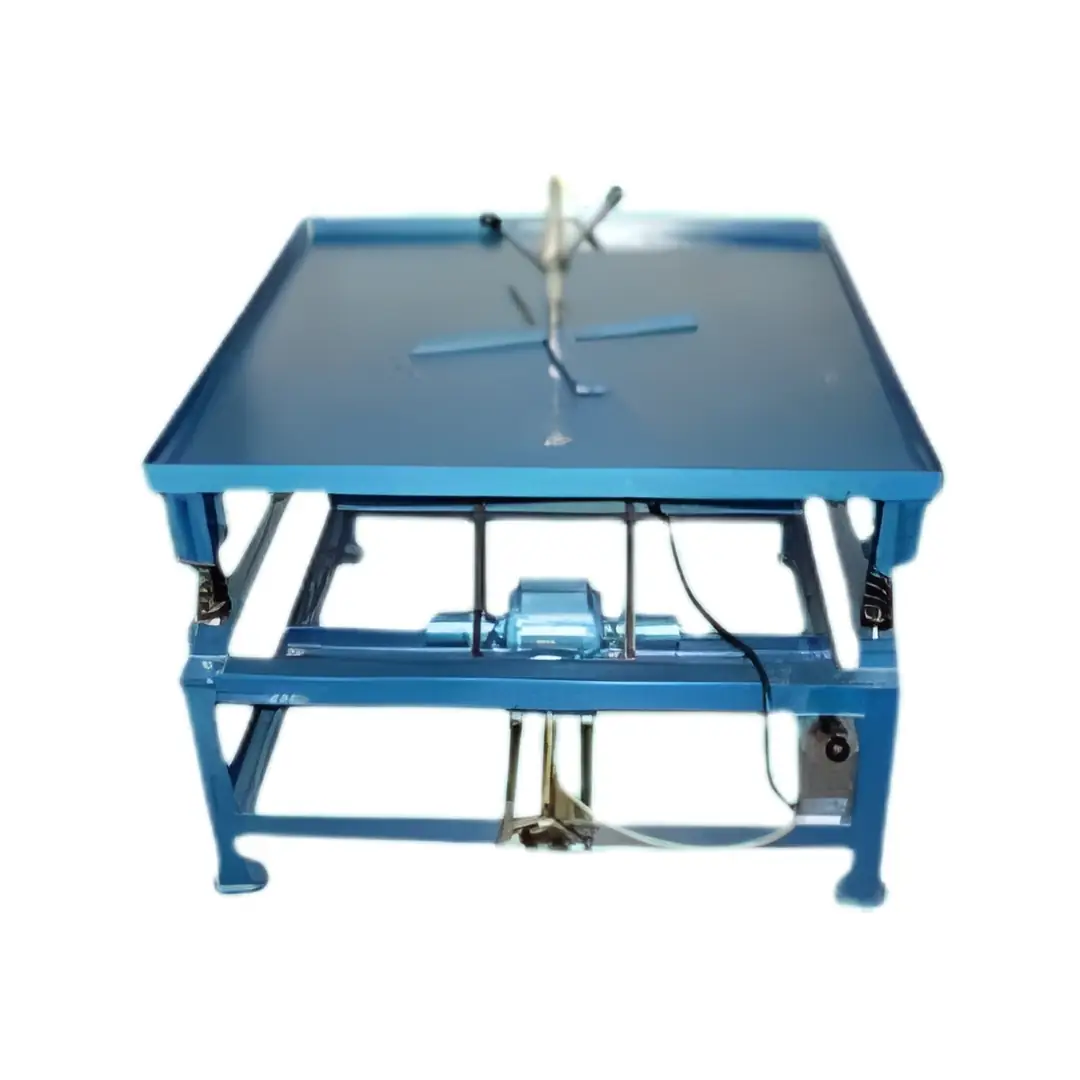
Vibrating Table
Vibrating Table
Vibrating Table is designed to provide controlled vibration for material compaction, settling, consolidation and laboratory or industrial testing applications. It is suitable for concrete, construction materials, casting, mould filling, material processing and other applications where controlled vibration is required.
OVERVIEW
Description
Vibrating Table
A vibrating table is a machine used to shake materials, moulds, containers or test samples. This movement helps the material settle properly and can also help remove air trapped inside it. Vibrating tables are used in laboratories, concrete work, casting and different factory processes.
The actual use of the machine depends on the type of material, mould size and work being done.
What Is a Vibrating Table?
A Vibrating Table is a mechanical equipment platform that generates controlled vibration through a vibration-generating mechanism mounted to or connected with the table.
The material, mould, container or specimen is placed on the table surface. When the machine operates, vibration is transferred from the table to the material or mould.
This movement can help settle materials, reduce air voids, improve material distribution and provide controlled consolidation depending on the application.
Working Principle
The working of a vibrating table is quite simple. First, the mould, container or material is placed on the table. When the machine is switched on, the motor creates vibration and moves the table surface.
This movement makes the material settle inside the mould or container. In concrete work, it can also help reduce air gaps and give the material a more even finish.
Typical Operating Process
- Put the mould, contianer or material on the table.
- Make sure it is placed properly and does not move unnessarily.
- Set the vibration level and time as required.
- Switch on the machine.
- Let the table run for the required time.
- Switch off the machine after the process in complete.
- Remove the mould, container or material from the table.
Applications of Vibrating Table
Vibrating Tables can be used across different laboratory, construction and industrial applications.
- Concrete and Construction Materials
- Concrete Specimen Preparation
- Casting and Mould Filling
- Precast Concrete
- Laboratory Applications
- Industrial Material Compaction
- Packaging and Material Settling
Features of Vibrating Table
Depending on the actual Innotech machine configuration, the Vibrating Table can include features such as:
• Robust table construction
• Controlled mechanical vibration
• Suitable vibration-generating mechanism
• Stable table platform
• Suitable arrangement for moulds and containers
• Easy material placement
• Laboratory and industrial applications
• Suitable for material settling and consolidation
• Easy operation
• Designed for repeated vibration cycles
• Suitable for customized applications
Exact table dimensions, vibration frequency, amplitude, load capacity, motor power and other technical specifications should be confirmed according to the selected Innotech model.
Benefits of Vibrating Table
- Controlled Material Vibration
- Improved Material Settling
- Support for Mould Consolidation
- Versatile Applications
- Easy Operation
- Suitable for Laboratory and Industrial Use
For heavier work, the machine may need a stronger frame and a higher load capacity.
Technical Specifications
| Parameter |
Laboratory / Light Duty |
Medium Duty |
Heavy Duty |
Industrial / Customized |
| Table Type |
Vibrating Table | Vibrating Table | Heavy-Duty Vibrating Table | Customized Vibrating Table |
| Approx. Table Size |
300 X 300 to 600 X 600 mm | 600 X 600 to 900 X 900 mm | 900 X 900 to 1200 X 1200 mm | As per requirement |
| Approx. Load Capacity |
25-100kg | 100-300kg | 300-500kg | 500kg and above |
| Vibration Frequency |
Adjustable, as required | Adjustable, as required | Adjustable, as required | As per application |
| Vibration Amplitude |
Adjustable, as required | Adjustable, as required | Adjustable, as required | As per application |
| Drive Mechanism |
Motorized vibration mechanism | Motorized vibration mechanism | Heavy-duty motorozed mechanism | Customized vibration system |
| Motor Capacity |
Approx. 0.25-0.5 HP | Approx. 0.5-1 HP | Approx. 1-2 HP | Selected according to load |
| Table Construction |
Fabricated steel structure | Heavy-duty fabricated structure | Reinforced fabricated structure | Customized construction |
| Vibration Control |
Manual / adjustable | Manual / adjustable | Adjustable | As required |
| Timer |
Optional | Optional | Available / Optional | As required |
| Mould / Container Holding |
As required | As required | As required | Customized fixtures available |
| Application |
Laboratory & sample preparation | Laboratory & general industrial work | Concrete, moulds & industrial applications | Special-pirpose applications |
| Power Supply |
Approx. 230V AC, 50 Hz | Approx. 230V AC, 50 Hz | 230/415 V AC, 50 Hz | As per motor configuration |
Additonal capacity Configuration
| Vibrating Table Configuraation |
Approx. Load Capacity |
Typical Application |
| Light-Duty Vibrating Table |
25-100 kg | Laboratory samples, small moulds and containers |
| Medium-Duty Vibrating Table |
100-300 kg | Concrete moulds, laboratory and general industrial work |
| Heavy-Duty Vibrating Table |
300-500 kg | Larger moulds, concrete adn industrial material compaction |
| High-Capacity Vibrating Table |
500-1000 kg | Heavy moulds and industrial applications |
| Customized Vibrating Table |
1000 kg and above | Special industrial requirements |
How to Choose a Vibrating Table?
Before buying a vibrating table, check a few basic things:
- Type of material
- Size of the mould or container
- Table working area
- Maximum load
- Vibration frequency
- Vibration amplitude
- Required working time
- Motor and vibration system
- Available space
- Electrial requirement
- Accessories needed
- Maintenance requirements
Choose the machine based on the work you plan to do. A laboratory table and an industrial table may have very different requirements.
Vibrating Table Manufacturer in India
Innotech Engineering Devices Private Limited provides vibrating tables and other equipment for laboratory and industrial requirements.
Our vibrating tabls can be used for concrete work, mould preparation, material settling and other applications where vibration is needed. For machine details, size capacity and price, customers can contact Innotech Engineering Devices Private Limited
Vibrating Table Manufacturer in Bhiwadi, Rajasthan
Innotech Engineering Devices Private Limited is a Vibrating Table manufacturer based in Bhiwadi, Rajasthan. We supply equipment to customers in Rajasthan, Delhi, Haryana, Punjab, Uttar Pradesh, Jammu, Bareily, Gujarat, Maharashtra and other parts of India.
The machine can be selected according to the customer's work, required table size and load. Contact our team to discuss your requirement and get product details.
FAQ About Vibrating Table
What is a Vibrating Table?
A vibrating table is a machine with a vibrating platform. A mould, container or material is placed on the platform, and the vibration helps it settle properly.
How does a Vibrating Table work?
A motor creates vibration in the table. When a mould or material is placed on it, the movement helps the material settle and can reduce air gaps.
Can a Vibrating Table be used for concrete?
Yes. Vibrating tables are commonly used with concrete moulds and samples. The vibration helps the concrete settle inside the mould and can reduce trapped air.
Can a Vibrating Table be used in laboratories?
Yes. Laboratories can use vibrating tables for sample preparation, mould filling and other work where controlled vibration is required.
What factors should be considered before buying a Vibrating Table?
Check the table size, load capacity, vibration level, mould size, motor, working time and available space. The right machine will depend on the type of work you need to perform.