
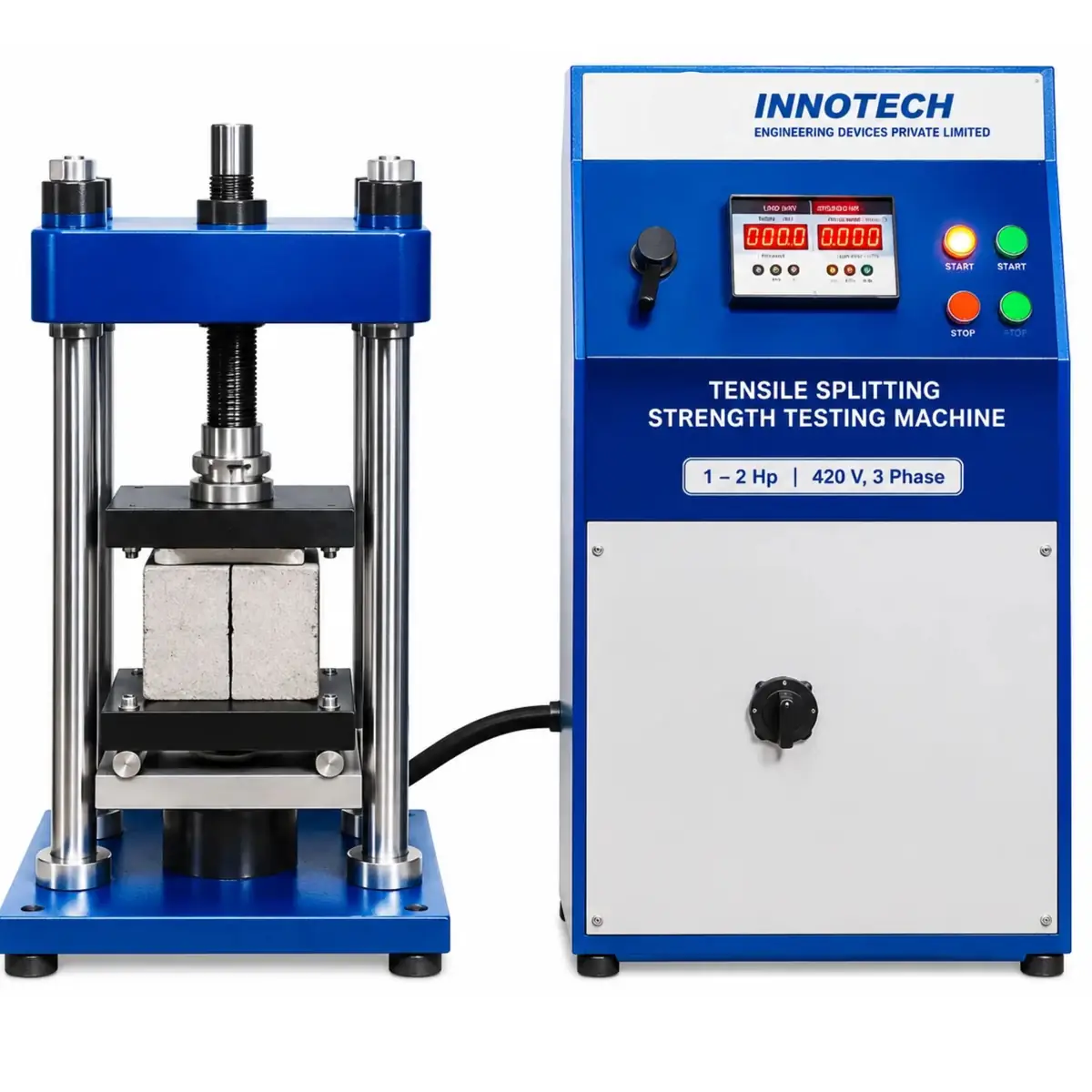
Tensile Splitting Strength Testing Machine
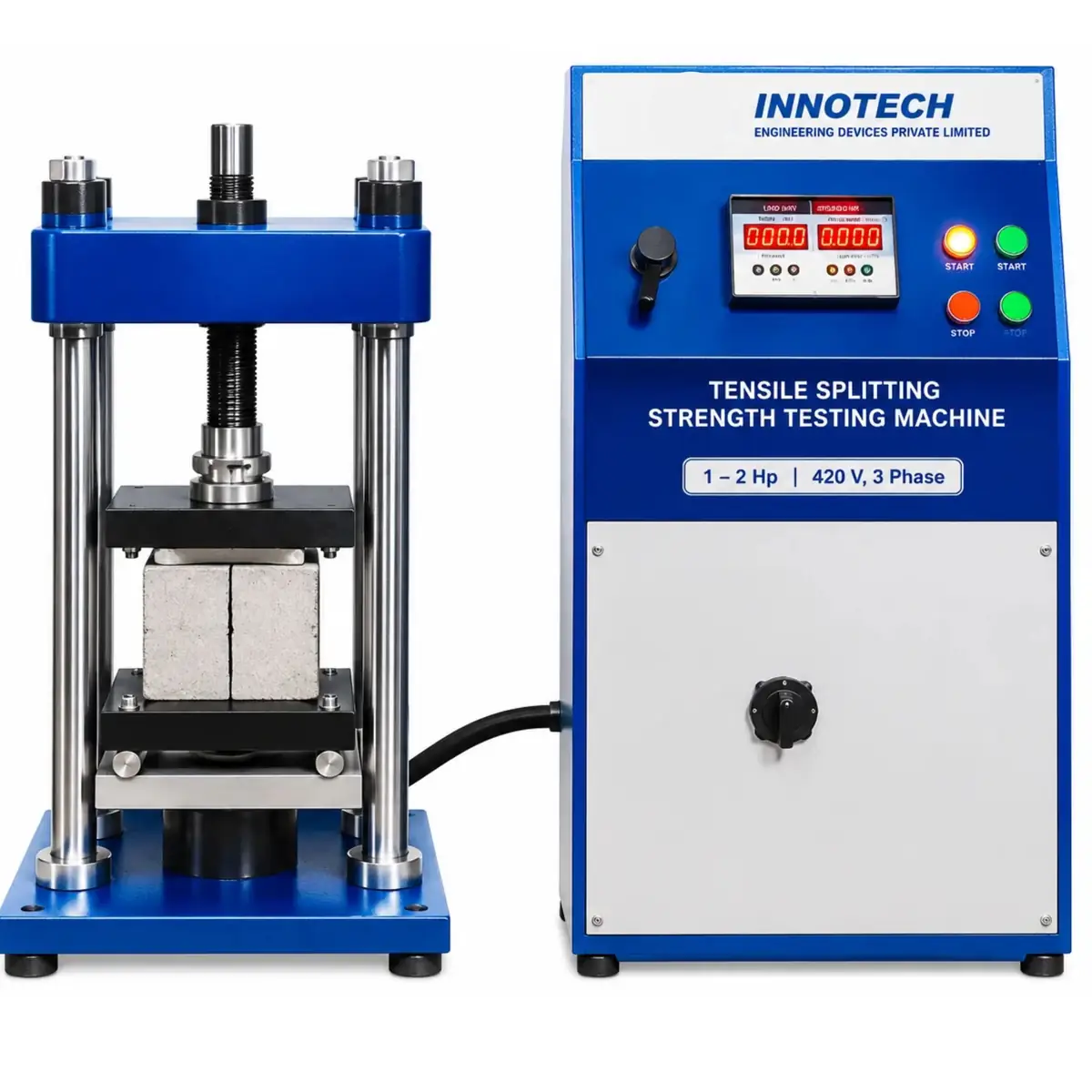
Tensile Splitting Strength Testing Machine
The Tensile Splitting Strength Testing Machine by Innotech Engineering Devices Private Limited is a 100 kN digital automatic testing system designed for laboratory evaluation of splitting tensile strength using suitable specimens and fixtures. Its published specifications include a 0–100 kN measuring range, 0.01 kN resolution, LED digital display, adjustable 0.5–5 mm/min test speed and automatic data recording. Manufactured in Bhiwadi, Rajasthan, India, the machine is intended for construction-material testing laboratories, research institutions and quality-control applications. Customized specimen fixtures and technical configurations can be discussed according to customer requirements.
MODEL
ITSSTM
OVERVIEW
Description
Tensile Splitting Strength Testing Machine Manufacturer in Bhiwadi India
Innotech Engineering Devices Private Limited manufactures and supplies the Tensile Splitting Strength Testing Machine, also known as a Splitting Tensile Strength Testing Machine or Concrete Split Tensile Testing Machine, for laboratory and construction-material testing applications.
The machine is designed to apply a controlled compressive load through an appropriate splitting-test fixture to evaluate the indirect tensile strength of suitable specimens.
Innotech's published model has a 100 kN rated capacity, digital load display, automatic control system and adjustable testing speed. Application-specific fixtures and machine configurations can be discussed with customers.
Manufactured in Bhiwadi, Rajasthan, India, the equipment is intended for material testing laboratories, civil engineering institutions, research facilities and industrial quality-control departments.
What Is a Tensile Splitting Strength Testing Machine?
A Tensile Splitting Strength Testing Machine evaluates a material's resistance to splitting under a controlled loading arrangement.
For concrete, splitting tensile strength is commonly measured using a cylindrical specimen loaded diametrically in compression.
Although the machine applies compressive force, this loading arrangement develops tensile stresses within the specimen. The specimen eventually splits when the induced tensile stress exceeds its resistance.
The method is also commonly known as the Brazilian splitting test.
Unlike a conventional direct tensile testing machine, the splitting tensile machine does not pull the specimen from both ends.
Working Principle of a Splitting Tensile Testing Machine
The specimen is positioned between suitable loading members.
The machine applies an increasing compressive load through the specified contact arrangement.
For a cylindrical concrete specimen, the load acts along its length, creating tensile stresses perpendicular to the loading direction.
As loading continues, a splitting crack typically develops.
The maximum applied load is recorded and used to calculate the splitting tensile strength according to the applicable standard.
Main Components
- Heavy-duty loading frame
- Upper loading arrangement
- Lower specimen support
- Hydraulic or mechanical loading system, as applicable
- Force measurement system
- Digital load indicator
- Automatic control arrangement
- Specimen positioning fixtures
- Electrical control cabinet
- Safety and overload protection, where provided
The final arrangement depends on the approved machine configuration.
Splitting Tensile Strength Test Procedure
A typical concrete splitting tensile test involves the following steps.
- Identify the concrete grade, specimen dimensions and applicable testing standard.
- Prepare and condition the specimen according to the specified procedure.
- Measure the relevant specimen dimensions.
- Position the specimen in the correct splitting-test fixture.
- Install the required bearing strips or loading members.
- Align the specimen with the loading axis.
- Set the required loading conditions.
- Apply the load continuously and without shock.
- Continue loading until the specified failure endpoint.
- Record the maximum load and fracture observations.
- Calculate splitting tensile strength.
- Prepare the laboratory test report.
Important: The test method specifies loading conditions that must be followed. The machine's adjustable crosshead or piston speed in mm/min is not automatically equivalent to the required splitting tensile stress rate.
Splitting Tensile Strength of Concrete Formula
For the standard diametral splitting test on a cylindrical specimen, the splitting tensile strength is calculated using:
fct = 2P / (πLD)
Where:
- fct = Splitting tensile strength in N/mm² (MPa)
- P = Maximum applied load in newtons
- L = Length of the cylindrical specimen in millimetres
- D = Diameter of the specimen in millimetres
Example Calculation
Consider a cylindrical specimen with:
- Diameter: 150 mm
- Length: 300 mm
- Maximum load: 100 kN
The calculated splitting tensile strength is approximately 1.41 MPa.
This is an illustrative calculation, not a test result for a particular concrete grade.
Industry Standards for Splitting Tensile Testing
IS 5816 — Indian Standard
IS 5816 is a recognized Indian reference for determining the splitting tensile strength of concrete.
ASTM C496/C496M
ASTM C496/C496M describes the splitting tensile strength test method for cylindrical concrete specimens.
EN 12390-6
EN 12390-6 covers the determination of tensile splitting strength of hardened concrete.
These standards are relevant to machine selection, but compliance must be verified against the actual machine, specimen fixture, loading control and test procedure.
A standard should not be listed as certified compliance merely because the machine is intended for splitting tensile testing.
Key Features of the Tensile Splitting Strength Testing Machine
The Innotech model includes published specifications for:
- 100 kN testing capacity
- Digital automatic operation
- LED load indication
- 0.01 kN display resolution
- Adjustable 0.5–5 mm/min test speed
- Automatic data recording
- RS232 / USB interface
- Heavy-duty steel loading frame
- Floor-mounted construction
- Three-phase electrical operation
The actual supply scope and additional functions should be confirmed in the technical offer.
Applications of Splitting Tensile Testing
The equipment is intended for suitable indirect tensile strength testing applications, including:
- Concrete material testing
- Concrete specimen evaluation
- Construction-material research
- Concrete mix development
- Laboratory quality-control testing
- Comparative material studies
- Civil engineering laboratory experiments
- Research and development projects
- Academic material testing
- Customized splitting-test applications
Testing of cubes, cylinders, blocks or other specimen geometries requires the correct fixtures, available working space and applicable test method.
Benefits of Splitting Tensile Strength Testing
Indirect Tensile Strength Evaluation
The method provides a practical way to evaluate tensile-related behaviour without directly gripping a concrete specimen in tension.
Material Comparison
It supports comparison of different concrete mixtures and specimen batches under controlled conditions.
Laboratory Quality Control
The results can support relevant quality-control and material evaluation procedures.
Digital Measurement
A digital load indicator allows operators to monitor applied force and record test values.
Research Applications
The method is useful in concrete technology and construction-material research.
Customized Testing Solutions
Innotech can discuss application-specific loading fixtures, specimen accommodation and control requirements.
Tensile Splitting Test vs Compression Test
| Splitting tensile test |
Compression test |
| Evaluates indirect tensile strength | Evaluates compressive strength |
| Uses a specified splitting loading arrangement | Applies compressive load over the prescribed bearing surfaces |
| Often uses concrete cylinders | Commonly uses cubes or cylinders |
| Reports splitting tensile strength | Reports compressive strength |
| Requires appropriate splitting fixtures | Requires appropriate compression platens |
A compression testing machine can sometimes perform splitting tensile testing using a suitable attachment. However, the loading capacity, measuring range, fixtures and test procedure must all be appropriate.
Customized Tensile Splitting Strength Testing Machine in India
Different laboratories may require different specimen dimensions, testing capacities and control arrangements.
Innotech can discuss customized configurations for:
- Specimen dimensions
- Loading fixtures
- Working clearance
- Force measurement
- Digital control
- Test data recording
- Safety arrangements
- Electrical supply
- Laboratory installation requirements
The final machine specification is determined by technical feasibility and the approved customer requirement.
Tensile Splitting Strength Testing Machine Manufacturer in Bhiwadi, Rajasthan
Innotech Engineering Devices Private Limited is an Indian manufacturer of testing machines and laboratory equipment.
Our manufacturing location in Bhiwadi, Rajasthan, serves industrial and institutional customers seeking laboratory testing equipment across India.
Buyers can contact Innotech for technical discussions, specimen compatibility checks and quotations.
Frequently Asked Questions
What is a Tensile Splitting Strength Testing Machine?
It is a testing machine used to evaluate indirect tensile strength by applying a controlled load through a specified splitting-test arrangement.
What is the capacity of Innotech's machine?
The published model has a rated capacity of 100 kN.
What is the splitting tensile test of concrete?
It is an indirect tensile test in which a concrete specimen is subjected to a specified compressive loading arrangement that produces tensile stresses and causes splitting failure.
Which standards are relevant?
IS 5816, ASTM C496/C496M and EN 12390-6 are relevant references for splitting tensile testing of concrete.
Can this machine test concrete cylinders?
A suitable cylindrical specimen can be tested if its dimensions, loading fixture and required failure load are compatible with the machine.
Can this machine test 150 × 150 × 150 mm concrete cubes?
The TradeIndia listing mentions this specimen size, but the separate published test-width value is only 100 mm. Cube compatibility must therefore be confirmed before ordering.
What is the difference between tensile splitting strength and compressive strength?
Splitting tensile strength describes resistance to indirect tensile stresses, while compressive strength describes resistance to compressive loading.
Does the machine have a digital display?
Yes. The published specification lists an LED digital display.
Is automatic data recording available?
The TradeIndia listing specifies automatic data recording and RS232/USB connectivity. The final reporting and software functions should be confirmed.
Can the machine be customized?
Innotech can discuss customized fixtures, specimen dimensions, measurement arrangements and controls according to customer requirements.
Who manufactures Tensile Splitting Strength Testing Machines in India?
Innotech Engineering Devices Private Limited manufactures and supplies testing machines from Bhiwadi, Rajasthan, India.
How can I request a quotation?
Provide the specimen material, dimensions, applicable test standard, required load capacity and installation location to Innotech for a technical quotation.
Contact Innotech Engineering Devices Private Limited
Looking for a Tensile Splitting Strength Testing Machine Manufacturer in India, Bhiwadi or Rajasthan?
Contact our team for technical specifications and application-specific machine requirements.
Company: Innotech Engineering Devices Private Limited
Factory: H-307, RIICO Industrial Area, Karoli, Tapukara, Bhiwadi – 301707, Rajasthan, India
Email: info@innotechgroup.net
Phone: +91 9810431604
WHY IT WORKS
Key benefits
Indirect tensile strength testing: Supports evaluation of splitting tensile strength using suitable specimens.
Digital load indication: Helps operators monitor the applied testing force.
Controlled loading: Supports repeatable laboratory test procedures when properly configured.
Material quality assessment: Helps evaluate suitable concrete and construction-material specimens.
Research support: Useful for concrete mix development and material studies.
Digital data recording: Supports test documentation and laboratory records.
Adjustable test speed: Provides flexibility within the published operating range.
Laboratory efficiency: Reduces reliance on manual load reading.
Comparative testing: Helps compare specimens tested under equivalent conditions.
Quality-control applications: Supports relevant construction-material inspection programs.
Industrial construction: Heavy-duty steel frame intended for laboratory use.
Data connectivity: RS232/USB interface offers integration possibilities.
Specimen-specific solutions: Customized fixtures can be discussed for special requirements.
Technical flexibility: Allows configuration discussions based on standards and specimen dimensions.
USE CASE
Application range
BUILT IN
Features
100 kN rated testing capacity.
Digital automatic control system.
LED digital load display.
Measuring range from 0 to 100 kN.
Specified load resolution of 0.01 kN.
Published measurement accuracy of 1%, subject to verification.
Adjustable testing speed from 0.5 to 5 mm/min.
Maximum specified test stroke of 50 mm.
Automatic data recording capability.
RS232 / USB interface for data communication.
Robust steel loading frame.
Floor-mounted industrial construction.
1–2 HP power specification.
Three-phase, 50 Hz electrical supply.
Customer-specific fixtures and configurations available after technical review.
SPEC
Specifications
Product Name
Tensile Splitting Strength Testing Machine
Equipment Type
Tensile Splitting Testing Machine
Brand
IEDPL
Capacity
100 kN
Test Range
0–100 kN
Measuring Range
0-100 kN
Resolution
0.01 kN
Accuracy
1%
Display Type
LED Digital Display
Automation Grade
Automatic
Control Mode
Digital / Automatic
Test Speed
0.5–5 mm/min, adjustable
Test Stroke
Up to 50 mm
Test Width
Up to 100 mm
Listed Specimen Size
150 × 150 × 150 mm
Maximum Height
500 mm
Number of Specimens
Dual / Multiple
Frame Construction
Robust steel frame
Motor Power
1–2 HP
Voltage
420 V
Operating Voltage
220 V AC — requires clarification
Power Supply
Three-phase
Frequency
50 Hz
Interface
RS232 / USB
Data Recording
Automatic
Safety Feature
Safety interlock
Response Time
2 seconds — function unspecified
Port Size
Standard ½ inch
Operating Temperature
0–40°C
Relative Humidity
10–90% RH
Mounting
Floor-mounted
Machine Weight
Approximately 100 kg
Application
Laboratory testing
Customization
As per approved customer requirements
Manufacturing Location
Bhiwadi, Rajasthan, India