
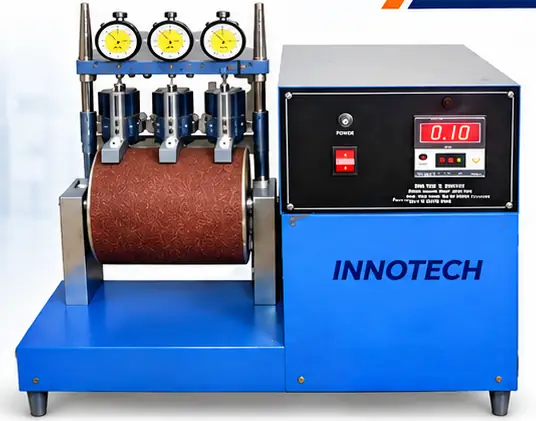
Sole Abrasion Machine
Sole Abrasion Machine
Sole Abrasion Machine is a specialised footwear testing instrument designed to evaluate the abrasion resistance and wear behaviour of shoe sole materials, rubber compounds and other flexible materials. It is available in DIN rotary drum and SATRA-type linear abrasion configurations to suit different testing methods and laboratory requirements. The machine helps footwear manufacturers, rubber product manufacturers and quality-control laboratories assess material wear, compare sole compounds and maintain consistent product quality. Innotech Engineering Devices Private Limited manufactures Sole Abrasion Testing Machines in Bhiwadi, Rajasthan, India, with customised configurations, fixtures and testing arrangements according to customer requirements. We serve footwear and industrial manufacturers across India.
MODEL
ISAM
OVERVIEW
Description
Sole Abrasion Machine Manufacturer in Bhiwadi, Rajasthan, India
Innotech Engineering Devices Private Limited is a manufacturer of Sole Abrasion Machines in Bhiwadi, Rajasthan, India, offering footwear testing equipment for evaluating the abrasion resistance and wear behaviour of shoe sole materials. Designed for footwear manufacturers, rubber industries, sole manufacturers, material testing laboratories and quality-control departments, the Sole Abrasion Testing Machine helps assess how materials respond to controlled abrasive action.
Shoe soles are continuously exposed to friction against different surfaces during walking, running and everyday use. The abrasion resistance of the sole material plays an important role in its durability, service life and overall quality. Testing helps manufacturers compare material formulations, evaluate production batches and select suitable materials for different footwear applications.
Innotech offers two testing configurations: DIN Rotary Drum Abrasion Testing Machine and SATRA-Type Linear Soling Material Abrasion Testing Machine. The configuration can be selected according to the required test method, specimen shape, material and applicable customer or industry standard.
What Is a Sole Abrasion Machine?
A Sole Abrasion Machine is a laboratory testing instrument used to evaluate the resistance of footwear sole materials to wear caused by friction and abrasive contact. It applies controlled abrasion to a prepared test specimen and helps determine changes such as mass loss, volume loss or thickness reduction, depending on the selected test method.
The machine is useful for evaluating materials such as rubber, synthetic rubber, thermoplastic rubber (TPR), polyurethane (PU), EVA-based compounds and other suitable sole materials, provided the specimen preparation and test method are appropriate.
Sole abrasion testing supports material development, incoming material inspection, production quality control and comparison of different sole compounds.
Two Sole Abrasion Testing Configurations Available
1. DIN Rotary Drum Sole Abrasion Testing Machine
The DIN-type Sole Abrasion Testing Machine is designed for rotary drum abrasion testing of rubber and suitable elastomer specimens. A prepared cylindrical specimen is held in a specimen holder and brought into contact with abrasive paper mounted on a rotating cylindrical drum under a controlled load.
As the drum rotates, the abrasive surface wears the specimen. The specimen is weighed before and after testing, and the mass loss is used with the specimen density to calculate volume loss. Depending on the selected method, the result may also be expressed as an abrasion resistance index.
This configuration is suitable for comparative abrasion testing of rubber sole compounds, footwear materials and other compatible elastomer products.
Typical test evaluation:
- Abrasion and wear resistance of rubber compounds
- Mass loss after controlled abrasion
- Calculated volume loss
- Comparison of different sole material formulations
- Quality-control evaluation of production batches
2. SATRA-Type Linear Sole Abrasion Testing Machine
The SATRA-type linear configuration is designed for testing soling and heel materials using an abrasive cloth supported on a horizontal testing bed. Prepared square test specimens are drawn across the abrasive surface under a specified load. The abrasive cloth moves at right angles to the specimen movement so that the specimen comes into contact with a fresh abrasive area.
The test helps evaluate material wear through thickness reduction. Depending on the machine configuration and test procedure, two specimens may be tested using the specified arrangement. A thickness-measuring system can be used to record the change in specimen thickness.
An effective debris-removal arrangement is also important because accumulated abrasion particles can influence test conditions.
Typical test evaluation:
- Abrasion behaviourt of shoe sole and heel materials
- Thickness loss during abrasion
- Comparative assessment of different sole materials
- Material development and footwear quality control
- Evaluation of soling materials under a specified test procedure
Important: The DIN rotary drum and SATRA-type linear methods use different specimen geometries, abrasive arrangements and result calculations. They are separate configurations, not interchangeable test procedures. The required method should be confirmed before ordering.
Working Principle of the Sole Abrasion Testing Machine
The working principle depends on the selected configuration.
DIN Rotary Drum Method:
1. Prepare the rubber or sole-material specimen according to the applicable test method.
2. Measure and record the initial specimen mass and other required measurements.
3. Mount the specimen in the holder.
4. Bring the specimen into contact with the abrasive-paper-covered rotating drum under the specified load.
5. Run the test for the required travel distance or test duration.
6. Remove and clean the specimen as required by the test procedure.
7. Record the final mass and calculate the abrasion loss or volume loss using the applicable method.
SATRA-Type Linear Method:
1. Prepare the required square sole-material specimens.
2. Measure the initial specimen thickness.
3. Mount the specimens in the test holders.
4. Apply the specified load to the specimens.
5. Move the specimens across the abrasive cloth while the cloth advances across a fresh abrasive area.
6. Remove the specimens after the prescribed test procedure.
7. Measure thickness loss and evaluate the results according to the applicable method.
Materials Suitable for Sole Abrasion Testing
Depending on the machine configuration, specimen preparation and test method, the equipment can be used for evaluating:
- Natural rubber and synthetic rubber
- Vulcanised rubber compounds
- Thermoplastic rubber (TPR)
- Polyurethane (PU) sole materials
- EVA-based footwear materials
- PVC-based sole compounds
- Rubbber outsole and heel materials
- Leather soling materials, where the selected method is suitable
- Other flexible footwear materials covered by the applicable test procedure
The suitability of each material depends on the specimen geometry, hardness, density and requirements of the test standard.
Applications of Sole Abrasion Machine
The Sole Abrasion Testing Machine is useful in several footwear and material manufacturing applications:
Footwear manufacturing: Testing outsole and sole materials before production and during quality inspection.
Rubber sole manufacturing: Comparing rubber formulations and evaluating their resistance to abrasive wear.
PU and TPR sole manufacturing: Assessing suitable sole compounds for footwear applications.
Sports shoe manufacturing: Evaluating sole materials used in sports and active footwear.
Safety footwear manufacturing: Supporting material quality assessment for industrial and protective footwear.
Leather footwear industry: Evaluating suitable soling and heel materials using the appropriate test configuration.
Footwear testing laboratories: Conducting abrasion-resistance tests for product development, inspection and customer requirements.
Research and development: Comparing new formulations, additives and material combinations during product development.
Why Is Sole Abrasion Testing Important?
Sole abrasion testing helps manufacturers understand how different materials respond to controlled abrasive conditions. A material that shows lower wear under a defined test procedure may be preferable for a particular product requirement, but test results should be interpreted according to the relevant standard and actual footwear application.
Testing can help manufacturers:
- Compare different rubber and polymer formulations
- Identify variations batween production batches
- Supports incoming raw-materials quality checks
- Evaluate changes in material formulation
- Improve footwear product-development decisions
- Maintain documented quality-control records
- Respond to customer and buyer testing requirements
Abrasion test results are comparative laboratory measurements. They should not be treated as a direct prediction of actual shoe service life because real-world wear also depends on walking conditions, surface type, user behaviour, sole design and environmental factors.
Applicable Standards for Sole Abrasion Testing
The applicable standard depends on the selected machine configuration and the test method required by the customer.
| Standard / Method |
Relevance |
| ISO 4649 | Rubber abrasion resistance using a rotating cylindrical drum device |
| ASTM D5963 | Rubber abrasion resistance using a rotary drum abrader |
| DIN 53516 | Earlier DIN reference for rubber abrasion testing, frequently cited in legacy specifications |
| SATRA STM 140 | Abrasion testing of leather soling and heel materials using abrasive cloth |
| EN ISO 20344 | Test methods for personal protective equipment footwear, select the relevant clause and apparatus |
| GB/T9867 | Rubber abrasion resistance using a rotating cylindrical drum method |
Standards and configuration note: ISO 4649 and ASTM D5963 relate to rotary drum abrasion testing. SATRA STM 140 describes a different linear abrasive-cloth arrangement for soling materials. DIN 53516 may appear in older customer specifications; confirm the required current or contractual edition before ordering. A machine should only be described as compliant with a standard when its design, accessories, calibration and operating procedure have been verified against that standard.
Key Factors That Affect Sole Abrasion Test Results
For meaningful comparison, the laboratory should control the test conditions and record the relevant parameters.
- Specimen preparation: Incorrect dimensions, surface condition or preparation can affect the test.
- Material density: Density is required for converting mass loss into volume loss in the DIN method.
- Applied load: The force acting on specimen affects abrasive contact.
- Abrasice surface: Abrasice grade, condition and replacement frequency can influence wear.
- Test distance or duration: The prescribed test distance or cycles must be followed.
- Specimen condition: Temperature, conditioning and storage can influence material behaviour.
How to Select the Right Sole Abrasion Testing Machine
Before purchasing a Sole Abrasion Machine, consider the following points:
1. Required test standard: Identify whether the requirement is ISO 4649, ASTM D5963, SATRA STM 140 or another specified method.
2. Material type: Confirm whether the samples are rubber, PU, TPR, EVA, leather or another material.
3. Specimen geometry: DIN rotary drum testing and SATRA-type linear testing require different specimen shapes and fixtures.
4. Result requirement: Decide whether the laboratory needs mass loss, volume loss, abrasion index or thickness reduction.
5. Testing frequency: Consider the number of samples tested per day and the required operating arrangement.
6. Accessories: Check the availability of specimen holders, abrasive media, cutting dies, measuring equipment and other method-specific accessories.
7. Customisation: Confirm whether the machine can be configured for the customer's testing method and laboratory requirements.
Sole Abrasion Machine Price in India
The price of a Sole Abrasion Testing Machine in India depends on the selected test configuration, standard requirements, loading arrangement, specimen fixtures, measuring system, digital controls and optional accessories.
A DIN Rotary Drum Abrasion Testing Machine and a SATRA-Type Linear Sole Abrasion Machine have different mechanical arrangements, so their prices may differ. For an accurate quotation, share the required standard, material type, specimen dimensions and desired testing configuration.
Contact Innotech Engineering Devices Private Limited for product details and a quotation based on your application.
Why Choose Innotech Engineering Devices Private Limited?
Innotech Engineering Devices Private Limited manufactures industrial testing machines and laboratory equipment in Bhiwadi, Rajasthan, India. We provide footwear testing equipment for manufacturers, laboratories and industrial buyers.
- Manufacturer of Sole Abrasion Testing Machines in Bhiwadi, Rajasthan
- DIN rotary drum and SATRA-type linear configurations
- Customised machine design and testing arrangements as per customer requirements
- Solutions for footwear, rubber and polymer material testing.
- Support in selecting a suitable machine configuration based in the required test method
- Supply of testing machines to customer across India
Frequently Asked Questions (FAQs)
1. What is a Sole Abrasion Machine used for?
A Sole Abrasion Machine evaluates the resistance of shoe sole materials to wear caused by controlled abrasive contact. It helps manufacturers compare materials and assess quality.
2. What is the difference between a DIN and SATRA-type Sole Abrasion Machine?
A DIN rotary drum machine uses a cylindrical specimen pressed against abrasive paper on a rotating drum. A SATRA-type linear machine moves prepared sole-material specimens across abrasive cloth and evaluates thickness loss.
3. Which materials can be tested using a Sole Abrasion Testing Machine?
Depending on the selected method, suitable materials may include natural rubber, synthetic rubber, PU, TPR, EVA, PVC-based compounds and leather soling materials.
4. Which standards are used for sole abrasion testing?
Relevant standards include ISO 4649 and ASTM D5963 for rotary drum rubber abrasion testing. SATRA STM 140 is relevant to linear abrasive-cloth testing of soling materials. The correct method must be selected for the sample and test requirement.
5. What is measured during a DIN abrasion test?
The specimen's mass loss is measured. Using the material density, volume loss can be calculated according to the test method.
6. What is measured during SATRA-type linear abrasion testing?
The test evaluates wear through thickness reduction of the soling material under the prescribed abrasive-cloth test conditions.
7. Can one Sole Abrasion Machine perform both DIN and SATRA-type tests?
These methods require different test mechanisms and specimen arrangements. Innotech offers both configurations, with the required configuration to be selected or specified at the time of ordering.
8. Can the Sole Abrasion Machine be customised?
Yes. Machine configuration, specimen fixtures, loading arrangements, controls and accessories can be customised according to the required test method and customer application.
9. What is the price of a Sole Abrasion Testing Machine?
The price depends on the test configuration, applicable standard, accessories, fixtures and customised requirements. Contact Innotech for a quotation.
10. Where can I buy a Sole Abrasion Machine in India?
You can contact Innotech Engineering Devices Private Limited, a manufacturer of testing machines in Bhiwadi, Rajasthan, India, for machine details, configuration and quotation.
Enquire About Sole Abrasion Testing Machine
Looking for a Sole Abrasion Machine for footwear, rubber or polymer testing? Contact Innotech Engineering Devices Private Limited to discuss your required test standard, specimen type and machine configuration.
Manufacturer: Innotech Engineering Devices Private Limited
Location: Bhiwadi, Rajasthan, India
Email: info@innotechgroup.net
Phone: +91 9810431604
Customised testing machines manufactured as per customer requirements. Supply across India.
WHY IT WORKS
Key benefits
Helps evaluate the abrasion resistance of footwear sole materials.
Supports comparison of different rubber and polymer compounds.
Helps identify variations in material wear behaviour.
Supports raw-material inspection and production quality control.
Provides test data for material development and product improvement.
Helps maintain documented laboratory testing records.
Offers two different abrasion-testing configurations for different test requirements.
Customised machine arrangements can be developed according to customer applications.
USE CASE
Application range
BUILT IN
Features
Available in DIN rotary drum and SATRA-type linear testing configurations.
Designed for footwear sole and suitable rubber material abrasion testing.
Controlled specimen loading according to the selected test method.
Abrasive drum arrangement for DIN-type testing.
Horizontal abrasive-cloth testing arrangement for SATRA-type configuration.
Specimen holding fixtures designed for the respective test method.
Provision for evaluating mass loss and volume loss in DIN-type testing.
Thickness measurement arrangement for SATRA-type testing, as configured.
Suitable for laboratory quality control and material comparison.
Customised fixtures and testing arrangements as per customer requirements.
Machine configuration can be selected according to applicable standards and customer specifications.