
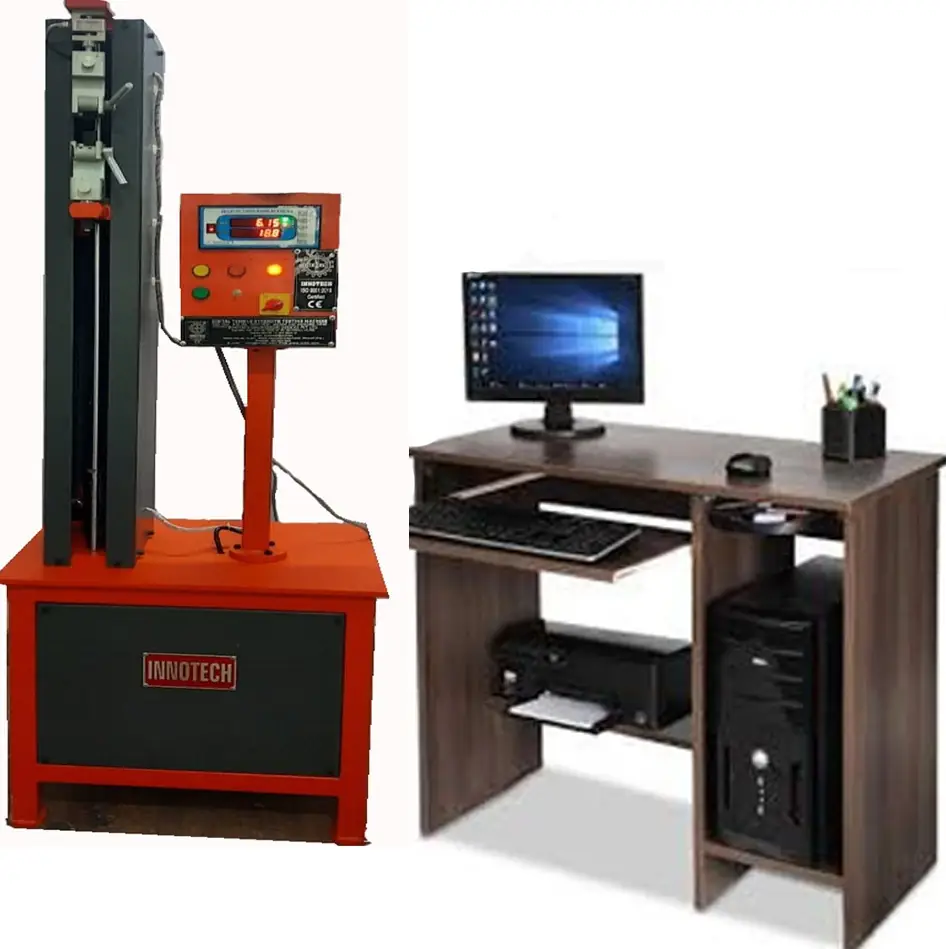
Single Column Computerized Tensile Testing Machine
Single Column Computerized Tensile Testing Machine
Innotech Engineering Devices offers a Single Column Computerized Tensile Testing Machine for measuring the tensile strength and pulling behaviour of suitable materials and components. The machine features a vertical single-column testing frame, digital control panel and computer-based testing arrangement, as shown in the product image. It is suitable for quality control laboratories, manufacturing units, research facilities and material testing applications. Contact Innotech for machine capacity, technical configuration, pricing and supply enquiries. We serve customers in Bhiwadi, Rajasthan, Delhi NCR and across India.
MODEL
I-SCCTT
OVERVIEW
Description
Single Column Computerized Tensile Testing Machine
The Single Column Computerized Tensile Testing Machine is designed to evaluate the tensile strength and pulling behaviour of materials or components by applying a controlled tensile force. It features a vertical single-column loading frame, a digital control panel and a separate computer-based arrangement, as shown in the product image.
This machine can be considered by manufacturers, quality control departments, testing laboratories and research institutions that need to assess how a material or component behaves when subjected to pulling force. Depending on the machine configuration and suitable grips or fixtures, it may be used for testing different material samples and finished products.
Innotech Engineering Devices Pvt. Ltd. is a testing machine manufacturer based in Bhiwadi, Rajasthan, India. We offer testing equipment for industrial and laboratory applications and can discuss machine configuration according to the customer's testing requirements.
What Is a Single Column Tensile Testing Machine?
A single column tensile testing machine is a material testing instrument with a vertical loading frame supported by one main column. It applies tensile force to a specimen held between suitable grips or fixtures.
During a tensile test, the specimen is pulled in a controlled manner until the required test endpoint, such as a specified load, extension or specimen failure, is reached. The machine's measurement system records the relevant test parameters according to its configuration.
A digital or computerized version may display measured values on its digital control panel and transfer or present test data through computer software. The available functions, calculations, graphs and report formats depend on the supplied measurement and software system.
Working Principle
The machine works on the principle of applying tensile force to a specimen and measuring its response.
1. Specimen Preparation: A sample is prepared according to the applicable test method and dimensions.
2. Specimen Mounting: The sample is secured between the upper and lower grips or suitable fixtures.
3. Test Parameter Selection: The operator selects the applicable test settings, such as test speed or other available parameters, according to the machine configuration and test procedure.
4. Application of Tensile Force: The machine's loading mechanism moves the crosshead or gripping arrangement to pull the specimen.
5. Measurement: The force and other supported parameters are measured through the machine's measurement system.
6. Digital Display and Recording: The digital panel and computer arrangement display or record the available test information, depending on the supplied software.
7. Test Evaluation: The recorded results are reviewed to evaluate the specimen's tensile behaviour.
The exact operating sequence and available calculations should be confirmed against the final machine configuration and applicable test method.
Key Applications
A single column tensile testing machine may be suitable for tensile or pull-force testing of materials and components, depending on the selected load capacity, grips and fixtures.
Potential application areas include:
- Plastic films, sheets and flexible materials
- Rubber and elastomer samples
- Textile materials, fabrics and threads
- Wires, cords and small flexible components
- Packaging materials and flexible components
- Adhesive bonds and selected bonded samples
- Small polymer and manufactured components
- Product and component quality control
The suitability of the machine for a particular material depends on its force capacity, gripping arrangement, specimen dimensions and test method.
Digital vs Computerized vs Conventional Tensile Testing Machine
| Comparison Parameter |
Conventional machine |
Digital tensile tester |
Computerized tensile tester |
| Measurement display | Mechanical or analogue indication | Digital display | Digital display with computer interface |
| Testing readings | Read manually | Display electronically | Displayed and potentially recorded through software |
| Data recording | Manual recording | Depends on available functions | Computer-based recording where supported |
| GRaph generation | Usually requires external recording | Depends on configuration | Available if supported by software |
| Result storage | Manual records | Depends on configuration | Digital storage where provided |
| Report generation | Manual preparation | Depends on configuration | Software-basaed reports where supported |
| Best suited for | Basic testing requirements | Digital measurement needs | Testing with computer-basead data handling |
Note: This is a general comparison of machine configurations, not a claim that every digital or computerized model includes all listed functions. Confirm the supplied features before ordering.
Why Choose Innotech Engineering Devices?
Innotech Engineering Devices Pvt. Ltd. supplies testing machines and laboratory equipment for industrial quality control and material testing requirements. When enquiring about a single column computerized tensile testing machine, buyers can discuss:
- Machine selection according to the material and expected force range.
- Suitabble grips and fixtures for the intended specimen
- Digital display and computer-based testing requirements.
- Application-specific machine configuration.
- Technical details and commercial quotation before purchase.
- Supply enquiries from Bhiwadi and other locations across india.
Our objective is to understand the actual testing application before recommending a machine configuration.
Single Column Tensile Testing Machine Price in India
The price of a single column computerized tensile testing machine in India depends on several factors, including:
- Maximum load capacity and load measurement system.
- Type and number of grips or fixtures.
- Crosshead speed and available speed control.
- Measurement resolution and specified accuracy.
- Digital display and computer software configuration.
- Data recording, graphing and reporting requirements.
- Installation, commissioning and other agreed supply requirements.
For an accurate price, buyers should share the material to be tested, expected maximum force, specimen dimensions, required test method and preferred computer-based functions. Contact Innotech for the latest price and a quotation based on the required configuration. We do not publish an unverified fixed price because machine configurations can differ.
Where to Buy a Single Column Computerized Tensile Testing Machine?
If you are looking for a single column computerized tensile testing machine in India, you can contact Innotech Engineering Devices Pvt. Ltd., Bhiwadi, Rajasthan for product details and a purchase quotation.
We accept enquiries from manufacturers, industrial units, testing laboratories, educational institutions and research facilities in Bhiwadi, Delhi NCR, Rajasthan and other parts of India.
Manufacturer and Supplier: Innotech Engineering Devices Pvt. Ltd.
Location: H-307, RIICO Industrial Area Karoli, Tapukara, Bhiwadi, Rajasthan, India
Email: info@innotechgroup.net
Phone: +91 9810431604
Contact our team with your testing requirements to discuss the appropriate machine configuration, availability, delivery and pricing.
Frequently Asked Questions
1. What is the use of a single column computerized tensile testing machine?
It is used to evaluate the tensile strength and pulling behaviour of suitable materials and components by applying tensile force and measuring their response.
2. What is the difference between a digital and a computerized tensile testing machine?
A digital tensile tester generally displays readings electronically. A computerized tensile testing machine may also connect to computer software for test monitoring, data recording, graphs and reports, depending on its configuration.
3. Which materials can be tested on this machine?
Potential materials include plastics, rubber, textiles, films, wires and other suitable components. The actual material range depends on the machine's capacity, grips and fixtures.
4. What is the price of a single column tensile testing machine in India?
The price depends on load capacity, measurement system, grips, speed control and software functions. Contact Innotech for a quotation based on your application.
5. Can I buy this machine directly from the manufacturer in Bhiwadi?
Yes. You can contact Innotech Engineering Devices Pvt. Ltd. in Bhiwadi, Rajasthan, for product information, technical discussions and purchase enquiries.
6. Does Innotech supply tensile testing machines outside Rajasthan?
Innotech accepts enquiries for testing machines from customers across India. Contact the company to confirm the supply and delivery arrangements for your location.
7. Can the machine generate tensile test graphs and reports?
Computer-based graphs and reports depend on the supplied software and measurement configuration. Confirm the required graph formats, calculations and report functions when requesting a quotation.
8. Why choose Innotech for a tensile testing machine?
Innotech is an engineering equipment manufacturer based in Bhiwadi, Rajasthan, with a focus on testing machines and laboratory equipment. Buyers can discuss their material, testing method, capacity and customization requirements directly with the company before finalizing a purchase.
9. What information should I provide before requesting a quotation?
Share the material type, expected maximum tensile force, specimen dimensions, required test method, grip requirements and whether you need computer-based data recording. These details help determine a suitable configuration.
10. What is the HSN code for a tensile testing machine?
Tensile testing machines generally fall under HSN heading 9024, which covers machines for testing mechanical properties such as strength and elasticity. The applicable eight-digit tariff item depends on the machine's intended use and classification. Confirm the final code with your GST or customs advisor before invoicing.
11. Is this machine suitable for all tensile testing standards?
Not automatically. Suitability depends on the machine configuration, grips, measurement system, specimen requirements and applicable test standard. Share the required standard before ordering so the configuration can be assessed.
WHY IT WORKS
Key benefits
Helps evaluate tensile strength and material resistance to pulling force.
Provides digital display of test readings.
Computer-based testing arrangement for supported data monitoring.
Helps maintain digital test records, subject to software configuration.
Supports material quality control and product evaluation.
Helps identify material behaviour under tensile loading.
Suitable for laboratory testing and industrial quality inspection.
Single-column design provides a compact vertical machine arrangement.
USE CASE
Application range
BUILT IN
Features
Single-column vertical loading frame.
Digital control panel for machine operation.
Separate computer workstation arrangement.
Tensile force application mechanism.
Specimen gripping arrangement as per testing requirements.
Digital measurement and reading display.
Computer interface for supported testing functions.
Suitable for different specimen types with compatible grips and fixtures.
Configuration can be selected according to required load capacity and application.
SPEC
Specifications
Machine type
Single Column Tensile Testing Machine
Operation
Digital / Computerized
Loading frame
Single vertical column
Maximum load capacity
To be confirmed
Load measurement
To be confirmed
Load accuracy
To be confirmed
Load resolution
To be confirmed
Crosshead speed
To be confirmed
Speed control
To be confirmed
Test space
To be confirmed
Maximum extension
To be confirmed
Grips / Fixtures
As per material and application
Display
Digital control panel
Computer interface
Shown in product image; software functions to be confirmed
Graph generation
To be confirmed
Data storage and reporting
To be confirmed
Power supply
To be confirmed
Applicable test standards
To be confirmed according to material and test method