
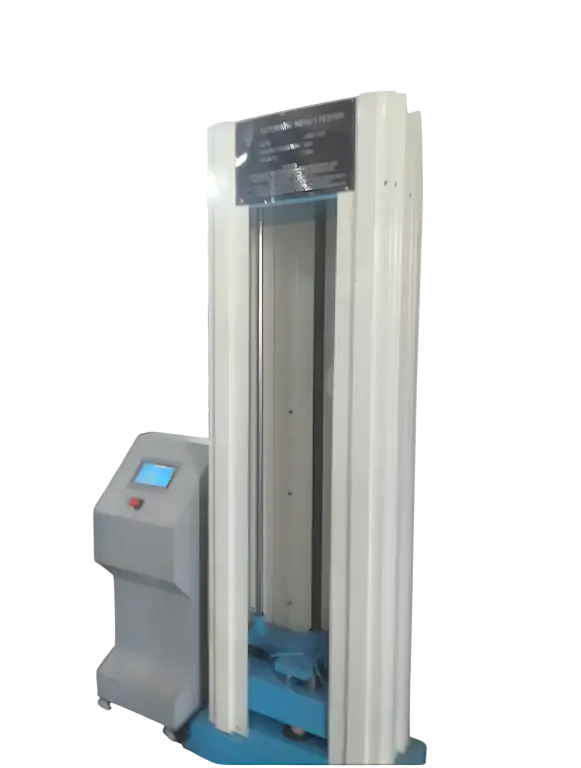
Rubber/Polymer Impact Testing Machine for Suspension Bushes
Rubber/Polymer Impact Testing Machine for Suspension Bushes
The Rubber/Polymer Impact Testing Machine for Suspension Bushes is designed to evaluate the impact response and energy absorption performance of rubber, polymer, and elastomeric suspension bush components under specified test conditions. It can be customized with suitable impact loading arrangements, component fixtures, measurement systems, and controls according to customer requirements. The machine supports material evaluation, automotive component testing, product development, and quality control applications.
OVERVIEW
Description
Rubber/Polymer Impact Testing Machine for Suspension Bushes
The Rubber/Polymer Impact Testing Machine for Suspension Bushes is a specialized testing system designed to evaluate the impact response and mechanical performance of rubber, polymer, and elastomeric components used in automotive suspension systems.
Suspension bushes help isolate vibration, reduce noise, accommodate movement, and support loads between connected vehicle components. Their performance depends on the material formulation, component geometry, bonding, operating conditions, and applied loads. Testing can help manufacturers assess how these components respond to impact loading and whether they meet defined product requirements.
Innotech Engineering Devices Private Limited manufactures customized testing equipment according to customer requirements, including specialized machines for rubber, polymer, elastomer, and automotive component testing.
What Is a Rubber/Polymer Impact Testing Machine?
A rubber/polymer impact testing machine is used to apply a defined impact load or impact energy to a test specimen or component and evaluate its response.
For suspension bushes, the test arrangement may be designed around the component's shape, mounting points, material, and intended service conditions. Depending on the testing objective, the system may measure impact force, displacement, energy-related parameters, deformation, or other selected responses.
The exact impact mechanism and measurement system depend on whether the application requires component-level impact testing, material impact characterization, or a specialized automotive validation test.
Why Is Impact Testing of Suspension Bushes Important?
Suspension bushes are exposed to repeated mechanical loads, vibration, movement, and changing service conditions. Understanding their response to impact loading can help automotive component manufacturers evaluate design performance and product consistency.
Impact testing may support:
• Evaluation of impact response under defined test conditions.
• Comparison of different rubber and polymer formulations.
• Assessment of component deformation during impact loading.
• Product development and design validation.
• Quality-control checks between manufactured batches.
• Investigation of component damage or failure.
• Evaluation of changes in component design or manufacturing processes.
The selected test method should reflect the intended application and the relevant customer or industry test procedure.
Working Principle
The working principle depends on the machine configuration and the required testing method. A typical component-level testing sequence may include the following steps:
1. Specimen preparation: The suspension bush or test specimen is prepared according to the specified procedure.
2. Component mounting: The specimen is positioned in a suitable fixture to maintain the required orientation and alignment.
3. Test parameter setting: The required impact conditions and measurement parameters are configured.
4. Impact application: The machine applies the defined impact using the selected impact mechanism.
5. Response measurement: The configured measurement system records the relevant parameters, such as impact force, displacement, or other application-specific data.
6. Result evaluation: The recorded results are reviewed against the specified acceptance criteria.
7. Documentation: Results may be recorded or exported if the machine includes a suitable data acquisition system.
The exact operating sequence must be established according to the required test method. Not every configuration measures impact energy, force, and displacement simultaneously.
Technical Specifications
The following specifications are indicative configuration parameters. Final values should be established according to the suspension bush design and required test procedure.
| Parameter |
Specifications |
| Machine Type | Rubber/Polymer Impact Testing Machine |
| Primary Application | Impact testing of suspension bushes |
| Material Type | Rubber, polymer, and elastomeric components |
| Testing Mode | Component-level or specimen-level imapct testing as required |
| Impact Mechanism | Selected according to the testing method |
| Impact Energy or Loading Range | As per customer requirement |
| Impact Force Measurement | Optional or as required |
| Displacement Measurement | Optional or as required |
| Test Specimen | Suspension bush or specified test specimen |
| Speciment Dimensions | As per component design |
| Fixtures and Mounting Arrangement | Cusomized for the component |
| Impact Direction | As per testing procedure |
| Test Parameter Control | Manual, digital, or programmable, as required |
| Measurement System | Application-specific sensors and instrumentation |
| Display System | Digital display or HMI, as required |
| Data Acquisition | Optional |
| Software adn Result Analysis | Optional, according to configuration |
| Operating Mode | Manual, semi-automatioc, or automatic |
| Safety Arrangement | Suitable guarding and safety provisions |
| Power Supply | Accordinga to machine configuration |
| Machine Dimensions | Based on test arrangement and component size |
| Cusomization | According to customer specifications |
Note: The table is a configurable reference, not a confirmed specification for a particular machine. Final technical parameters depend on the required impact method, test energy, component geometry, measurement needs, and customer acceptance criteria.
Key Features
• Designed for specialized rubber, polymer, and suspension bush testing applications.
• Component-specific specimen mounting and fixture arrangements.
• Configurable impact loading mechanism.
• Optional force and displacement measurement.
• Application-specific digital controls and monitoring.
• Optional data acquisition and test-result recording.
• Customizable testing sequence and measurement parameters.
• Suitable for laboratory, R&D, and industrial quality-control applications.
• Machine design tailored to customer requirements.
Applications
The machine may be configured for:
• Automotive suspension bush impact testing.
• Rubber bush component evaluation.
• Polymer and elastomer component testing.
• Comparison of rubber and polymer formulations.
• Automotive component development.
• Impact response evaluation of specialized rubber components.
• Quality control in automotive component manufacturing.
• Research and development of elastomeric products.
Additional applications should be confirmed according to the machine's final design and test method.
Industries Served
Automotive Component Manufacturing
For testing and evaluating rubber suspension bushes and other compatible elastomeric components used in vehicle assemblies.
Rubber and Elastomer Manufacturing
For evaluating selected mechanical responses of rubber products under defined impact conditions.
Polymer and Plastic Manufacturing
For specialized impact testing of suitable polymer components.
Automotive Research and Development
For component development, design comparison, and evaluation of material or geometry changes.
Testing Laboratories and Quality Control
For controlled component testing and comparison against defined customer specifications.
How to Select the Right Machine
Before selecting an impact testing machine for suspension bushes, consider:
• Type and material of the suspension bush.
• Component geometry and mounting arrangement.
• Required impact mechanism and direction.
• Required impact energy or force range.
• Measurement parameters and sensor requirements.
• Test speed or impact conditions, where applicable.
• Required test procedure and acceptance criteria.
• Data acquisition and reporting needs.
• Safety and guarding requirements.
• Expected testing volume and automation level.
Providing component drawings, sample parts, and the intended test procedure can help determine the appropriate machine configuration.
Customized Rubber/Polymer Testing Machine Manufacturer in India
Innotech Engineering Devices Private Limited manufactures testing equipment and special-purpose machines for industrial and laboratory applications. We develop machine configurations according to customer requirements, including component fixtures, loading arrangements, measurement systems, controls, and optional data acquisition.
For automotive manufacturers, rubber product manufacturers, mechanical engineers, and testing laboratories, the machine configuration can be discussed according to the component design and intended testing application.
Frequently Asked Questions
What is a suspension bush impact testing machine used for?
It is used to evaluate the response of suspension bushes under defined impact conditions. The measured parameters depend on the machine configuration and test procedure.
Can the machine test different rubber and polymer components?
The machine can be designed for specified components, subject to suitable fixtures, loading arrangements, and measurement requirements.
Can the impact force and displacement be measured?
Force and displacement measurement can be incorporated where required, depending on the test method and machine configuration.
Can the machine be customized for a particular automotive component?
Yes. The fixture, impact mechanism, test parameters, instrumentation, and control system can be selected according to customer requirements.
What information is needed before requesting a quotation?
Provide the component drawing or sample, material details, required impact test method, target impact conditions, measurement requirements, and any applicable customer testing procedure.
Consult an Expert
Looking for a customized Rubber/Polymer Impact Testing Machine for Suspension Bushes?
Contact Innotech Engineering Devices Private Limited to discuss your component design and testing requirements.
Email: info@innotechgroup.net
Phone: +91 9810431604
Website: www.innotechgroup.net
Location: Bhiwadi, Rajasthan, India
Consult to Expert for a machine configuration suited to your testing application.