
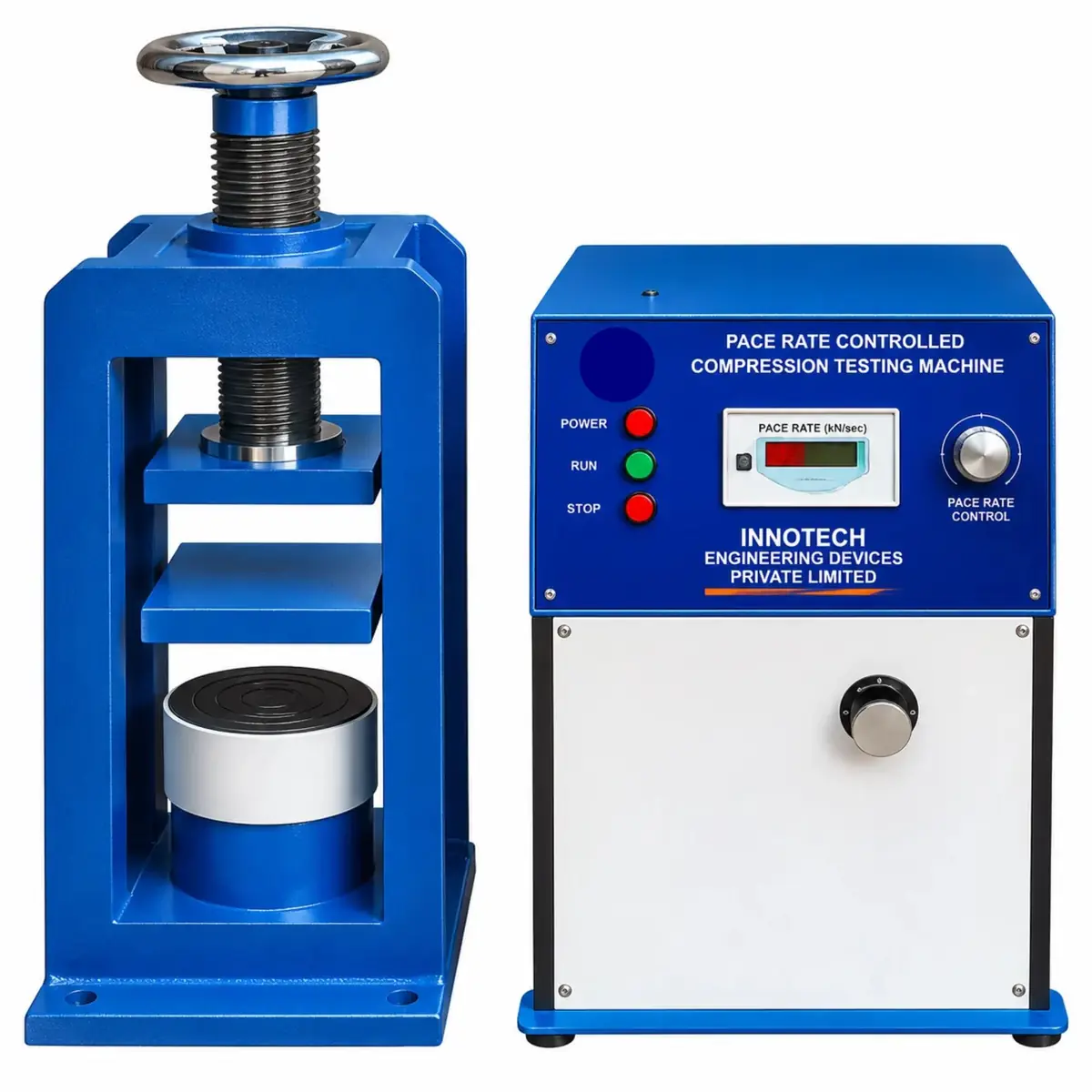
Pace Rate Controlled Compression Testing Machine (CTM)
Pace Rate Controlled Compression Testing Machine (CTM)
Need consistent loading during concrete strength testing? Innotech's Pace Rate Controlled Compression Testing Machine offers application-specific capacities, digital force measurement and configurable loading control. Designed for concrete, cement, bricks and construction materials, our customized CTM solutions are manufactured in Bhiwadi, Rajasthan, India. Request technical specifications and a quotation.
MODEL
IPCCTM
OVERVIEW
Description
Pace Rate Controlled Compression Testing Machine Manufacturer in India
Looking for a reliable Pace Rate Controlled Compression Testing Machine for concrete cubes, cylinders, bricks and construction material strength testing? Innotech Engineering Devices Private Limited is a Compression Testing Machine manufacturer in India, offering customized CTM solutions for construction companies, cement industries, ready-mix concrete plants, infrastructure projects and material testing laboratories.
As a Compression Testing Machine manufacturer in Rajasthan, Innotech develops application-specific testing machines according to the customer's required capacity, specimen dimensions, loading rate and applicable testing standards. Our IPCCTM model is designed for controlled compressive loading and material strength evaluation.
What Is a Pace Rate Controlled Compression Testing Machine?
A pace rate controlled CTM applies compressive force to a specimen at a specified loading rate. Maintaining the required rate of loading is important for obtaining meaningful and repeatable compressive strength results.
The machine uses a loading frame, hydraulic loading arrangement and electronic measurement system according to its configuration. Automatic pace rate control can regulate the applied load based on programmed testing parameters.
Explore our complete range of Automatic Compression Testing Machines https://innotechgroup.net/categories/compression-testing-machines/automatic-compression-testing-machines for advanced loading control requirements.
Customized CTM Capacity Options
Innotech evaluates customized load capacities according to the customer's testing application.
| Capacity Requirement |
Typical Application |
| 250 kN | Cement mortar and small specimens |
| 500 kN | Bricks and selected construction materials |
| 1000 kN | Concrete and industrial material testing |
| 1500 kN | Concrete cube strength testing |
| 2000 kN | Concrete cubes and cylinders |
| 3000 kN and above | High-strength concrete and special applications |
Final machine capacity and measurement range are selected according to expected failure loads, specimen geometry and test requirements.
Key Features and Configuration Options
- Programmable rate of loading.
- Digital force measurement and peak-load indication.
- Automatic pace rate control where specified.
- Rigid compression loading frame.
- Hydraulic power pack with suitable loading control.
- Self-aligning compression platen options.
- Compressive strength calculation with compatible controllers.
- Automatic test termination and result storage options.
- Customized platens, spacers and specimen fixtures.
- Application-specific overload protection and safety arrangements.
Working Principle
The specimen is positioned centrally between suitable compression platens. The operator selects the test parameters and required loading rate.
Compressive force is applied progressively until the specimen fails or reaches the defined test endpoint. Depending on the control system, peak load and compressive strength can be displayed and recorded.
For concrete specimens, compressive strength is generally calculated as:
Compressive Strength (MPa) = Maximum Load (N) / Loaded Area (mm²)
Correct specimen preparation, loading rate and machine calibration are essential for valid test results.
Applications
| Material |
Testing Application |
| Concrete cubes | Compessive strength |
| Concrete cyulinders | Axial compressive strength |
| Cement mortar | Strength evaluation |
| Bricks | Crushing strength |
| Concrete blocks | Load-bearing strength |
| AAC blocks | Compressive strength |
| Paver blocks | Mechanical strength evaluation |
| Precast product | Construction material quality control |
The machine can be configured with appropriate fixtures and measurement ranges according to the relevant specimen and test method.
Applicable Testing Standards
- IS 14858 – Compression testing machines for concrete and mortar.
- IS 516 (Part 1/Sec 1) – Strength testing of hardened concrete.
- IS 4031 (Part 6) – Compressive strength testing of hydraulic cement.
- ASTM C39/C39M – Compressive strength of cylindrical concrete specimens.
- EN 12390-4 – Compression testing machines for hardened concrete.
Machine compliance, calibration and applicable standard editions are confirmed according to the finalized purchase specifications.
Why Choose Innotech as Your Compression Testing Machine Manufacturer in Bhiwadi?
Innotech manufactures testing equipment according to customer-specific requirements instead of restricting laboratories to fixed machine configurations.
Our engineering solutions include customized capacities, loading arrangements, measurement systems, compression platens and control options.
For advanced graphical analysis and electronic reporting, discover our Computerized Compression Testing Machines https://innotechgroup.net/categories/compression-testing-machines/computerized-compression-testing-machines
Learn more about CTM applications in our guide on What Is a Compression Testing Machine? https://innotechgroup.net/blog/what-is-a-compression-testing-machine
Pace Rate Controlled Compression Testing Machine Price in India
The price depends on the rated capacity, loading control technology, hydraulic system, measuring accuracy, controller and supplied accessories.
If you are looking for a 1000 kN, 2000 kN or customized pace rate controlled compression testing machine, contact Innotech with your testing requirements.
Request a technical catalogue, customized machine configuration and commercial quotation directly from a compression testing machine manufacturer in India.
Innotech Engineering Devices Private Limited
Location: Bhiwadi, Rajasthan, India
Email: info@innotechgroup.net
Phone: +91 9810431604
WHY IT WORKS
Key benefits
Helps maintain the required loading rate during testing.
Supports consistent compression testing procedures.
Enables evaluation of specimen compressive strength.
Simplifies load monitoring through digital indication.
Supports construction-material quality-control activities.
Can accommodate different specimen formats with suitable fixtures.
Optional result storage can improve test record management.
Configurable for laboratory, production and research requirements.
USE CASE
Application range
BUILT IN
Features
Controlled compressive load application.
Pace-rate control according to the selected test method.
Digital load indication or controller, as configured.
Hydraulic loading arrangement, subject to model design.
Suitable loading platens for the intended specimens.
Rigid compression testing frame.
Peak-load indication, depending on controller.
Optional automatic compressive-strength calculation.
Optional test data storage and report generation.
Specimen spacers and fixtures according to application.
Safety provisions selected for the machine configuration.
SPEC
Specifications
Model
IPCCTM
Reference capacity
2000 kN
Other capacity requests
250, 500, 1000, 1500, 3000 kN or customized
Loading system
Electrohydraulic
Control mode
Automatic load-rate control
Load measurement
Calibrated load cell or pressure transducer
Load accuracy target
Class 1 / ±1% within verified range
Pace rate accuracy target
±2% of set rate within validated conditions
Loading rate
Programmable according to test method
Display
Digital controller
Frame
Rigid four-column or plate-type construction
Platen diameter
Proposed 250–300 mm
Ram stroke
Proposed 50–60 mm
Vertical daylight
Proposed 350 mm
Specimen size
150 mm cube / 150 × 300 mm cylinder, as configured
Upper platen
Spherical self-aligning arrangement
Result indication
Peak load and compressive strength
Data storage
Optional
PC connectivity
Optional
Safety
Overload protection, emergency stop and specimen guard
Power supply
230 V AC, 50 Hz — proposed
Calibration
Traceable force calibration