
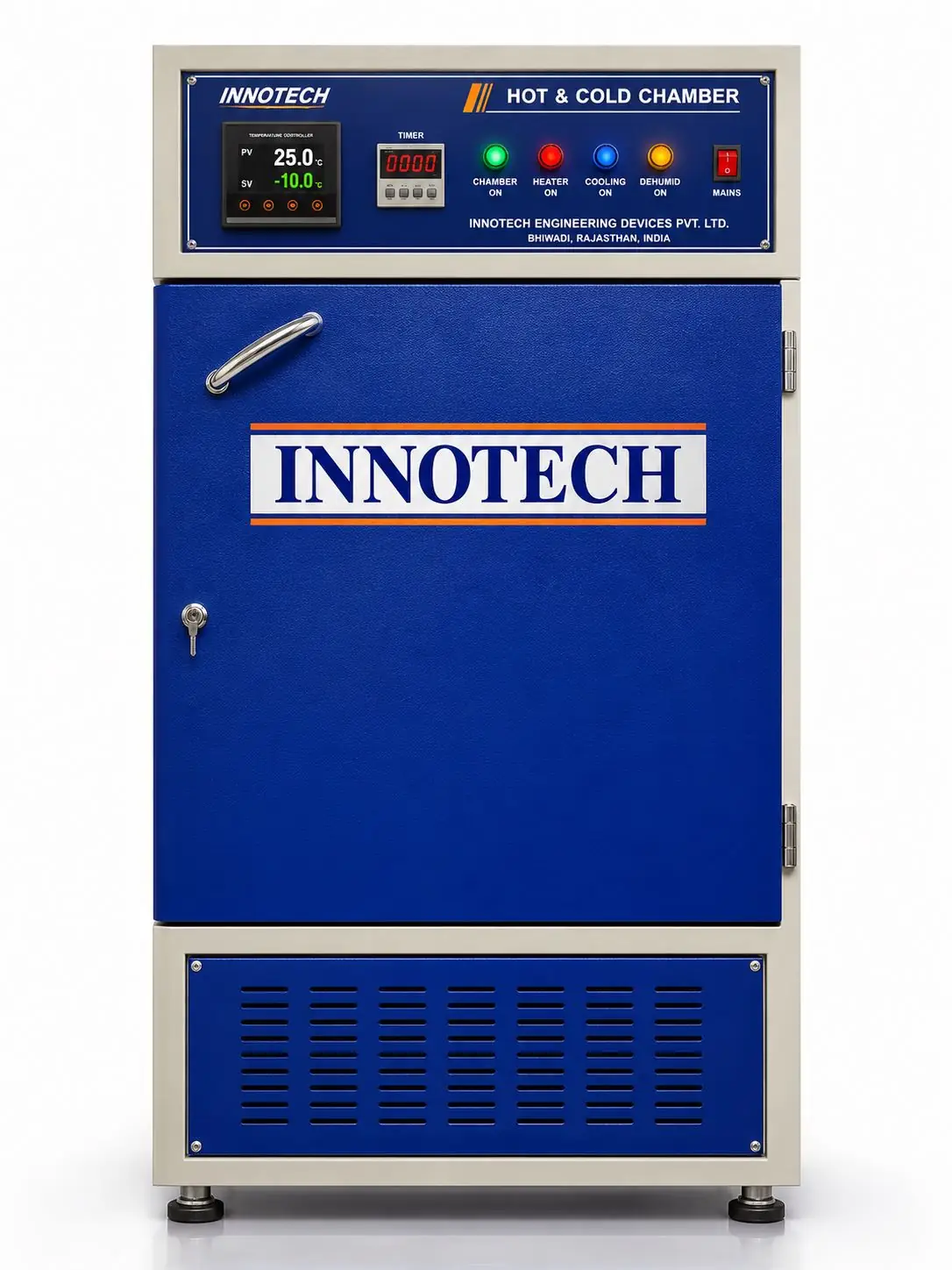
Hot and Cold Chamber
Hot and Cold Chamber
A Hot and Cold Chamber is used to evaluate how products, materials and components perform under controlled high- and low-temperature conditions. It helps manufacturers identify temperature-related changes such as cracking, deformation, dimensional variation and performance loss. Suitable for product development, quality control and reliability testing, with temperature range, chamber size and test cycles configured according to application requirements.
MODEL
IHCC
OVERVIEW
Description
Hot and Cold Chamber for Temperature Testing of Industrial Products
Products used in industries are often exposed to changing temperatures during manufacturing, storage, transportation and actual service conditions. A component that performs properly at room temperature may behave differently when exposed to extreme heat or cold. These changes can affect its strength, dimensions, flexibility, electrical performance and overall reliability.
A Hot and Cold Chamber provides a controlled environment for testing products at selected high and low temperatures. It allows manufacturers and testing laboratories to observe how a sample responds to temperature exposure and whether it continues to meet the required performance criteria.
The chamber is suitable for temperature testing of industrial components, electrical and electronic products, automotive parts, plastic materials, rubber components and other products that require temperature-based evaluation. Test conditions can be selected according to the material, product design and applicable testing procedure.
For manufacturers looking for a Hot and Cold Chamber manufacturer in India, the important factors are not only the minimum and maximum temperature. Chamber working volume, sample size, temperature stability, heating and cooling performance, control system and required test cycle should also be considered before selecting a machine.
How Does a Hot and Cold Chamber Work?
The chamber creates a controlled temperature environment inside an insulated testing space. A heating system raises the internal temperature, while a refrigeration system lowers it. Temperature sensors monitor the chamber conditions and provide feedback to the temperature controller.
The operator places the test specimen inside the chamber, selects the required temperature and sets the test duration or programmed cycle, depending on the machine configuration.
During testing, the controller manages the heating and cooling systems to maintain the selected conditions. The sample is then inspected or evaluated to identify changes caused by temperature exposure.
Typical testing sequence:
1. Place the specimen inside the chamber using the available shelves, trays or sample fixtures.
2. Select the required high or low temperature.
3. Set the holding time or programmed temperature sequence.
4. Allow the chamber to reach and maintain the selected condition.
5. Repeat the required temperature stages or cycles.
6. Remove the specimen after the test and evaluate its condition or performance.
The actual sequence, temperature transition rate and holding period should follow the customer's test procedure or applicable standard.
Types of Hot and Cold Temperature Testing
The chamber configuration depends on whether the test requires exposure at a fixed temperature or repeated changes between hot and cold conditions.
1. Steady-State Temperature Testing
In steady-state testing, the specimen is maintained at a selected high or low temperature for a specified period. This helps evaluate how a product behaves after remaining in a controlled temperature environment.
2. Temperature Cycling Testing
In temperature cycling, the chamber follows a programmed sequence of high and low temperature stages. The sample experiences repeated temperature changes to help assess its response to expansion, contraction and repeated thermal exposure.
3. Programmable Hot and Cold Testing
For applications requiring multiple temperature stages, a programmable controller can be configured to run selected temperature profiles, holding periods and cycles, subject to the machine's control features.
Note: A conventional temperature cycling chamber changes the temperature within its test space. A dedicated thermal shock chamber is designed for much faster temperature transitions, often using separate hot and cold zones. These machines should not be treated as interchangeable when a test procedure specifies a thermal shock method.
What Can Be Evaluated Using a Hot and Cold Chamber?
Temperature exposure can affect products in several ways. The chamber helps manufacturers evaluate these changes under controlled conditions.
- Dimensional stability: Identify expansion, contractin or changes in roduct dimensions
- Material behaviour: Oserve changes in flexibility, hardness, brittleness or physical condition.
- Cracking and deformation: Examine whether components develop cracks, warping or other visible damage.
- Joint and bonding performance: Evaluate the response of bonded, assembled or joined components to temperature changes.
- Electrical and electronic performance: Check whether components continue to function under specified temperature conditions
- Product reliability: Assess whether the product maintains its required performance after exposure to selected temperature conditions
The exact evaluation method depends on the product and the testing standard being followed.
How to Select the Right Hot and Cold Chamber
Choosing a chamber only by its temperature range may result in a machine that does not suit the actual testing requirement. Before requesting a quotation, consider the following points:
1. Required temperature range: Identify the highest and lowest temperatures specified in your test procedure.
2. Specimen dimensions: Check the size, shape and quantity of samples that will be tested together.
3. Test method: Decide whether the application requires fixed-temperature exposure or repeated temperature cycling.
4. Heating and cooling rate: Confirm the required rate of temperature change rather than assuming all chambers operate at the same speed.
5. Temperature stability and uniformity: Ask for the specified performance at the actual working conditions and sample load.
6. Controller and data requirements: Decide whether a digital controller is sufficient or whether programmable cycles, data logging or computer connectivity are needed.
7. Applicable testing standard: Share the standard and test clause, where available, so the chamber can be configured around the correct procedure.
Providing these details helps the manufacturer recommend a suitable chamber instead of offering a configuration based only on a general product name.
Hot and Cold Chamber Manufacturer in India
Innotech Engineering Devices Private Limited manufactures testing machines and laboratory equipment for industrial and quality-control applications. Hot and cold temperature testing systems can be discussed according to the required test conditions, chamber workspace, temperature profile and operating requirements.
For customers looking for a Hot and Cold Chamber manufacturer in Bhiwadi, Rajasthan, the machine requirement can be discussed with the engineering team before finalizing the configuration. Buyers from Delhi NCR and other parts of India can share their sample details and testing procedure to help determine a suitable arrangement.
Whether the requirement is for material evaluation, component testing, product development or routine quality inspection, the selection should be based on the actual test method and operating conditions.
Why Choose Innotech?
- Industrial testing machine and laboratory equipment manufacturing experience.
- Configurations discussed according to the customer's testing application.
- Support in understanding chamber size, temperature range and test-cycle requirements.
- Solutions for manufacturing quality control and laboratory testing.
- Enquiry support for customers across India.
Frequently Asked Questions
1. What is a Hot and Cold Chamber used for?
It is used to expose products and materials to controlled high and low temperatures. The test helps evaluate dimensional stability, material behaviour, cracking, deformation and functional performance under specified temperature conditions.
2. Is a Hot and Cold Chamber the same as a temperature cycling chamber?
A chamber designed for programmed changes between high and low temperatures is commonly used for temperature cycling. The exact capabilities depend on its controller and heating and cooling arrangement.
3. What is the difference between a Hot and Cold Chamber and a Thermal Shock Chamber?
A Hot and Cold Chamber generally changes the temperature of the test space according to a controlled profile. A thermal shock chamber is designed to expose specimens to much faster transitions between hot and cold environments, often through separate zones. The correct equipment depends on the test procedure.
4. Can plastic and rubber samples be tested in this chamber?
Yes, suitable plastic and rubber samples can be evaluated under specified temperature conditions. The sample size, temperature limits and test method should be checked before selecting the chamber.
5. Can the chamber perform automatic temperature cycling?
Programmable temperature cycling can be provided when included in the selected configuration. The required stages, holding times and cycle sequence should be shared during enquiry.
6. What is the price of a Hot and Cold Chamber in India?
The price depends on the temperature range, internal volume, heating and refrigeration requirements, control system, temperature change rate and optional features. Share your testing requirements to receive a suitable quotation.
7. How do I select the correct chamber capacity?
Consider the dimensions and quantity of specimens, the space needed for air circulation and the required test arrangement. The working volume should be selected around the actual samples rather than only the external dimensions of the chamber.
8. Can a Hot and Cold Chamber be customized?
Chamber dimensions, temperature requirements, control options and testing arrangements can be discussed according to the application and feasible machine configuration.
Request a Quote for a Hot and Cold Chamber
Looking for a Hot and Cold Chamber for your manufacturing unit, testing laboratory or product development facility?
Share your required temperature range, specimen dimensions, test method and applicable standard. The engineering team can review your application and help identify a suitable chamber configuration.
Innotech Engineering Devices Private Limited
Email: info@innotechgroup.net
Phone: +91 9810431604
Location: Bhiwadi, Rajasthan, India
WHY IT WORKS
Key benefits
Find temperature-related weaknesses
Improve product development
Support quality control
Evaluate material suitability
Check product reliability
Maintain repeatable test conditions
Reduce field-related surprises
USE CASE
Application range
BUILT IN
Features
Controlled heating and cooling for high- and low-temperature testing.
Insulated chamber construction to support temperature stability.
Temperature monitoring through a suitable sensing and control arrangement.
Adjustable test conditions according to the required application.
Provision for steady-state or programmed temperature cycling, depending on configuration.
Internal workspace designed to accommodate the required test specimens.
Suitable control and safety arrangements based on the selected model.
Custom chamber dimensions and testing arrangements can be discussed according to project requirements.
SPEC
Specifications
Product
Hot and Cold Chamber
Temperature Range
As per customer testing requirement
Internal Chamber Volume
As per required specimen size
Temperature Control
As per selected controller configuration
Temperature Uniformity
To be specified for the selected model
Heating System
As per chamber design
Cooling System
As per required low-temperature range
Temperature Cycling
Available as per selected configuration
Heating/Cooling Rate
As per required test profile
Shelves / Trays
As per specimen requirement
Inner Chamber Material
To be confirmed for selected model
Outer Body Construction
As per design
Safety Protection
As per selected configuration
Power Supply
As per machine design and site requirement
Optional Features
As per application and customer requirement