
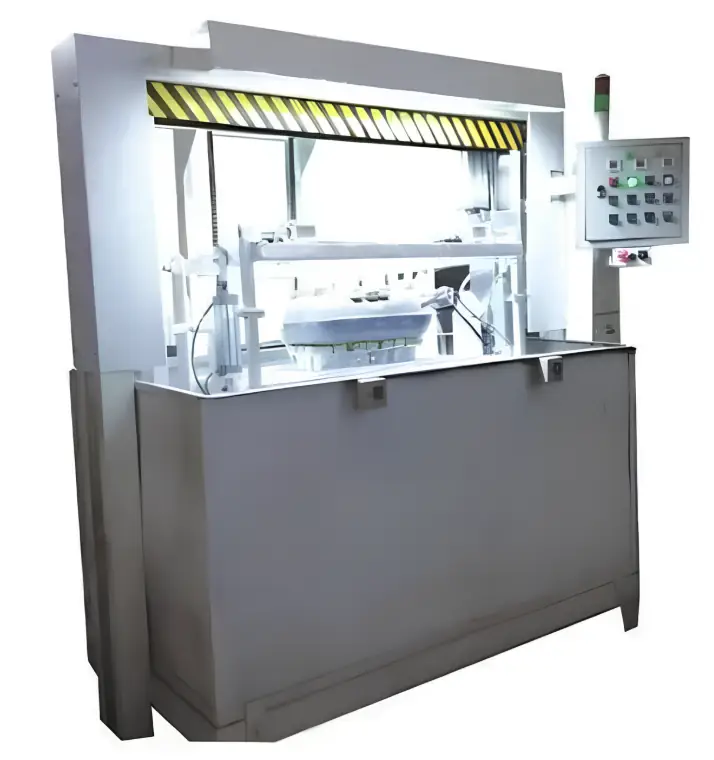
Fuel Tank Leakage Testing Machine
Fuel Tank Leakage Testing Machine
The Fuel Tank Leakage Testing Machine is designed to evaluate the leakage performance and sealing integrity of fuel tanks and related components used in automotive and industrial applications. It can be configured with suitable pressure or vacuum testing methods, fixtures, control systems, and measurement arrangements according to the tank design and customer requirements. Innotech Engineering Devices Private Limited manufactures customized fuel tank leakage testing machines for quality control, production inspection, and component testing applications.
OVERVIEW
Description
Fuel Tank Leakage Testing Machine
A Fuel Tank Leakage Testing Machine is used to check the leakage performance and sealing integrity of fuel tanks and related components. It helps manufacturers identify potential leakage paths, sealing defects, and manufacturing inconsistencies before components are approved for further production or use.
Fuel tank leakage testing is important in automotive manufacturing because tanks must meet the applicable design, performance, and safety requirements. The appropriate testing method depends on the tank material, design, capacity, opening arrangement, and the required acceptance criteria.
Innotech Engineering Devices Private Limited manufactures customized fuel tank leakage testing machines according to customer specifications and application requirements.
What Is a Fuel Tank Leakage Testing Machine?
A fuel tank leakage testing machine is a testing system designed to determine whether a tank or component maintains the required sealing performance under specified test conditions.
Depending on the application, testing may use a controlled pressure or vacuum method, pressure decay measurement, or another suitable leakage detection arrangement. The selected method depends on the component design and the applicable testing procedure.
The system can be designed for individual laboratory testing, production-line inspection, or specialized automotive component testing.
Working Principle
The working principle depends on the selected test method. A typical pressure-based leakage test follows these steps:
1. Component loading: The fuel tank or component is positioned in the designated fixture.
2. Connection and sealing: Suitable adapters and seals connect the component to the testing system.
3. Test condition setting: The required pressure or vacuum, test duration, and acceptance criteria are configured.
4. Testing: The system applies the specified test condition to the component.
5. Measurement: The machine monitors the relevant pressure change, leakage indication, or other selected measurement parameter.
6. Result evaluation: The measured result is compared with the defined acceptance criteria.
7. Unloading: The test is completed, the system is safely returned to its required condition, and the component is removed.
The exact sequence, detection method, and pass/fail logic are finalized according to the customer's application. Testing parameters must be suitable for the tank material and design to avoid damage.
Technical Specifications
The following parameters can be customized according to the required application.
| Parameter |
Specification |
| Machine Type | Fuel Tank Leakage Testing Machine |
| Application | Fuel tank and component leakage testing |
| Test Method | Pressure, vacuum, pressure decay, or another suitable method |
| Component Type | Fuel tanks and compatible automative components |
| Tank Size and Capacity | As per customer requirements |
| Test Pressure or Vacuum | As per component design and test procedure |
| Leakage Detection Method | Selected according to the required sensitivity |
| Pressure Measurement | Suitable sensore or transducer |
| Test Duration | Adjustable or programmable, as required |
| Test Fixtures | Customized for component geometry |
| Sealing Arrangement | Application-specific |
| Control System | Manual, digital, PLC-basaead, or automated |
| Display | Digital display or HMI, as required |
| Pass/Fail Indication | Optional, according to configuration |
| Data Recording | Optional, as required |
| Automation | Manual, semi-automatic, or automatic |
| Safety Features | Application-specific safety arrangement |
| Power Supply | As per machine configuration and site requirements |
| Machine Dimensions | Based on component size and design |
| Customization | According to customer specifications |
Note: This is an indicative, configurable specification table, not a confirmation of the exact configuration of a particular machine. Final specifications depend on the testing method, component design, required leakage sensitivity, and customer requirements.
Key Features
• Designed for fuel tank and automotive component leakage testing.
• Configurable pressure or vacuum testing arrangements.
• Customized fixtures and sealing connections for different tank designs.
• Suitable pressure measurement and monitoring systems.
• Manual, semi-automatic, or automatic operating options.
• Optional digital controls, PLC, and HMI.
• Optional test-result recording and pass/fail indication.
• Application-specific testing sequence and control settings.
• Machine configuration tailored to customer requirements.
Applications
Fuel tank leakage testing machines can be configured for applications such as:
• Automotive fuel tank leakage testing.
• Leakage inspection of compatible tank assemblies.
• Sealing performance evaluation.
• Quality-control inspection during manufacturing.
• Production-line testing of automotive components.
• Testing of specially designed fuel storage components, where the method is suitable.
• Research, development, and component validation.
The suitability of the machine for a particular tank type must be confirmed based on its design, material, and testing requirements.
Industries Served
Automotive Manufacturing
For leakage inspection and quality control of fuel tanks and compatible automotive components.
Automotive Component Manufacturing
For testing sealing performance during production and component validation.
Plastic Component Manufacturing
For suitable plastic tanks and moulded components, subject to the specified test method and material limitations.
Quality Control and Testing Laboratories
For repeatable leakage testing under defined and controlled conditions.
Research and Development
For evaluating component designs and developing suitable testing procedures.
How to Select the Right Fuel Tank Leakage Testing Machine
Before selecting a machine, manufacturers and testing engineers should consider:
• Type and material of the tank.
• Tank dimensions and connection points.
• Required test method and test medium.
• Required pressure or vacuum range.
• Acceptable leakage limit and measurement sensitivity.
• Test duration and production volume.
• Fixture and sealing requirements.
• Need for automated operation and pass/fail indication.
• Data recording and traceability requirements.
• Applicable customer specifications and testing standards.
Sharing these details with the manufacturer helps determine a suitable machine configuration.
Customized Fuel Tank Leakage Testing Machine Manufacturer in India
Innotech Engineering Devices Private Limited manufactures testing equipment and special-purpose machines for industrial and laboratory applications. Our fuel tank leakage testing machines can be configured according to the component design, test method, required measurement system, fixtures, controls, and production requirements.
Whether you require a machine for laboratory inspection, production quality control, or a specialized automotive application, the configuration can be discussed according to your testing needs.
Frequently Asked Questions
What is a fuel tank leakage testing machine used for?
It is used to evaluate the leakage performance and sealing integrity of fuel tanks and compatible components under specified test conditions.
Which testing methods can be used?
Depending on the application, pressure testing, vacuum testing, pressure decay, or another suitable leakage detection method may be considered.
Can the machine be customized for different tank sizes?
Yes. The fixtures, sealing arrangement, working area, controls, and testing method can be designed according to customer requirements.
Can the machine be automated?
Manual, semi-automatic, and automatic configurations may be considered depending on production volume and the required testing sequence.
What information is needed to select a suitable machine?
Useful details include tank drawings or dimensions, material, test method, required pressure or vacuum, acceptable leakage limit, test duration, production volume, and automation requirements.
Consult an Expert
Looking for a fuel tank leakage testing machine for your automotive manufacturing or quality-control application?
Contact Innotech Engineering Devices Private Limited to discuss your component design and testing requirements.
Email: info@innotechgroup.net
Phone: 9810431604
Website: www.innotechgroup.net
Location: Bhiwadi, Rajasthan, India
Consult to Expert for a suitable machine configuration based on your application.