
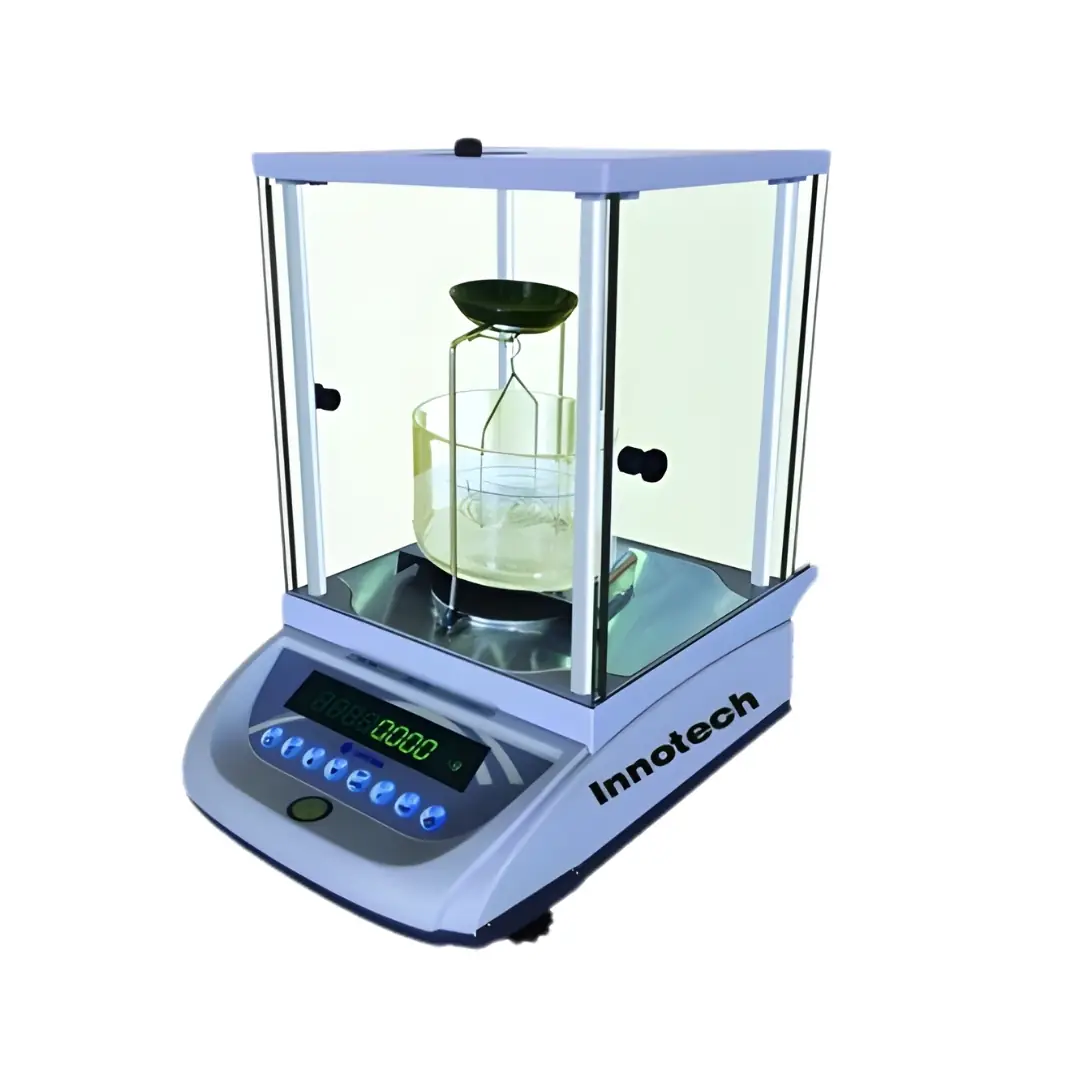
Electronic Density and Specific Gravity Analytical Balance
Electronic Density and Specific Gravity Analytical Balance
The Electronic Density and Specific Gravity Analytical Balance is designed to measure the density and specific gravity of suitable solid material specimens. It combines precision weighing with a suitable density measurement arrangement for applications involving rubber, plastics, polymers, elastomers, and other engineering materials. It can support material evaluation, research and development, and quality control in laboratories and manufacturing industries. The measurement method and instrument configuration can be selected according to the material being tested and the customer's requirements.
OVERVIEW
Description
Electronic Density and Specific Gravity Analytical Balance
The Electronic Density and Specific Gravity Analytical Balance is a laboratory testing instrument used to evaluate the density and specific gravity of suitable solid materials. These measurements help manufacturers and laboratory professionals understand material properties, compare formulations, and check the consistency of raw materials and finished products.
Innotech Engineering Devices Private Limited provides testing equipment for industrial and laboratory applications. This analytical balance is relevant to laboratories working with rubber, plastics, polymers, elastomers, and other suitable engineering materials where density measurement is an important part of material evaluation and quality control.
Whether you are checking incoming raw materials, comparing different material formulations, or monitoring production batches, density and specific gravity testing can provide useful information for making informed quality decisions.
What Is an Electronic Density and Specific Gravity Analytical Balance?
An electronic density and specific gravity analytical balance is a weighing instrument configured for determining the density and specific gravity of suitable test specimens.
Density describes the mass of a material per unit volume. Specific gravity compares the density of a material with the density of a reference substance under specified conditions. Water is commonly used as the reference for suitable applications.
By combining mass measurement with an appropriate method of determining specimen volume, the instrument supports the evaluation of these physical properties.
Working Principle
The instrument works on the relationship between the mass and volume of a material.
Density = Mass % Volume
For suitable solid specimens, density may be determined using an appropriate measurement arrangement. Depending on the material and configuration, this may involve weighing a specimen in air and under specified immersion conditions.
Specific gravity is then determined by comparing the specimen's density with that of the selected reference substance.
The measurement procedure depends on the specimen characteristics, selected method, applicable testing standard, and instrument configuration. The exact calculation and display functions should be confirmed for the model being supplied.
Key Features
- Electronic weighing for laboratory material evaluation.
- Designed for density and specific gravity measurement.
- Suitable for appropriate solid material specimens.
- Digital weight display for convenient reading.
- Useful for rubber, plasatic, polymer, and elastomer testing.
- Supports raw-material inspection and production quality control.
- Helps compare material formulations and production batches.
- Designed to support routine laboratory measurement procedures.
- Configuration options can be discussed according to the intended applicaiton.
The available measurement range, readability, accuracy, specimen capacity, and density calculation functions should be confirmed according to the selected configuration.
Applications of Density and Specific Gravity Testing
Rubber Testing
Density measurement helps evaluate rubber materials and compounds. Comparing results between batches can assist in identifying changes in composition, filler content, or material consistency.
Applications include:
- Natural and synthetic rubber specimens.
- Rubber compounds and sheets.
- Vulcanized rubber products.
- Industrial rubber components.
- Suitable elastomer samples.
Plastic and Polymer Testing
Density testing is useful for comparing plastic materials and evaluating material consistency during development and production.
Applications include:
- Thermoplastic materials
- Engineering plastics
- Polymer sheets and compounds
- Molded plastic components
- Polymer blends and suitable solid specimens
Elastomer Testing
Manufacturers can use density and specific gravity measurements when evaluating suitable elastomer formulations, flexible polymer materials, and sealing components.
Research and Development
Laboratories can compare material samples, investigate formulation changes, and collect physical-property data during product development.
Quality Control
Density testing can support incoming material inspection, production batch comparisons, finished-product evaluation, and supplier material assessment.
Industries That Use Density Testing Equipment
The Electronic Density and Specific Gravity Analytical Balance may be relevant to:
- Rubber manufacturing industries
- Tyre and automotive component manufacturers
- Plastics and polymer processing industries
- Elastomer product manufacturers
- Industrial material testing laboratories
- Research and development facilities
- Quality control laboratories
- Technical and educational institutions
The suitability of the instrument depends on the specimen, measurement method, and required testing procedure.
Why Is Density and Specific Gravity Testing Important?
Material density can provide useful information about composition and consistency. For manufacturers, differences in density between samples may indicate changes in raw materials, formulations, processing conditions, or filler content.
Regular density testing can help laboratories:
Document physical-property measurements for interval evaluations.
- Compare incoming materials with established specifications
- identify variations between production batches
- Evaluate different rubber and polymer formulations
- Suppport material development and product improvement
- Maintain consistent quality control porcedures
Density alone does not establish the complete quality or performance of a material. Results should be interpreted alongside other relevant tests and material specifications.
Typical Testing Procedure
The testing procedure should follow the selected method and applicable standard. A typical workflow may include:
1. Identify the material and select a suitable test method.
2. Prepare and clean the specimen as required.
3. Position the balance on a stable laboratory surface.
4. Check the instrument's calibration or verification status.
5. Measure the specimen's mass.
6. Use the appropriate density measurement arrangement.
7. Determine the specimen's volume using the selected method.
8. Calculate or obtain the density result.
9. Determine specific gravity where required.
10. Record the results and compare them with the applicable material specification.
Specimen preparation, temperature, moisture, surface condition, trapped air during immersion, and balance calibration can affect measurement results. The applicable procedure should therefore be followed carefully.
How to Select the Right Analytical Balance
Before selecting density testing equipment, consider the following requirements:
- Material type: Identify whether you will test rubebr, plastic, polymers, elastometer or other solid materials/
- Specimen dimensions: Identify whether you will test rubber, plastics, polymers, elastomers, or other solid materials.
- Meaurement range: Confirm the required weighing capacity and density range.
- Readability and accuracy: Specify the measurement resolution and acceptable uncertainty for your application.
- Measurement method: Confirm whether the intended procedure requires immersion weighing or another suitable arrangement.
- Calculation functionality: Establish whether density and specific gravity calculations must be performed by the instrument or separately.
- Testing standards: Identify any applicable material or industry-specific requirements.
Discussing these details before ordering helps ensure that the selected configuration suits your laboratory's needs.
Frequently Asked Questions
What is an electronic density and specific gravity analytical balance used for?
It is used to determine the density and specific gravity of suitable specimens by combining mass measurement with an appropriate volume determination method.
Can this balance be used for rubber density testing?
Yes, suitable rubber specimens can be evaluated for density and specific gravity using the appropriate measurement procedure.
Is it suitable for plastic and polymer testing?
It can be used for density measurement of suitable plastic and polymer specimens. The method should be selected according to the material and test requirements.
What is the difference between density and specific gravity?
Density is mass per unit volume. Specific gravity is the ratio of a material's density to the density of a reference substance under specified conditions.
Does the instrument calculate density automatically?
This depends on the selected model and its functionality. Confirm automatic calculation and display features before ordering.
What specifications should I confirm before purchasing?
Confirm weighing capacity, readability, measurement accuracy, specimen dimensions, density measurement method, calculation functions, and any required standards.
Can the configuration be selected according to customer requirements?
The appropriate configuration can be discussed according to the material, measurement method, specimen characteristics, and required performance. Contact Innotech Engineering Devices Private Limited to discuss your application.
Consult to Expert
Looking for an Electronic Density and Specific Gravity Analytical Balance for your laboratory or manufacturing application?
Innotech Engineering Devices Private Limited supplies testing equipment for industrial and laboratory requirements. Contact our team to discuss your material type, measurement needs, and preferred configuration.
Company: Innotech Engineering Devices Private Limited
Location: Bhiwadi, Rajasthan, India
Website: https://www.innotechgroup.net
Email: info@innotechgroup.net
Phone: +91 9810431604
Consult to Expert for assistance in identifying a suitable density and specific gravity testing solution.