
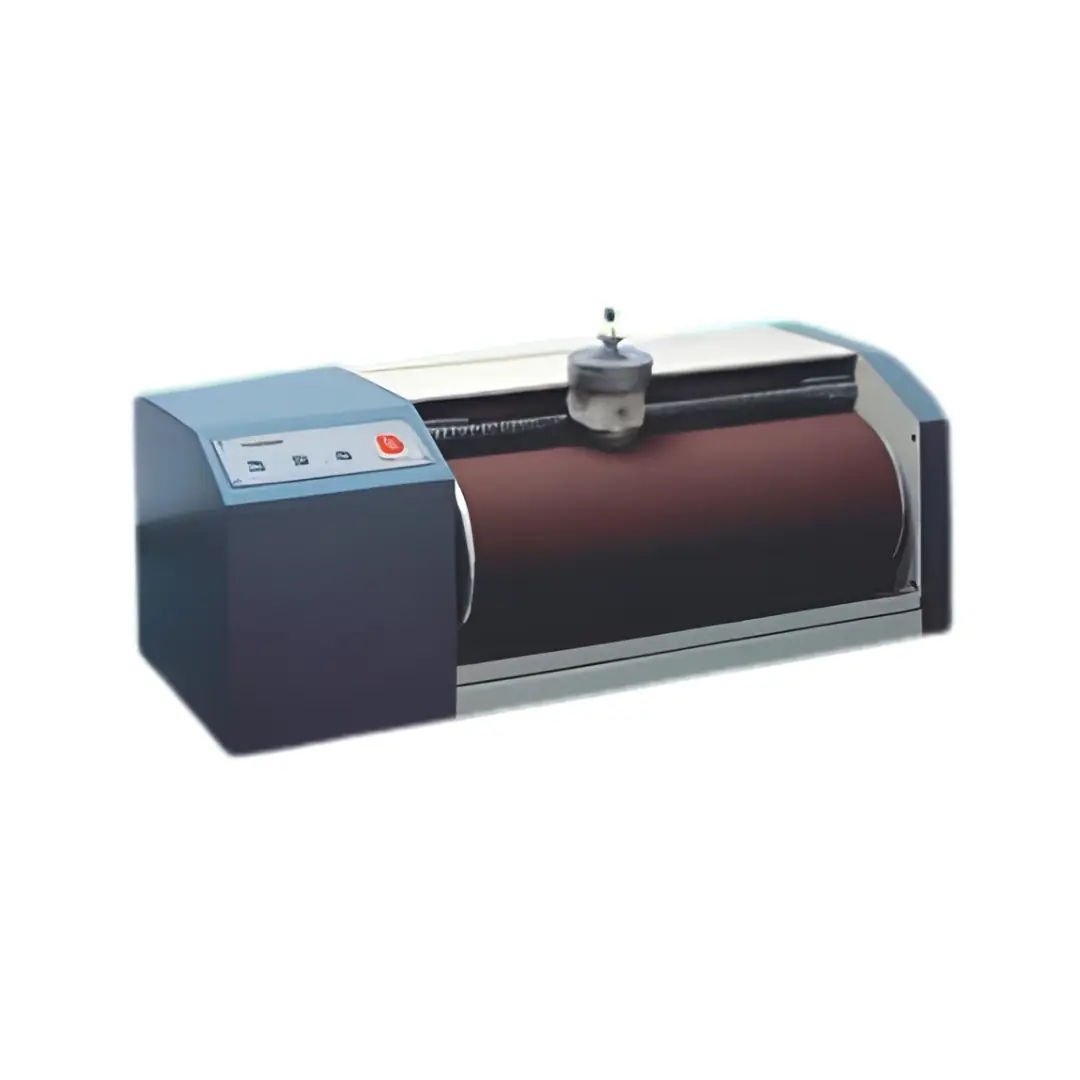
DIN Abrasion Resistance Testing Machine
DIN Abrasion Resistance Testing Machine
The DIN Abrasion Resistance Testing Machine is designed to evaluate the abrasion resistance and wear characteristics of rubber, elastomers, and other suitable materials. It helps manufacturers and laboratories assess material loss under controlled abrasive conditions for quality control, product development, and material comparison. Innotech Engineering Devices Private Limited offers testing equipment configurations according to customer requirements, including applicable test standards, specimen dimensions, load, abrasive drum arrangement, and testing conditions. We supply testing equipment across India, with our factory and office located in Bhiwadi, Rajasthan.
OVERVIEW
Description
DIN Abrasion Resistance Testing Machine
The DIN Abrasion Resistance Testing Machine is a laboratory instrument used to evaluate how rubber and other suitable materials resist wear caused by friction against an abrasive surface. The test helps manufacturers understand material durability and compare the abrasion performance of different compounds under controlled conditions.
Abrasion resistance is an important property for products exposed to repeated rubbing, sliding, and surface contact during use. Rubber soles, tyre compounds, conveyor belt covers, seals, gaskets, and industrial elastomer components are examples of products where resistance to wear can affect service life and performance.
Innotech Engineering Devices Private Limited manufactures and supplies testing equipment for industrial and laboratory applications. We offer DIN abrasion testing machine configurations according to customer requirements, including specimen dimensions, test conditions, applicable standards, and required machine features.
Our testing equipment is available to customers across India. Our factory and office are located in Bhiwadi, Rajasthan, where customers can arrange a meeting with our team by confirming an appointment in advance.
What Is a DIN Abrasion Resistance Testing Machine?
A DIN Abrasion Resistance Testing Machine, also known as a DIN Abrasion Tester or rubber abrasion tester, is used to evaluate the resistance of suitable materials to abrasive wear.
During testing, a prepared specimen is brought into controlled contact with an abrasive surface, typically a rotating drum. The abrasive action removes a small amount of material from the specimen. By measuring the specimen before and after testing and applying the appropriate calculation method, the laboratory can assess its abrasion behaviour.
The results help engineers compare rubber compounds, evaluate material formulations, and monitor product quality. The test method and calculation should be selected according to the applicable standard and the material being evaluated.
Technical Specifications
Technical note: The specification parameters, not guaranteed numerical ratings for a standard model. Confirm the actual load, drum dimensions, speed, test distance, specimen size, controls, and other machine details with Innotech before publishing fixed values or placing an order.
Key Features
- Designed for abrasion resistance testing of suitable rubber and elastomer materials.
- Controlled abrasice action for comparative wear evaluation.
- Specimen holder arrangement selected according to the test method.
- Supports material loss assessment before and after testing.
- Useful for comparing rubber compounds and material formulations.
- Applicable to laboratory testing and manufacturing quality control.
- Supports raw-material inspection and finished-product evaluation.
- can be configured according to the required specimen and test procedure.
- Suitable for material development and research applications.
- Technical requirements can be discussed before ordering.
Working Principle
The DIN abrasion test evaluates the material removed from a specimen when it is exposed to a specified abrasive action.
Specimen preparation
A specimen is prepared according to the selected test method. Its dimensions, conditioning, and initial mass are recorded as required.
Controlled abrasive contact
The specimen is mounted in the holder and brought into contact with the specified abrasive surface. The machine applies the test conditions required by the applicable procedure.
Abrasion and material loss
As the specimen moves against the abrasive surface, material is gradually removed. The amount of wear depends on the material properties and the selected test conditions.
Measurement and evaluation
The specimen is assessed after testing. Depending on the applicable procedure, mass loss may be used with material density and the required calculation method to determine volume loss or abrasion resistance.
A lower abrasion loss generally indicates better resistance to wear when results are compared under equivalent test conditions. Results from different methods or test conditions should not be compared without considering their differences.
Applications
Rubber and Elastomer Testing
DIN abrasion testing is useful for evaluating suitable rubber compounds and elastomer products, including:
- Rubber sheets and blocks
- Rubebr profiles and molded components
- Seals and gaskets
- Rubbber hoses and industrial rubbber parts
- Wear-resistant rubber products.
Tyre and Automotive Components
The test can help compare suitable tyre rubber compounds and automotive elastomer components for resistance to abrasive wear.
Applications may include tread compounds, rubber bushes, mounts, and other suitable rubber components.
Footwear and Shoe Sole Materials
Abrasion resistance is an important property for footwear materials exposed to repeated contact with floors and other surfaces.
Suitable applications include rubber soles, outsoles, heel materials, and selected polymer-based sole compounds. The test method must be appropriate for the material being assessed.
Conveyor Belt Materials
Conveyor belt cover compounds may experience continuous friction and contact with transported materials. Abrasion testing helps manufacturers compare suitable rubber formulations and evaluate their wear characteristics.
Polymer and Industrial Materials
Depending on the selected method, the machine may also be relevant to other suitable flexible materials and polymer compounds. Confirm material compatibility before selecting the test configuration.
Why Is Abrasion Resistance Testing Important?
Abrasion can gradually reduce the thickness and integrity of a material. In industrial products, excessive wear may affect dimensional stability, grip, sealing performance, and product service life.
Abrasion testing helps manufacturers and laboratories:
- Compare the wear performance of different compounds.
- Evaluate changes in material formulations.
- Support incoming raw-material inspection.
- Monitor production batch consistency.
- Assess suitable materials during product development.
- Investigate variations in wear performance.
- Support qulaity-control documentation.
- Make informed material-selection decisions.
Abrasion results should be interpreted alongside other relevant material properties and the requirements of the finished product.
Industries That Use DIN Abrasion Testing Equipment
The machine may be suitable for applications in:
- Rubber manufacturing
- Tyre manufacturing
- Automotive component manufacturing
- Footwear manufacturing
- Converyor belt manufacturing
- Elastomer and polymer processing
- Industrial rubber-product manufacturing
- Material testing laboratories
- Research and development failities
- Quality-control laboratories
The required test method and machine configuration should match the material and intended application.
Applicable Standards and Test Requirements
DIN abrasion testing is associated with standardized procedures for evaluating the abrasion resistance of rubber and related materials. DIN 53516 and ISO 4649 are examples of standards associated with rubber abrasion testing.
The applicable standard, edition, specimen preparation, abrasive requirements, test conditions, and calculation method should be confirmed before ordering the machine. Do not assume that every configuration complies with every version of a standard.
If your laboratory requires testing according to a particular DIN, ISO, ASTM, or other specification, share that requirement with our team so that the proposed configuration can be reviewed.
How to Select the Right DIN Abrasion Tester
Before selecting a machine, consider the following factors.
Material Type:
Identify whether you will test rubber, elastomers, tyre compounds, footwear materials, or another material suitable for the intended method.
Required Testing Standard
Specify the standard and test procedure required by your laboratory, customer, or quality system.
Specimen Dimensions
Confirm the specimen size, shape, preparation requirements, and holder arrangement.
Test Load and Abrasive Conditions
The applied load and abrasive characteristics affect the test result. Select them according to the applicable method rather than choosing arbitrary values.
Measurement and Reporting
Determine whether your procedure requires mass loss, volume loss, or another specified reporting format. Confirm the necessary balance, density information, and calculation process.
Laboratory Requirements
Consider the available installation space, power supply, operating environment, and any documentation or calibration requirements relevant to your laboratory.
Typical Testing Procedure
The following is a general workflow. The exact procedure must follow the applicable standard and machine instructions.
1. Identify the material and required test method.
2. Prepare and condition the specimen as specified.
3. Record the initial specimen mass and any other required measurements.
4. Check the abrasive surface and test setup.
5. Secure the specimen in the appropriate holder.
6. Apply the prescribed load and operating conditions.
7. Run the test for the required distance or cycle.
8. Remove and prepare the specimen for post-test measurement.
9. Record the final mass or other required measurement.
10. Calculate the applicable abrasion result.
11. Compare the result with the relevant material specification or reference criteria.
Correct specimen preparation, conditioning, abrasive characteristics, load, test distance, and measurement procedures are important for obtaining meaningful and repeatable results.
Why Choose Innotech Engineering Devices Private Limited?
Innotech Engineering Devices Private Limited supplies testing equipment for industrial and laboratory requirements. We understand that customers may need different machine configurations depending on their materials, testing standards, specimen dimensions, and laboratory procedures.
Our team can discuss your requirements before you select a DIN Abrasion Resistance Testing Machine.
- Application-based machine selection
- Configuratin discussions according to customer requirements.
- Supprt in reviewing required test parameters.
- Supply in reviewing required test parameters.
- Supply of testing equipment across india.
- Factory and office located in Bhiwadi, Rajasthan.
Contact our team with your intended material, test standard, and specimen requirements so we can discuss a suitable configuration.
Frequently Asked Questions
What is a DIN Abrasion Resistance Testing Machine used for?
It is used to evaluate the abrasion resistance of suitable rubber, elastomer, and other materials under controlled abrasive conditions.
What does a DIN abrasion test measure?
Depending on the applicable procedure, it evaluates material loss caused by abrasion, commonly using mass loss and/or calculated volume loss.
Can the machine test rubber and tyre compounds?
Yes, DIN abrasion testing is relevant to suitable rubber compounds and tyre-related materials when the selected method is appropriate for the specimen.
Is the DIN abrasion tester suitable for footwear materials?
It may be suitable for selected rubber and polymer-based sole materials, provided the required test method and specimen configuration are appropriate.
What is the difference between mass loss and volume loss?
Mass loss is the difference between the specimen's initial and final mass. Volume loss expresses the amount of material removed by volume and may be calculated using mass loss and material density according to the specified method.
Which standard should I specify when ordering?
Specify the exact DIN, ISO, or other test standard required by your laboratory or customer. The relevant standard and edition should be confirmed before finalizing the configuration.
Can the machine specifications be customized?
The machine configuration can be discussed according to your test method, specimen dimensions, required operating conditions, and other application requirements. Final options must be confirmed with our technical team.
Does Innotech supply testing equipment across India?
Yes. Innotech supplies testing equipment to customers across India. Contact us to discuss your location, requirements, and delivery arrangements.
Consult to Expert – DIN Abrasion Resistance Testing Machine
Looking for a DIN Abrasion Resistance Testing Machine for rubber, tyre compounds, footwear materials, or industrial elastomer testing?
Innotech Engineering Devices Private Limited can discuss a suitable configuration based on your material, test standard, specimen dimensions, and testing requirements.
Company: Innotech Engineering Devices Private Limited
Supply: Across India
Website: https://www.innotechgroup.net
Email: info@innotechgroup.net
Phone: +91 9810431604
Planning to visit our Bhiwadi facility? Please contact us beforehand and confirm your appointment date and time.
Consult to Expert to discuss your DIN abrasion testing requirements and request a quotation.
SPEC
Specifications
Machine type
DIN Abrasion Resistance Testing Machine
Testing purpose
Abrasion resistance and wear evaluation
Test specimen
Suitable rubber and elastomer specimens; other materials subject to method suitability
Abrasive arrangement
Drum and abrasive surface configuration according to the selected method
Test load
To be specified according to the applicable standard and customer requirement
Abrasive characteristics
To be selected according to the required test procedure
Test distance or cycle
To be configured according to the selected method
Specimen dimensions
According to the applicable standard and specimen requirements
Specimen holder
Configuration based on specimen geometry and test method
Measurement method
Mass loss, volume loss, or other result specified by the applicable procedure
Material density input
Required where applicable to the volume-loss calculation
Drive and controls
To be confirmed for the selected machine configuration
Applicable standard
Confirm the required DIN or ISO test method before ordering
Special requirements
Discussed according to the intended application