
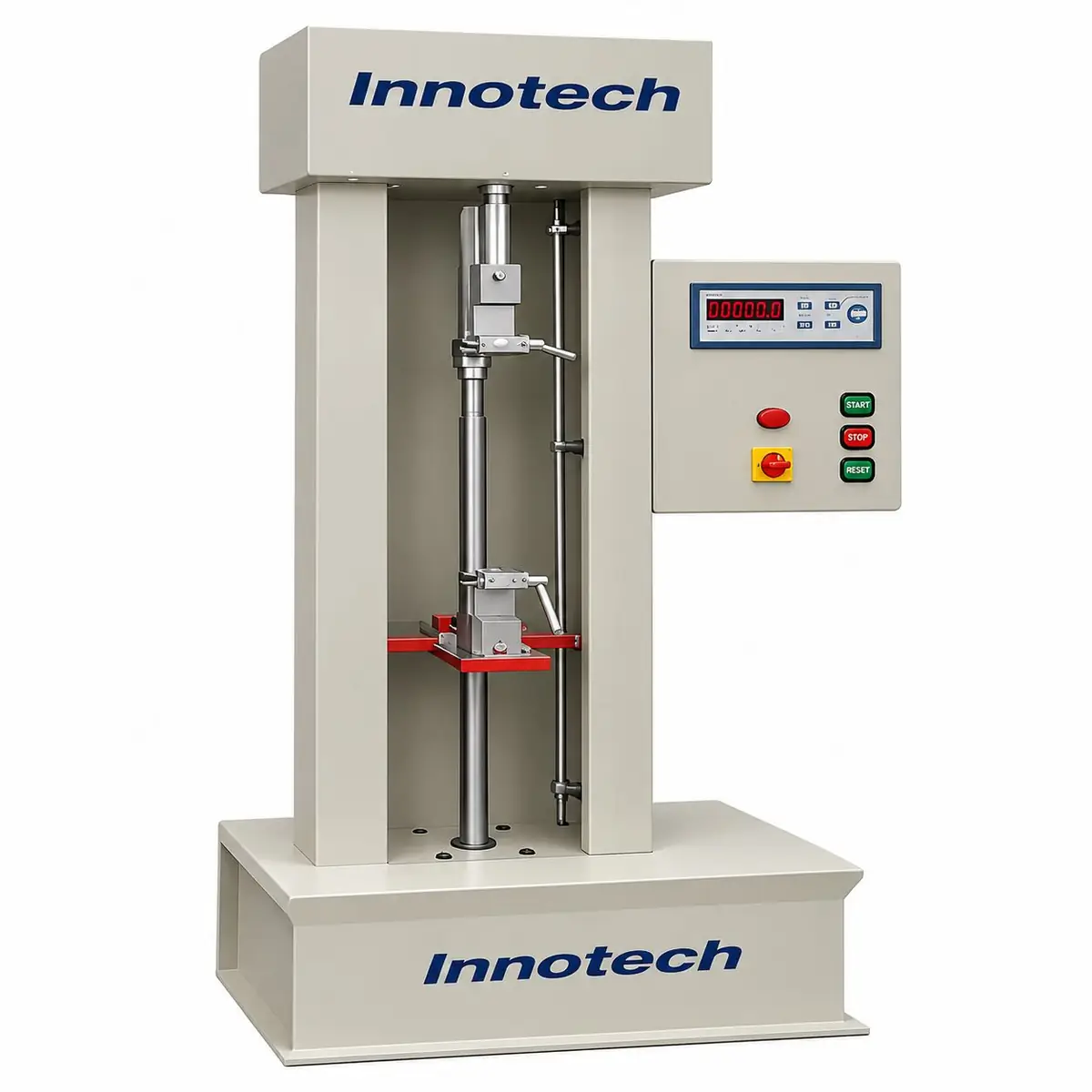
Digital Tensile Testing Machine – Customized Tensile Strength Tester
Digital Tensile Testing Machine – Customized Tensile Strength Tester
The Digital Tensile Testing Machine from Innotech Engineering Devices Private Limited is designed for tensile strength, breaking load and material elongation testing under controlled loading conditions. Manufactured in Bhiwadi, Rajasthan, India, the machine is available in customized capacities and configurations for industrial quality-control laboratories, manufacturing units and research institutions. The machine features a digital measurement system and can be configured with suitable load cells, gripping arrangements, test travel and control options according to the material and application. Suitable configurations can be developed for metals, wires, plastics, rubber, textiles, films and other compatible specimens.
MODEL
IDTTM
OVERVIEW
Description
Digital Tensile Testing Machine Manufacturer in Bhiwadi India – Customized Tensile Strength Tester
Innotech Engineering Devices Private Limited is an Indian manufacturer of Digital Tensile Testing Machines, Tensile Strength Testers and customized material testing equipment, based in Bhiwadi, Rajasthan, India.
Our Digital Tensile Testing Machine is designed to evaluate the tensile performance of materials and components by applying a controlled pulling force and measuring the resulting load and deformation.
The equipment is suitable for industrial manufacturers, quality-control departments, research laboratories and educational institutions requiring tensile strength, breaking load and elongation testing.
We manufacture tensile testing machines in different capacities and designs according to customer requirements, including specimen dimensions, material type, required test load, gripping arrangements and control preferences.
What Is a Digital Tensile Testing Machine?
A Digital Tensile Testing Machine is a mechanical testing instrument used to measure the resistance of a material to tensile force.
During testing, a specimen is secured between suitable grips. The machine applies a controlled pulling force while the measurement system monitors the applied load.
Depending on the configuration and instrumentation, the test can determine:
- Maximum tensile force
- Breaking load
- Tensile strength
- Elongation at break
- Load versus displacement behaviour
- Yield properties, where suitable measurement and analysis systems are provided
- Other tensile properties required by the applicable test standard
The machine provides digital load indication, making it suitable for routine laboratory testing and industrial material evaluation.
Why Choose a Digital Tensile Strength Tester?
Manufacturers must understand how their materials behave under pulling forces.
A material may appear strong during visual inspection but fail under actual mechanical loading.
A Digital Tensile Strength Tester helps manufacturers evaluate the performance of raw materials, production batches and finished products.
It is particularly useful for verifying material consistency, comparing alternative materials and investigating failures.
Working Principle of a Digital Tensile Testing Machine
The working principle is based on applying a controlled tensile load to a prepared specimen.
Step 1 – Specimen preparation: Prepare the specimen according to the applicable material testing standard.
Step 2 – Grip selection: Select grips suitable for the specimen geometry and expected testing force.
Step 3 – Specimen mounting: Secure the specimen between the upper and lower gripping arrangements.
Step 4 – Test settings: Set the required test conditions according to the machine configuration and testing procedure.
Step 5 – Load application: The machine separates the gripping points and applies tensile force.
Step 6 – Digital measurement: The load-measuring system monitors the applied force. Displacement or strain is measured where suitable instrumentation is provided.
Step 7 – Test completion: The test continues to the specified endpoint, which may include specimen fracture.
Step 8 – Result evaluation: The operator records the required results using the digital display or available data acquisition system.
Main Components of a Digital Tensile Testing Machine
1. Loading Frame
The loading frame provides structural support during testing and maintains alignment of the loading arrangement.
2. Load Cell
The load cell converts applied force into an electrical signal for the digital measurement system.
Its capacity and verified measuring range must be selected according to the intended tests.
3. Digital Load Indicator
The digital indicator displays the measured testing force and may provide additional functions depending on the controller.
4. Tensile Grips
Grips hold the specimen securely during the test.
Suitable options may include wedge grips, vice-type grips, roller grips, wire grips and customized fixtures.
5. Loading Mechanism
The loading mechanism applies tensile force by moving one gripping point relative to the other.
Its drive and control arrangement depend on the selected machine design.
6. Displacement or Elongation Measurement
Machine displacement can be measured using a suitable position sensor. Direct specimen strain measurement requires an appropriate extensometer or equivalent measurement system.
7. Control Panel
The control panel provides machine operating functions and digital measurement indication.
8. Safety System
The machine may be equipped with appropriate travel limits, emergency stopping arrangements and other protections according to its design.
Digital Tensile Testing Machine for Different Materials
Metal and Engineering Components
Suitable configurations can evaluate the tensile properties of metal specimens, wires and engineering components.
Higher-force applications may require specialized frames, grips and strain-measurement systems.
Rubber and Elastomers
Rubber testing may require long-travel measurement, suitable gripping arrangements and test speeds specified by the applicable standard.
Plastic and Polymer Materials
Plastic tensile testing commonly involves controlled test speeds and specimen-specific grips.
Textile and Fabric Materials
Textile specimens may require special grips to prevent slipping and excessive grip-induced damage.
Wire and Cable
Wire and cable tensile testing requires suitable gripping systems, gauge length and sufficient load capacity.
Films and Flexible Packaging
Thin specimens may require low-force measurement systems and specialized grips to minimize premature failure.
Customized Digital Tensile Testing Machine Manufacturer in India
Every material testing application is different.
A machine selected for thin polymer film may be unsuitable for a heavy metal component. Similarly, testing a highly extensible rubber specimen may require substantially more travel than testing a short metallic specimen.
Innotech therefore offers technical consultation for customized tensile testing equipment.
Customers can specify:
- Required testing capacity
- Material and specimen dimensions
- Applicable testing standard
- Maximum expected breaking load
- Required testing speed
- Grip-to-grip separation
- Specimen elongation
- Preffered frips and fixtures
- Digital or computerized control requirements
- Data recording and reporting requirements
- Installation and electrical requirements
Our engineering team reviews these requirements to determine a suitable machine configuration.
Digital Tensile Testing Machine vs Computerized Tensile Testing Machine
A digital tensile tester and a computerized tensile tester are related but not necessarily identical.
A Digital Tensile Testing Machine generally provides electronic measurement and digital indication of testing force.
A Computerized Tensile Testing Machine additionally uses a computer-based system for functions such as test control, data acquisition, graphical analysis and report generation, depending on the supplied configuration.
Buyers should confirm the actual controller functions rather than assuming that every digital tester includes software or automatic stress–strain analysis.
Relevant Industry Testing Standards
Different materials require different tensile testing procedures.
Common references include:
| Standard |
Typical application |
| ASTM E8/E8M | Metallic mateial tensile testing |
| ISO 6892-1 | Metallic materials at room temperature |
| IS 1608 (Part 1) | Tensile testing of metallic materials |
| ASTM D638 | Tensile properties of plastics |
| ISO 527 series | Tensile properties of plastics |
| ASTM D412 | Vulcanized rubber and thermoplastics elastomers |
| ISO 37 | Rubber tensile stress-strain properties |
| ASTM D882 | Tensile properties of thin plastic sheeting |
| ASTM D5034 | Breaking strength and elongation of textile fabrics by the grab method |
| ISO 13934-1 | Tensile properties of fabrics using the strip method |
Standards note: These are application references, not claims that every Innotech digital tensile tester complies with every standard. The selected machine, grips, measurement accuracy, speed control and test procedure must meet the relevant requirements.
How to Select the Right Digital Tensile Testing Machine
Before purchasing, buyers should consider five important factors.
Testing capacity: Choose a load range suitable for the expected specimen strength, including the required measurement accuracy at lower forces.
Material type: Different materials require different test speeds, gripping methods and measurement systems.
Specimen dimensions: Gauge length, specimen thickness and expected elongation influence machine travel and fixture selection.
Testing standards: The applicable ASTM, ISO or IS standard may specify test speed, strain measurement, specimen preparation and reporting requirements.
Digital versus computerized control: Decide whether a digital load display is sufficient or whether software, automatic test control and graphical reporting are required.
Digital Tensile Tester Price in India
The price of a Digital Tensile Testing Machine in India depends on its technical configuration.
Major cost factors include testing capacity, loading frame, drive system, load cell, accuracy requirements, test speed, travel, grips, extensometer and software.
A small-capacity digital tensile tester and a heavy-duty industrial tensile testing machine can have substantially different specifications and manufacturing costs.
For an accurate quotation, share your material, expected test load, specimen dimensions and applicable testing standard with Innotech.
Why Choose Innotech Engineering Devices Private Limited?
Innotech is an Indian manufacturer of testing machines and laboratory equipment located in Bhiwadi, Rajasthan.
We offer different machine capacities and customized configurations to address the testing requirements of industrial buyers across India.
Our focus is on understanding the customer's material, required test method and operating conditions before recommending a suitable machine.
Frequently Asked Questions
What is a Digital Tensile Testing Machine?
It is a testing instrument that applies tensile force to a specimen and measures the applied load using a digital measurement system.
What is the difference between a Digital Tensile Tester and a UTM?
A Digital Tensile Tester primarily focuses on tensile testing. A Universal Testing Machine may support tensile, compression, bending and other tests when equipped with the appropriate frame, fixtures and controls.
What is the capacity of an Innotech Digital Tensile Testing Machine?
Innotech manufactures machines in different capacities according to customer requirements. The exact available range should be confirmed for the selected design.
Can the machine test rubber and plastics?
Yes, suitable configurations can be developed for rubber, plastics and other compatible materials, subject to the required capacity, travel, grips and testing standard.
Can the machine measure elongation?
Elongation or displacement measurement can be provided according to the selected configuration. Accurate specimen strain measurement may require an extensometer.
Can Innotech customize the tensile grips?
Application-specific grips and fixtures can be discussed based on specimen dimensions, material and expected testing load.
Does the machine include computer software?
Computer connectivity and reporting software depend on the selected model. They should be specified separately in the technical offer.
What is the price of a Digital Tensile Testing Machine in India?
The price depends on capacity, frame design, drive system, measurement accuracy, grips, travel and control features. Contact Innotech for a configuration-specific quotation.
Where is Innotech's Digital Tensile Testing Machine manufactured?
Innotech Engineering Devices Private Limited is based in Bhiwadi, Rajasthan, India.
Does Innotech supply Digital Tensile Testing Machines across India?
Innotech serves industrial and institutional customers across India. Delivery and installation arrangements can be confirmed during quotation.
Which testing standard should I choose?
The correct standard depends on the material and application. Examples include ASTM E8/E8M for metals, ASTM D638 for plastics and ASTM D412 for applicable rubber materials.
How can I request a customized machine?
Send your specimen material, dimensions, expected load, required standard and preferred control functions to Innotech for technical evaluation.
Request a Digital Tensile Testing Machine Quotation
Looking for a Digital Tensile Testing Machine Manufacturer in India, a Digital Tensile Strength Tester or a Customized Tensile Testing Machine?
Contact Innotech Engineering Devices Private Limited.
Manufacturing Location: H-307, RIICO Industrial Area, Karoli, Tapukara, Bhiwadi – 301707, Rajasthan, India
Email: info@innotechgroup.net
Phone: +91 9810431604
Share your testing requirements to receive a suitable machine recommendation and technical quotation.
WHY IT WORKS
Key benefits
Helps evaluate tensile strength and breaking load.
Supports raw material quality inspection.
Provides digital indication of measured force.
Helps compare different material batches.
Supports manufacturing quality-control programs.
Enables selection of capacity according to the application.
Offers flexibility in gripping different specimens.
Supports research and material development.
Helps identify premature material failure.
Can be configured for different test travel requirements.
Supports repeatable testing under controlled conditions.
Allows optional computerized data analysis.
Helps laboratories evaluate material performance.
Offers customized designs for specialized testing requirements.
Provides direct technical consultation with an Indian manufacturer.
USE CASE
Application range
BUILT IN
Features
Digital measurement and display of tensile force
Customized testing capacities according to customer requirements
Vertical tensile testing frame configuration
Load-cell-based force measurement
Controlled tensile loading
Material-specific tensile gripping arrangements
Options for different specimen lengths and sizes
Test travel selected according to application
Suitable for maximum load and breaking load testing
Displacement or elongation measurement options
Digital or computerized configurations as specified
Optional data recording and software integration
Custom fixtures for specialized specimens
Suitable for industrial and laboratory testing
Application-specific safety and control arrangements
SPEC
Specifications
Product
Digital Tensile Testing Machine
Country of manufacture
India
Manufacturing location
Bhiwadi, Rajasthan
Machine orientation
Vertical
Testing type
Tensile / Breaking Load
Capacity
As per customer requirement
Loading frame
According to selected capacity
Force measurement
Load cell
Display
Digital
Test speed
As per application
Load resolution
To be confirmed for selected model
Force accuracy
To be confirmed for selected model
Grip-to-grip separation
Customized
Test travel
Customized
Tensile grips
According to specimen
Displacement measurement
As per configuration
Extensometer
Optional
Data acquisition
Optional
Computer software
Optional
Electrical supply
According to machine design
Overall dimensions
According to capacity and design
Standards
As applicable to approved configuration
Customization
Available
supply region
Across India