
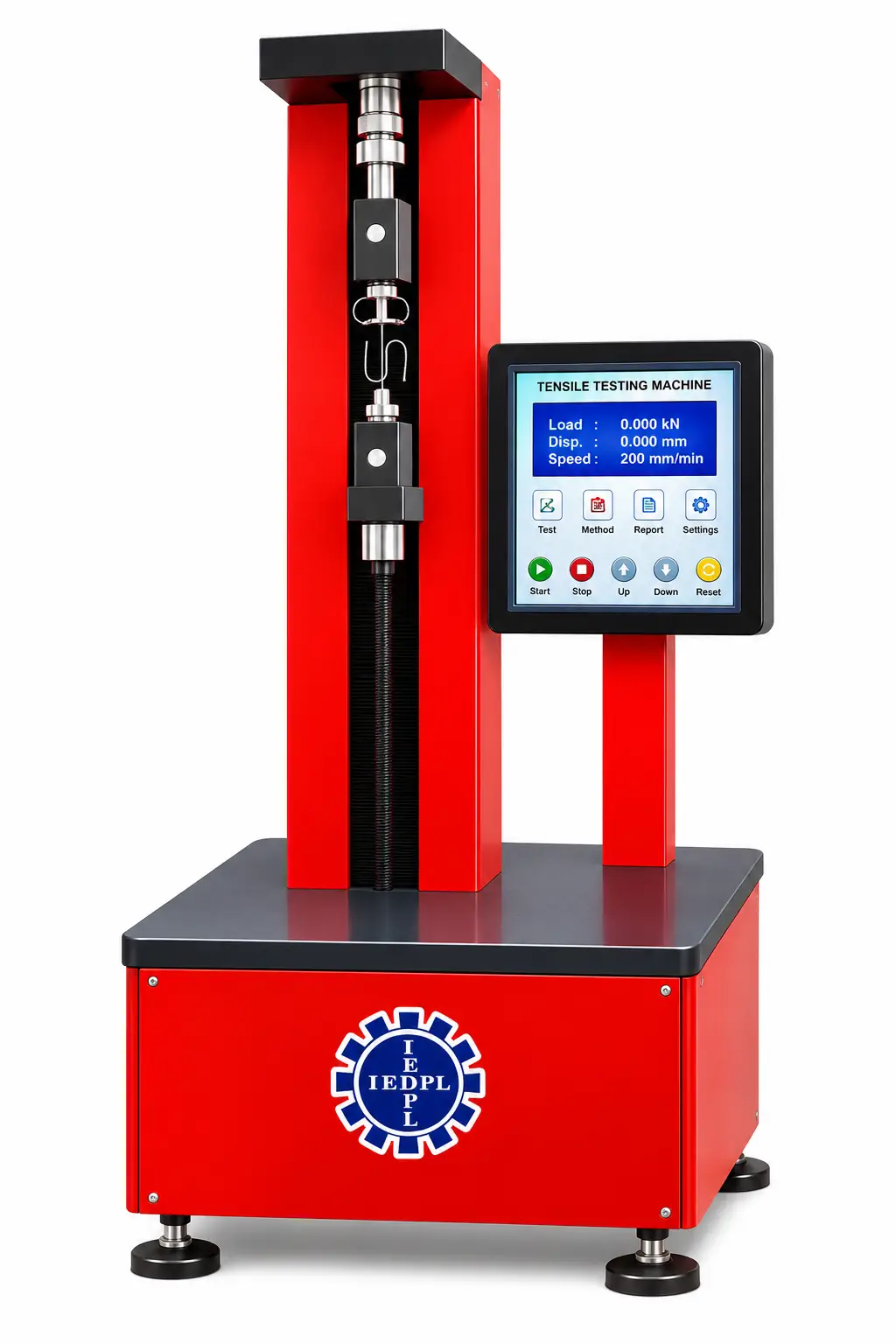
Digital Tensile Testing Machine 100 kg – Single Column
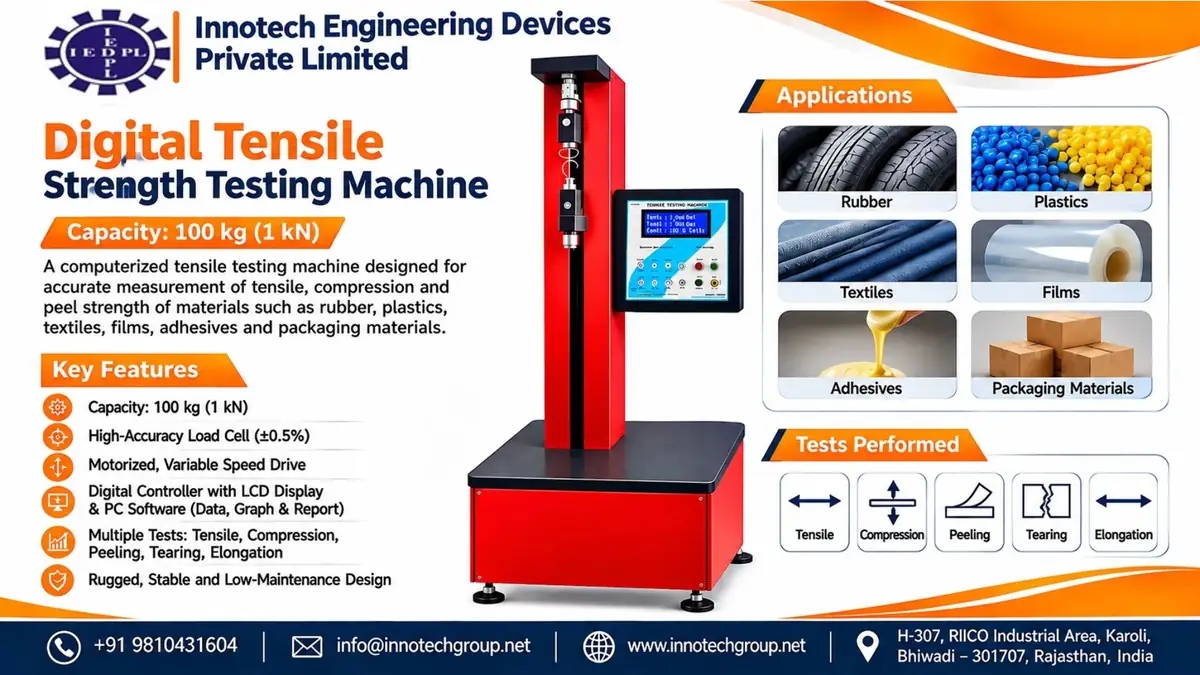
Digital Tensile Testing Machine 100 kg – Single Column
The Digital Tensile Testing Machine 100 kg (1 kN) by Innotech Engineering Devices Private Limited is a single-column, computerized tensile strength tester designed for laboratory and industrial material testing. Featuring ±0.5% indicated-load accuracy, adjustable test speed from 1–500 mm/min, an LCD digital controller and PC software for load–displacement graphs and test reports, it supports tensile, compression, peeling, tearing and elongation tests with suitable fixtures. Manufactured in Bhiwadi, Rajasthan, India, the machine is suitable for rubber, plastics, textiles, films, adhesives and packaging materials within its capacity and configuration.
MODEL
IDTT-100KG
OVERVIEW
Description
Digital Tensile Testing Machine 100 kg (1 kN) – Single Column Manufacturer in Bhiwadi India
Looking for a Digital Tensile Testing Machine for testing rubber, plastics, textile materials, packaging films, adhesives or other low-force specimens? Selecting the correct machine is important for obtaining reliable tensile strength, elongation, compression and peel-test results.
Innotech Engineering Devices Private Limited, a testing machine manufacturer in Bhiwadi, Rajasthan, India, offers a 100 kg (1 kN) Digital Tensile Strength Testing Machine with a single-column structure, electronic load measurement, motorized crosshead and computerized test reporting.
The machine is designed for industrial quality control, research and development, incoming-material inspection and laboratory testing. Its compact construction makes it suitable for laboratories that require controlled mechanical testing without the capacity or space requirements of a larger Universal Testing Machine.
What Is a Digital Tensile Testing Machine?
A Digital Tensile Testing Machine is an instrument that applies a controlled mechanical load to a specimen while measuring its response.
During a tensile test, the specimen is held between suitable grips and pulled apart at a specified test speed. The system measures the applied force and crosshead displacement, allowing operators to evaluate material behaviour.
Depending on specimen geometry, testing method and measurement accessories, the results may include:
- Maximum tensile force
- Tensile strength
- Force at break
- Extension at break
- Percentage elongation
- Load–displacement behaviour
- Peel or tear force
A digital tensile tester displays measured values electronically and may connect to computer software for graphical analysis, data storage and reporting.
Digital Tensile Testing Machine 100 kg – Capacity and Construction
The Innotech single-column tensile testing machine has a maximum rated capacity of 100 kgf, approximately 1 kN.
It is intended for testing specimens whose required forces remain within the machine's rated capacity and usable measurement range.
The single-column construction combines a vertical loading frame with a motorized crosshead, load cell, digital controller and specimen fixtures.
According to the Innotech catalogue, the machine provides:
- 100 kg (1 kN) maximum capacity
- ±0.5% accuracy of indicated load
- Variable test speed of 1–500 mm/min
- Crosshead travel up to 1000 mm
- LCD digital display
- Computer-based test control and reporting
- Load and displacement measurement
- Multiple test arrangements using suitable accessories
The appropriate specimen size, grip arrangement and test method should be confirmed before ordering.
Digital Tensile Testing Machine Working Principle
The working principle of a tensile testing machine is based on applying a controlled force or displacement to a specimen and recording its mechanical response.
The main stages are:
1. The specimen is prepared according to the applicable testing method.
2. Suitable grips or fixtures are installed on the machine.
3. The specimen is positioned and secured.
4. The required test parameters are entered through the controller or software.
5. The motorized crosshead moves at the selected speed.
6. The load cell measures the applied force.
7. The system records force and displacement during testing.
8. The test stops according to the configured conditions.
9. The operator reviews the graph and calculated results.
10. The software generates the required test report.
The machine's digital controller provides real-time operating information, while PC software supports graphical analysis and documentation.
Tensile Strength Test – How Are Results Calculated?
A tensile strength test evaluates how a material behaves when subjected to a pulling force.
For a specimen with a known original cross-sectional area:
Tensile Strength = Maximum Tensile Force ÷ Original Cross-Sectional Area
When force is expressed in newtons and area in square millimetres, the result is expressed in N/mm², equivalent to MPa.
For example, if a specimen with an original cross-sectional area of 20 mm² reaches a maximum force of 400 N:
Tensile Strength = 400 ÷ 20 = 20 MPa
The appropriate strength calculation depends on the material and test method. For thin films, textiles and other products, results may also be expressed as force, force per unit width or another method-specific quantity.
Tensile and Elongation Test – Measuring Material Extension
A tensile and elongation test helps evaluate how much a specimen stretches before breaking or reaching a specified load.
The general engineering strain formula is:
Engineering Strain = Change in Gauge Length ÷ Original Gauge Length
Percentage elongation is:
Elongation (%) = (Change in Gauge Length ÷ Original Gauge Length) × 100
For example, if the measured gauge length increases from 50 mm to 75 mm:
Elongation = (25 ÷ 50) × 100 = 50%
Crosshead movement is not always equal to actual specimen elongation because machine compliance, grip movement and specimen seating may contribute to displacement.
For accurate strain measurement or Young's modulus determination, an appropriate extensometer or validated strain-measurement method may be required.
How to Read Tensile Test Results and Graphs
A digital tensile testing machine with software can help users examine force–displacement curves and test results.
| Result |
What It Means |
| Maximum Force | Highest recorded tensile load |
| Force at Break | Applied force when the specimen breaks |
| Extension | Recorded change in position or measured specimen length |
| Tensile Strength | Force divided by the relevant original area |
| Elongation at Break | Extension at failure, evaluated according to the method |
| Long-Displacement Graph | Relationship between applied force and displacement |
| Stress-Strain Graph | Relationship between calculated stress and measured strain, where supported |
A load–displacement graph should not automatically be described as a stress–strain graph. Stress and strain calculations require valid specimen dimensions and appropriate strain data.
This distinction is especially important when calculating Young's modulus, yield strength and elongation.
Tests Performed on a Single Column Tensile Testing Machine
The Innotech 100 kg Digital Tensile Testing Machine is described in its catalogue as supporting several mechanical test arrangements.
Tensile Testing
The machine pulls a specimen under controlled loading conditions to determine tensile force, strength and extension characteristics.
Compression Testing
With suitable compression platens, the machine can apply compressive force to small components and materials within its capacity.
Peel Testing
A tensile pull test or peel test can be performed on suitable bonded or laminated specimens using the required grips and test procedure.
Tearing Testing
Certain tear tests can be performed using a tensile-based configuration with appropriate specimen preparation and fixtures.
Elongation Testing
The machine can evaluate extension during tensile loading. Accurate gauge-length strain measurements may require additional instrumentation.
Not every test is suitable for every material. The machine configuration must match the applicable test standard.
Single Column Tensile Testing Machine vs Universal Testing Machine
A single-column digital tensile testing machine is a type of electromechanical testing system designed for suitable low-force applications.
A Universal Testing Machine (UTM) may perform tensile, compression, bending and other tests depending on its construction, capacity and accessories.
The main difference is not simply the name. The frame configuration, capacity, measurement range and testing accessories determine what the equipment can perform.
For low-force films, fabrics, adhesives and polymer specimens, a single-column tester may be a practical solution.
For higher loads, larger specimens or more demanding fixture requirements, a dual-column or higher-capacity Universal Testing Machine may be more appropriate.
Digital Tensile Testing Machine for Rubber and Elastomers
Rubber and elastomer manufacturers use tensile testing to evaluate strength, extension and material consistency.
The 100 kg tensile tester can be considered for suitable low-force rubber specimens, provided the required specimen force, extension and gripping conditions fall within the machine's capabilities.
For standardized rubber testing, specimen dimensions, test speed, grips and strain measurement must follow the selected method.
Tensile Testing Machine for Plastic Films and Packaging
Plastic films, laminates and flexible packaging materials often require testing at relatively low forces.
A single-column digital tensile strength tester can be configured for suitable tensile, peel and tear tests using application-specific fixtures.
The correct gripping method is important to avoid premature specimen failure, slippage or damage at the jaws.
Tensile Testing Machine Software and Digital Reporting
Computerized testing provides advantages for laboratories that need recorded results and repeatable documentation.
According to the Innotech catalogue, the PC software supports:
- Test control
- Data logging
- Graph generation
- Test report generation
- Load and displacement recording
The actual calculations, export formats and report templates should be confirmed against the installed software version.
Tensile Testing Machine Test Standards
The relevant standard depends on the material and test configuration.
| Standard |
Application |
| ASTM D638 | Tensile properties of plastics |
| ISO 527 series | Tensile properties of plastics |
| ASTM D412 | Tensile properties of rubber and thermoplastic elastomers |
| ISO 37 | Tensile stress-strain properties of rubber |
| ASTM D882 | Tensile properties of thin plastic sheeting |
| ASTM D1876 | Peel resistance of adhesives using a T-ppeel configuration |
These standards are examples of potential applications. The machine's suitability for a particular method must be verified against the required force, speed, specimen geometry, grips and measurement requirements.
Digital Tensile Testing Machine Manufacturer in India
Industrial buyers searching for Tensile Testing Machine Manufacturers in India should evaluate equipment accuracy, available test speed, crosshead travel, control system, software, calibration documentation and technical support.
Innotech Engineering Devices Private Limited manufactures industrial testing machines and laboratory equipment in Bhiwadi, Rajasthan.
Our 100 kg single-column digital tensile testing machine is designed for laboratory and industrial testing requirements where controlled low-force mechanical testing is needed.
Customers searching for a Tensile Testing Machine Manufacturer in Rajasthan, Digital Tensile Testing Machine in Bhiwadi, or Tensile Strength Tester Supplier in India can contact our technical team for specifications and quotations.
Digital Tensile Testing Machine Price in India
The Digital Tensile Testing Machine price depends on capacity, controller, drive arrangement, load-cell configuration, grips, software and testing accessories.
A 100 kg single-column machine and a higher-capacity dual-column system have different construction and performance requirements.
For a technical quotation, buyers should share:
- Material to be tested
- Required test standard
- Maximum expected force
- Specimen dimensions
- Required crosshead speed
- Grips and fixtures
- Strain-measurement requirements
- Software and reporting requirements
- Delivery location
Frequently Asked Questions
What is the capacity of Innotech's Digital Tensile Testing Machine?
The catalogue specifies 100 kg, approximately 1 kN.
What is the speed range?
The published catalogue specifies a variable crosshead speed range of 1–500 mm/min.
Can the machine perform compression and peel tests?
Yes, the catalogue lists compression, peeling and tearing applications using suitable fixtures.
Does the machine provide tensile test results on a computer?
Yes. The catalogue describes PC software for data logging, graph generation and test reports.
Can it calculate Young's modulus?
A valid modulus calculation requires appropriate stress and strain measurements. Confirm the necessary extensometer and software functions before specifying this capability.
Is the machine suitable for tensile testing of plastics?
It may be suitable for low-force plastic specimens, depending on the test standard, force range, grips and specimen dimensions.
What is the difference between a 100 kg tensile tester and a 5 kN UTM?
A 100 kgf tester has approximately 1 kN capacity, while a 5 kN UTM has approximately five times that rated force capacity. The appropriate choice depends on the test load and configuration.
Buy Digital Tensile Testing Machine 100 kg from Innotech
Looking for a Digital Tensile Testing Machine Manufacturer in India for rubber, plastics, textiles, films, adhesives or packaging applications?
Contact Innotech Engineering Devices Private Limited for the 100 kg single-column tensile testing machine's technical specifications, accessories, software details and commercial quotation.
Manufacturer: Innotech Engineering Devices Private Limited
Location: Bhiwadi, Rajasthan, India
Email: info@innotechgroup.net
Phone: +91 9810431604
Request a Technical Quotation for the Digital Tensile Testing Machine 100 kg (1 kN).
WHY IT WORKS
Key benefits
Suitable for controlled low-force material testing.
Enables digital measurement of applied load.
Supports multiple mechanical tests with suitable fixtures.
Provides variable crosshead speed for different applications.
Supports graphical analysis through PC software.
Helps generate documented laboratory test reports.
Compact single-column construction for laboratory use.
Supports research, product development and quality control.
Reduces manual calculation and recordkeeping effort.
Provides a versatile alternative to separate low-force test instruments.
USE CASE
Application range
BUILT IN
Features
100 kg (approximately 1 kN) maximum testing capacity.
High-accuracy strain-gauge load cell.
±0.5% indicated-load accuracy.
Motorized crosshead movement.
Variable speed range of 1–500 mm/min.
Crosshead travel up to 1000 mm.
LCD digital controller with real-time readings.
Computerized test control and reporting software.
Load and displacement data recording.
Rigid single-column industrial construction.
SPEC
Specifications
Machine Type
Digital Tensile Strength Testing Machine
Maximum Capacity
100 kg (approximately 1 kN)
Load Cell
High-accuracy strain-gauge type
Load Accuracy
±0.5% of indicated value
Speed Range
1–500 mm/min, variable
Crosshead Travel
Up to 1000 mm
Load Resolution
0.01 N
Displacement Resolution
0.01 mm
Display
LCD digital display
Control
Digital controller with PC software
Data Output
Load, displacement, strength, test report
Software
Test control, data logging, graph and report generation
Test Types
Tensile, compression, peeling, tearing, elongation
Power Supply
230 V AC, 50 Hz, single phase
DIM
Dimensions
Approx. Height
1450 mm
Approx. Width
550 mm
Approx. Depth
500 mm
Approx. Net Weight
110 kg