
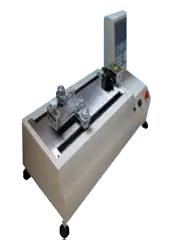
Coefficient of Friction Machine
Coefficient of Friction Machine
The Coefficient of Friction Machine is designed to measure the frictional behaviour between two contacting surfaces under controlled test conditions. It can be configured for different materials, specimen sizes, loads, speeds and test requirements. Innotech Engineering Devices Private Limited, Bhiwadi, Rajasthan, manufactures Coefficient of Friction Machines according to customer requirements and application needs.
OVERVIEW
Description
Coefficient of Friction Machine
The Coefficient of Friction Machine is laboratory testing equipment used to evaluate the frictional characteristics between two surfaces when they are in contact and one surface moves relative to the other.
Coefficient of friction is an important property when evaluating materials, surfaces, packaging materials, films, plastics, rubber, paper and other products where friction can affect handling, movement, feeding, sliding or overall performance.
The exact design of a Coefficient of Friction Machine depends on the intended application. Factors such as test material, specimen dimensions, normal load, sliding arrangement, test speed, friction measurement system and data recording requirements can vary from one customer to another.
Therefore, Innotech Engineering Devices Private Limited develops and manufactures the machine according to the required testing application rather than limiting it to one fixed configuration.
What Is a Coefficient of Friction Machine?
A Coefficient of Friction Machine determines the resistance between two surfaces when they are placed in contact and relative movement is produced.
The machine applies a controlled normal load between the test surfaces and creates relative motion. The resulting frictional force is measured by a suitable force-measuring system.
The coefficient of friction can then be determined from the relationship between frictional force and normal force.
The equipment can be configured to measure different friction-related characteristics, including static and kinetic friction, where applicable to the selected test method.
How Does the Coefficient of Friction Machine Work?
The general testing process includes:
1. The test specimens are prepared according to the applicable test method.
2. The specimen surfaces are cleaned and positioned correctly.
3. One specimen is fixed on the test platform.
4. The mating specimen or sled is positioned over the test surface.
5. A specified normal load is applied.
6. The machine creates controlled relative movement between the surfaces.
7. The frictional resistance generated during movement is measured.
8. The control or data-acquisition system records the relevant force information.
9. Static and/or kinetic coefficient of friction can be determined according to the selected test method and machine configuration.
The exact testing procedure depends on the material being tested and the applicable standard or customer requirement.
Technical Specifications
Since Innotech Engineering Devices Private Limited manufactures this equipment according to customer requirements, the following parameters can be configured according to the application:
| Parameter |
Specification |
| Product Type | Coefficient of Friction Machine |
| Test Type | Coefficient of friction / frictional behaviour testing |
| Friction Measurement | Static and/pr kinetic friction as required |
| Test Material | As per customer application |
| Specimen Size | As per applicable test method/customer requirement |
| Normal Load | As required for the test applicaiton |
| Sliding Arrangement | As per test method |
| Sliding Speed | As per application/test method |
| Friction Force Measurement | Load cell / suitable force measurement system |
| Load Capacity | As required |
| Test Surface | Suitable material/specimen arrangement |
| Specimen Holder | Applicaiton specific |
| Test surface | Suitable material/specimen arrangement |
| Specimen Holder | Application-specific |
| Sled / Moving Fixture | As required |
| Test Distance | As per application/test method |
| Drive System | Motorized controlled movement |
| Motion Control | As required |
| Static Friciton Measurement | Available where required |
| Kinetic Friction Measurement | Available where required |
| Force Display | Digital/electronic display as configured |
| Data Acquistion | Optional / as required |
| Software | Optional / application-specific |
| Result Calculation | According to selected test method |
| Test Counter / Timer | Optional / as required |
| Control System | Digital/electronic control |
| Safety Arrangement | As required |
| Construction | Rigid laboratory-grade construction |
| Power Supply | As per final machine configuration |
| Dimensions | As per machine configuration |
| Weight | According to final configuration |
| Customization | Available according to customer requirements |
Note: Exact values for load, speed, specimen dimensions, travel distance, capacity and other parameters should be finalized according to the required test method and customer's application. They should not be assumed as standard values for every machine.
Key Features
- Designed for coefficient of friciton testing
- Suitable for static and/or kinetic friction evaluation
- Controlled normal loading
- Force measurement through suitable measuring system
- Digital monitoring and control
- Application-specific specimen fixtures
- Configurable test speed and distance
- Optional data acquisition and software
- Suitable for laboratory testing
- Robust and rigid construction
- Customer-specific machine configuration
- Suitable for different material testing applicaitons
- Designed according to applicable test requirements
Why Is Coefficient of Friction Testing Important?
Friction affects how two materials interact when they come into contact and move against each other.
A material with a high coefficient of friction may resist sliding, while a material with a lower coefficient of friction may slide more easily.
Coefficient of friction testing can therefore help manufacturers and laboratories evaluate:
- Surface behaviour
- Sliding resistance
- Material interaction
- Packaging performance
- Feeding and handling behaviour
- Surface finish characteristics
- Material selection
- Product consistency
- Quality-control requirements
The test result can be useful during product development, quality control and comparative material evaluation.
What Materials Can Be Tested?
Depending on the machine configuration, the Coefficient of Friction Machine can be designed for applications involving:
- Plastic films
- Packaging films
- Polymer materials
- Paper and paper products
- Rubber materials
- Coated materials
- Laminated materials
- Textiles
- Sheets and flexible materials
- Packaging materials
- Other engineering or industrial surfaces
The appropriate specimen arrangement and test conditions should be selected according to the material and applicable testing requirement.
Applications
The machine can be used for:
- Coefficient of friction testing
- Static friction testing
- Kinetic friction testing
- Packaging material evaluation
- Plastic film testing
- Polymer testing
- Paper testing
- Rubber testing
- Surface comparison
- Research and development
- Quality-control testing
- Product development
- Material selection
- Production quality monitoring
h2: Industries Served
Customized Coefficient of Friction Machines can be suitable for:
- Packaging Industry
- Platic Manufacturing Industry
- Polymer & Film Testing
- Paper Industry
- Rubber Industry
- Printing and Coating Industry
- Automotive Component Testing
- Material Testing Laboratories
- Research & Development Laboratories
- Quality Control Laboratories
- Manufacturing Industries
Customized Coefficient of Friction Machine Manufacturer in Bhiwadi, Rajasthan
Innotech Engineering Devices Private Limited is a testing equipment manufacturer based in Bhiwadi, Rajasthan, providing laboratory and industrial testing machines according to customer applications.
For coefficient of friction testing, different customers may require different:
- Test loads
- Specimen dimensions
- Test speeds
- Test distances
- Fixtures
- Friction measurement arrangements
- Data recording systems
- Software
- Control systems
Our engineering approach allows these requirements to be considered during machine configuration.
Customers can share the material to be tested, required test method, specimen dimensions and desired test parameters so that a suitable machine configuration can be proposed.
What to Consider Before Buying a Coefficient of Friction Machine?
Before selecting a machine, consider:
Test Material: Identify whether the application involves film, plastic, paper, rubber, textile, coating or another material.
Test Method: The machine should be configured according to the applicable testing standard or internal laboratory method.
Normal Load: The required normal force affects the machine's load-measuring and loading arrangement.
Friction Measurement: Determine whether static friction, kinetic friction or both need to be measured.
Specimen Dimensions: The fixture and working area should accommodate the required specimen size.
Sliding Speed and Distance: These should match the intended test method and application.
Data Recording: For research and quality-control applications, digital data acquisition and result recording may be useful.
Why Choose Innotech Engineering Devices Private Limited?
- Customer-specific machine configurations
- Application-based engineering
- Customized fixtures and testing arrangements
- Suitable for laboratory and industrial applications
- Focus on practical testing requirements
- Support for special-purpose testing equipments
- Manufacturing facility in Bhiwadi, Rajasthan
- Testing equipment solutions for Indian Industries
Frequently Asked Questions
What is a Coefficient of Friction Machine?
A Coefficient of Friction Machine is laboratory testing equipment used to measure the frictional resistance between two surfaces under controlled test conditions.
What does the coefficient of friction indicate?
The coefficient of friction indicates the relationship between frictional force and normal force between two contacting surfaces.
Can the machine measure static and kinetic friction?
Yes. The machine can be configured for static friction, kinetic friction or both, depending on the required application and test method.
Can the Coefficient of Friction Machine be customized?
Yes. Innotech Engineering Devices Private Limited manufactures the machine according to customer requirements, including load, speed, specimen dimensions, fixtures, measurement and control arrangements.
What materials can be tested?
Depending on configuration, materials such as plastic films, packaging materials, paper, rubber, polymers, coatings and other surfaces can be evaluated.
Who manufactures Coefficient of Friction Machines in Bhiwadi, Rajasthan?
Innotech Engineering Devices Private Limited manufactures customized testing equipment in Bhiwadi, Rajasthan, including Coefficient of Friction Machines designed according to application requirements.
How do I select the right Coefficient of Friction Machine?
Share the material being tested, specimen size, required load, test method, friction type and other testing requirements. Our technical team can recommend a suitable configuration.
Consult an Expert
Looking for a Coefficient of Friction Machine for your specific testing application?
Do not select a machine only on the basis of generic specifications. Share your material, test method and required testing parameters with our technical team.
Innotech Engineering Devices Private Limited
H-307, RIICO Industrial Area, Karoli, Tapukara, Bhiwadi, Rajasthan
📞 +91 9810431604
📧 info@innotechgroup.net
🌐 www.innotechgroup.net
Consult an Expert for the right Coefficient of Friction Machine configuration.