
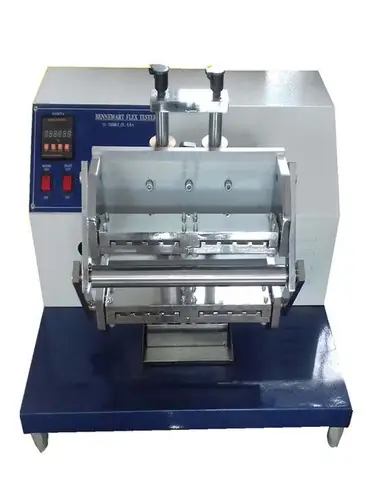
Bennewart Flex Tester – Footwear Sole Flex Resistance Testing Machine
Bennewart Flex Tester – Footwear Sole Flex Resistance Testing Machine
Bennewart Flex Tester is a footwear testing machine designed to evaluate the resistance of shoe outsoles to repeated bending, cut growth and crack development. It applies controlled flexing movements to mounted test specimens to assess material durability under repeated mechanical stress. Manufactured by Innotech Engineering Devices Private Limited in Bhiwadi, Rajasthan, this machine can be configured according to testing requirements and supplied across India.
MODEL
IBFT
OVERVIEW
Description
Bennewart Flex Tester Manufacturer in Bhiwadi, Rajasthan, India
The Bennewart Flex Tester is a specialised footwear testing instrument used to determine the resistance of shoe soles to cut growth and cracking during repeated flexing. It helps footwear manufacturers, material testing laboratories and quality control departments evaluate the durability of outsole materials before they are used in finished footwear.
During testing, the outsole specimen is securely mounted between fixed and movable gripping fixtures. The machine repeatedly bends the specimen around a specified flexing arrangement. Depending on the selected test method, an initial cut can be introduced into the specimen to examine how the cut develops after a defined number of flexing cycles.
The results help manufacturers compare different sole materials, identify potential weaknesses and improve footwear product quality.
Working Principle
The Bennewart Flex Tester operates through a mechanical drive arrangement that produces repeated movement of the specimen-holding fixture. The specimen is positioned between the gripping arrangements and subjected to controlled bending. A digital preset counter can be used to monitor the completed test cycles and stop the machine at the selected count, depending on the supplied configuration.
After testing, the specimen is inspected to evaluate cut growth, crack formation and visible material damage.
Industrial Applications
The machine is suitable for testing footwear outsoles and other compatible flexible components. It supports footwear material development, incoming material inspection, production quality control and laboratory durability assessment.
Customised Manufacturing and Supply
Innotech Engineering Devices Private Limited manufactures testing equipment in Bhiwadi, Rajasthan, and supplies machines across India. We offer customised configurations based on specimen requirements, number of test stations, operating parameters and laboratory requirements.
Machine pricing depends on the selected configuration and technical specifications. Contact our team for product details, technical consultation and a customised quotation.
Applicable testing standards
The relevant methods to consider for this product include:
- SATRA TM161 - Bebbewart flex test, resistance to cut growth on flexing.
- ISO 17707 - Footwear test method for outsole flex resistance.
- ISO 20344 - Personal protective equipment, footwear test methods.
- DIN 53543 - Relevant historical test reference for flexible polyurethane materials.
Important technical reference: Comparable Bennewart testers commonly specify a 90° flexing angle, 125–150 cycles/minute, 30 mm mandrel and approximately 110 mm clamp spacing. These are reference-machine values, not yet confirmed specifications of your pictured machine.
Importance of Flex Resistance Testing in the Footwear Industry
Footwear soles are exposed to continuous bending, walking pressure and repeated mechanical stress during everyday use. These conditions can gradually lead to cracks, material separation or enlargement of existing cuts in the outsole. Flex resistance testing helps footwear manufacturers understand how their sole materials behave under repeated bending conditions before selecting them for commercial production.
A Bennewart Flex Tester supports this evaluation by applying repeated flexing movements to a prepared footwear specimen. The testing process provides useful information about material durability, resistance to crack propagation and the overall performance of footwear outsoles. Manufacturers can use these observations to compare different material formulations and improve their footwear designs.
Materials Suitable for Bennewart Flex Testing
The Bennewart Flex Tester is primarily associated with footwear outsole testing. Depending on the specimen dimensions, fixture arrangement and selected testing method, it can be used to evaluate different flexible sole materials.
Rubber Shoe Soles
Rubber outsoles are commonly used in industrial footwear, sports shoes and everyday footwear. Flex testing helps evaluate their resistance to repeated bending and the development of cracks.
PU and PVC Soles
Polyurethane and polyvinyl chloride are widely used in footwear manufacturing. Testing helps manufacturers examine the flexing behaviour and visible damage development of these materials.
Synthetic and Flexible Sole Materials
Other suitable synthetic outsole materials can also be evaluated when the specimen preparation and testing arrangement are compatible with the selected test method.
Factors Affecting Footwear Outsole Flex Testing
Several factors can influence the results of a flex resistance test. Understanding these factors helps laboratories maintain consistency and obtain meaningful comparisons between different material samples.
- Specimen preparation: Consistent specimen dimensions and preparation are important for reliable comparisons.
- Initial cut preparation: Where required by the testing method, the initial cut must be prepared accurately.
- Flexing conditions: The selected flexing angle, speed and test cycles should follow the applicable test procedure.
- Material thickness: Differences in outsole thickness can influence the bending behaviour of the specimen.
- Test cycle count: Specimens can be inspected after the spcified number of flexing cycles to evaluate damage development.
- Environmental conditions: Temperature and conditioning requirements should be considered according to the selected testing standard.
Quality Control and Product Development Applications
Footwear manufacturers can use Bennewart flex testing during material development and production quality control. It helps quality teams compare incoming outsole materials, investigate material-related failures and evaluate changes in material formulations.
During product development, testing different outsole compositions can help manufacturers identify materials with suitable flexing characteristics. The observations can also support supplier evaluation and internal quality assurance procedures.
For footwear testing laboratories, this equipment provides a dedicated arrangement for evaluating outsole flex resistance and examining the development of cuts and cracks under repeated bending.
How to Select a Bennewart Flex Tester
Before purchasing a Bennewart Flex Tester, manufacturers and laboratories should consider their testing requirements, specimen dimensions and applicable test procedures.
The selection process should include the required testing method, specimen holding arrangement, number of testing stations, flexing mechanism, cycle counter configuration and electrical requirements. Laboratories should also consider their available installation space and the type of footwear materials they intend to evaluate.
Selecting the appropriate machine configuration helps ensure that the equipment meets the laboratory's intended testing applications. Innotech offers customised testing machine configurations based on customer requirements, specimen arrangements and technical preferences.
Why Choose Innotech Engineering Devices Private Limited?
Innotech Engineering Devices Private Limited is a manufacturer of industrial testing machines and laboratory equipment based in Bhiwadi, Rajasthan, India. We develop testing equipment for different industrial applications and provide customised machine solutions according to customer requirements.
Our Bennewart Flex Tester can be configured according to the required testing application, fixture arrangement and operating requirements. We focus on providing practical testing solutions for footwear manufacturers, quality control departments and material testing laboratories.
We supply testing machines to customers across India, with product configurations and pricing depending on the selected technical specifications.
Request a Quote for Bennewart Flex Tester
Looking for a Bennewart Flex Testing Machine for your footwear manufacturing unit or testing laboratory? Contact Innotech Engineering Devices Private Limited for machine details, customised configurations and pricing.
Share your testing application, material type and laboratory requirements with our team. We can discuss a suitable machine configuration based on your requirements.
Manufacturer: Innotech Engineering Devices Private Limited
Location: Bhiwadi, Rajasthan, India
Email: info@innotechgroup.net
Phone: +91 9810431604
Frequently asked questions
Q1. What is a Bennewart Flex Tester used for?
It is used to evaluate the resistance of footwear outsoles to repeated bending, cut growth and crack development.
Q2. Which materials can be tested?
Primarily footwear outsole materials such as rubber, PU, PVC and other compatible flexible materials.
Q3. What does the Bennewart flex test measure?
It evaluates cut growth and crack formation after repeated flexing cycles.
Q4. Which standard is associated with this machine?
SATRA TM161 is a recognised Bennewart flex test method. Other applicable methods depend on the product and test requirements.
Q5. Can the machine be customised?
Yes. Test stations, fixtures and machine configuration can be discussed according to customer requirements.
Q6. Do you supply the Bennewart Flex Tester outside Rajasthan?
Yes. Innotech Engineering Devices Private Limited manufactures in Bhiwadi, Rajasthan, and supplies testing equipment across India.
WHY IT WORKS
Key benefits
Evaluates outsole durability under repeated bending.
Helps identify cut propagation and material cracking.
Supports footwear material selection and product development.
Improves consistency in laboratory quality testing.
Helps compare the flexing performance of different sole materials.
Supports quality control before finished footwear production.
USE CASE
Application range
BUILT IN
Features
Digital preset cycle counter for test-cycle monitoring.
Mechanical flexing arrangement with fixed and movable grips.
Specimen-holding fixtures for controlled bending.
30 mm bending mandrel in the listed product configuration.
Rigid industrial machine construction.
Accessible specimen mounting and inspection arrangement.
Customisable test configuration according to customer requirements.
SPEC
Specifications
Machine name
Bennewart Flex Tester
Testing application
Footwear outsole flex resistance
Bending mandrel diameter
30 mm – listed configuration
Specimen size
100 × 180 mm – existing listing
Measuring range
1–100 N – existing listing; verify relevance
Test frequency
To be confirmed
Flexing angle
To be confirmed
Number of test stations
To be confirmed
Cycle counter range
To be confirmed
Drive mechanism
Mechanical flexing arrangement
Control system
Digital control panel shown
Power supply
To be confirmed
Operating temperature
10–40°C – existing listing; verify
Machine dimensions
To be confirmed
Machine weight
To be confirmed
Customisation
Available as per requirements