
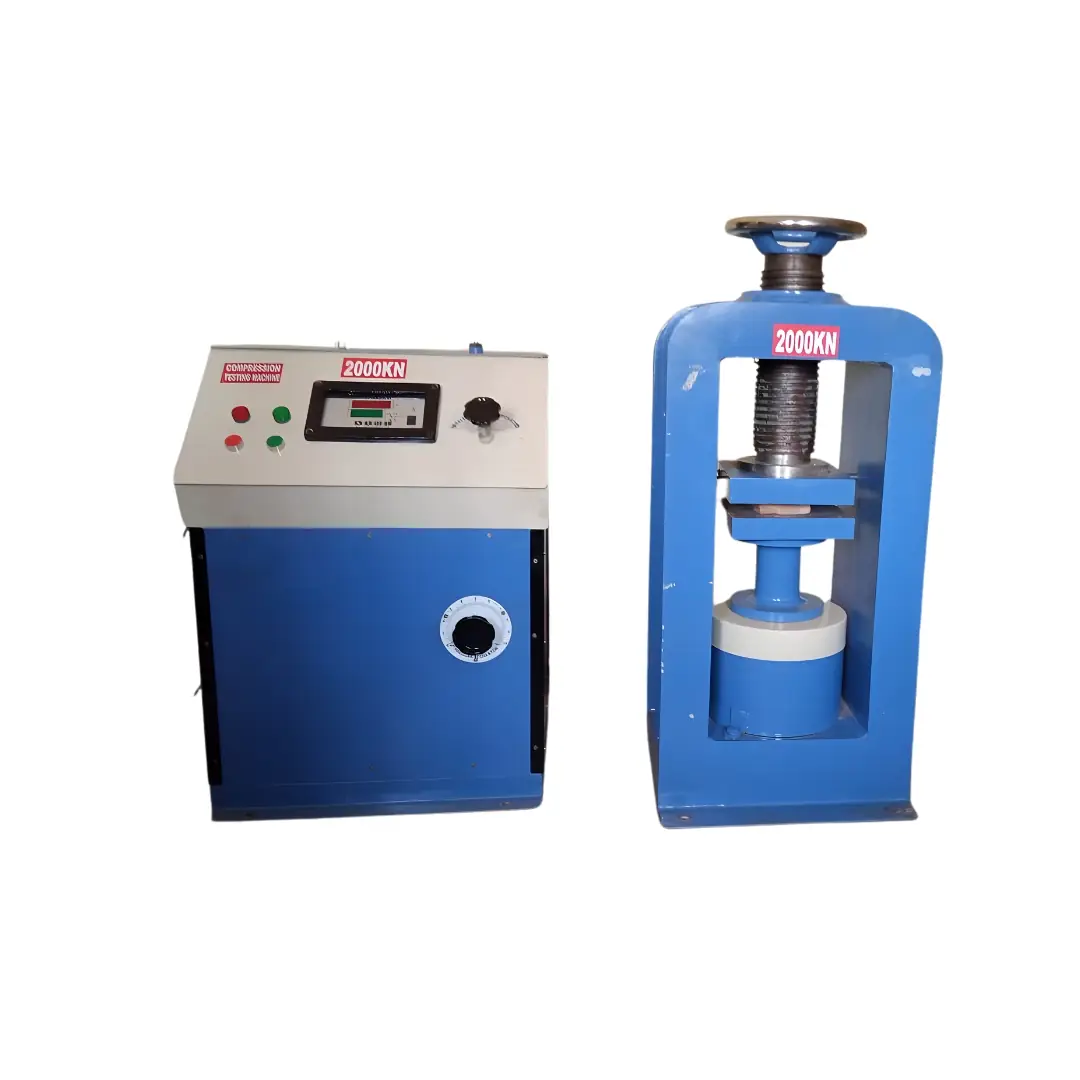
2000 kN Compression Testing Machine (CTM)
2000 kN Compression Testing Machine (CTM)
Looking for a reliable 2000 kN Compression Testing Machine for concrete cubes, cylinders and construction materials? Innotech manufactures heavy-duty hydraulic CTM machines with digital measurement, customizable testing arrangements and optional automatic pace rate control. Explore specifications and request a competitive quotation directly from a compression testing machine manufacturer in Bhiwadi, Rajasthan, India.
MODEL
ICTM-2000kN
OVERVIEW
Description
2000 kN Compression Testing Machine Manufacturer in India
Looking for a reliable 2000 kN Compression Testing Machine for concrete cubes, cylinders, construction materials and high-load compression testing? Innotech Engineering Devices Private Limited is a Compression Testing Machine manufacturer in India, offering application-specific material testing equipment for construction companies, ready-mix concrete plants, cement industries, infrastructure projects, industrial laboratories and engineering institutions.
As a Compression Testing Machine manufacturer in Rajasthan, Innotech develops heavy-duty hydraulic CTM machines according to customer-specific load capacity, specimen dimensions, measurement requirements and testing standards. Our 2000 kN CTM is designed around the requirements of concrete compressive strength testing, with customization options to accommodate different laboratory workflows, operating methods and purchasing budgets.
What Is a 2000 kN Compression Testing Machine?
A 2000 kN Compression Testing Machine, commonly known as a 2000 kN CTM or 200-ton class concrete cube testing machine, is used to determine the compressive strength and load-bearing capacity of materials.
The machine applies compressive force to a specimen positioned between two compression platens. The applied load is progressively increased until the specimen fails or reaches the specified test endpoint.
The maximum applied force is measured and used to determine the compressive strength of the specimen according to the applicable testing procedure.
Unlike general-purpose hydraulic presses, a CTM is specifically designed for controlled material strength testing and calibrated force measurement.
Why Choose a 2000 kN CTM for Concrete Testing?
The 2000 kN concrete compression testing machine is a widely used capacity in construction material testing laboratories because it accommodates a broad range of conventional concrete strength requirements.
It is particularly relevant for laboratories testing standard concrete cubes and cylinders during construction quality control, mix design evaluation and material acceptance testing.
Selecting an appropriate CTM capacity helps laboratories avoid machine overloading while maintaining suitable measurement performance within the calibrated force range.
For laboratories with different testing force requirements, Innotech manufactures customized Compression Testing Machines https://innotechgroup.net/categories/compression-testing-machines according to the material and intended application.
Concrete Compressive Strength Calculation
Concrete compressive strength is calculated by dividing the maximum compressive force at failure by the appropriate loaded cross-sectional area of the specimen.
Compressive Strength (MPa) = Maximum Load (N) ÷ Loaded Area (mm²)
For a standard concrete cube measuring 150 × 150 × 150 mm, the loaded area is 22,500 mm².
The relationship between concrete compressive strength and approximate failure load is illustrated below.
| Example Compressive Strength |
Failure Load for 150 mm Cube |
| 20 MPa | 450 kN |
| 25 MPa | 562.5 kN |
| 30 MPa | 675 kN |
| 40 MPa | 900 kN |
| 50 MPa | 1125 kN |
| 60 MPa | 1350 kN |
| 70 MPa | 1575 kN |
| 80 MPa | 1800 kN |
These theoretical values help laboratories estimate required machine capacity. Actual specimen failure loads may vary, and appropriate capacity margins and calibrated measurement ranges must be considered.
Read our detailed guide on What Is a Compression Testing Machine? https://innotechgroup.net/blog/what-is-a-compression-testing-machine for further information about compression testing principles.
How Does a 2000 kN Hydraulic Compression Testing Machine Work?
The hydraulic loading system generates the force required to compress the specimen. After positioning the specimen centrally between the compression platens, the operator applies the load according to the specified test procedure.
The electronic measuring system monitors the applied force and displays the measured load. At specimen failure, a compatible digital controller records the peak load for compressive strength evaluation.
Proper specimen preparation, platen alignment, loading rate and machine calibration are essential for meaningful test results.
Digital, Automatic or Computerized 2000 kN CTM?
Selecting the appropriate operating configuration depends on testing frequency, laboratory requirements and the level of automation needed.
Digital CTM machines are suitable for laboratories requiring electronic force indication and operator-controlled loading. Explore our Digital Compression Testing Machines https://innotechgroup.net/categories/compression-testing-machines/digital-compression-testing-machines
Automatic configurations are relevant where regulated loading rates and reduced manual intervention are required. Discover our Pace Rate Controlled Compression Testing Machine https://innotechgroup.net/products/pace-rate-controlled-compression-testing-machine
Laboratories requiring graphical analysis, electronic data acquisition and detailed reports can explore our Computerized Compression Testing Machines https://innotechgroup.net/categories/compression-testing-machines/computerized-compression-testing-machines
Relevant Concrete Testing Standards
The 2000 kN CTM can be configured according to testing and machine requirements associated with IS 516, IS 14858, ASTM C39/C39M and EN 12390-3 and EN 12390-4.
The applicable standard, specimen geometry, loading procedure, force verification and calibration requirements should be identified before finalizing the machine configuration.
CTM or UTM for High-Capacity Material Testing?
A dedicated compression testing machine is primarily intended for compressive strength evaluation. A Universal Testing Machine is more suitable when the laboratory also requires tensile, bending, shear and other mechanical testing capabilities.
Read our comparison of Compression Testing Machine vs Universal Testing Machine https://innotechgroup.net/blog/compression-testing-machine-vs-universal-testing-machine to understand which machine best suits your laboratory.
Customized 2000 kN Compression Testing Machine Manufacturer in Bhiwadi
Innotech manufactures industrial testing equipment in Bhiwadi, Rajasthan, India, with machine configurations developed according to customer requirements.
Customers can discuss their preferred loading frame, specimen clearance, compression platen dimensions, operating system, measurement accuracy and calibration requirements directly with our engineering team.
As a compression testing machine manufacturer in Rajasthan, Innotech serves industrial and laboratory equipment requirements across Bhiwadi, Neemrana, Alwar, Jaipur, Gurugram, Delhi NCR and other regions of India.
2000 kN Compression Testing Machine Price in India
The price of a 2000 kN CTM depends on its hydraulic loading system, frame construction, force measurement system, automation level, controller, calibration and supplied accessories.
Whether you require a conventional digital concrete compression machine or an advanced automatic configuration, Innotech can evaluate your requirements and provide a suitable technical and commercial quotation.
Share your specimen dimensions, required testing standards, operating preferences and delivery location with our engineering team.
Request a technical catalogue and customized quotation directly from Innotech Engineering Devices Private Limited, a 2000 kN Compression Testing Machine manufacturer in India.
Manufacturing Location: Bhiwadi, Rajasthan, India
Email: info@innotechgroup.net
Phone: +91 9810431604
FAQ
What is a 2000 kN Compression Testing Machine?
A 2000 kN Compression Testing Machine is a high-capacity material testing machine used to determine the compressive strength of concrete cubes, cylinders and other suitable materials.
How many tons is a 2000 kN CTM?
A 2000 kN CTM has a rated force equivalent to approximately 203.94 metric tonne-force. It is commonly referred to as a 200-ton class compression testing machine.
What is the price of a 2000 kN Compression Testing Machine in India?
The price depends on the hydraulic system, controller, automation level, load accuracy, accessories and calibration requirements. Contact Innotech for a customized technical and commercial quotation.
Can a 2000 kN CTM test M60 concrete?
A 150 mm concrete cube with a compressive strength of 60 MPa theoretically requires approximately 1350 kN of force. A 2000 kN CTM can accommodate this nominal load, provided the actual specimen failure force and required measurement range remain within its rated and calibrated limits.
Is a 2000 kN CTM available with automatic pace rate control?
Innotech offers application-specific configurations that can incorporate automatic pace rate control, digital measurement and optional computerized reporting.
Who manufactures 2000 kN compression testing machines in Rajasthan?
Innotech Engineering Devices Private Limited is a compression testing machine manufacturer in Bhiwadi, Rajasthan, India, offering customized CTM configurations for laboratories and industrial customers.
What information is required to purchase a 2000 kN CTM?
Customers should provide specimen dimensions, required testing standards, expected material strength, preferred operating method, calibration requirements and delivery location.
WHY IT WORKS
Key benefits
High Testing Capacity: 2000 kN rated capacity for demanding concrete and construction material strength testing.
Reliable Force Measurement: Calibrated electronic load measurement supports consistent and traceable test results.
Versatile Material Testing: Suitable for concrete cubes, cylinders and compatible construction materials with appropriate fixtures.
Improved Laboratory Productivity: Motorized hydraulic operation reduces manual pumping effort.
Convenient Result Interpretation: Digital load indication and peak-load recording simplify test result evaluation.
Long-Term Equipment Reliability: Heavy-duty loading frame designed for repeated high-force testing applications.
Reduced Operator Dependence: Optional automatic pace rate control minimizes manual loading adjustments.
Customized Testing Solutions: Compression platens, specimen clearance and control systems can be configured according to customer requirements.
Enhanced Operational Safety: Proposed protective guards, overload protection and emergency stop arrangements support safer testing.
Direct Manufacturer Support: Application-specific engineering, installation, calibration and technical support options from Innotech, Bhiwadi, Rajasthan.
USE CASE
Application range
BUILT IN
Features
Heavy-duty 2000 kN hydraulic compression loading system.
High-rigidity four-column or welded steel loading frame.
Microprocessor-based digital force indication.
Hardened and precision-ground compression platens.
Spherically seated, self-aligning upper compression platen.
Electrically operated hydraulic power pack with loading rate adjustment.
Peak-load retention and compressive strength calculation.
Digital pace rate indication with optional automatic loading control.
Adjustable testing space using suitable machined spacer blocks.
Overload protection, ram travel limitation, protective specimen guard and emergency stop arrangement.
SPEC
Specifications
Manufacturer
Innotech Engineering Devices Private Limited
Brand
IEDPL
Model
ICTM-2000 kN
Machine Type
Digital Hydraulic Compression Testing Machine
Rated Load Capacity
2000 kN
Equivalent Capacity
Approximately 203.94 metric tonne-force
Loading System
Electrohydraulic
Operation
Motorized with manual pace rate adjustment
Automatic Pace Rate Control
Optional
Computerized Operation
Optional
Loading Frame
Heavy-duty welded steel or four-column construction
Load Measuring System
Electronic pressure transducer or load cell
Measuring Range
200–2000 kN, proposed verified range
Load Accuracy
Class 1, ±1% of indicated load within calibrated range
Digital Load Resolution
0.1 kN
Display
Microprocessor-based digital LCD
Force Units
kN
Compressive Strength Units
N/mm² or MPa
Peak Load Indication
Provided in proposed configuration
Pace Rate Indication
Digital
Automatic Pace Rate Range
0.5–20 kN/sec, optional design target
Upper Compression Platen
Spherically seated and self-aligning
Lower Compression Platen
Hardened and precision ground
Compression Platen Diameter
300 mm
Compression Platen Thickness
60 mm, subject to structural design validation
Platen Hardness
55–60 HRC
Platen Surface Flatness
Within 0.02 mm, proposed target
Maximum Vertical Clearance
350 mm
Horizontal Clearance
350 mm
Hydraulic Ram Diameter
250 mm
Maximum Ram Stroke
50 mm
Hydraulic Cylinder
Precision-machined high-pressure hydraulic cylinder
Hydraulic Power Pack
Motorized hydraulic pumping unit
Nominal Hydraulic Working Pressure
Approximately 410 bar at full rated force, ideal calculation
Electric Motor
1.5 kW
Hydraulic Oil Tank Capacity
Approximately 25 litres
Loading Rate Adjustment
Manual flow control or optional closed-loop system
Standard Cube Specimens
100 mm and 150 mm cubes
Larger Cube Specimens
Up to 200 mm, subject to force and fixture requirements
Cylinder Specimens
Up to Ø150 × 300 mm
Testing Space Adjustment
Precision-machined spacer blocks
Automatic Strength Calculation
With compatible digital controller
Overload Protection
Hydraulic pressure relief and electronic load-limit protection
Ram Travel Protection
Limit switch arrangement
Emergency Stop
Mushroom-type emergency stop push button
Operator Protection
Specimen safety guard
PC Connectivity
Optional USB, RS-232 or Ethernet interface
Computer Software
Optional Windows-based testing software
Data Export
Optional electronic report and spreadsheet-compatible export
Electrical Supply
230 V AC, Single Phase, 50 Hz
Alternative Power Supply
415 V AC, Three Phase, 50 Hz
Approximate Machine Dimensions
900 × 600 × 1400 mm (W × D × H)
Approximate Machine Weight
800–1000 kg
Calibration
Traceable force calibration
Reference Machine Standards
IS 14858, EN 12390-4 and applicable force verification requirements
Reference Test Standards
IS 516 (Part 1/Sec 1), ASTM C39/C39M and EN 12390-3
Customization
Available according to customer requirements