



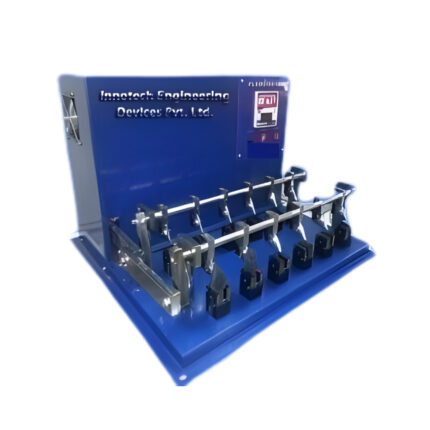
DIGITAL BURSTING STRENGTH TESTER
Technical Specifications
-
Measurement Range: 0–100 kg/cm² / 0–1000 kPa (customizable)
-
Display: High-resolution digital LCD / LED display
-
Accuracy: ±1% of full scale
-
Pressure System: Hydraulic pressure with rubber diaphragm
-
Clamping Method: Manual / Pneumatic clamping (optional)
-
Specimen Diameter: As per standard (e.g., 30.5 mm / 50 mm)
-
Pressure Application Rate: Adjustable, as per standard requirements
-
Control System: Microprocessor-based digital controller
-
Peak Hold Function: Yes (maximum burst value capture)
-
Units Displayed: kg/cm², kPa, PSI (selectable)
-
Power Supply: 220–240 V AC, 50 Hz
-
Standards Compliance:
-
IS: 1060
-
TAPPI T403
-
ISO 2758 / ISO 2759
-
ASTM D3786 / ASTM D3787
-
-
Optional Features:
-
Computer interface (RS-232 / USB)
-
Bursting index calculation
-
Data storage & printer output
-
The Digital Bursting Strength Tester is a precision testing instrument designed to determine the bursting strength and bursting index of paper, paperboard, corrugated board, textile fabrics, leather, and packaging materials. The tester applies hydraulic pressure through a rubber diaphragm until the specimen ruptures, while a digital system accurately records the maximum pressure at burst.
Equipped with a microprocessor-based digital display, the instrument ensures high accuracy, repeatability, and ease of operation. It conforms to major international testing standards, making it ideal for quality control, R&D, and production environments in paper mills, packaging industries, textile labs, and inspection agencies.
Related products

FLEXURAL STRENGTH TESTING MACHINE
Technical Specifications
Load Capacity
-
Range: 10 kN to 300 kN
-
Suitable for concrete beams, tiles, blocks, polymers, composites
Loading Type
-
Three-point bending
-
Four-point bending
Control System
-
Manual / Motorized / Servo-controlled
-
Pace rate control available
-
Closed-loop feedback system (in advanced models)
Display
-
Digital load indicator
-
Touchscreen controller (computerized models)
-
Real-time load vs deflection graph
Accuracy
-
±1% or better of indicated load
-
Calibrated load cell system
Loading Rate
-
Adjustable loading rate
-
Standard compliant loading speed control
Test Span Adjustment
-
Adjustable support span
-
Roller support fixtures
Drive Mechanism
-
Hydraulic power pack or electromechanical screw drive
-
Servo motor (in advanced systems)
Data Output
-
Software-based data acquisition
-
Test reports generation
-
USB / PC connectivity
-
Automatic peak load capture
Safety Features
-
Overload protection
-
Emergency stop
-
Limit switches
-
Guard enclosure
Standards Compliance
-
ASTM C78 / ASTM D790
-
IS 516
-
ISO standards for flexural testing

SERVO CONTROLLED UTM
📊 Typical Technical Parameters
(Specifications vary by model & capacity: 100 kN–2000 kN or more)
| Parameter | Typical Range / Value |
|---|---|
| Load Capacity | 100 kN, 200 kN, 400 kN, 600 kN, 1000 kN, 2000 kN etc. |
| Load Accuracy | ±1 % or better |
| Test Speed | 0.001 to 500 mm/min (configurable) |
| Position Resolution | 0.01 mm or better |
| Control Modes | Load, strain/elongation, displacement, hold |
| Measurement Feedback | Load cell, encoder/extensometer |
| Data Output | Real-time graph, exportable results |

DIN ABRASION TESTER
Key Features
-
Conforms to DIN 53516 / ISO 4649 / ASTM D5963
-
Precision abrasive drum with uniform speed
-
Constant load application mechanism
-
Digital revolution counter
-
Sliding distance control
-
Specimen holder with angular adjustment
-
High accuracy and repeatability
-
Rugged, vibration-free construction
-
Easy specimen mounting and removal
Technical Specifications (Typical)
-
Drum Diameter: ~150 mm
-
Drum Speed: 40 ± 1 rpm
-
Abrasive Paper: Grit 60 (as per DIN)
-
Normal Load: 10 N
-
Sliding Distance: 40 m (standard)
-
Specimen Size: Ø16 mm × 6–15 mm thickness
-
Display: Digital / LCD
-
Power Supply: 220–240 V AC, 50 Hz
Applications
-
Rubber and elastomer industries
-
Tyre and automotive components
-
Conveyor belts and hoses
-
Footwear and sole materials
-
PU and polymer products
-
Quality control and R&D laboratories
Advantages
-
Reliable abrasion resistance evaluation
-
Standard-compliant testing
-
Consistent and repeatable results
-
Low maintenance
-
User-friendly operation
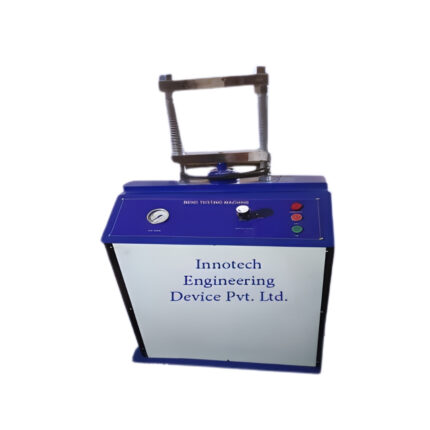
HYDRAULIC BEND TESTING MACHINE
Key Features
-
Heavy-duty hydraulic loading system
-
Rigid steel frame construction
-
Smooth and controlled bending operation
-
Hardened bending rollers and mandrels
-
Digital load indicator / PLC touch screen (optional)
-
Manual / semi-automatic operation
-
Low maintenance and long service life
-
Safety valves and overload protection
-
Compact and floor-mounted design
Applications
-
TMT bar bend and rebend testing
-
Weld joint bend testing
-
Structural steel quality verification
-
Pipe and tube bend testing
-
Research & development laboratories
-
Educational and training institutes
Standards Compliance
-
IS 1599
-
IS 1786
-
ASTM A370
-
ISO 15630
-
EN standards

MOTORIZED KNOTCH CUTTER
Key Features
-
Motorized operation for uniform and precise notch cutting
-
High-accuracy linear slide mechanism
-
Interchangeable cutters for V-notch and U-notch
-
Rigid body construction for vibration-free operation
-
Adjustable cutting depth and feed
-
Safety cover for operator protection
-
Suitable for metals, plastics, and composite specimens
Technical Specifications (Typical)
-
Notch Types: V-notch (45°), U-notch (2 mm radius)
-
Specimen Size: As per ASTM / ISO standards
-
Motor: Single phase / Three phase AC motor
-
Cutting Accuracy: ±0.01 mm
-
Standards Compliance: ASTM E23, ISO 148, IS 1757
-
Operation: Bench-mounted, motor-driven
Applications
-
Impact test specimen preparation
-
Quality control laboratories
-
Metallurgical testing labs
-
Plastic and polymer testing
-
Research & development centers

GOVERNOR TESTING MACHINE
Main Functions
-
Testing of centrifugal governors
-
Measurement of speed vs lift characteristics
-
Determination of controlling force
-
Study of stability and sensitiveness
-
Calibration of mechanical governors
Construction & Components
-
Rigid MS fabricated frame
-
Variable speed electric motor with controller
-
Vertical spindle with governor mounting arrangement
-
Precision RPM measuring system (digital tachometer / encoder)
-
Sleeve lift measurement using dial gauge / LVDT
-
Load application mechanism (weights / spring system)
-
Safety guard enclosure
-
Digital display / DAQ system (optional)
Typical Technical Specifications
-
Speed Range: 0 – 6000 RPM (customizable)
-
Speed Control: VFD / Servo drive
-
RPM Accuracy: ±0.5%
-
Lift Measurement Range: 0 – 25 mm
-
Lift Accuracy: 0.01 mm
-
Power Supply: 230V / 415V AC
-
Mounting Type: Vertical
-
Data Output: Digital display / PC interface (optional)
Types of Governors Tested
-
Watt Governor
-
Porter Governor
-
Proell Governor
-
Hartnell Governor
-
Wilson-Hartnell Governor
Applications
-
Mechanical engineering laboratories
-
Polytechnic & engineering colleges
-
R&D centers
-
Industrial training institutes
-
Governor calibration workshops

COMPUTERIZED SPRING TESTING MACHINE
Key Functions
-
Load–Deflection Testing
-
Spring Rate (k) Calculation
-
Compression / Tension Testing
-
Cycle (Fatigue) Testing (optional)
-
Free Length & Solid Height Measurement
Types of Springs Tested
-
Compression springs
-
Tension (extension) springs
-
Torsion springs
-
Disc (Belleville) springs
Main Components
-
High-precision Load Cell
-
Servo / Stepper Motor Drive
-
Ball Screw & Linear Guide System
-
Computer with Testing Software
-
Digital Displacement Encoder
-
Safety Enclosure & Limit Switches
Typical Specifications (Indicative)
-
Capacity: 10 N to 50 kN (customizable)
-
Accuracy: ±0.5%
-
Stroke Length: 100–500 mm
-
Speed Range: 0.1–500 mm/min
-
Data Output: Load–deflection curve, test reports (PDF/Excel)
Software Features
-
Real-time load vs deflection graph
-
Automatic spring constant calculation
-
Test method storage
-
Pass/Fail limits
-
Data export & printer support
Standards Supported
-
IS, ASTM, DIN, JIS, ISO
-
Automotive & industrial spring standards
Applications
-
Automotive spring manufacturers
-
Electrical & electronics industry
-
Aerospace components
-
R&D laboratories
-
Incoming and final inspection
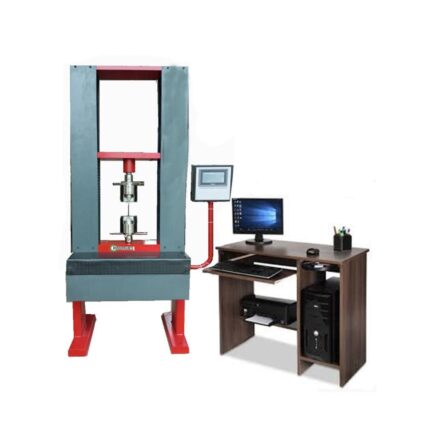
COMPUTERIZED TENSILE TESTING MACHINE
A Computerized Tensile Testing Machine (CTTM) is used to measure the mechanical properties of materials by applying a controlled tensile (pulling) load and recording the response digitally.
What it does
It determines properties such as:
-
Tensile strength
-
Yield strength
-
Elongation (%)
-
Reduction in area
-
Young’s modulus (with extensometer)
All results are captured, displayed, and stored via computer-based data acquisition software.
Main components
-
Loading Frame
-
Rigid two- or four-column structure
-
Driven by servo motor / AC motor / hydraulic system
-
-
Grips & Fixtures
-
Wedge grips (manual or hydraulic)
-
Suitable for flat, round, wire, or threaded specimens
-
-
Load Cell
-
High-accuracy force measurement (typically Class 1 or better)
-
-
Crosshead & Drive System
-
Precise speed control for strain-rate–dependent tests
-
-
Extensometer (optional but recommended)
-
For accurate strain and modulus measurement
-
-
Computer & Testing Software
-
Real-time load–elongation / stress–strain curves
-
Automatic calculation of results
-
Report generation and data export
-
Typical capacities
-
1 kN – 100 kN → plastics, rubber, wires, thin metals
-
100 kN – 600 kN → structural steel, rebars, plates
-
Higher capacities available in hydraulic models
Materials tested
-
Metals (steel, aluminum, copper, rebars)
-
Plastics & polymers
-
Rubber & elastomers
-
Wires, cables, fasteners
-
Composites and sheets
Standards supported
-
ASTM: A370, E8, D638, D412
-
ISO: 6892, 527
-
IS: 1608, 1828
-
BS / DIN standards (as required)
Key advantages
-
High accuracy and repeatability
-
Fully automated testing & reporting
-
Easy calibration and compliance
-
Suitable for R&D, QA/QC, and production labs
Optional features
-
Video extensometer
-
Temperature chamber (hot/cold testing)
-
Automatic hydraulic grips
-
Networked data storage
-
Customized test methods
If you want, I can help you with:
-
Technical specifications for a particular capacity
-
Comparison: electromechanical vs hydraulic
-
Tender / purchase specification
-
Brochure-style product description
-
Price range in India
Reviews
There are no reviews yet.