

Tensile Testing Machine
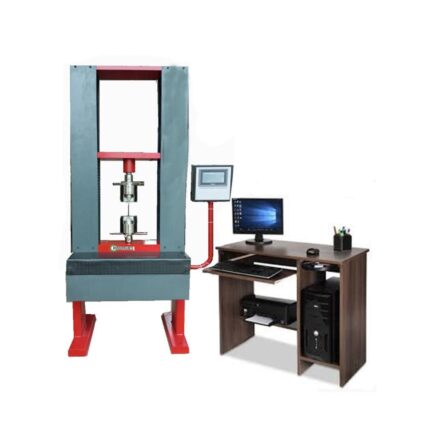
COMPUTERIZED TENSILE TESTING MACHINE
A Computerized Tensile Testing Machine (CTTM) is used to measure the mechanical properties of materials by applying a controlled tensile (pulling) load and recording the response digitally.
What it does
It determines properties such as:
-
Tensile strength
-
Yield strength
-
Elongation (%)
-
Reduction in area
-
Young’s modulus (with extensometer)
All results are captured, displayed, and stored via computer-based data acquisition software.
Main components
-
Loading Frame
-
Rigid two- or four-column structure
-
Driven by servo motor / AC motor / hydraulic system
-
-
Grips & Fixtures
-
Wedge grips (manual or hydraulic)
-
Suitable for flat, round, wire, or threaded specimens
-
-
Load Cell
-
High-accuracy force measurement (typically Class 1 or better)
-
-
Crosshead & Drive System
-
Precise speed control for strain-rate–dependent tests
-
-
Extensometer (optional but recommended)
-
For accurate strain and modulus measurement
-
-
Computer & Testing Software
-
Real-time load–elongation / stress–strain curves
-
Automatic calculation of results
-
Report generation and data export
-
Typical capacities
-
1 kN – 100 kN → plastics, rubber, wires, thin metals
-
100 kN – 600 kN → structural steel, rebars, plates
-
Higher capacities available in hydraulic models
Materials tested
-
Metals (steel, aluminum, copper, rebars)
-
Plastics & polymers
-
Rubber & elastomers
-
Wires, cables, fasteners
-
Composites and sheets
Standards supported
-
ASTM: A370, E8, D638, D412
-
ISO: 6892, 527
-
IS: 1608, 1828
-
BS / DIN standards (as required)
Key advantages
-
High accuracy and repeatability
-
Fully automated testing & reporting
-
Easy calibration and compliance
-
Suitable for R&D, QA/QC, and production labs
Optional features
-
Video extensometer
-
Temperature chamber (hot/cold testing)
-
Automatic hydraulic grips
-
Networked data storage
-
Customized test methods
If you want, I can help you with:
-
Technical specifications for a particular capacity
-
Comparison: electromechanical vs hydraulic
-
Tender / purchase specification
-
Brochure-style product description
-
Price range in India