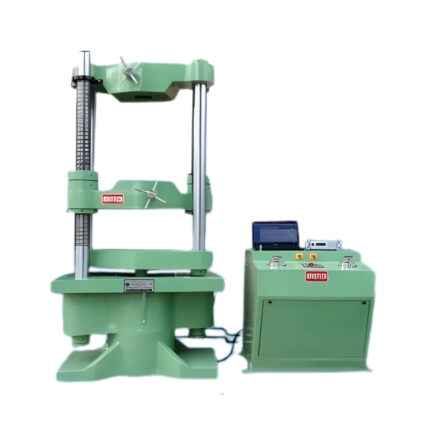
Computerized Universal Testing Machine

Key Features of Computerized UTMs (10–200 Ton)

🔧 Capacity & Load

  • Designed for capacities from roughly 100 kN (≈10 ton) up to 2000 kN (≈200 ton) depending on model.

  • Load measurement is done via high-accuracy load cells and displayed/recorded with high resolution.

🖥️ Computer & Software Integration

  • Connects to PC software for data acquisition, graphs, reports (Load vs. time, stress-strain, etc.).

  • Many systems support batch testing, statistical analysis, and export to Excel/PDF.

📏 Mechanical Specs (Typical)

These vary by capacity, but common ranges include:

  • Clearance for tensile tests: ~50–700 mm (varies with model)

  • Clearance for compression: ~0–700 mm

  • Column spacing: ~500–750 mm

  • Ram stroke: ~150–300 mm

  • Straining speed (no load): ~0–150 mm/min (lower for larger machines)

⚙️ Accessories & Fixtures

  • Tensile jaws for round/flat specimens

  • Compression plates

  • Bending fixtures

  • Optional extensometers for precise strain measurement

  • Load stabilizers, special grips, shear/peel fixtures available on demand.

🛠️ Control & Accuracy

  • Microprocessor or servo-controlled systems with feedback loops for precise force and displacement control.

  • Typical load accuracy ±1 % or better.

🧠 How It Works (Simplified)

  1. Specimen is mounted between grips or fixtures.

  2. Load is applied by hydraulic or motorized drive.

  3. Sensors capture force and deformation in real time.

  4. Software calculates and displays key mechanical properties.


📌 Choosing the Right UTM Model

Consider: ✅ Maximum load capacity (e.g., ~10 ton vs ~200 ton)
✅ Test types needed (tensile, compression, bending etc.)
✅ Required accuracy, speed range, and software features
✅ Type of materials to test (metal, plastic, composites etc.)