
Wire Torsion Testing Machine: Working Principle, Specifications & Buying Guide
Jay Pal Singh
20 November 2026
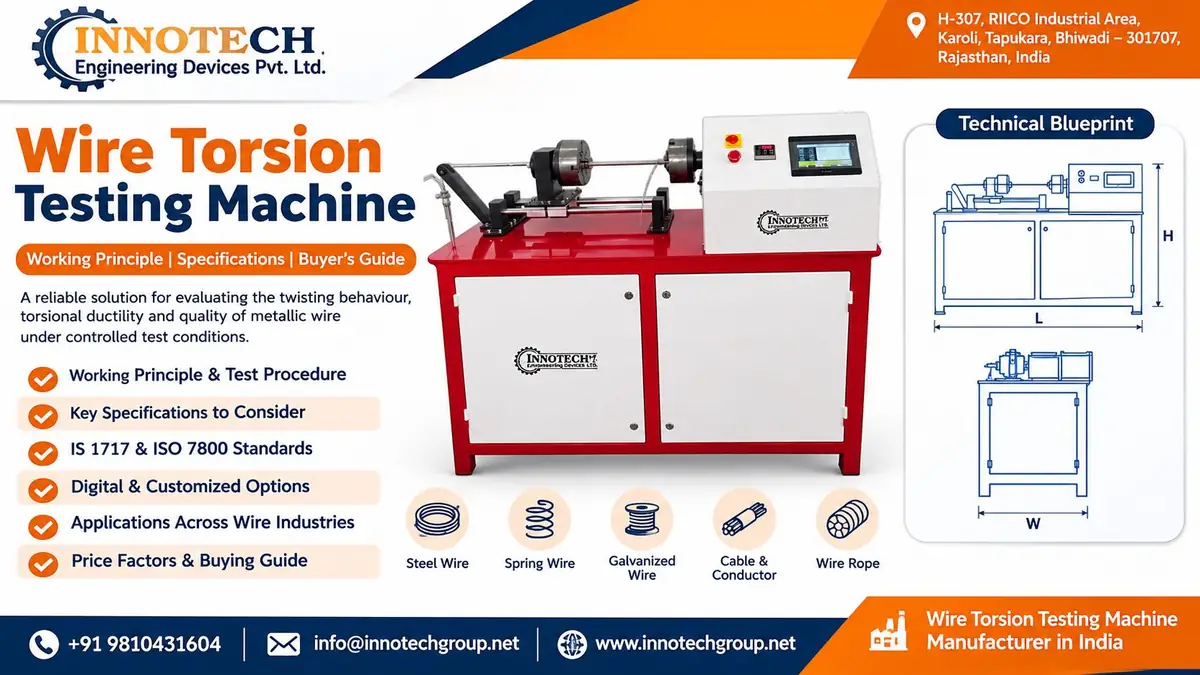
Planning to buy a Wire Torsion Testing Machine in India? Learn how wire torsion testing works, which materials can be tested, important IS 1717 and ISO 7800 requirements, digital twist-counting features, technical specifications and machine price factors. This practical guide helps wire manufacturers, industrial laboratories and purchase teams select suitable testing equipment and request an accurate quotation.
Wire Torsion Testing Machine: Working Principle, Specifications & Buying Guide
If you manufacture steel wires, galvanized wires, spring wires or other metallic wire products, selecting the right Wire Torsion Testing Machine is important for material inspection and quality control.
A wire may perform well during tensile testing but behave differently when twisted. A wire torsion test helps evaluate its ability to withstand controlled twisting and provides useful information about torsional ductility and fracture behaviour.
For manufacturers, testing laboratories and purchase departments, the main questions are straightforward:
- Which wire diameter can the machine test?
- How many twists can the specimen withstand?
- Is a digital twist counter required?
- Which testing standard should be followed?
- What affects the machine price?
- Can the machine be customized for different wires?
This guide explains these questions in simple language and helps buyers choose suitable Wire Torsion Testing Equipment in India.
What Is a Wire Torsion Testing Machine?
A Wire Torsion Testing Machine, also called a Wire Twist Testing Machine or Wire Torsion Tester, is equipment used to evaluate how a metallic wire behaves when twisted around its own longitudinal axis.
The wire specimen is held between two grips. One grip is restrained while the other rotates at a specified speed.
The test generally continues until the wire fractures or reaches another endpoint defined by the applicable test method.
The number of completed turns, specimen condition and fracture behaviour are recorded.
Wire torsion testing is used in suitable wire-manufacturing and quality-control applications to assess the ability of wire to undergo twisting deformation.
Why Is Wire Torsion Testing Important?
Metallic wires may experience twisting during manufacturing, handling, assembly or service.
Even when a wire meets its tensile strength requirement, additional testing may be needed to understand its behaviour under torsional deformation.
A wire torsion test can help manufacturers:
- Evauate torsional ductility
- Compare wire batches
- Observe premature fracture
- Investigate manufacturing-related defects
- Support incoming material inspection
- Verify applicable product-standard requirements
- Document quality-control test results
A torsion test is not a replacement for tensile testing, reverse bending or other required wire tests. Each evaluates different material behaviour.
Working Principle of a Wire Torsion Testing Machine
The basic principle is controlled rotation of a wire specimen about its longitudinal axis.
The machine consists of a stationary gripping arrangement and a rotating gripping arrangement.
The specimen is installed between the grips at the required free length. Where the test method requires it, a suitable initial tensile force is applied to maintain the specimen condition.
The rotating grip then twists the wire at the prescribed speed.
A mechanical or digital counter records the number of completed rotations.
The test ends at fracture or another specified endpoint.
Main Parts of a Wire Torsion Tester
| Component |
Function |
| Main frame | Supports the testing mechanism |
| Fixed grip | Holds one end of the specimen |
| Rotating grip | Applies twisting movement |
| Motor or manual drive | Produces controlled rotation |
| Twist counter | Records completed turns |
| Adjustable grip support | Sets specimen free length |
| Tensioning arrangement | Applies initial specimen tension where required |
| Control panel | Controls selected test functions |
| Protective guard | Helps protect the operator during specimen fracture |
The exact components depend on the machine design.
Wire Torsion Test Procedure — Step by Step
A typical simple torsion test follows these stages.
Step 1: Select the Wire Specimen
Identify the wire material, grade, nominal diameter and applicable testing standard.
Step 2: Measure the Specimen
Measure the required dimensions and prepare the specified test length.
Step 3: Install the Wire
Secure the specimen between the fixed and rotating grips.
Ensure that the wire is properly aligned and does not slip.
Step 4: Apply Initial Tension
Where required by the testing method, apply the specified initial tensile force.
Step 5: Set the Testing Speed
Select the rotational speed required by the applicable standard or approved laboratory procedure.
Step 6: Start the Torsion Test
Rotate the moving grip and monitor the specimen.
Step 7: Record the Number of Twists
The counter records completed turns until fracture or the specified test endpoint.
Step 8: Examine the Specimen
Observe the fracture condition and any relevant surface damage.
Step 9: Prepare the Test Report
Record specimen identification, dimensions, test conditions, number of turns and observations.
Important: This is a general explanation, not a substitute for the detailed requirements of IS 1717, ISO 7800 or a product-specific standard.
Wire Torsion Testing Standards: IS 1717 and ISO 7800
IS 1717
IS 1717 is an Indian standard referenced for simple torsion testing of metallic wires.
Indian wire-product specifications may require torsion testing according to IS 1717.
ISO 7800:2012
ISO 7800:2012 covers a simple torsion test for metallic wire with a diameter or characteristic dimension from 0.1 mm to 14 mm.
This range describes the scope of the standard, not the verified testing capacity of every machine.
Product-Specific Standards
Steel wire, wire rope and other wire products may have additional requirements for specimen selection, testing conditions and acceptance criteria.
Before buying a machine, confirm which standard and edition your laboratory must follow.
Digital Wire Torsion Testing Machine vs Basic Motorized Machine
| Feature |
Basic motorized model |
Digital model |
| Specimen twisting | Motor-driven | Motor-driven |
| Twist counting | Mechanical or basic counter | Electronic counter |
| Test indication | Basic controls | Digital display |
| Speed adjustment | Depends on drive | Depends on drive and controller |
| Automatic stopping | Configuration-dependent | Configuration-dependent |
| Data recording | Usually limited | Available if specified |
| Computer interface | Not necessarily inculded | Optional, if supplied |
A digital display does not automatically mean that the machine measures torque or includes computer software.
When comparing quotations, ask manufacturers to identify which functions are standard and which are optional.
Wire Torsion Testing Machine Specifications Buyers Should Compare
| Parameter |
What the buyer should check |
| Wire diameter range | Minimum and maximum diameter |
| Wire material | Steel, stainless steel, galvanized or other suitable metal |
| Grip seperation | Required specimen free length |
| Rotation speed | Required RPM and speed control |
| Rotation direction | One-direction or reversible operation |
| Twist counter | Mechanical or digital |
| Initial tension | Required range and adjustment |
| Specimen grips | Compatibility with wire dimensions |
| Automatic stop | Fracture detection and stopping arrangement |
| Controller | Manual, motorized or digital |
| Data recording | Whether test data can be stored or exported |
| Safety enclosure | Guarding of rotating and fracture areas |
| Electrical supply | Voltage,phase and frequency |
| Calibration | Counter, speed and relevant measurement verification |
| Machine dimensions | Required laboratory footprint |
| Documentation | Operating manual, calibration and commissioning scope |
A detailed technical comparison is more useful than comparing machine prices alone.
Small Wire Torsion Testing Machine
A Small Wire Torsion Testing Machine is intended for suitable fine-wire specimens.
Small-diameter wires may require specially designed gripping arrangements to prevent slipping or premature damage near the grips.
The required specimen length, initial tension and rotation speed must also be considered.
Buyers should specify the actual minimum wire diameter rather than requesting only a “small machine.”
Customized Wire Torsion Testing Machine
Not every wire manufacturer tests the same material or diameter.
A Customized Wire Torsion Testing Machine can be designed around the required specimen range and laboratory workflow.
Innotech Engineering Devices Private Limited offers customer-requirement-based configurations for:
- Wire diameter range
- Specimen length
- Adjustable grip seperation
- Motorized operation
- Rotation speed
- Digital twist counting
- Initial tensioning
- Automatic stopping
- Specimen fixtures
- Protective guarding
- Data recording, where required
Final capabilities are determined by the approved technical specification.
Industries Using Wire Torsion Testing Machines
Steel Wire Manufacturers
For relevant torsional ductility testing and wire quality control.
Galvanized Wire Manufacturers
For evaluating suitable galvanized steel wire specimens according to specified procedures.
Wire Rope Manufacturers
For applicable testing of individual steel wires used in rope manufacturing.
Spring Wire Manufacturers
For relevant wire-material inspection and torsion test requirements.
Cable and Conductor Manufacturers
For metallic wire products where torsion testing is specified.
Research Laboratories
For comparative testing and material behaviour studies.
Engineering Colleges
For laboratory demonstrations and practical wire torsion experiments.
Industrial Quality-Control Departments
For recording wire test results and evaluating applicable acceptance requirements.
Wire Torsion vs Wire Wrapping vs Tensile Testing
| Test |
Main purpose |
| Wire torsion test | Evaluates wire behaviour under twisting |
| Wire wrapping test | Evaluates wire behaviour when wrapped around a specified mandrel |
| Wire tensile test | Evaluates wire response to axial pulling force |
| Wirte reverse bend test | Evaluates behaviour under repeated bending in opposite directions |
A wire torsion testing machine should not be assumed to perform wrapping, tensile or reverse-bend tests unless the appropriate equipment and fixtures are included.
Wire Torsion Testing Machine Price in India
The Wire Torsion Testing Machine Price in India depends on the machine configuration.
Important cost factors include:
- Minimum and maximum wire diameter
- Required specimen length
- Mechanical frame and grip arrangement
- Motor and speed-control system
- Digital counter
- Inital tensioning system
- Automatic fracture stopping
- Protective safety enclosure
- Optional software and data recording
- Calibration and documentation
- Installation and commissioning
- Special-prupose customization
For accurate pricing, request a quotation based on your actual testing requirements.
A low-cost machine may not be suitable if it cannot hold your wire properly or achieve the required testing conditions.
How to Choose a Wire Torsion Testing Machine Manufacturer in India
Before selecting a supplier, confirm whether the proposed machine meets your actual test requirements.
Ask these questions:
1. Can the machine test my minimum and maximum wire diameters?
2. Is the required grip separation available?
3. Can the required rotation speed be achieved?
4. Does the machine provide a reliable twist count?
5. Is initial specimen tensioning included?
6. Does the quotation include the required grips?
7. Is automatic stopping required?
8. Which calibration documents will be supplied?
9. Can the machine be customized?
10. What are the warranty, installation and service terms?
The manufacturer should provide a clear technical offer identifying the agreed configuration.
Wire Torsion Testing Machine Manufacturer in Bhiwadi, Rajasthan
Innotech Engineering Devices Private Limited manufactures and supplies industrial testing machines and laboratory equipment from Bhiwadi, Rajasthan, India.
Our Wire Torsion Testing Machine, Model IWTTM, is ffered with customer-requirement-based technical configurations.
Industrial buyers across India, particularly Delhi NCR, Rajasthan, Haryana, Uttar Pradesh, Punjab and other manufacturing regions, can contact Innotech for specifications, machine selection and quotations.
For complete product information, visit:
Wire Torsion Testing Machine – Model IWTTM https://innotechgroup.net/products/wire-torsion-testing-machine
Frequently Asked Questions
What is a Wire Torsion Testing Machine used for?
It is used to evaluate the twisting behaviour and torsional ductility of suitable metallic wire specimens under specified testing conditions.
What does a wire torsion test measure?
A simple wire torsion test commonly records the number of turns sustained by the wire before fracture or another specified endpoint.
What is a Digital Wire Torsion Testing Machine?
It is a wire torsion tester equipped with electronic counting or display functions. Additional automation depends on the selected configuration.
Which standard is used for wire torsion testing in India?
IS 1717 is an important Indian reference. ISO 7800 is an international standard for simple torsion testing of metallic wires.
What is the price of a Wire Torsion Testing Machine in India?
The price depends on specimen capacity, grip separation, motor drive, digital functions, tensioning system, safety features and accessories.
Can the machine test small-diameter wire?
Yes, if the selected machine has suitable grips, alignment and operating conditions for the specified diameter.
Does a wire torsion tester measure torque?
Not necessarily. A simple wire torsion tester commonly counts twists. Torque measurement requires suitable additional instrumentation.
Can galvanized wire be tested?
Suitable galvanized wire specimens can be tested when the machine and procedure meet the relevant material and product requirements.
What is the difference between a wire torsion test and a tensile test?
Torsion testing evaluates twisting behaviour, while tensile testing evaluates response to axial pulling force.
Can Innotech manufacture a customized machine?
Yes. Innotech can discuss customized configurations according to wire material, diameter, specimen length, testing speed and required control features.
What information should I provide for a quotation?
Share the wire material, diameter range, specimen length, testing standard, rotation speed, digital requirements, initial tensioning needs and delivery location.
Conclusion: Choose the Right Wire Torsion Testing Machine
The best wire torsion testing machine is not simply the one with the highest capacity or lowest price.
It is the machine that supports your wire material, specimen dimensions, testing method, required measurements and laboratory workflow.
For manufacturers and quality-control laboratories, choosing the correct equipment helps establish meaningful testing procedures and dependable inspection records.
Looking for a Wire Torsion Testing Machine Manufacturer in India?
Contact Innotech Engineering Devices Private Limited for application-specific machine specifications and a technical quotation.
Factory: H-307, RIICO Industrial Area, Karoli, Tapukara, Bhiwadi – 301707, Rajasthan, India
Email: info@innotechgroup.net
Phone: +91 9810431604
Category: Torsion Testing Equipment
Tags: wire torsion testing machine, wire torsion testing machine manufacturer in India, wire torsion testing machine in India, wire torsion testing machine price in India, digital wire torsion testing machine, customized wire torsion testing machine, small wire
Last Updated: 20 November 2026