
What Is an Endurance Testing Machine? Meaning, Working Principle, Types and Applications
Jay Pal Singh
31 October 2026
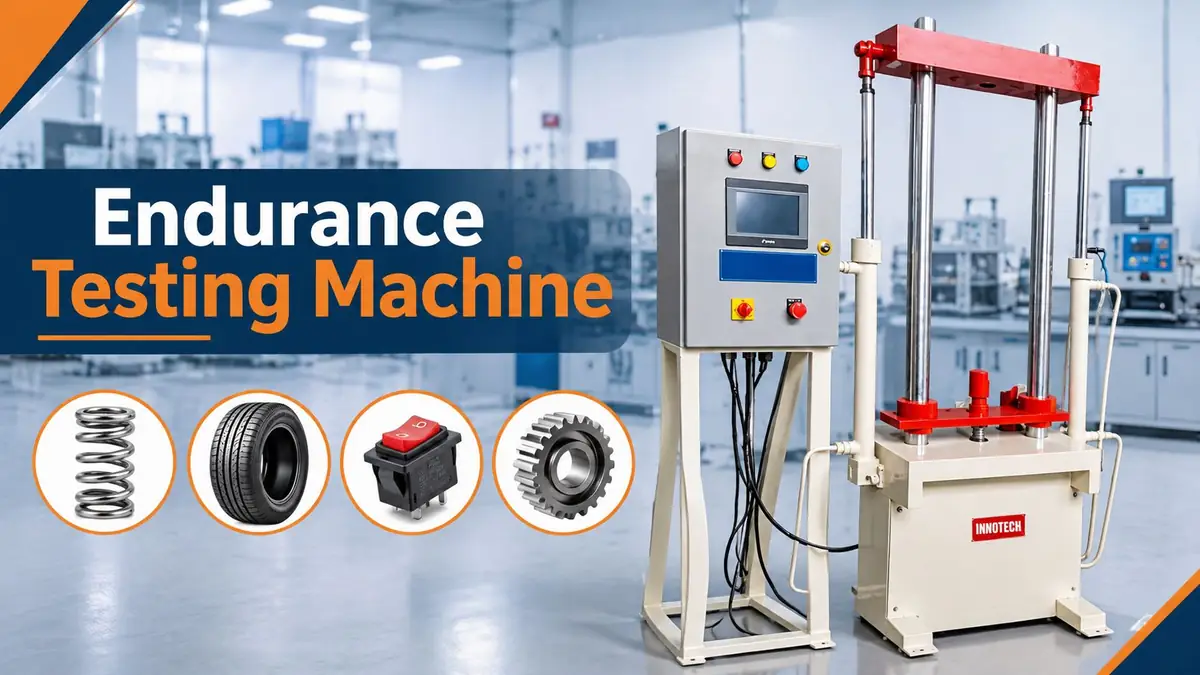
Indurial Endurance Testing Machine
What Is an Endurance Testing Machine? Meaning, Working Principle, Types and Applications
How can a manufacturer check whether a product or component will continue working properly after thousands or even millions of operating cycles? How can a company evaluate the durability of a component before using it in an actual product?
This is where endurance testing becomes important.
An Endurance Testing Machine is used to evaluate the durability, reliability and performance of products or components under repeated operating conditions. Depending on the application, the machine may apply repeated loads, movements, pressure, switching operations or other controlled test cycles to a specimen.
Endurance testing is important in automotive manufacturing, mechanical engineering, electrical equipment manufacturing, industrial product development and quality control. It helps manufacturers understand how a product behaves during repeated use and identify possible performance variations or failures.
In this article, we explain the meaning of endurance testing, its working principle, different types of endurance testing machines, applications, advantages, selection factors and price considerations in India.
What Is Endurance Testing?
Endurance testing is a testing process used to evaluate how a product, material, assembly or component performs when subjected to repeated operations or specified operating conditions over a defined period or number of cycles.
The purpose is to understand whether the product can maintain its intended performance during repeated use.
For example:
- An automotive component may be tested through repeated mechanical movements.
- A spring may be compressed and related repeaedly to evaluate its performance.
- An electrical switch may be operated repeatedly to assess its operating life.
- A tyre may be operated under specified load and speed conditions to evaluate its endurance.
- A mechanical assembly may be tested under repeated loading to assess its durability.
The test conditions depend on the product and the intended application. Endurance testing may involve repeated mechanical movement, cyclic loading, environmental exposure, electrical operation or a combination of test conditions.
What Is an Endurance Testing Machine?
An Endurance Testing Machine is testing equipment designed to perform repeated operating cycles on a component or product under defined conditions.
The machine generally consists of a structural frame, a specimen holding or fixture arrangement, an operating mechanism and a control system. Depending on the application, it may also include sensors, measurement devices, a cycle counter and a data recording arrangement.
The machine repeatedly operates or loads the test specimen according to the selected test procedure. The operator can evaluate the specimen's condition and performance during or after testing.
An industrial endurance testing machine can be designed for a particular component or application. For this reason, the required machine configuration should be selected according to the product being tested rather than choosing a machine only by its name.
Working Principle of an Endurance Testing Machine
The working principle of an endurance testing machine is based on repeated operation under controlled test conditions.
The exact working mechanism depends on whether the machine performs cyclic loading, compression, movement, rotation, switching or another type of endurance test.
A typical testing procedure involves the following steps:
1. Specimen Preparation
The product or component selected for testing is inspected and prepared according to the test procedure. Its dimensions, initial condition and other relevant details may be recorded.
2. Specimen Mounting
The specimen is placed in the machine using a suitable fixture, grip, holder or mounting arrangement. Proper positioning is important for consistent testing.
3. Test Parameter Setting
The required test conditions are configured. Depending on the machine, these may include:
- Applied load or force.
- Operating stroke or movement
- Test speed or frequency
- Number of operating cycles
- Test duration
- Pressure or other application-specific conditions
4. Repeated Testing Operation
The machine starts the defined test sequence and repeatedly operates the specimen. The component experiences the selected operating conditions over the specified number of cycles or test duration.
5. Monitoring and Cycle Counting
The operator monitors the machine during testing. A configured control system may display operating status, cycle count, test progress or measurement values.
Automatic cycle counting and data recording depend on the machine configuration.
6. Test Completion and Inspection
After the test reaches the specified stopping condition, the specimen is inspected. The evaluation may include checking for wear, deformation, cracks, loosening, functional changes or other application-specific performance variations.
The final results are compared with the acceptance criteria defined for the product or test procedure.
Major Functions of an Endurance Testing Machine
The functions of an endurance testing machine vary according to its design. Common functions in application-specific systems may include:
- Repeated operating cycle execution
- Cyclic loading or movement
- Controlled operation of a test specimen
- Test duratin monitoring
- Cycle counting
- Operating parameter adjustment
- Observation of specimen performance
- Test completion and stopping control
- Data recording and reporting, where configured
- Support for product durability evaluation
Not every endurance testing machine includes all these functions. The required functions should be confirmed when selecting or ordering the equipment.
Types of Endurance Testing Machines
Endurance testing is used for different products and industries. The testing machine must match the component, operating conditions and test method.
1. Tyre Endurance Testing Machine
A tyre endurance testing machine is used to evaluate tyre performance under specified load, speed and operating conditions. The tyre is tested using a suitable rotating drum or other test arrangement.
Tyre endurance testing may be used to assess structural durability and performance under defined operating conditions. It is a specialized application and requires a dedicated tyre testing system.
2. Spring Endurance Testing Machine
A spring endurance testing machine is used to evaluate the performance of springs under repeated compression, extension or other specified loading cycles.
It can help assess changes in spring behaviour after repeated operation. The testing arrangement depends on the spring type, dimensions, load and required movement.
3. Switch Endurance Testing Machine
A switch endurance testing machine is used to evaluate the operating life of electrical or mechanical switches through repeated switching operations.
The system may operate the switch repeatedly and monitor the number of operations or selected electrical and mechanical parameters, depending on the test requirements.
4. Mechanical Component Endurance Testing Machine
Mechanical endurance testing systems are designed to evaluate components or assemblies under repeated operating conditions.
Examples may include mechanical linkages, joints, mechanisms and selected industrial components. The machine may use repeated loading, movement, rotation or another application-specific operation.
5. Fatigue Testing Machine
A fatigue testing machine applies repeated or cyclic loading to a material or component to evaluate its resistance to fatigue damage.
It is commonly used in material research, automotive engineering, aerospace applications and mechanical component development. Fatigue testing may involve tension, compression, bending or other loading arrangements.
Fatigue testing is closely related to endurance testing, but the terms are not always interchangeable. Fatigue testing specifically studies damage and failure associated with repeated stress or strain.
6. Creep and Creep-Fatigue Testing Systems
Creep testing evaluates material deformation under sustained load over time, commonly under controlled temperature conditions.
Creep-fatigue testing combines sustained loading or hold periods with cyclic loading. These are specialized material testing applications and require dedicated test configurations.
Endurance Testing vs Fatigue Testing vs Stress Testing
These terms are related but describe different testing objectives.
| Comparison |
Endurance Testing |
Fatigue Testing |
Stress Testing |
| Main purpose | Evaluate durability during repeted use | Evaluate damage under cyclic stress or strain | Evaluate behaviour under demanding or increased stress conditions |
| Test conditions | Repeatead operation or defined cycles | Repeated loading or deformation | Higher or challenging operating conditions |
| Main focus | Operating life and performance | Fatigue damage and fatigue life | Strength, limits and response under stress |
| Typical applications | Switches, springs. tyres and components | Metals, structures and mechanical components | Produc, material and system evaluation |
| Equipment | Application-specific endurance tester | Fatigue testing machine | Depends on the type of stress test |
Endurance Testing vs Durability Testing
Durability testing is a broad term used to evaluate how well a product withstands use, environmental exposure and other conditions over time.
Endurance testing is one approach to evaluating durability, particularly when a product is subjected to repeated operating cycles.
Endurance Testing vs Software Stress Testing
In software engineering, endurance testing is sometimes called soak testing. It checks whether a software system can operate for an extended period under a sustained workload without problems such as memory leaks or performance degradation.
Software stress testing, on the other hand, evaluates how a system behaves when pushed beyond normal operating conditions.
These software testing terms are different from industrial mechanical endurance testing machines. This article focuses on physical products, components and industrial testing equipment.
What Are the Advantages of Endurance Testing?
Endurance testing provides useful information for product development, manufacturing and quality control.
1. Helps Evaluate Product Durability
Repeated testing helps manufacturers understand how a product behaves during extended or repeated use.
2. Supports Quality Control
Manufacturers can use endurance test results as part of their quality inspection and product evaluation processes.
3. Helps Identify Potential Failures
Testing may reveal wear, deformation, cracks, loosening or functional changes that may not appear during a short-duration test.
4. Supports Product Development
Engineers can use test observations to review product design, material selection and component performance.
5. Helps Compare Product Performance
Different samples or designs can be evaluated under the same defined test conditions to identify performance variations.
6. Supports Reliability Evaluation
Endurance testing helps assess whether a component continues to perform according to the specified requirements during repeated operation.
7. Helps with Manufacturing Validation
It can form part of product validation and quality assurance procedures before products are released for use.
What Tests Are Used to Measure Endurance?
There is no single test that measures endurance for every type of product. The test method depends on what is being evaluated.
Common examples include:
- Cyclic load tesing: Repeated application and removal of a specified load.
- Compression endurance testing: Repeated compression of a component.
- Tensile fatigue testing: Repeated tensile loading to evaluate fatigue behaviour.
- bending fatigue testing: Repeated bending to evaluate resistance to fatigue damage.
- Rotational endurance testing: Repated rotation under defined conditions.
- Switching cycle testing: Repeated opening and closing of switches.
- Tyre endurance testing: Operation under specified load and speed conditions.
- Creep testing: Evaluation of deformation under sustained load over time.
- Environmental endurance testing: Evaluation under specified temperature, humidity or other environmental conditions.
The appropriate test method and acceptance limits should be selected according to the product specification and applicable test standard.
How Can You Test Endurance?
A typical industrial endurance testing procedure follows these steps:
1. Identify the product or component to be tested.
2. Define the purpose of the test.
3. Select the appropriate test method.
4. Decide the required load, movement, speed, duration or cycle count.
5. Select a suitable endurance testing machine.
6. Mount the specimen securely using the appropriate fixture.
7. Set the test parameters.
8. Run the specified test cycles.
9. Monitor the specimen and machine operation.
10. Inspect and evaluate the specimen after testing.
11. Compare the observations or results with the defined acceptance criteria.
For reliable results, the test procedure, specimen preparation, machine configuration and measurement arrangement should be suitable for the application.
Where Are Endurance Testing Machines Used?
Endurance testing equipment is used across industries where repeated operation and product durability are important.
| Industry |
Example of Testing Application |
| Automotive | Selected mechanical components and assemblies |
| Tyre manufacturing | Tyre load and speed endurance |
| Electrical equipment | Switch operating life |
| Spring manufacturing | Repeated spring compression or extension |
| Mechanical engineering | Cyclic performance of components |
| Industrial manufacturing | Repeated operation of machine parts |
| Product development | Durability and reliability evaluation |
| Research development | Material and component erndurance studies |
The machine and test arrangement should be selected according to the particular component and application.
How to Select the Right Endurance Testing Machine
Choosing the right machine is important because different products require different testing arrangements.
Before purchasing an endurance testing machine, consider the following factors:
1. Type of Component
Identify whether you need to test a spring, switch, tyre, mechanical assembly, material specimen or another product.
2. Testing Objective
Decide whether the purpose is to evaluate cyclic loading, operating life, repeated movement, durability, fatigue behaviour or another parameter.
3. Required Load or Force
Determine the maximum and minimum load required for the test, if applicable.
4. Operating Stroke and Movement
For machines involving linear or mechanical movement, define the required stroke, displacement and movement pattern.
5. Testing Frequency
Specify the required operating speed or cycle frequency.
6. Number of Test Cycles
Determine the required number of cycles or test duration.
7. Fixture and Holding Arrangement
The machine should have a suitable specimen mounting arrangement to hold the test component safely and consistently.
8. Control and Monitoring System
Check whether you require manual, semi-automatic or automatic operation, cycle counting, test monitoring, alarms or data recording.
9. Applicable Test Standard
If the test is being performed according to a customer specification or standard, share the relevant test method before finalizing the machine.
10. Customization Requirements
If a standard machine does not meet your testing needs, discuss a customized endurance testing machine with the manufacturer.
Endurance Testing Machine Price in India
The price of an endurance testing machine in India depends on its application and technical configuration. There is no single price applicable to all endurance testing machines because a tyre endurance tester, spring endurance tester and mechanical component endurance tester can have very different designs.
Factors affecting the price include:
- Type of component being tested.
- Maximum testing load or operating capacity.
- Loading or movement mechanism.
- Required operating speed and cycle frequency.
- Test stroke and working area.
- Specimen fixtures and accessories.
- Manual, semi-automatic or automatic operation.
- Control panel and monitoring arrangement.
- Cycle counting and data recording requirements.
- Special-purpose design and customization.
If you are searching for an endurance testing machine price in India, share your application and technical requirements with the manufacturer to receive a suitable quotation.
Endurance Testing Machine Manufacturer and Supplier in India
If you are looking for an Endurance Testing Machine Manufacturer in India or an industrial testing equipment supplier, it is important to select a manufacturer who understands your application and can discuss the required testing arrangement.
Innotech Engineering Devices Pvt. Ltd. is a manufacturer of testing machines and laboratory equipment based in Bhiwadi, Rajasthan, India.
We work with industrial testing equipment and customized machine requirements. Endurance testing machine configurations can be discussed according to the component, test method, required operating conditions and customer specifications.
Customers looking for an endurance testing machine supplier in Bhiwadi, Rajasthan, Delhi NCR, Haryana, Uttar Pradesh, Punjab, Gujarat, Maharashtra, Mumbai, Kolkata, Chennai, Bengaluru and other parts of India can contact our team for product enquiries.
For customized requirements, share the product details, test procedure, required load, operating cycles, movement and other available technical information.
Frequently Asked Questions About Endurance Testing Machines
1. What is an endurance testing machine?
An endurance testing machine is equipment used to evaluate the durability and performance of a product or component under repeated operating conditions, such as cyclic loading, movement or switching operations.
2. What is the meaning of endurance testing?
Endurance testing means evaluating how well a product or component performs during repeated use or over a defined operating period.
3. What is the working principle of an endurance testing machine?
The machine operates a test specimen through a specified repeated cycle. The specimen is subjected to defined operating conditions, and its performance is monitored or inspected during and after testing.
4. What are the different types of endurance testing machines?
Common application-specific systems include tyre endurance testing machines, spring endurance testing machines, switch endurance testing machines, mechanical component endurance testers and fatigue testing machines.
5. What is the difference between endurance testing and fatigue testing?
Endurance testing is a broad evaluation of performance under repeated operating conditions. Fatigue testing specifically evaluates material or component damage caused by repeated stress or strain.
6. Is an endurance testing machine the same as a durability testing machine?
The terms are related, but durability testing is broader. Endurance testing is one method used to evaluate durability under repeated operating conditions.
7. Can an endurance testing machine be customized?
Yes, a machine can be designed or configured according to the component, test method, required load, operating cycles, fixtures and control requirements, subject to technical feasibility.
8. What is the price of an endurance testing machine in India?
The price depends on machine capacity, test application, operating mechanism, automation, fixtures and customization. Contact the manufacturer with your requirements for a quotation.
9. Where can I buy an endurance testing machine in India?
You can contact testing machine manufacturers and suppliers in India. Innotech Engineering Devices Pvt. Ltd., based in Bhiwadi, Rajasthan, accepts enquiries for industrial testing equipment and customized machine requirements.
10. Can one endurance testing machine test tyres, springs and switches?
Not necessarily. These products require different test arrangements, fixtures and operating mechanisms. A machine should be selected or customized according to the specific application.
Contact Innotech for Endurance Testing Machine Enquiries
Looking for an industrial endurance testing machine or a customized testing solution?
Discuss your application and technical requirements with Innotech Engineering Devices Pvt. Ltd.
Innotech Engineering Devices Pvt. Ltd.
Email: info@innotechgroup.net
Phone: +91 9810431604
Address: H-307, RIICO Industrial Area Karoli, Tapukara, Bhiwadi, Rajasthan, India.
Contact our team for product details, customization discussions and price enquiries.
Category: Testing Machines & Equipment
Tags: Endurance Testing Machine, Endurance Testing, Durability Testing, Cyclic Testing, Fatigue Testing, Industrial Testing Equipment, Material Testing, Quality Control, Component Testing, Testing Machine Manufacturer India
Last Updated: 31 October 2026