
What Does 500 Hours of Salt Spray Testing Actually Mean?
Jay Pal Singh
01 October 2026
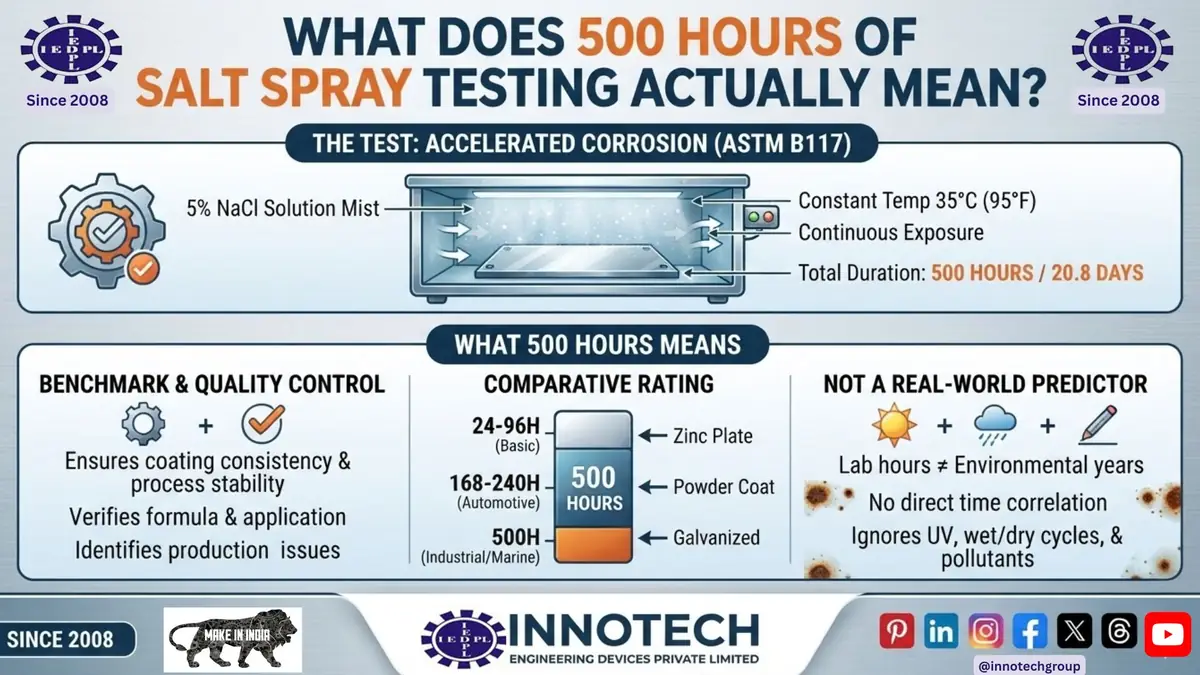
What Does 500 Hours of Salt Spray Testing Actually Mean?
Imagine buying a coated metal component that comes with a claim of 500 hours of salt spray testing. Does that mean the component will remain rust-free for 500 days, 500 months or a specific number of years?
The answer is no. Five hundred hours refers to the duration of a laboratory test, not a guaranteed service life in real-world conditions.
Salt spray testing is commonly used to evaluate the corrosion resistance of suitable coated metals and other specimens under controlled laboratory conditions. Understanding what the test duration means can help manufacturers, quality-control teams and product buyers interpret test results more accurately.
In this article, we explain what 500 hours of salt spray testing means, how the test works and what you should check before comparing results.
What Is Salt Spray Testing?
Salt spray testing is a laboratory method used to expose suitable test specimens to a controlled corrosive environment containing a salt solution.
A Salt Spray Chamber creates and maintains the required test environment according to the selected test method. The specimens are exposed for a specified duration and examined according to the applicable evaluation criteria.
This testing method can be used to assess the corrosion performance of suitable:
- Coated metal components
- Painted metal surfaces
- Protective coatings
- Plated components
- Metal fasteners
- Indusrial Metal Products
- Other Materials suitable for the selected test procedure
The exact application depends on the specimen, coating system and test method.
What Does 500 Hours of Salt Spray Testing Mean?
A 500-hour salt spray test means that a specimen is exposed to the specified test environment for 500 hours.
Since one day contains 24 hours, 500 hours equals approximately 20 days and 20 hours of continuous testing.
However, the number of hours alone does not explain how well a product will perform throughout its working life.
The test result must be interpreted according to the test method, specimen preparation, exposure conditions and acceptance criteria.
For example, two coated metal specimens may both undergo 500 hours of testing but show different levels of corrosion. One may meet the required acceptance criteria, while the other may not.
Therefore, the test duration should always be considered together with the observed results.
Does 500 Hours of Salt Spray Testing Equal Several Years Outdoors?
No. There is no universal conversion between salt spray test hours and years of outdoor service.
Real-world corrosion depends on many factors, including:
- Humidity & temperature changes
- Rainfall & moistures exposure
- Salt deposits & environmental pollution
- UV exposure & sunlight
- Coating quality and thickness
- Surface preparation
- Scratches and mechanical damage
- The location & conditions of use
A laboratory salt spray test creates a controlled exposure environment. Outdoor conditions can involve changing and combined environmental factors that are not fully represented by a single salt spray test.
For this reason, a claim such as “500 hours of salt spray testing equals five years of outdoor life” should not be accepted without appropriate supporting evidence for the specific product and conditions.
How Is a Salt Spray Test Performed?
The testing process generally follows these steps, with the exact procedure depending on the applicable test method.
1. Specimen Preparation
The specimen is prepared according to the specified procedure. Surface condition, cleaning and any required pre-test measurements should be addressed before testing.
2. Chamber Preparation
The Salt Spray Chamber is prepared, and the required test conditions are established. The salt solution and equipment settings must comply with the selected test method.
3. Specimen Placement
The specimens are positioned using the specified arrangement and orientation. Correct placement helps ensure that the intended exposure conditions are maintained.
4. Controlled Exposure
The specimens remain exposed for the required duration while the relevant test conditions are monitored.
5. Inspection and Evaluation
After the specified exposure period, the specimens are evaluated using the applicable inspection procedure and acceptance criteria.
The final assessment depends on the observed corrosion, coating condition and requirements of the product or test specification.
What Should You Check in a 500-Hour Salt Spray Test Report?
The test duration is only one part of the report. Before using a result to compare products or approve a coating, consider the following information:
Test method: Which test procedure was followed?
Specimen details: What material, coating or component was tested?
Preparation: How were the specimens prepared before exposure?
Exposure conditions: Were the required conditions maintained?
Test duration: How long did the exposure continue?
Evaluation criteria: What was inspected or measured?
Observed results: Was corrosion present, and where did it occur?
Acceptance requirements: Did the specimen meet the specified requirements?
A report with clear test conditions and evaluation criteria is more useful than a statement that only mentions the number of hours.
Why Do Manufacturers Use Salt Spray Chambers?
Manufacturers may use salt spray testing during product development, coating evaluation and quality-control activities.
Typical applications include:
- Comparing suitable coating systems
- Evaluating protective surface treaments
- Checking corrosion performance against defined requirements
- Supporting product development
- Assessing production consistency
- Investigating coating-related concerns
- Providing test data for customers or internal specifications
Salt spray testing should be selected according to the material, intended application and applicable requirements. It does not replace every other corrosion test.
How to Select a Salt Spray Chamber
When selecting a Salt Spray Chamber, consider the actual testing requirements of your laboratory or manufacturing facility.
Important factors include:
- Specimen size and quantity
- Required test method
- Required temperature and exposure conditions
- Chamber dimensions
- Solution preparation and delivery arrangemens
- Controls and monitoring features
- Cleaning and maintenance requirements
- Specimen support and positoning
- Data recoding requiremens
- Available technical support
Before purchasing, discuss your test method and specimen requirements with the equipment supplier so that the proposed configuration matches your application.
Salt Spray Testing Equipment from Innotech Engineering Devices Private Limited
Innotech Engineering Devices Private Limited manufactures and supplies testing equipment for industrial and laboratory applications.
A Salt Spray Chamber can support laboratories and manufacturers evaluating the corrosion performance of suitable specimens under specified test conditions.
If you are planning to purchase corrosion testing equipment, identify your testing method, specimen dimensions, required exposure conditions and evaluation criteria before finalising the equipment configuration.
Contact Innotech Engineering Devices Private Limited to discuss your testing equipment requirements.
Website: https://www.innotechgroup.net
Email: info@innotechgroup.net
Phone: 9810431604
Frequently Asked Questions
How many days are 500 hours of salt spray testing?
Five hundred hours equals 20 days and 20 hours. This is the laboratory exposure duration, not a prediction of product life.
Does a 500-hour salt spray test guarantee rust-free performance?
No. The result depends on the specimen, coating, test conditions and evaluation criteria. A specified test duration does not guarantee that a product will remain rust-free in every environment.
What does a Salt Spray Chamber do?
A Salt Spray Chamber creates a controlled salt-containing test environment used to evaluate corrosion performance according to a selected test method.
Which products can be evaluated using salt spray testing?
Depending on the test method, suitable coated metals, painted surfaces, plated components, fasteners and other corrosion-sensitive specimens may be evaluated.
Can two products have different results after 500 hours?
Yes. Differences in materials, coatings, preparation and test requirements can lead to different observed results.
Is salt spray testing enough to predict outdoor durability?
Not by itself. Outdoor performance depends on several environmental factors. Additional testing or field data may be needed for a particular service-life assessment.
Conclusion
A 500-hour salt spray test represents a defined period of laboratory exposure, not a guaranteed number of years of corrosion protection.
To understand what a result means, review the test method, specimen preparation, exposure conditions, observations and acceptance criteria together. This helps manufacturers and buyers make better-informed decisions when evaluating protective coatings and corrosion resistance.
For salt spray testing equipment and other laboratory testing solutions, contact Innotech Engineering Devices Private Limited.
Explore our website: https://www.innotechgroup.net
Talk to Expert Call now 9810431604
Category: Salt Spray Testing / Corrosion Testing
Tags: salt spray testing, 500 hours salt spray test, salt spray test duration, salt spray chamber, corrosion resistance testing, salt spray test results, corrosion testing equipment, salt spray test procedure, coating corrosion resistance, metal corrosion testi
Last Updated: 01 October 2026